
Language of Composition Chapter 1 Key Terms n

- Slides: 15
Language of Composition Chapter 1
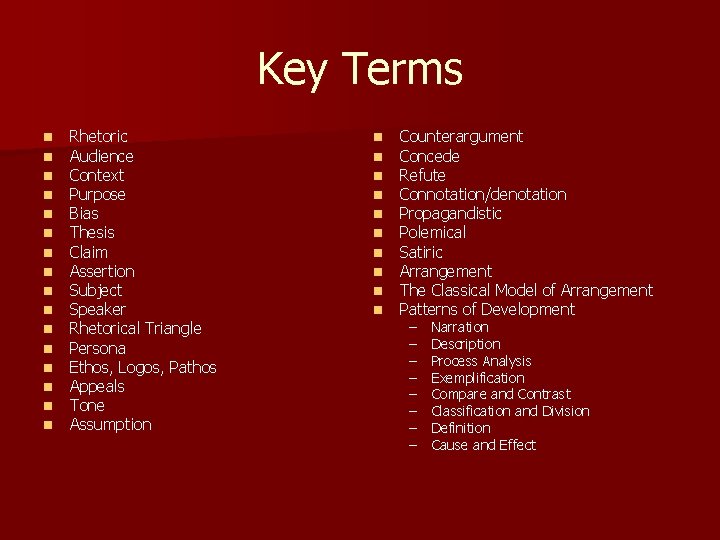
Key Terms n n n n Rhetoric Audience Context Purpose Bias Thesis Claim Assertion Subject Speaker Rhetorical Triangle Persona Ethos, Logos, Pathos Appeals Tone Assumption n n Counterargument Concede Refute Connotation/denotation Propagandistic Polemical Satiric Arrangement The Classical Model of Arrangement Patterns of Development – – – – Narration Description Process Analysis Exemplification Compare and Contrast Classification and Division Definition Cause and Effect
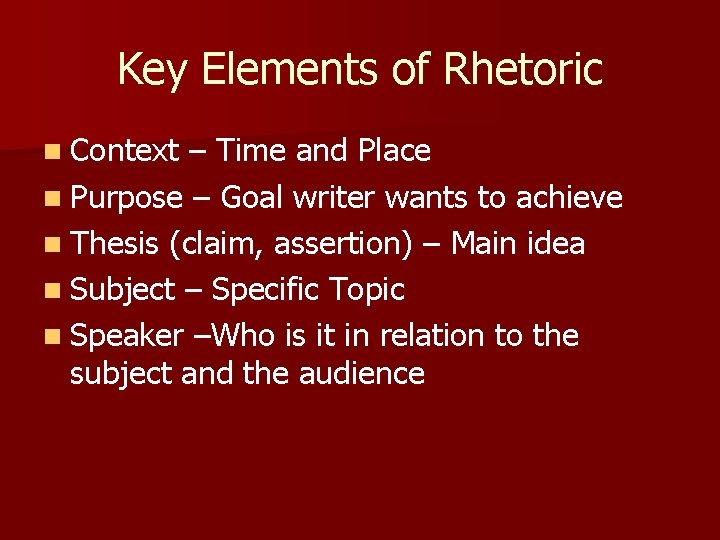
Key Elements of Rhetoric n Context – Time and Place n Purpose – Goal writer wants to achieve n Thesis (claim, assertion) – Main idea n Subject – Specific Topic n Speaker –Who is it in relation to the subject and the audience
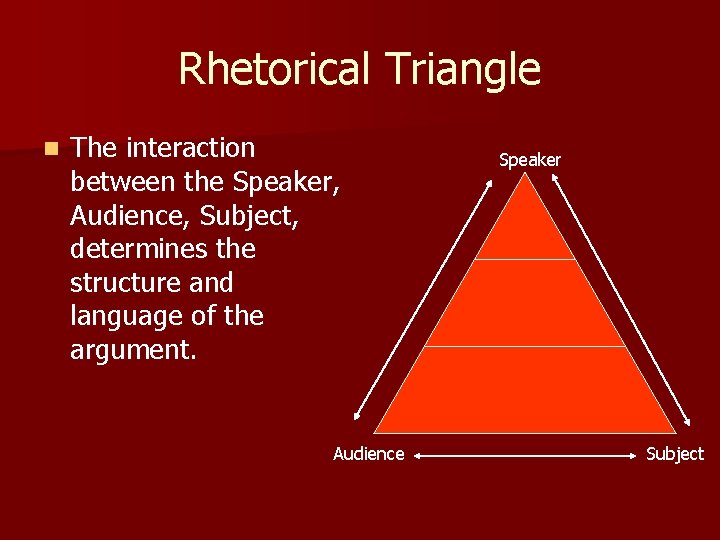
Rhetorical Triangle n The interaction between the Speaker, Audience, Subject, determines the structure and language of the argument. Audience Speaker Subject
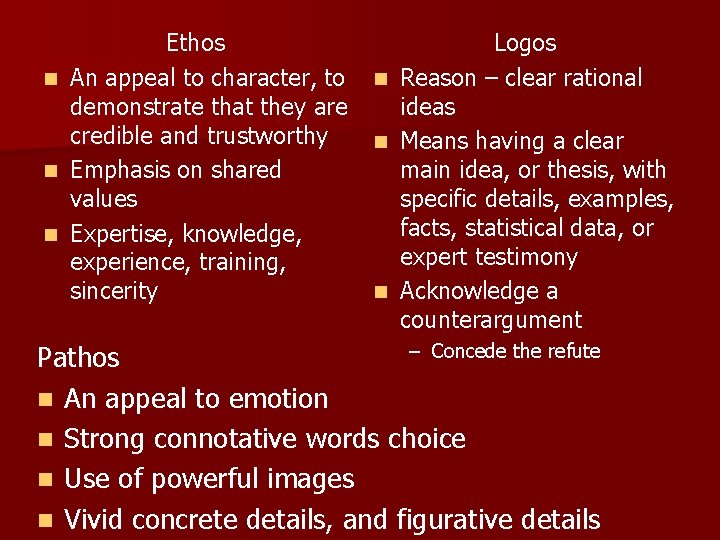
Ethos n An appeal to character, to demonstrate that they are credible and trustworthy n Emphasis on shared values n Expertise, knowledge, experience, training, sincerity Logos n Reason – clear rational ideas n Means having a clear main idea, or thesis, with specific details, examples, facts, statistical data, or expert testimony n Acknowledge a counterargument – Concede the refute Pathos n An appeal to emotion n Strong connotative words choice n Use of powerful images n Vivid concrete details, and figurative details
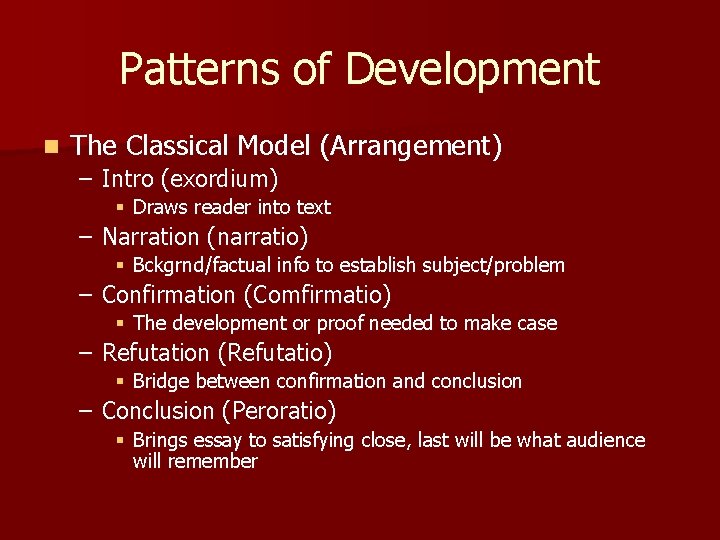
Patterns of Development n The Classical Model (Arrangement) – Intro (exordium) § Draws reader into text – Narration (narratio) § Bckgrnd/factual info to establish subject/problem – Confirmation (Comfirmatio) § The development or proof needed to make case – Refutation (Refutatio) § Bridge between confirmation and conclusion – Conclusion (Peroratio) § Brings essay to satisfying close, last will be what audience will remember
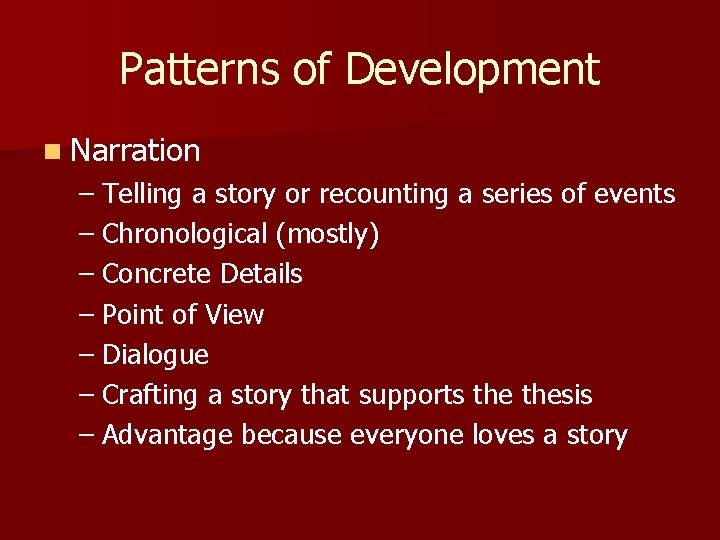
Patterns of Development n Narration – Telling a story or recounting a series of events – Chronological (mostly) – Concrete Details – Point of View – Dialogue – Crafting a story that supports thesis – Advantage because everyone loves a story
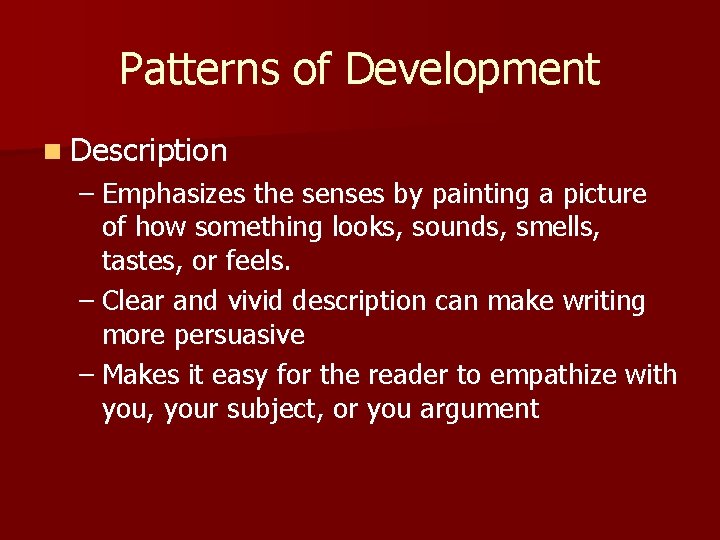
Patterns of Development n Description – Emphasizes the senses by painting a picture of how something looks, sounds, smells, tastes, or feels. – Clear and vivid description can make writing more persuasive – Makes it easy for the reader to empathize with you, your subject, or you argument
Patterns of Development n Process Analysis – Explains how something works, how to do something, or how something was done – The key is clarity
Patterns of Development n Exemplification – Providing a series of examples – facts, specific cases, or instances – One extended example or a series of smaller examples – Usually involves Induction (Specific examples leading to a general conclusion)
Patterns of Development n Comparison and Contrast – Juxtaposing two things to highlight the similarities and differences – Purpose to discuss the subtle differences or similarities in the method, style, or purpose of two texts. – Organized by subject-by-subject or point-bypoint
Patterns of Development n Classification and Division – To sort material or ideas into major categories – Writer’s main task is to develop his or her own categories, to find a distinctive way of breaking down a larger idea or concept into parts
Patterns of Development n Definition – To ensure that writers and their audiences are speaking the same language, definition may lay the foundation to establish common ground or identifying area of conflict
Patterns of Development n Cause and Effect – Analyzing the causes that lead to a certain effect or, conversely, the effects that result from a cause is a powerful foundation for argument
More Information n For more information regarding the Patterns of Development please go to: Fricke’s Forum blogs. muskegonisd. org/frickewi/english-101/