
Language Modeling Language Modeling Introduction to Ngrams Probabilistic
Language Modeling
Language Modeling Introduction to N-grams
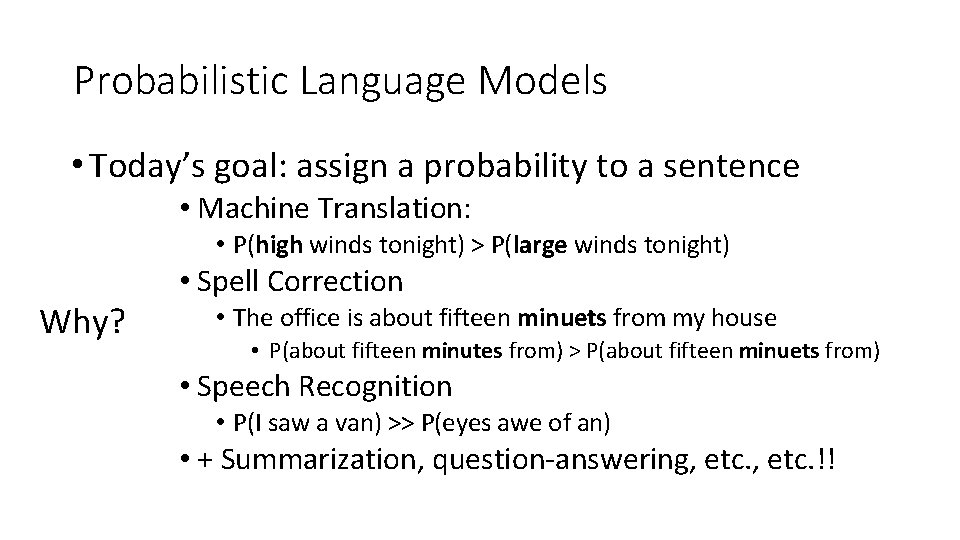
Probabilistic Language Models • Today’s goal: assign a probability to a sentence • Machine Translation: • P(high winds tonight) > P(large winds tonight) Why? • Spell Correction • The office is about fifteen minuets from my house • P(about fifteen minutes from) > P(about fifteen minuets from) • Speech Recognition • P(I saw a van) >> P(eyes awe of an) • + Summarization, question-answering, etc. !!
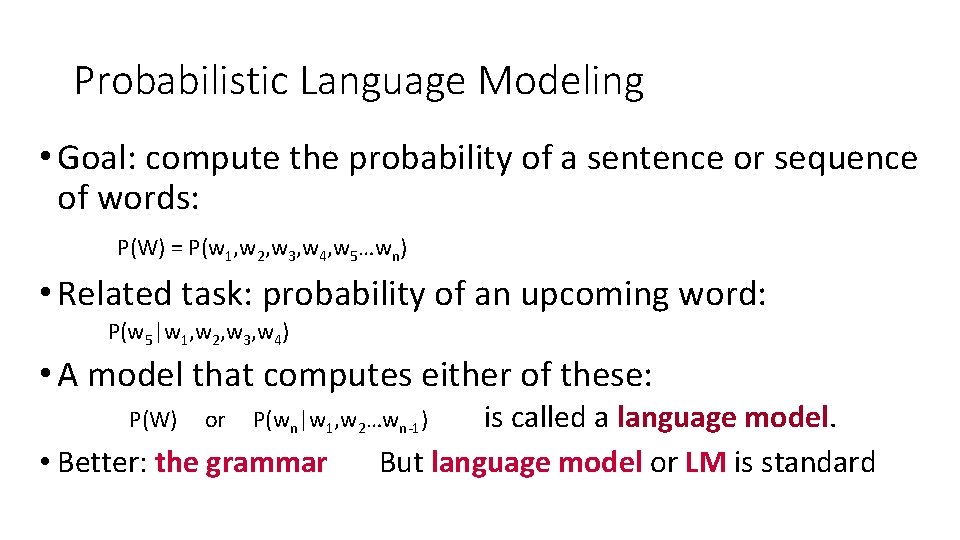
Probabilistic Language Modeling • Goal: compute the probability of a sentence or sequence of words: P(W) = P(w 1, w 2, w 3, w 4, w 5…wn) • Related task: probability of an upcoming word: P(w 5|w 1, w 2, w 3, w 4) • A model that computes either of these: P(W) or is called a language model. But language model or LM is standard P(wn|w 1, w 2…wn-1) • Better: the grammar
How to compute P(W) • How to compute this joint probability: • P(its, water, is, so, transparent, that) • Intuition: let’s rely on the Chain Rule of Probability

Reminder: The Chain Rule • Recall the definition of conditional probabilities Rewriting: • More variables: P(A, B, C, D) = P(A)P(B|A)P(C|A, B)P(D|A, B, C) • The Chain Rule in General P(x 1, x 2, x 3, …, xn) = P(x 1)P(x 2|x 1)P(x 3|x 1, x 2)…P(xn|x 1, …, xn-1)
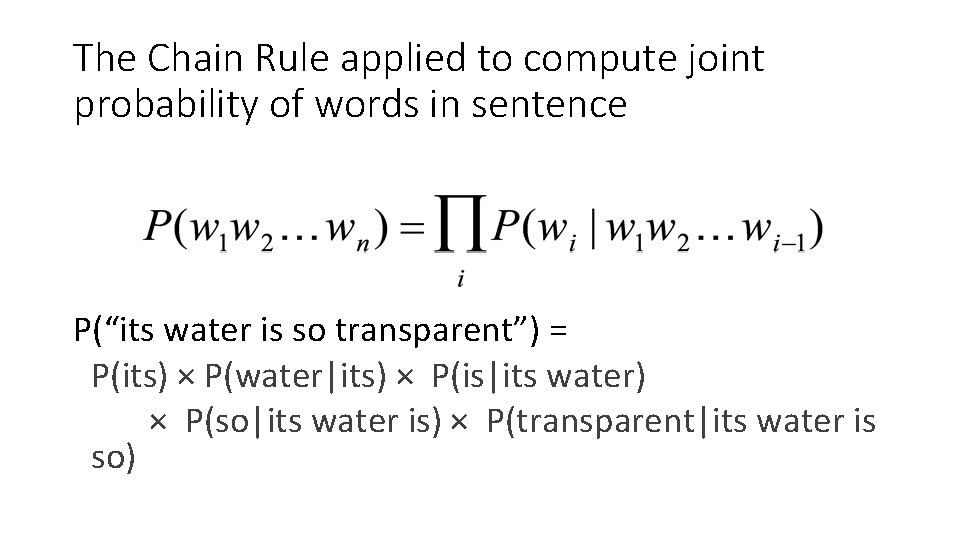
The Chain Rule applied to compute joint probability of words in sentence P(“its water is so transparent”) = P(its) × P(water|its) × P(is|its water) × P(so|its water is) × P(transparent|its water is so)
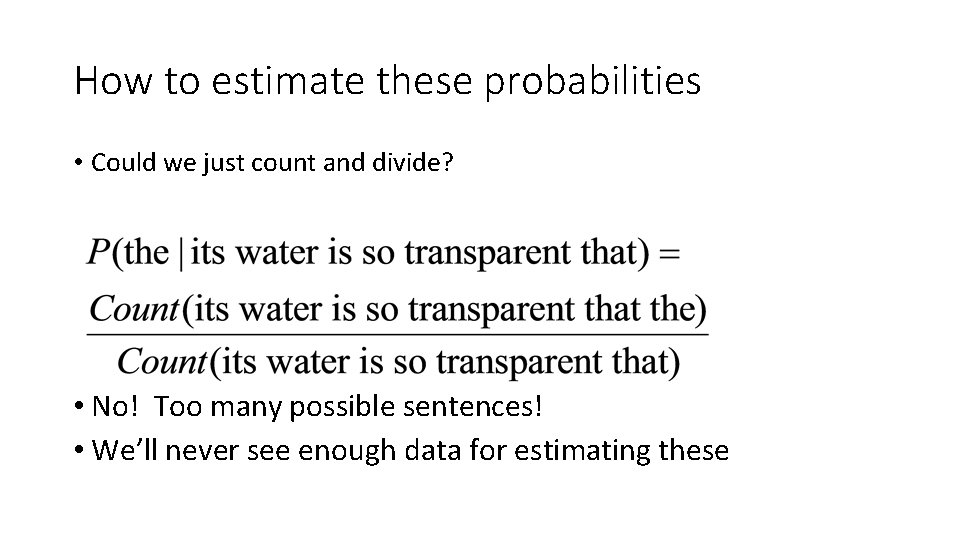
How to estimate these probabilities • Could we just count and divide? • No! Too many possible sentences! • We’ll never see enough data for estimating these
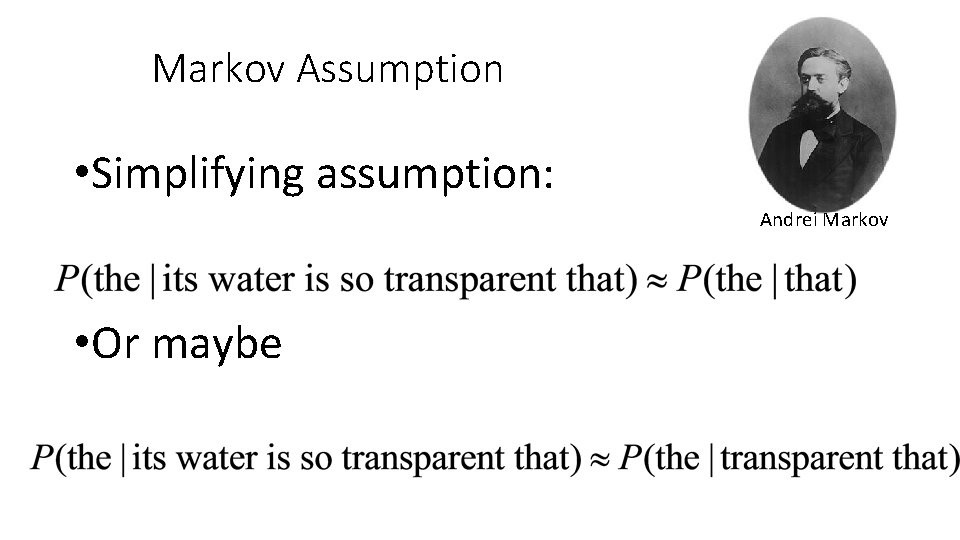
Markov Assumption • Simplifying assumption: Andrei Markov • Or maybe
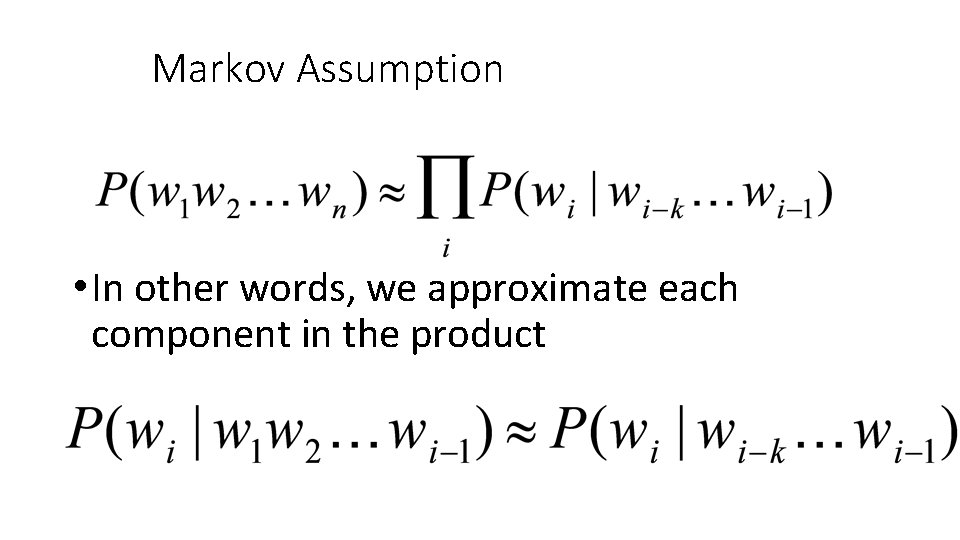
Markov Assumption • In other words, we approximate each component in the product
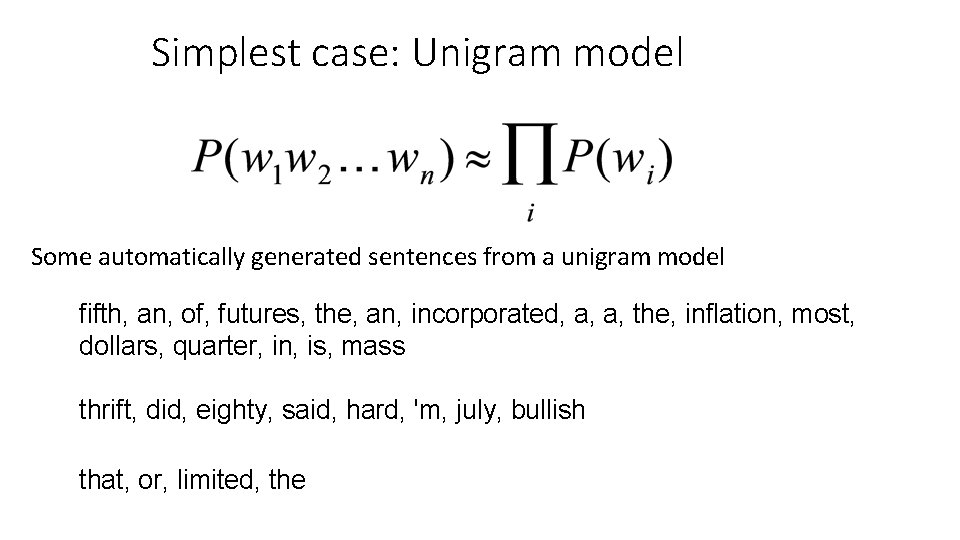
Simplest case: Unigram model Some automatically generated sentences from a unigram model fifth, an, of, futures, the, an, incorporated, a, a, the, inflation, most, dollars, quarter, in, is, mass thrift, did, eighty, said, hard, 'm, july, bullish that, or, limited, the
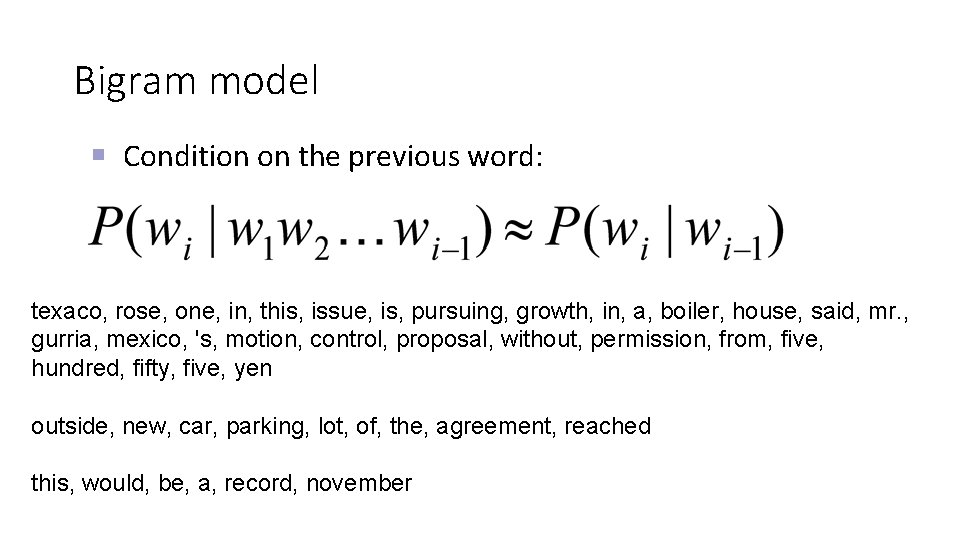
Bigram model Condition on the previous word: texaco, rose, one, in, this, issue, is, pursuing, growth, in, a, boiler, house, said, mr. , gurria, mexico, 's, motion, control, proposal, without, permission, from, five, hundred, fifty, five, yen outside, new, car, parking, lot, of, the, agreement, reached this, would, be, a, record, november
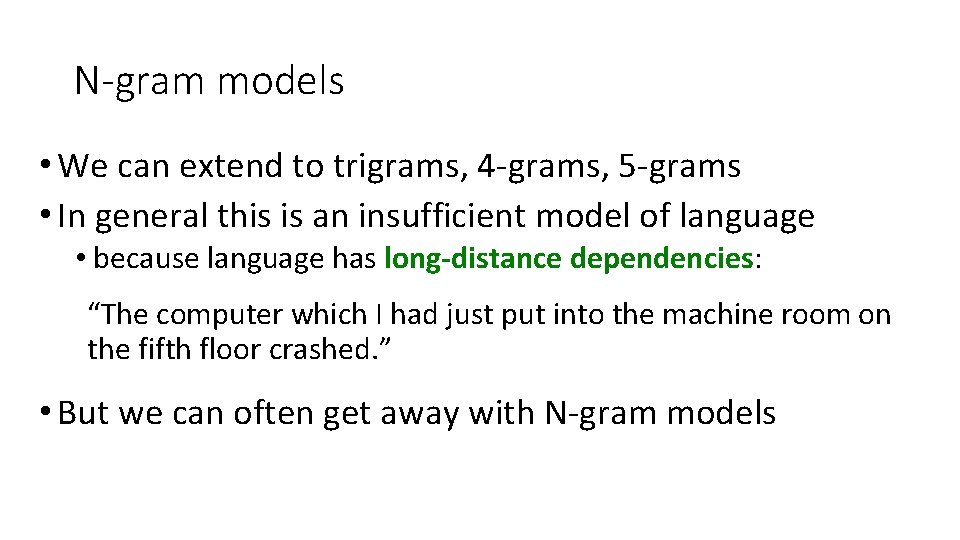
N-gram models • We can extend to trigrams, 4 -grams, 5 -grams • In general this is an insufficient model of language • because language has long-distance dependencies: “The computer which I had just put into the machine room on the fifth floor crashed. ” • But we can often get away with N-gram models
Language Modeling Estimating N-gram Probabilities
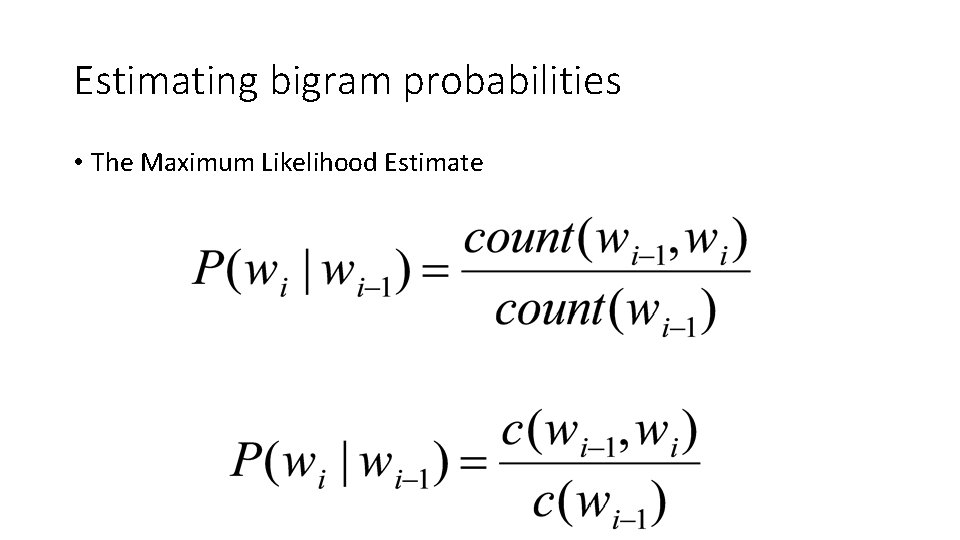
Estimating bigram probabilities • The Maximum Likelihood Estimate
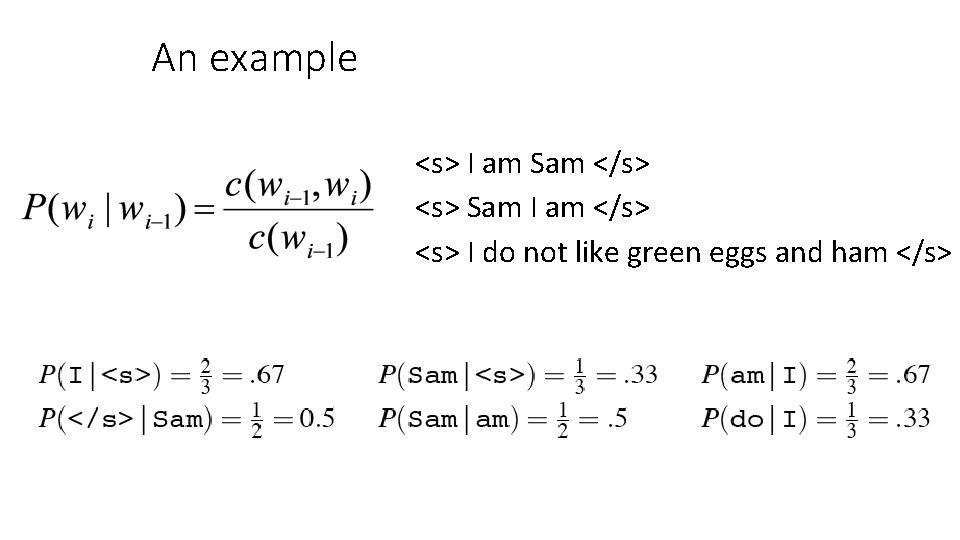
An example <s> I am Sam </s> <s> Sam I am </s> <s> I do not like green eggs and ham </s>
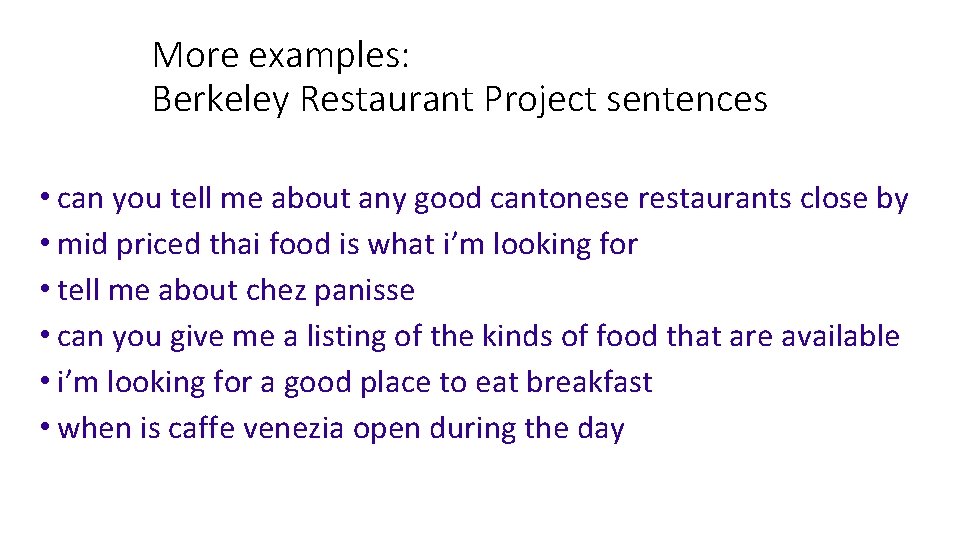
More examples: Berkeley Restaurant Project sentences • can you tell me about any good cantonese restaurants close by • mid priced thai food is what i’m looking for • tell me about chez panisse • can you give me a listing of the kinds of food that are available • i’m looking for a good place to eat breakfast • when is caffe venezia open during the day
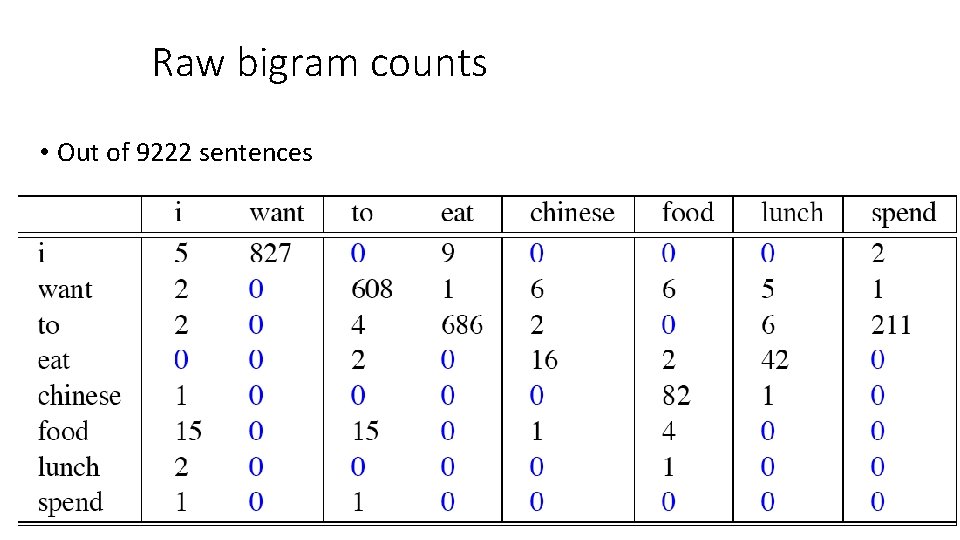
Raw bigram counts • Out of 9222 sentences
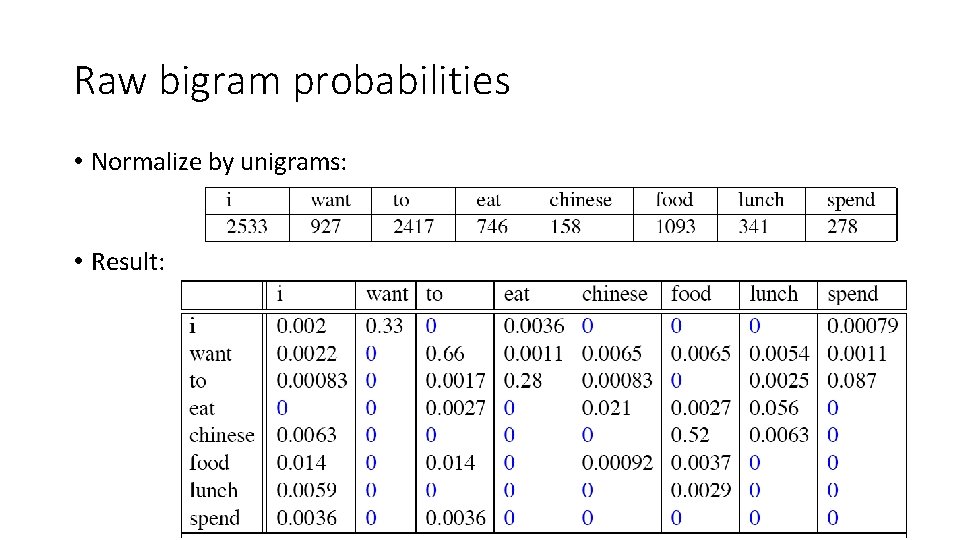
Raw bigram probabilities • Normalize by unigrams: • Result:
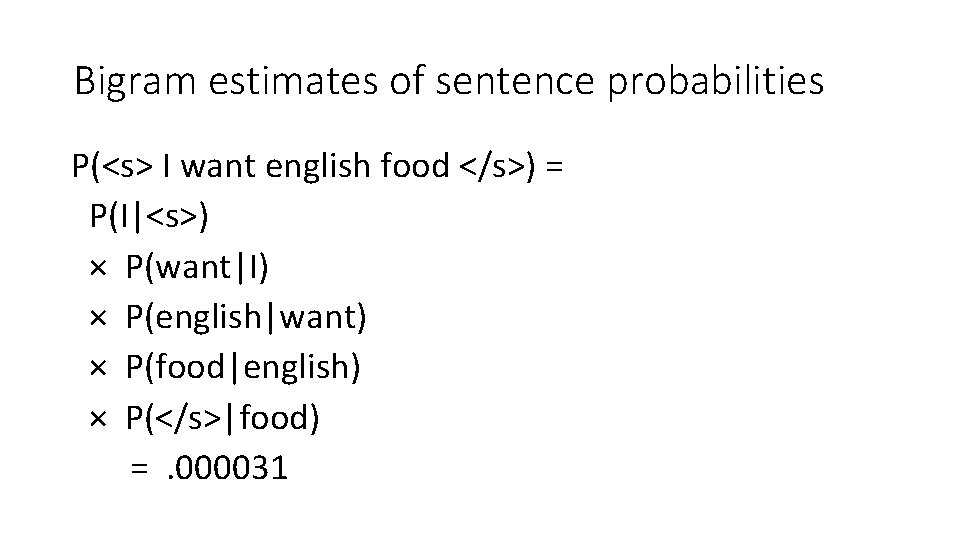
Bigram estimates of sentence probabilities P(<s> I want english food </s>) = P(I|<s>) × P(want|I) × P(english|want) × P(food|english) × P(</s>|food) =. 000031
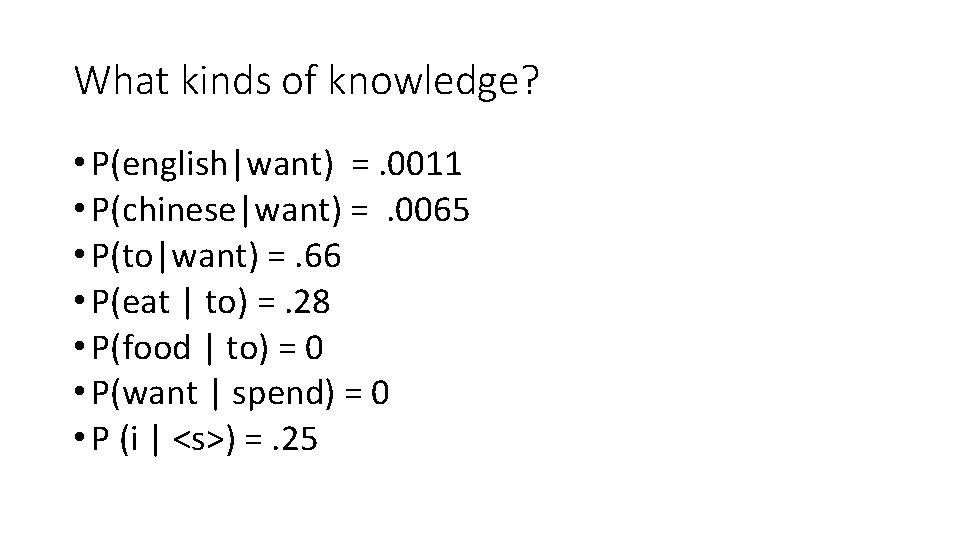
What kinds of knowledge? • P(english|want) =. 0011 • P(chinese|want) =. 0065 • P(to|want) =. 66 • P(eat | to) =. 28 • P(food | to) = 0 • P(want | spend) = 0 • P (i | <s>) =. 25
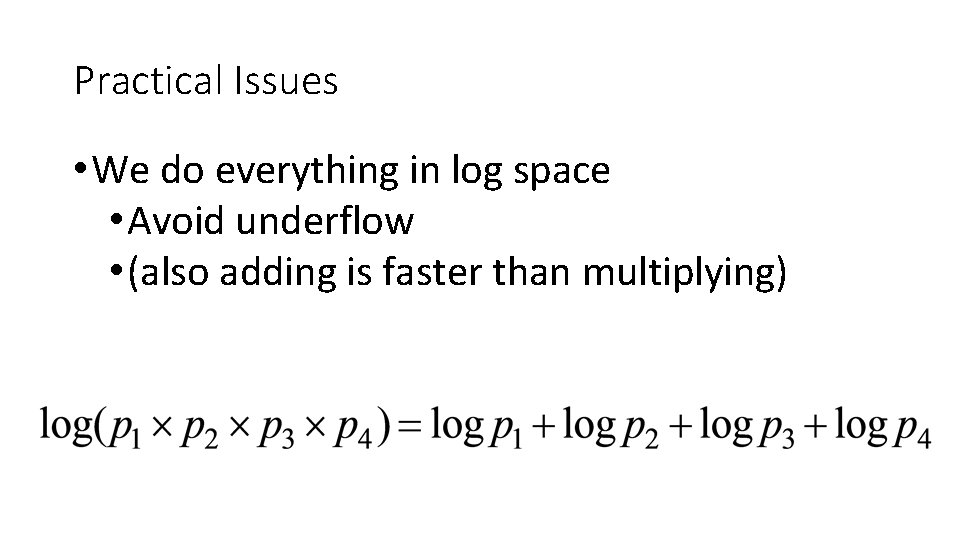
Practical Issues • We do everything in log space • Avoid underflow • (also adding is faster than multiplying)
Language Modeling Toolkits • SRILM • http: //www. speech. sri. com/projects/srilm/
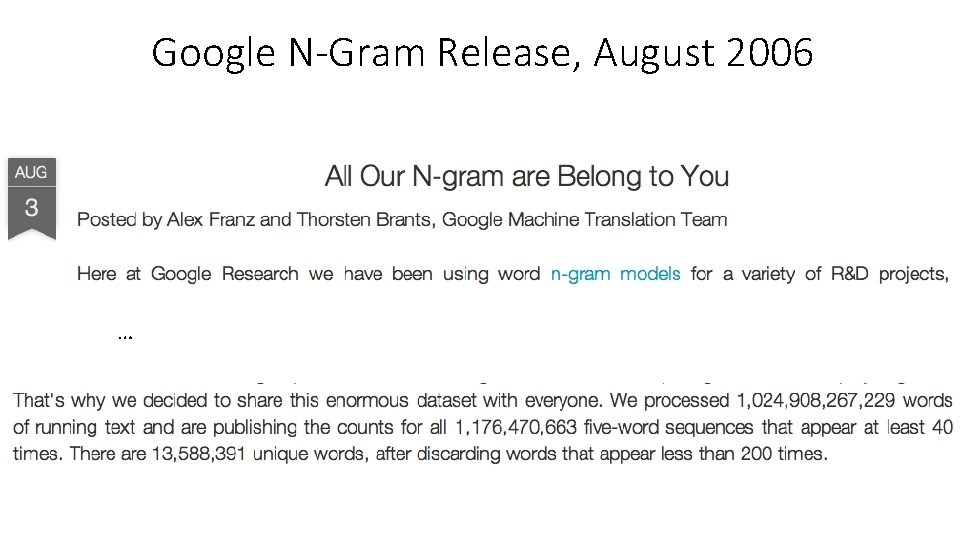
Google N-Gram Release, August 2006 …
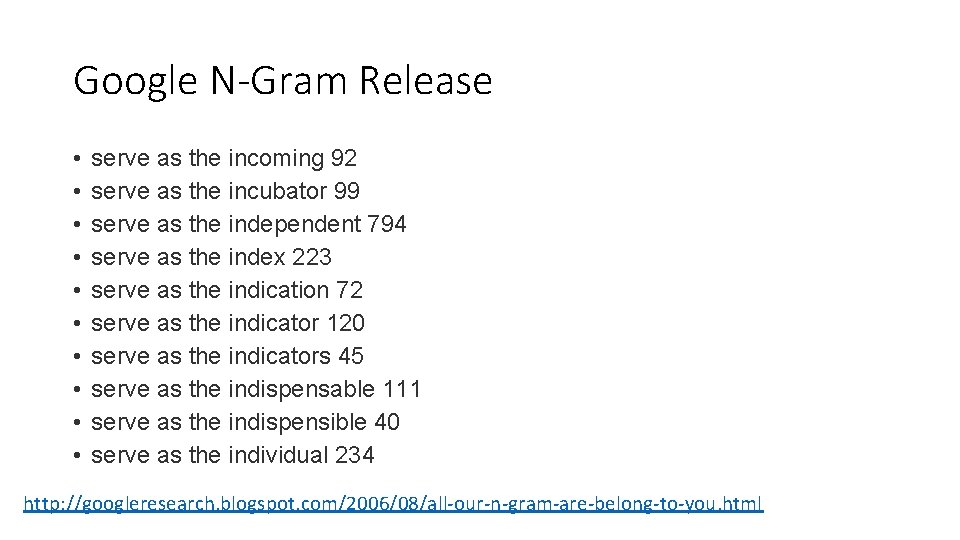
Google N-Gram Release • • • serve as the incoming 92 serve as the incubator 99 serve as the independent 794 serve as the index 223 serve as the indication 72 serve as the indicator 120 serve as the indicators 45 serve as the indispensable 111 serve as the indispensible 40 serve as the individual 234 http: //googleresearch. blogspot. com/2006/08/all-our-n-gram-are-belong-to-you. html
Google Book N-grams • http: //ngrams. googlelabs. com/
Language Modeling Evaluation and Perplexity
Evaluation: How good is our model? • Does our language model prefer good sentences to bad ones? • Assign higher probability to “real” or “frequently observed” sentences • Than “ungrammatical” or “rarely observed” sentences? • We train parameters of our model on a training set. • We test the model’s performance on data we haven’t seen. • A test set is an unseen dataset that is different from our training set, totally unused. • An evaluation metric tells us how well our model does on the test set.
Extrinsic evaluation of N-gram models • Best evaluation for comparing models A and B • Put each model in a task • spelling corrector, speech recognizer, MT system • Run the task, get an accuracy for A and for B • How many misspelled words corrected properly • How many words translated correctly • Compare accuracy for A and B
Difficulty of extrinsic (in-vivo) evaluation of N -gram models • Extrinsic evaluation • Time-consuming; can take days or weeks • Sometimes use intrinsic evaluation: perplexity • Bad approximation • unless the test data looks just like the training data • So generally only useful in pilot experiments • But is helpful to think about.
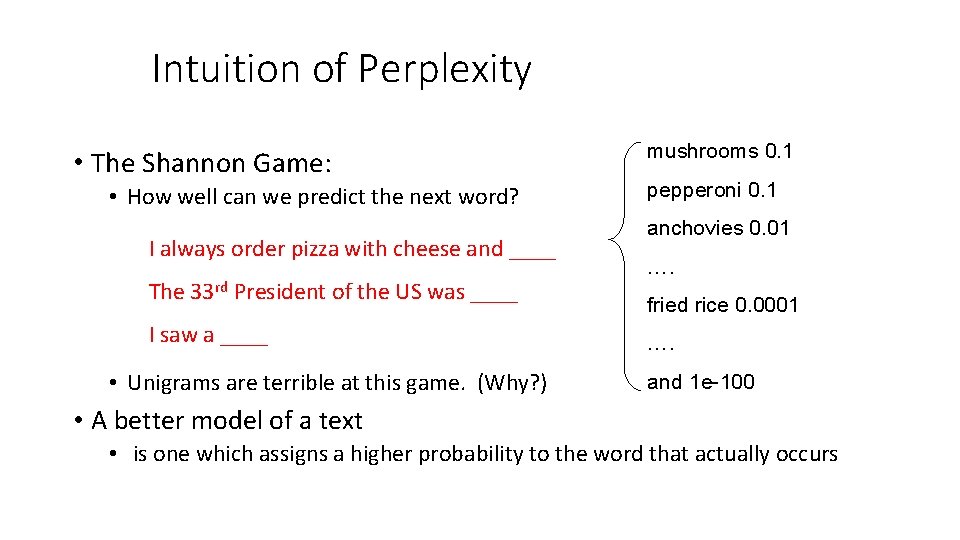
Intuition of Perplexity • The Shannon Game: • How well can we predict the next word? I always order pizza with cheese and ____ The 33 rd President of the US was ____ I saw a ____ • Unigrams are terrible at this game. (Why? ) mushrooms 0. 1 pepperoni 0. 1 anchovies 0. 01 …. fried rice 0. 0001 …. and 1 e-100 • A better model of a text • is one which assigns a higher probability to the word that actually occurs
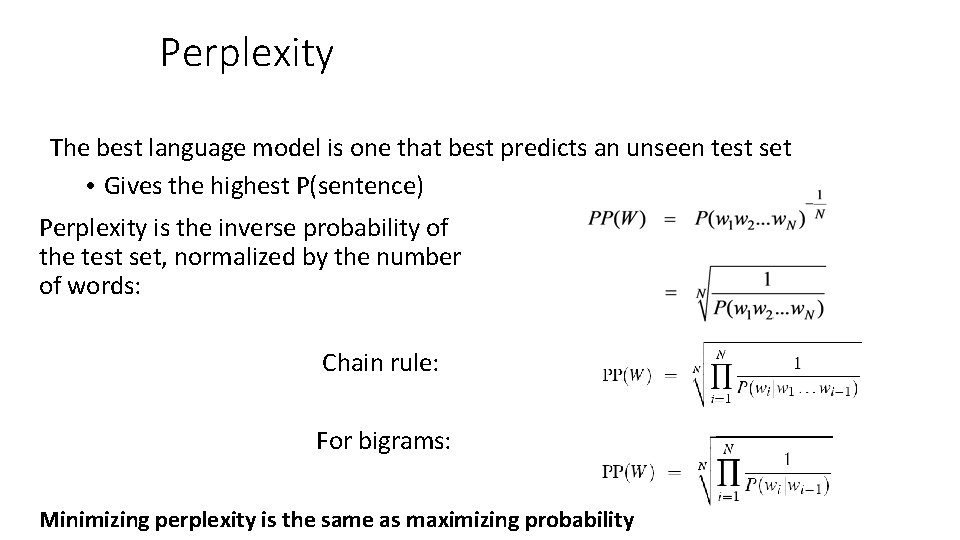
Perplexity The best language model is one that best predicts an unseen test set • Gives the highest P(sentence) Perplexity is the inverse probability of the test set, normalized by the number of words: Chain rule: For bigrams: Minimizing perplexity is the same as maximizing probability
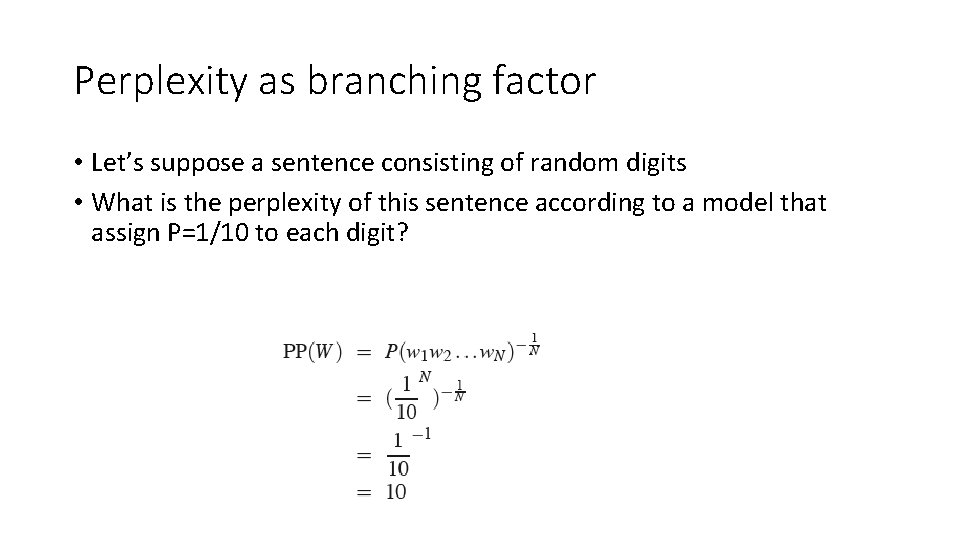
Perplexity as branching factor • Let’s suppose a sentence consisting of random digits • What is the perplexity of this sentence according to a model that assign P=1/10 to each digit?
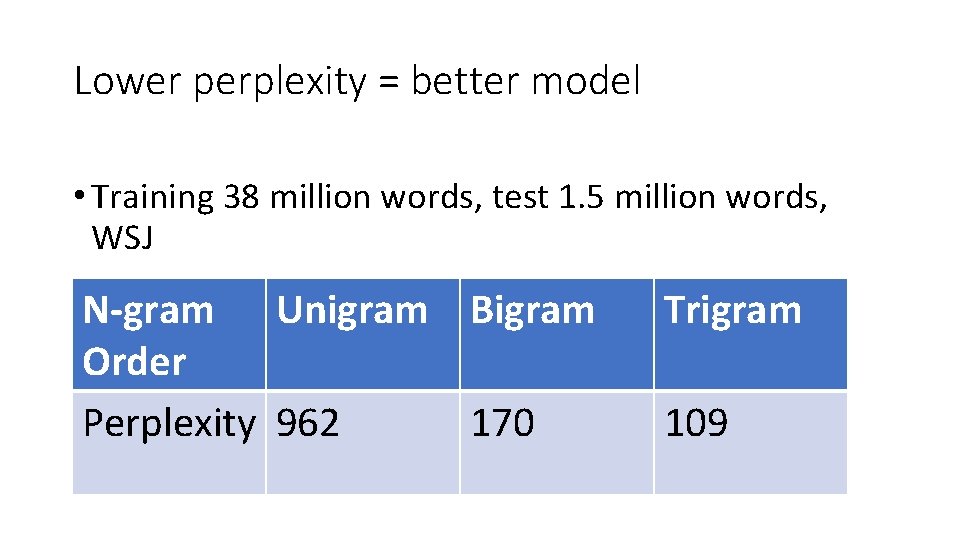
Lower perplexity = better model • Training 38 million words, test 1. 5 million words, WSJ N-gram Unigram Bigram Order Perplexity 962 170 Trigram 109
Language Modeling Generalization and zeros
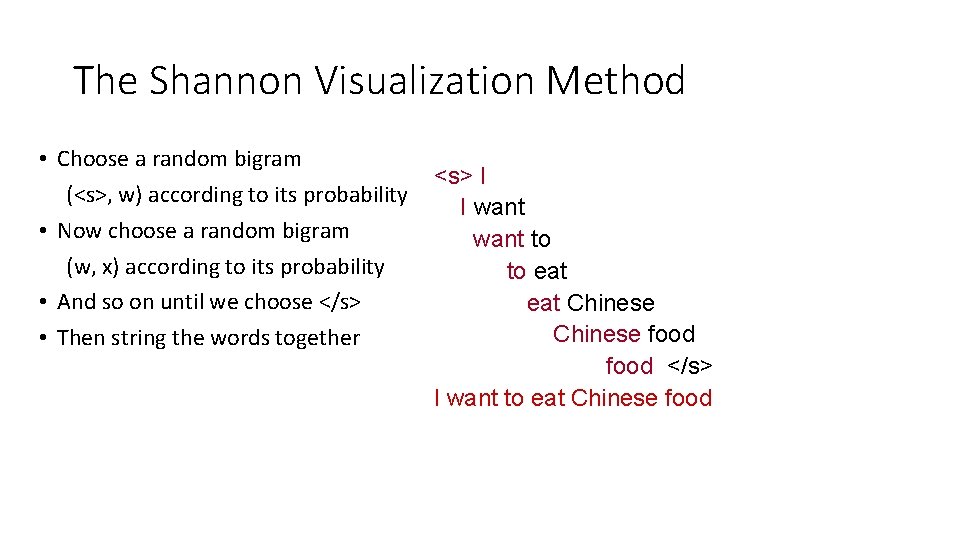
The Shannon Visualization Method • Choose a random bigram (<s>, w) according to its probability • Now choose a random bigram (w, x) according to its probability • And so on until we choose </s> • Then string the words together <s> I I want to to eat Chinese food </s> I want to eat Chinese food
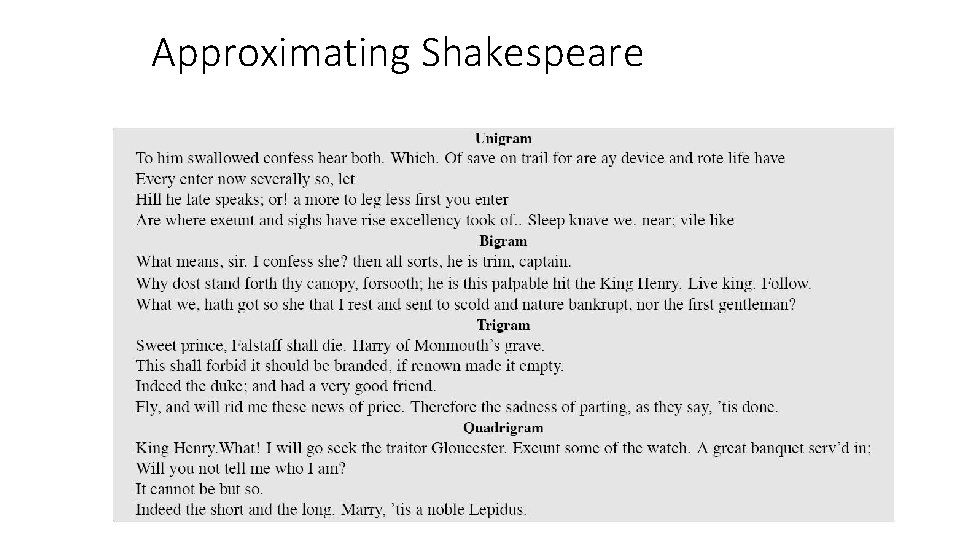
Approximating Shakespeare
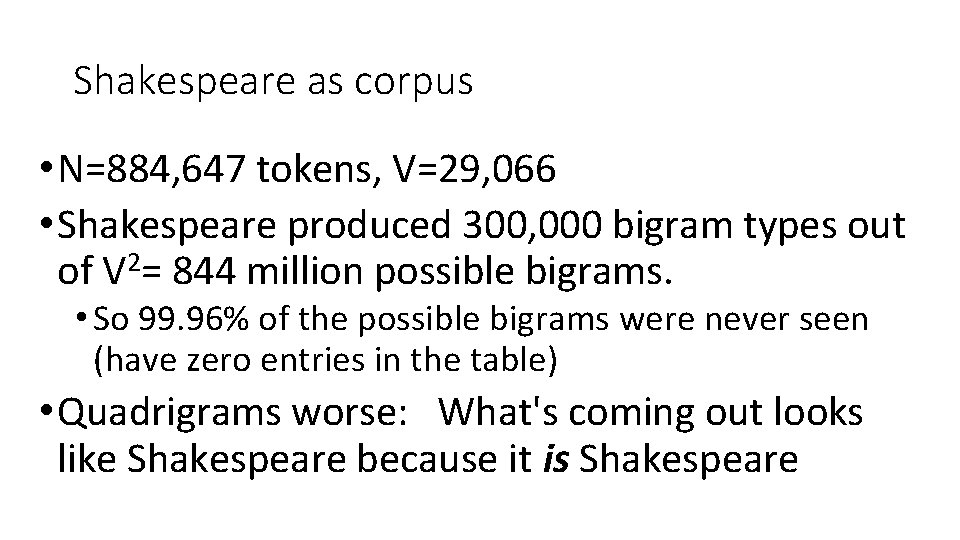
Shakespeare as corpus • N=884, 647 tokens, V=29, 066 • Shakespeare produced 300, 000 bigram types out of V 2= 844 million possible bigrams. • So 99. 96% of the possible bigrams were never seen (have zero entries in the table) • Quadrigrams worse: What's coming out looks like Shakespeare because it is Shakespeare
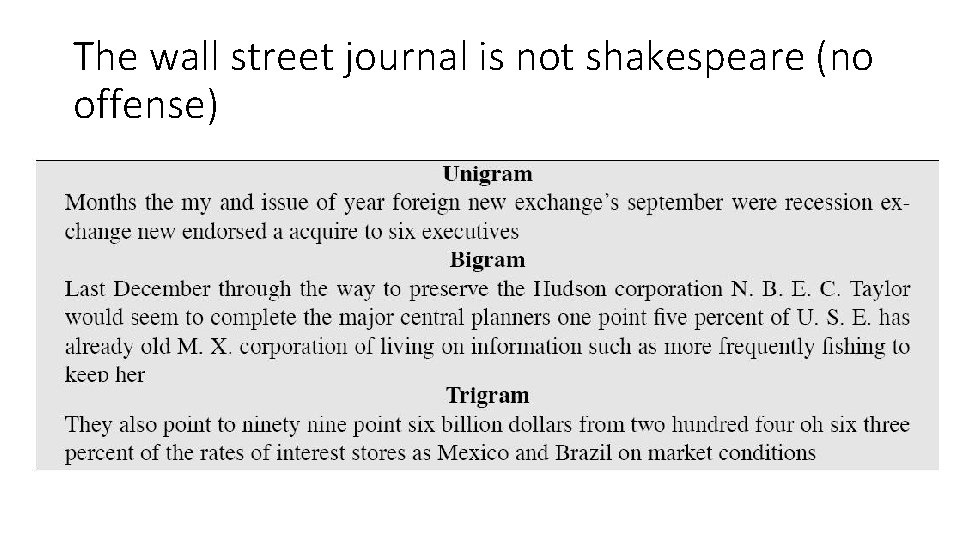
The wall street journal is not shakespeare (no offense)
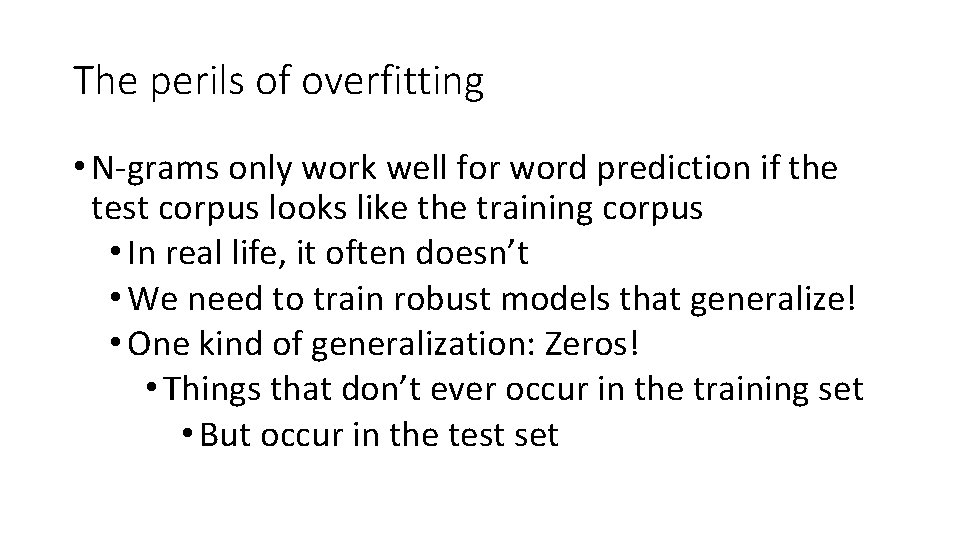
The perils of overfitting • N-grams only work well for word prediction if the test corpus looks like the training corpus • In real life, it often doesn’t • We need to train robust models that generalize! • One kind of generalization: Zeros! • Things that don’t ever occur in the training set • But occur in the test set
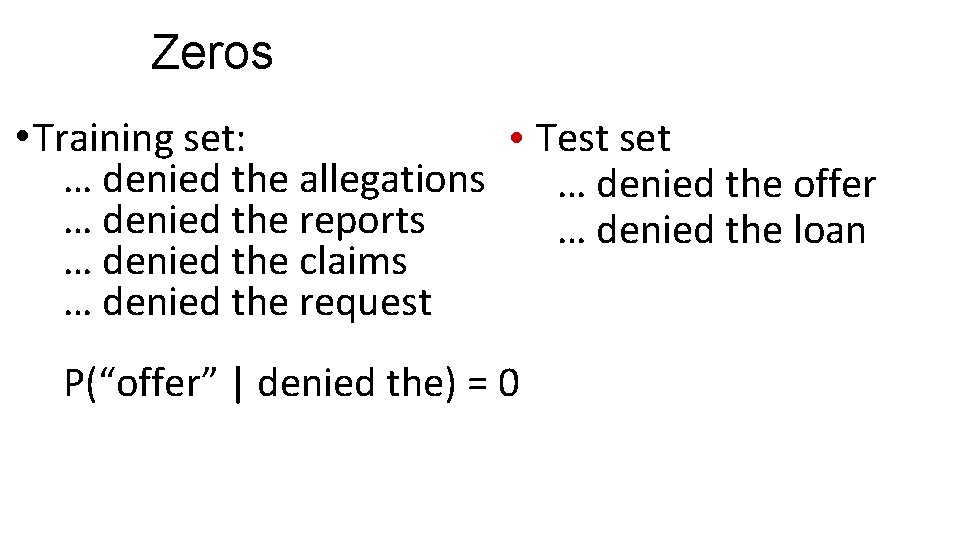
Zeros • Test set • Training set: … denied the allegations … denied the offer … denied the reports … denied the loan … denied the claims … denied the request P(“offer” | denied the) = 0
Zero probability bigrams • Bigrams with zero probability • mean that we will assign 0 probability to the test set! • And hence we cannot compute perplexity (can’t divide by 0)!
Language Modeling Smoothing: Add-one (Laplace) smoothing
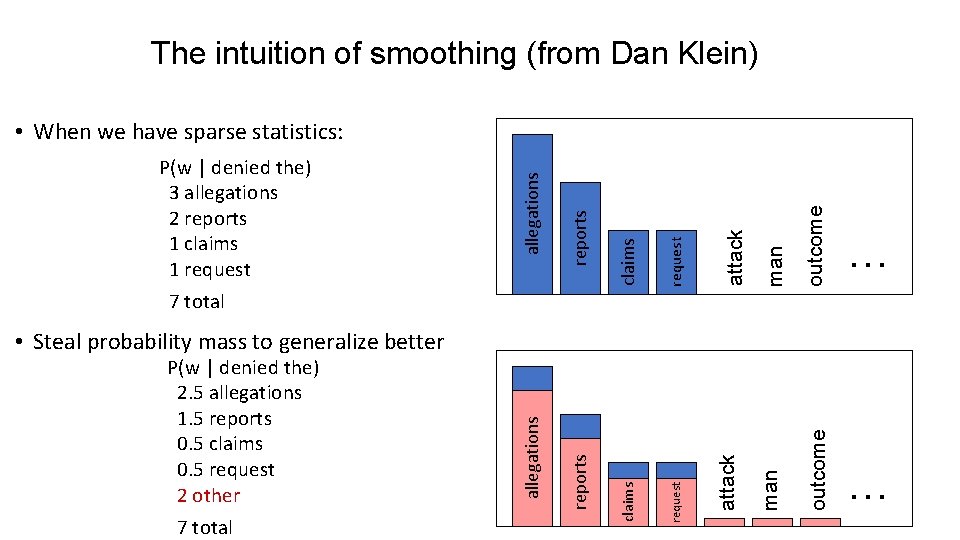
The intuition of smoothing (from Dan Klein) man outcome attack request claims reports P(w | denied the) 3 allegations 2 reports 1 claims 1 request 7 total allegations • When we have sparse statistics: … attack request claims reports P(w | denied the) 2. 5 allegations 1. 5 reports 0. 5 claims 0. 5 request 2 other 7 total allegations • Steal probability mass to generalize better …
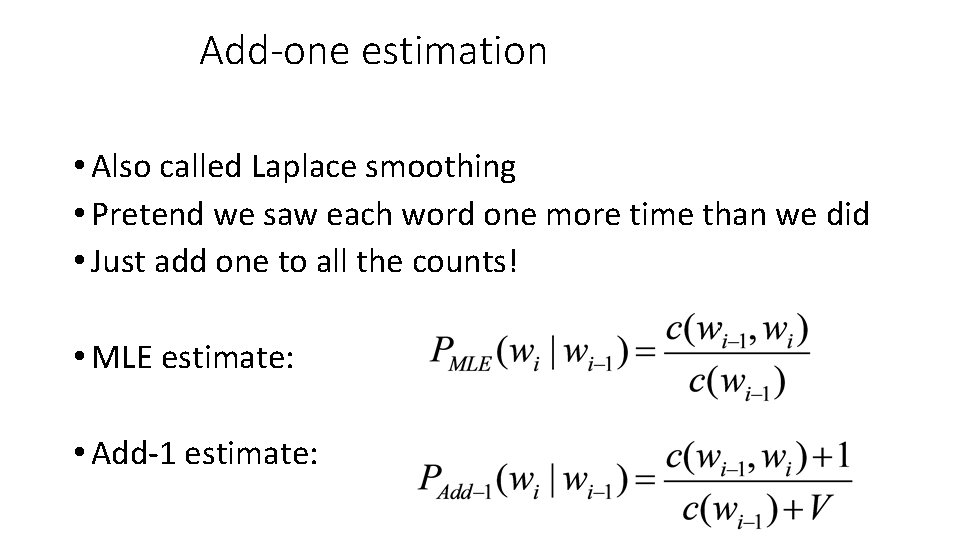
Add-one estimation • Also called Laplace smoothing • Pretend we saw each word one more time than we did • Just add one to all the counts! • MLE estimate: • Add-1 estimate:
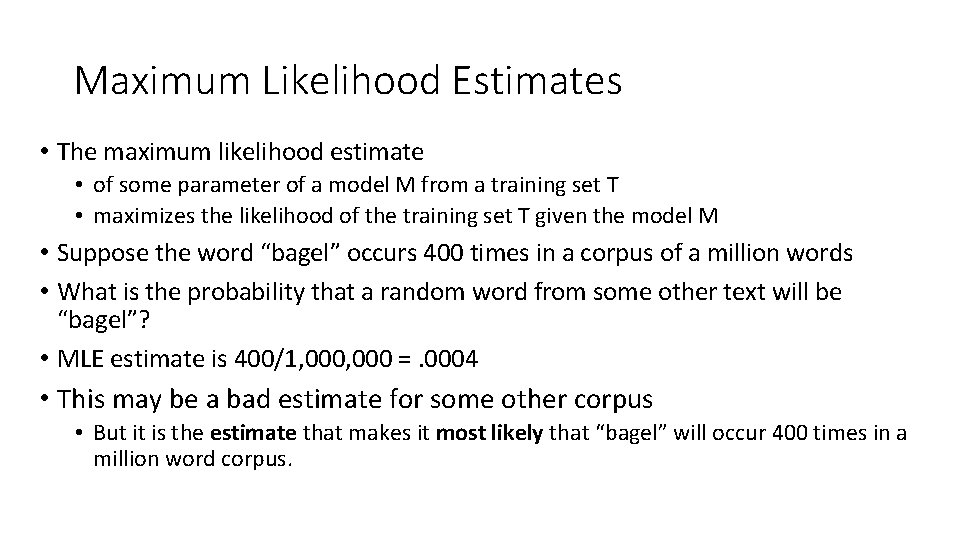
Maximum Likelihood Estimates • The maximum likelihood estimate • of some parameter of a model M from a training set T • maximizes the likelihood of the training set T given the model M • Suppose the word “bagel” occurs 400 times in a corpus of a million words • What is the probability that a random word from some other text will be “bagel”? • MLE estimate is 400/1, 000 =. 0004 • This may be a bad estimate for some other corpus • But it is the estimate that makes it most likely that “bagel” will occur 400 times in a million word corpus.
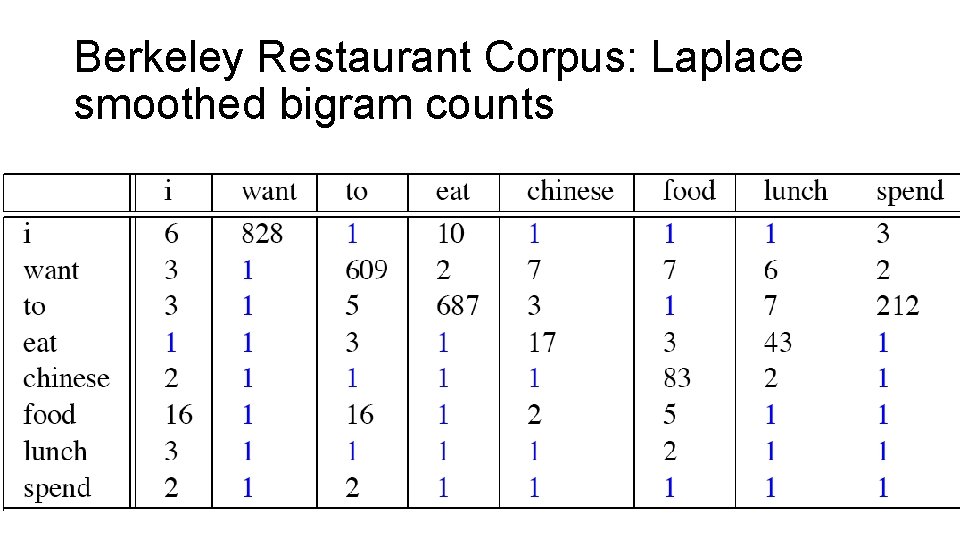
Berkeley Restaurant Corpus: Laplace smoothed bigram counts
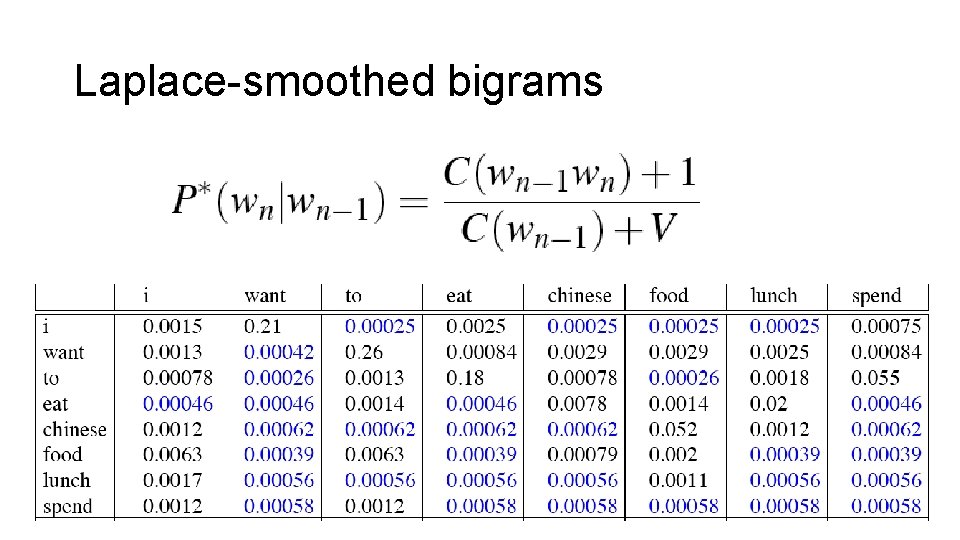
Laplace-smoothed bigrams
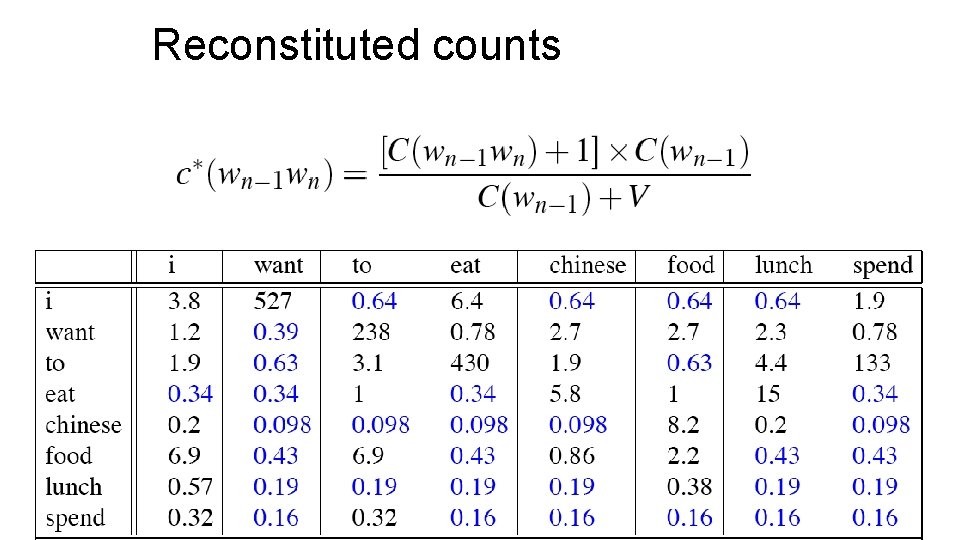
Reconstituted counts
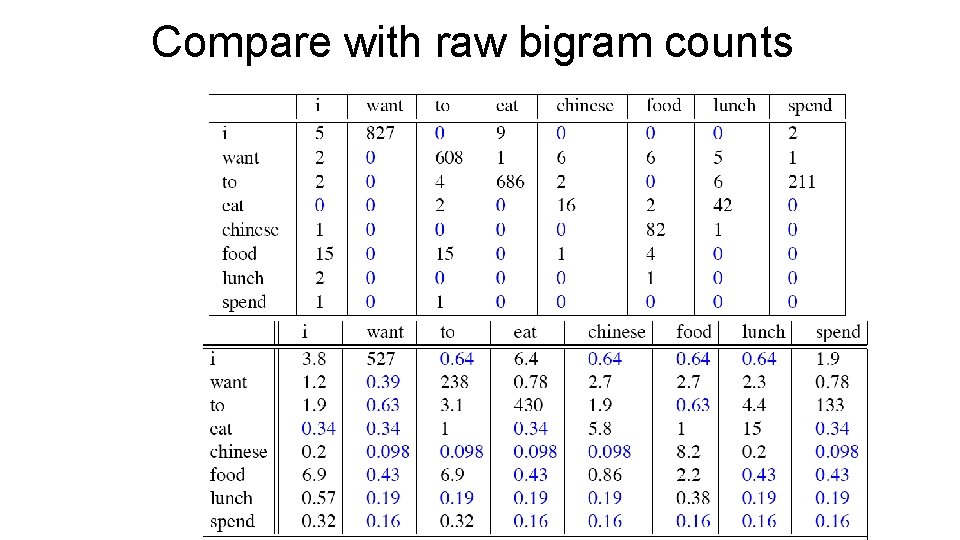
Compare with raw bigram counts
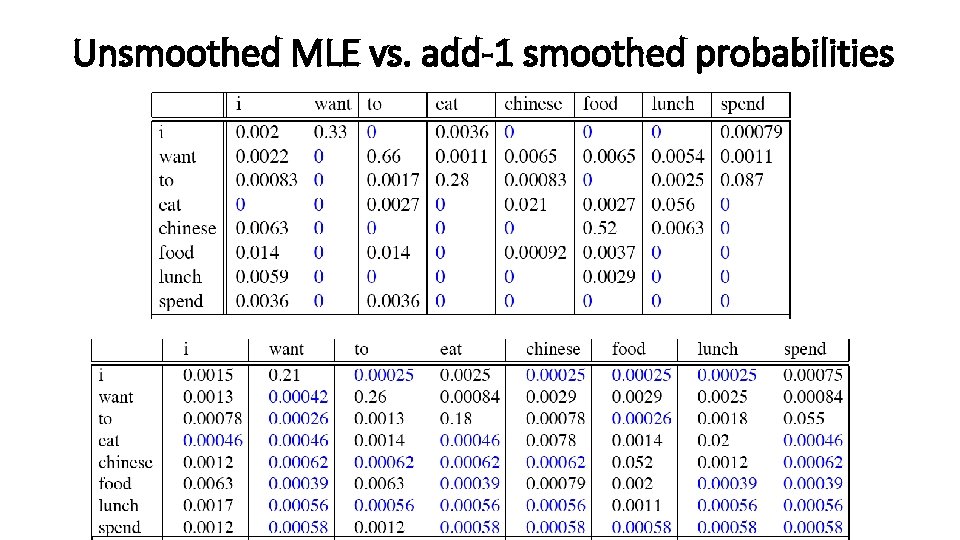
Unsmoothed MLE vs. add-1 smoothed probabilities
Add-1 estimation is a blunt instrument • So add-1 isn’t used for N-grams: • We’ll see better methods • But add-1 is used to smooth other NLP models • For text classification • In domains where the number of zeros isn’t so huge.
Language Modeling Interpolation, Backoff, and Web-Scale LMs
Backoff and Interpolation • Sometimes it helps to use less context • Condition on less context for contexts you haven’t learned much about • Backoff: • use trigram if you have good evidence, • otherwise bigram, otherwise unigram • Interpolation: • mix unigram, bigram, trigram • Interpolation works better
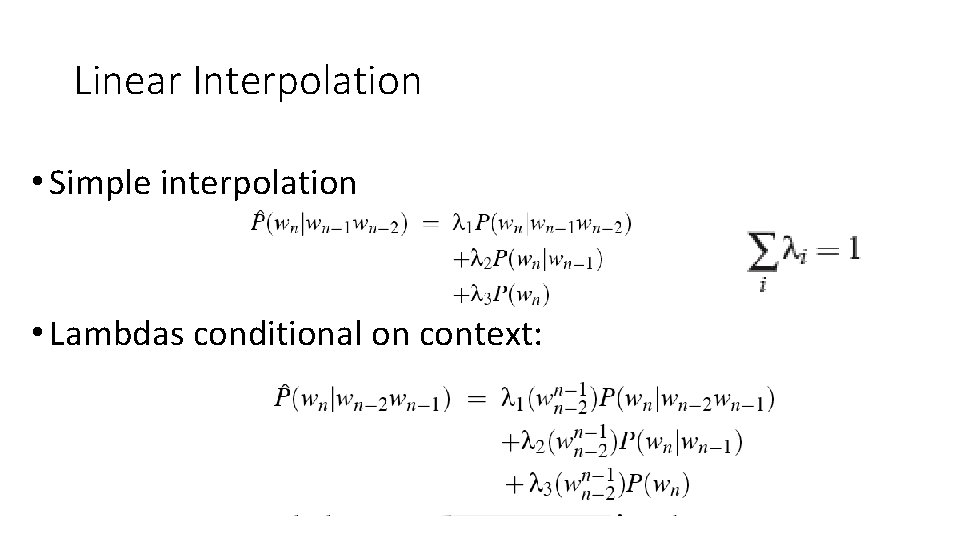
Linear Interpolation • Simple interpolation • Lambdas conditional on context:
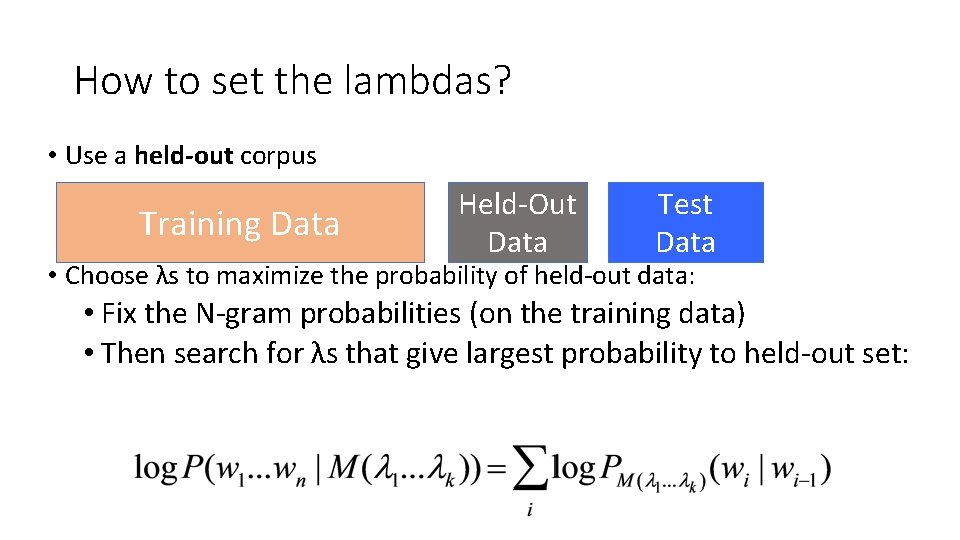
How to set the lambdas? • Use a held-out corpus Training Data Held-Out Data Test Data • Choose λs to maximize the probability of held-out data: • Fix the N-gram probabilities (on the training data) • Then search for λs that give largest probability to held-out set:
Unknown words: Open versus closed vocabulary tasks • If we know all the words in advance • Vocabulary V is fixed • Closed vocabulary task • Often we don’t know this • Out Of Vocabulary = OOV words • Open vocabulary task • Instead: create an unknown word token <UNK> • Training of <UNK> probabilities • Create a fixed lexicon L of size V • At text normalization phase, any training word not in L changed to <UNK> • Now we train its probabilities like a normal word • At decoding time • If text input: Use UNK probabilities for any word not in training
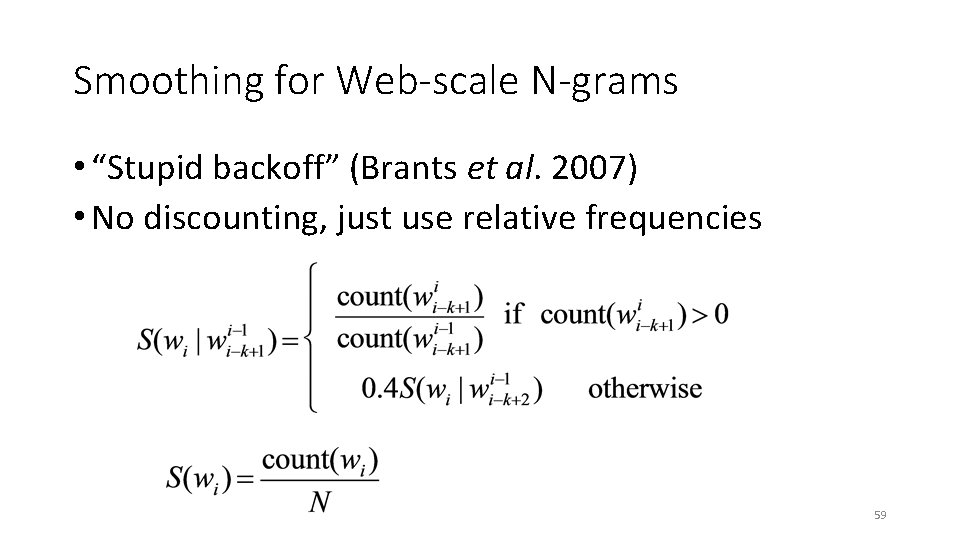
Smoothing for Web-scale N-grams • “Stupid backoff” (Brants et al. 2007) • No discounting, just use relative frequencies 59
N-gram Smoothing Summary • Add-1 smoothing: • OK for text categorization, not for language modeling • The most commonly used method prior to deep learning: • Extended Interpolated Kneser-Ney • For very large N-grams like the Web: • Stupid backoff 60
Credits • This slide set has been adapted from: https: //web. stanford. edu/~jurafsky/NLPCoursera. Slides. html
- Slides: 60