
Language Modeling Generalization and zeros The Shannon Visualization

- Slides: 50
Language Modeling Generalization and zeros
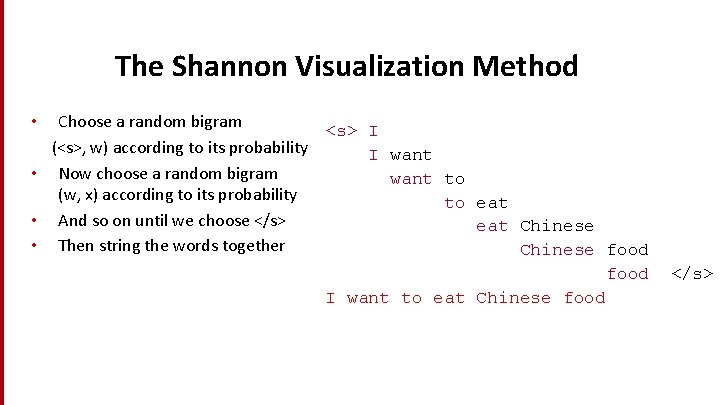
The Shannon Visualization Method Choose a random bigram <s> I (<s>, w) according to its probability I want • Now choose a random bigram want to (w, x) according to its probability to eat • And so on until we choose </s> eat Chinese • Then string the words together Chinese food I want to eat Chinese food • </s>
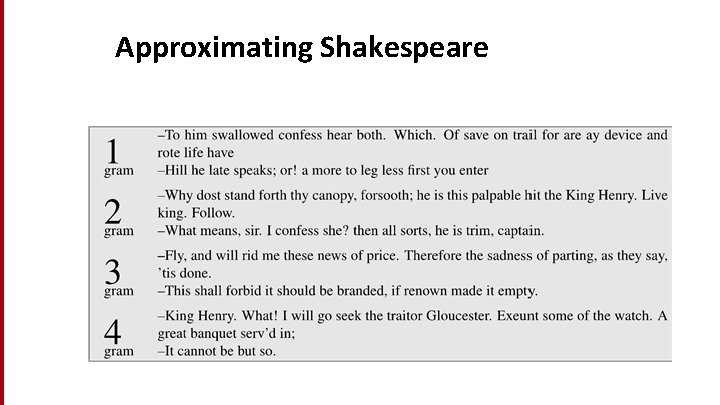
Approximating Shakespeare
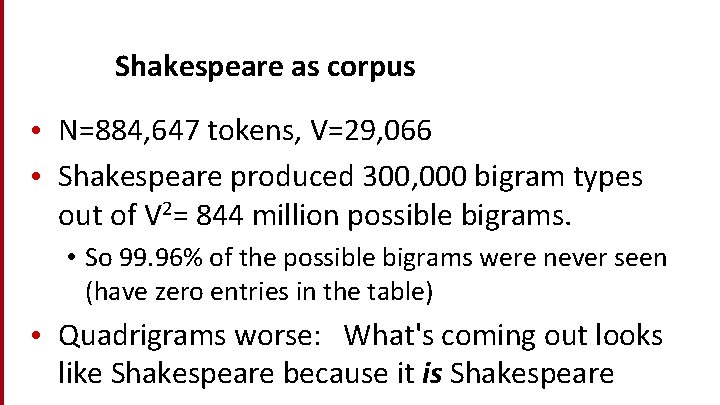
Shakespeare as corpus • N=884, 647 tokens, V=29, 066 • Shakespeare produced 300, 000 bigram types out of V 2= 844 million possible bigrams. • So 99. 96% of the possible bigrams were never seen (have zero entries in the table) • Quadrigrams worse: What's coming out looks like Shakespeare because it is Shakespeare
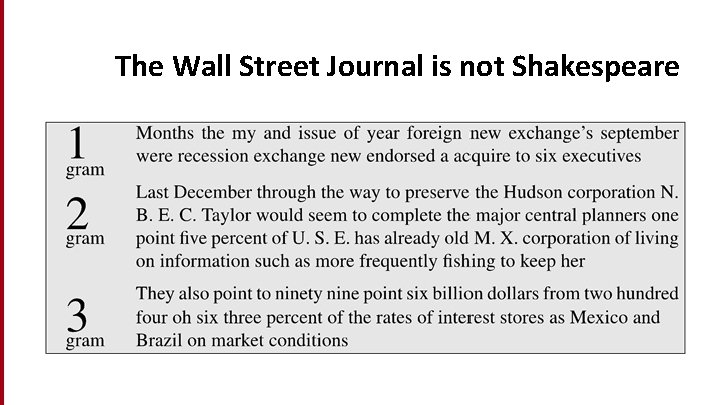
The Wall Street Journal is not Shakespeare
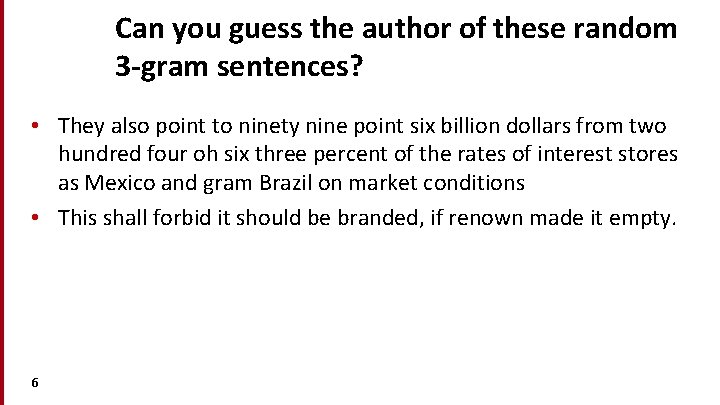
Can you guess the author of these random 3 -gram sentences? • They also point to ninety nine point six billion dollars from two hundred four oh six three percent of the rates of interest stores as Mexico and gram Brazil on market conditions • This shall forbid it should be branded, if renown made it empty. 6
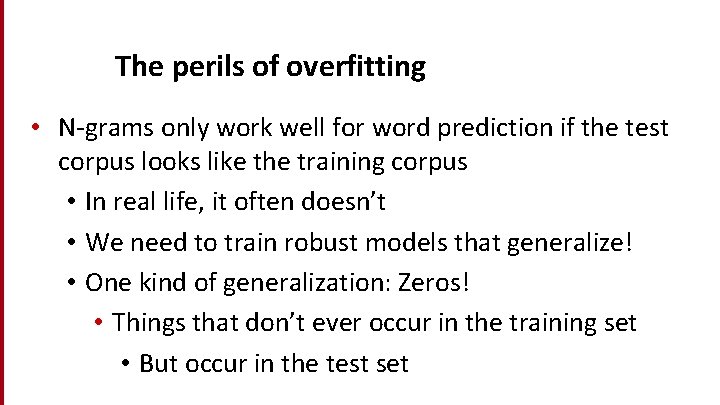
The perils of overfitting • N-grams only work well for word prediction if the test corpus looks like the training corpus • In real life, it often doesn’t • We need to train robust models that generalize! • One kind of generalization: Zeros! • Things that don’t ever occur in the training set • But occur in the test set
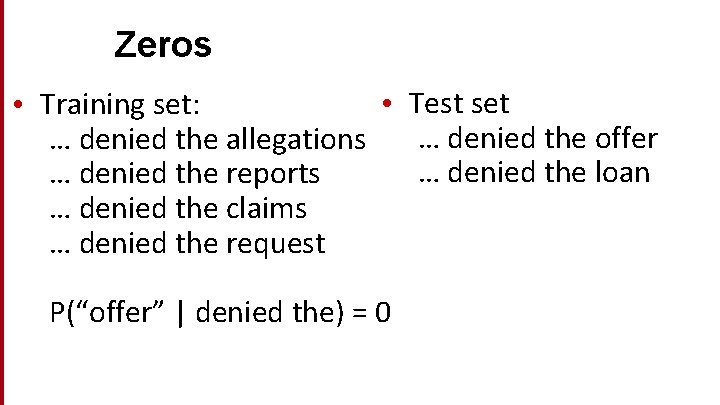
Zeros • Test set • Training set: … denied the offer … denied the allegations … denied the loan … denied the reports … denied the claims … denied the request P(“offer” | denied the) = 0
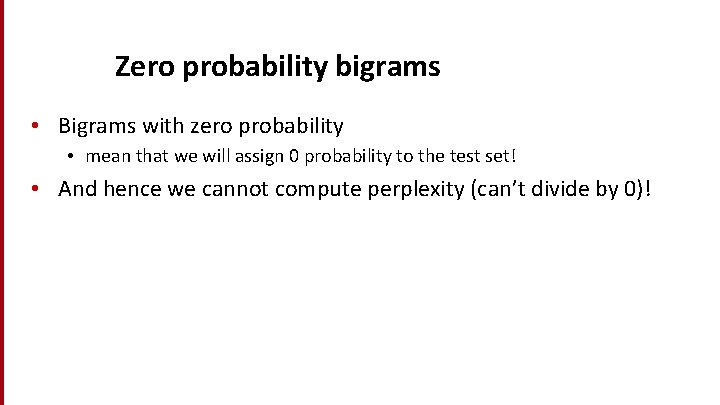
Zero probability bigrams • Bigrams with zero probability • mean that we will assign 0 probability to the test set! • And hence we cannot compute perplexity (can’t divide by 0)!
Language Modeling Smoothing: Add-one (Laplace) smoothing
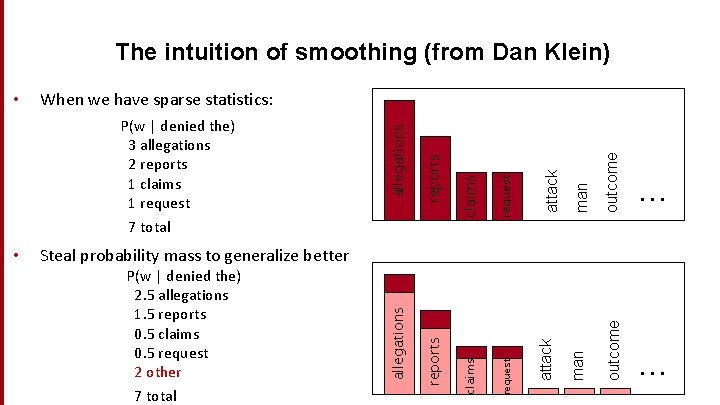
The intuition of smoothing (from Dan Klein) man outcome … man outcome attack request claims reports … attack P(w | denied the) 2. 5 allegations 1. 5 reports 0. 5 claims 0. 5 request 2 other 7 total request Steal probability mass to generalize better claims • reports P(w | denied the) 3 allegations 2 reports 1 claims 1 request 7 total allegations When we have sparse statistics: allegations •
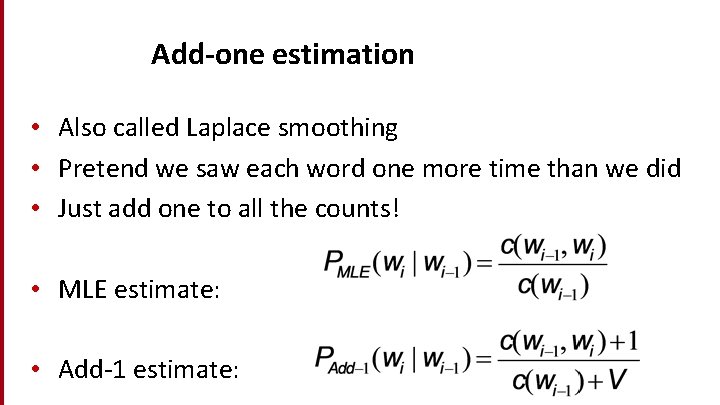
Add-one estimation • Also called Laplace smoothing • Pretend we saw each word one more time than we did • Just add one to all the counts! • MLE estimate: • Add-1 estimate:
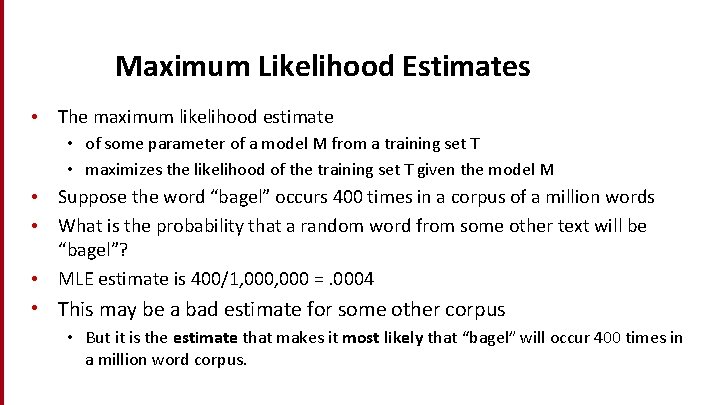
Maximum Likelihood Estimates • The maximum likelihood estimate • of some parameter of a model M from a training set T • maximizes the likelihood of the training set T given the model M • Suppose the word “bagel” occurs 400 times in a corpus of a million words • What is the probability that a random word from some other text will be “bagel”? • MLE estimate is 400/1, 000 =. 0004 • This may be a bad estimate for some other corpus • But it is the estimate that makes it most likely that “bagel” will occur 400 times in a million word corpus.
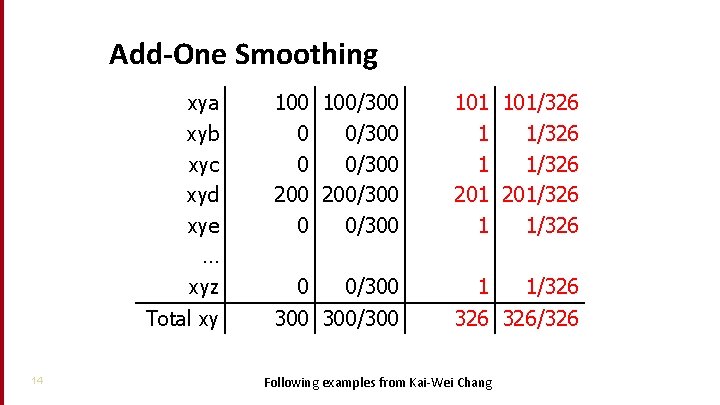
Add-One Smoothing 14 xya xyb xyc xyd xye … xyz 100/300 0 0/300 200/300 0 0/300 Total xy 300/300 0 0/300 101/326 1 1/326 201/326 1 1/326 326/326 Following examples from Kai-Wei Chang
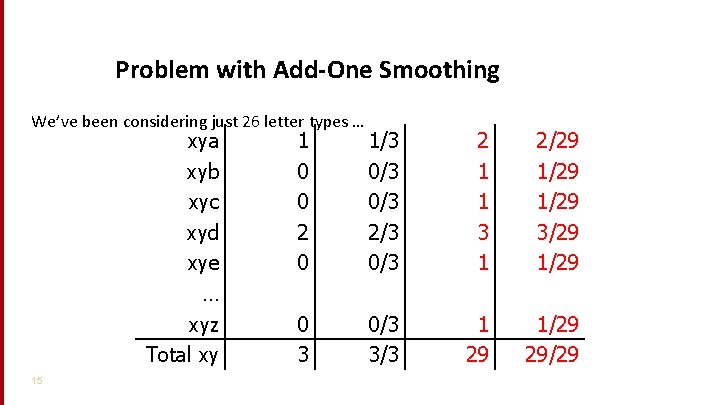
Problem with Add-One Smoothing We’ve been considering just 26 letter types … xya xyb xyc xyd xye … xyz Total xy 15 1 0 0 2 0 1/3 0/3 2/3 0/3 2 1 1 3 1 2/29 1/29 3/29 1/29 0 3 0/3 3/3 1 29 1/29 29/29
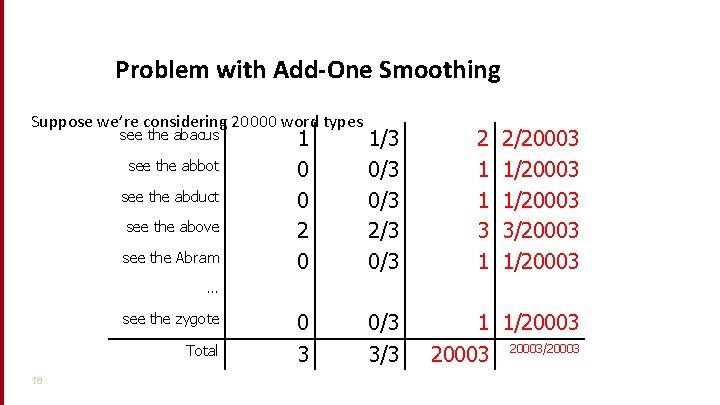
Problem with Add-One Smoothing Suppose we’re considering 20000 word types 1 0 0 2 0 1/3 0/3 2/3 0/3 2 1 1 3 1 see the zygote 0 0/3 1 1/20003 Total 3 3/3 see the abacus see the abbot see the abduct see the above see the Abram 2/20003 1/20003 3/20003 1/20003 … 16 20003/20003
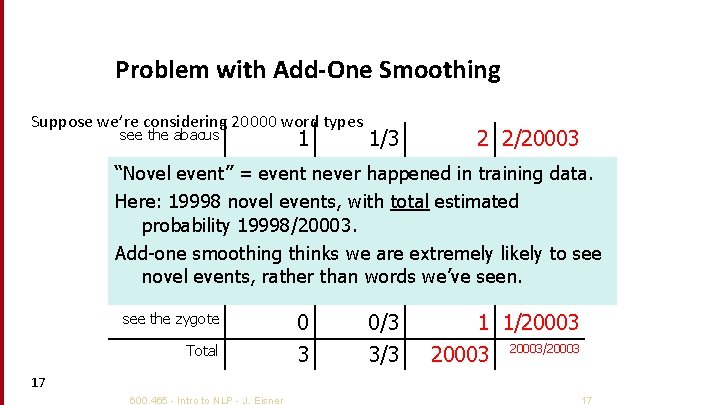
Problem with Add-One Smoothing Suppose we’re considering 20000 word types 1 1/3 2 2/20003 see the abbot 0/3 1/20003 “Novel event” = event 0 never happened in 1 training data. see the 19998 abduct novel events, 0 0/3 total estimated 1 1/20003 Here: with seeprobability the above 19998/20003. 2 2/3 3 3/20003 Add-one smoothing thinks we 0/3 are extremely to see the Abram 0 1 likely 1/20003 see the abacus novel events, rather than words we’ve seen. … see the zygote 0 0/3 Total 3 3/3 1 1/20003/20003 17 600. 465 - Intro to NLP - J. Eisner 17
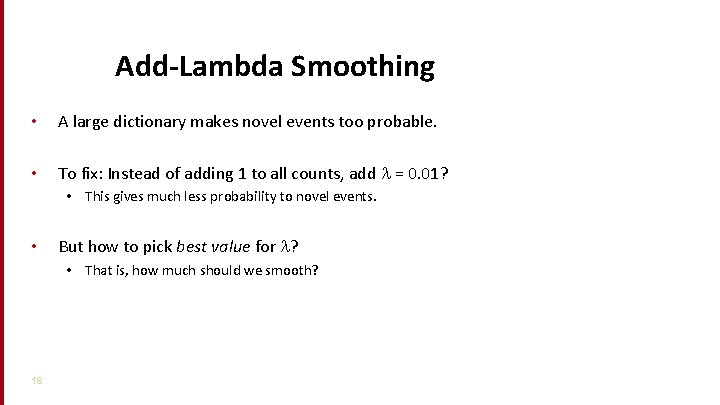
Add-Lambda Smoothing • A large dictionary makes novel events too probable. • To fix: Instead of adding 1 to all counts, add = 0. 01? • This gives much less probability to novel events. • But how to pick best value for ? • That is, how much should we smooth? 18
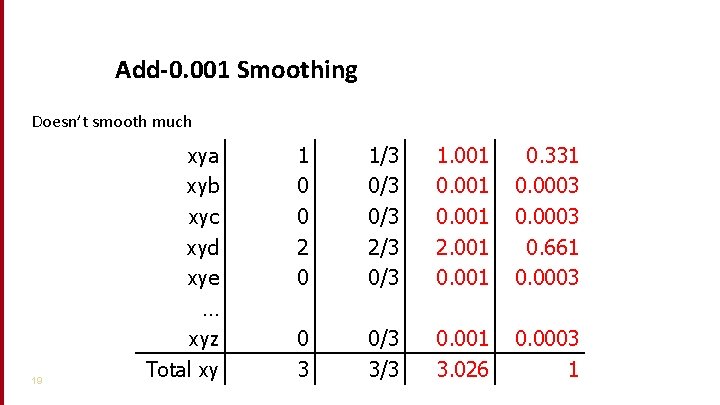
Add-0. 001 Smoothing Doesn’t smooth much 19 xya xyb xyc xyd xye … xyz Total xy 1 0 0 2 0 1/3 0/3 2/3 0/3 1. 001 0. 001 2. 001 0. 331 0. 0003 0. 661 0. 0003 0 3 0/3 3/3 0. 001 3. 026 0. 0003 1
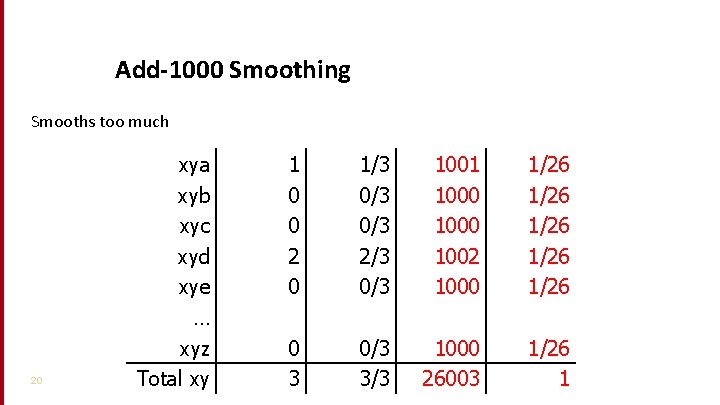
Add-1000 Smoothing Smooths too much 20 xya xyb xyc xyd xye … xyz Total xy 1 0 0 2 0 1/3 0/3 2/3 0/3 1001 1000 1002 1000 1/26 1/26 0 3 0/3 3/3 1000 26003 1/26 1
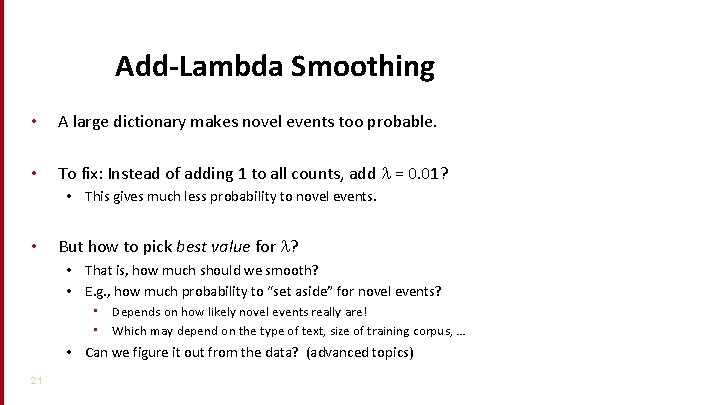
Add-Lambda Smoothing • A large dictionary makes novel events too probable. • To fix: Instead of adding 1 to all counts, add = 0. 01? • This gives much less probability to novel events. • But how to pick best value for ? • That is, how much should we smooth? • E. g. , how much probability to “set aside” for novel events? • Depends on how likely novel events really are! • Which may depend on the type of text, size of training corpus, … • Can we figure it out from the data? (advanced topics) 21
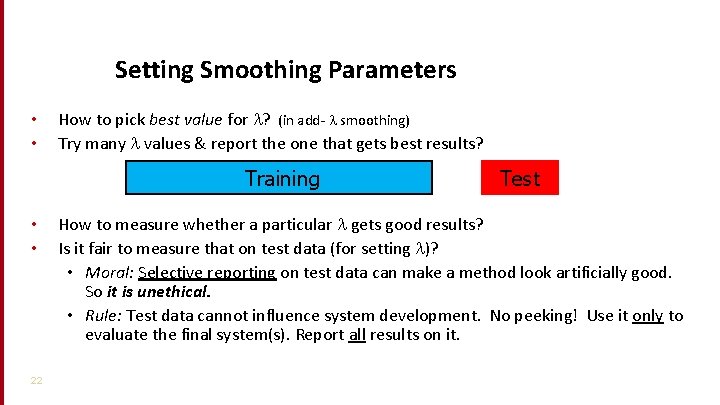
Setting Smoothing Parameters • • How to pick best value for ? (in add- smoothing) Try many values & report the one that gets best results? Training • • 22 Test How to measure whether a particular gets good results? Is it fair to measure that on test data (for setting )? • Moral: Selective reporting on test data can make a method look artificially good. So it is unethical. • Rule: Test data cannot influence system development. No peeking! Use it only to evaluate the final system(s). Report all results on it.
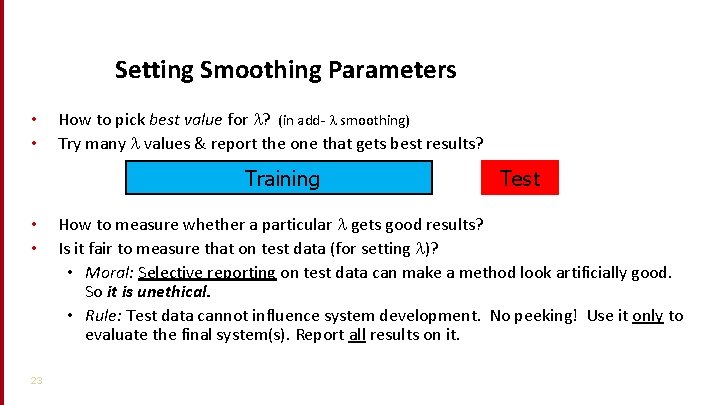
Setting Smoothing Parameters • • How to pick best value for ? (in add- smoothing) Try many values & report the one that gets best results? Training • • 23 Test How to measure whether a particular gets good results? Is it fair to measure that on test data (for setting )? • Moral: Selective reporting on test data can make a method look artificially good. So it is unethical. • Rule: Test data cannot influence system development. No peeking! Use it only to evaluate the final system(s). Report all results on it.
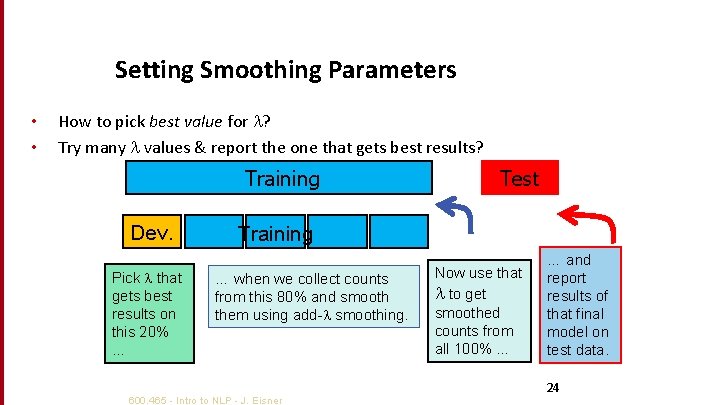
Setting Smoothing Parameters • • How to pick best value for ? Try many values & report the one that gets best results? Training Dev. Pick that gets best results on this 20% … Test Training … when we collect counts from this 80% and smooth them using add- smoothing. 600. 465 - Intro to NLP - J. Eisner Now use that to get smoothed counts from all 100% … … and report results of that final model on test data. 24
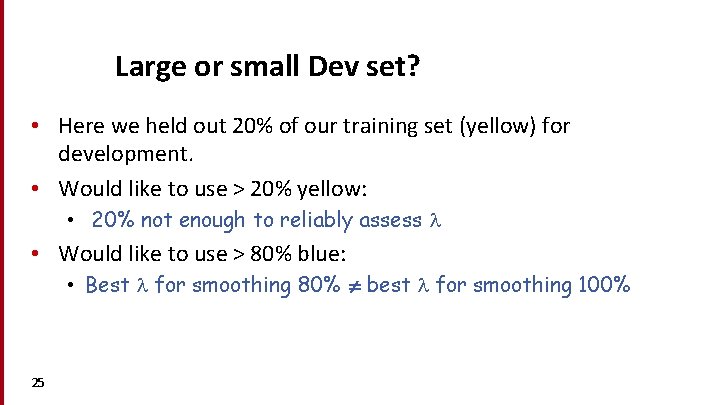
Large or small Dev set? • Here we held out 20% of our training set (yellow) for development. • Would like to use > 20% yellow: • 20% not enough to reliably assess • Would like to use > 80% blue: • Best for smoothing 80% best for smoothing 100% 25
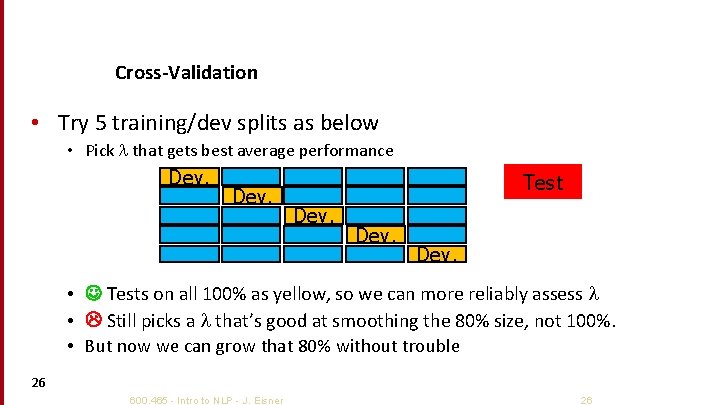
Cross-Validation • Try 5 training/dev splits as below • Pick that gets best average performance Dev. Test Dev. • Tests on all 100% as yellow, so we can more reliably assess • Still picks a that’s good at smoothing the 80% size, not 100%. • But now we can grow that 80% without trouble 26 600. 465 - Intro to NLP - J. Eisner 26
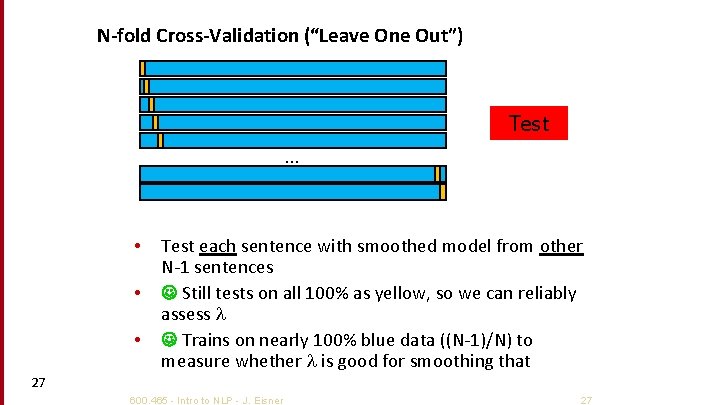
N-fold Cross-Validation (“Leave One Out”) Test … • • • Test each sentence with smoothed model from other N-1 sentences Still tests on all 100% as yellow, so we can reliably assess Trains on nearly 100% blue data ((N-1)/N) to measure whether is good for smoothing that 27 600. 465 - Intro to NLP - J. Eisner 27
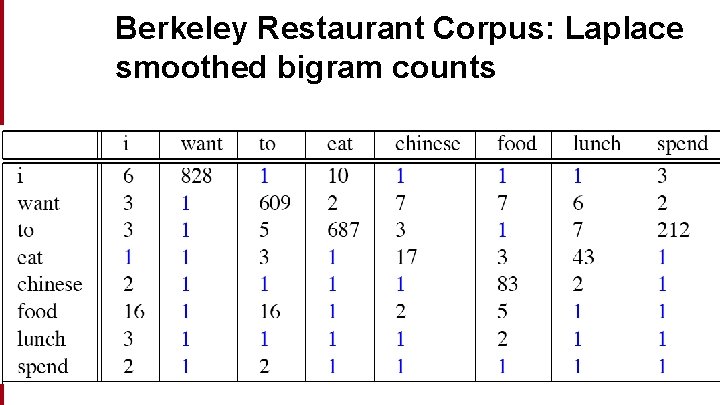
Berkeley Restaurant Corpus: Laplace smoothed bigram counts
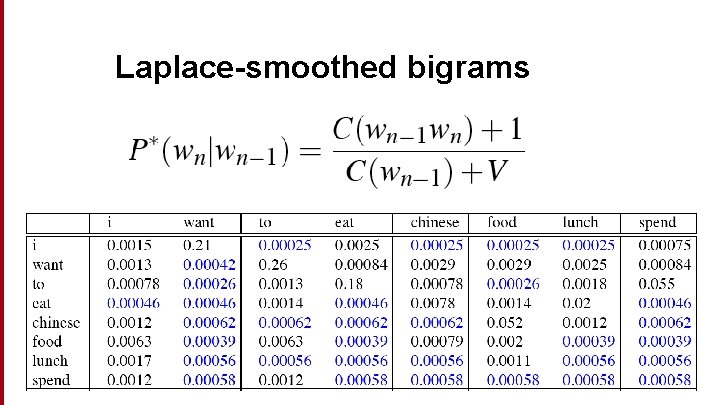
Laplace-smoothed bigrams
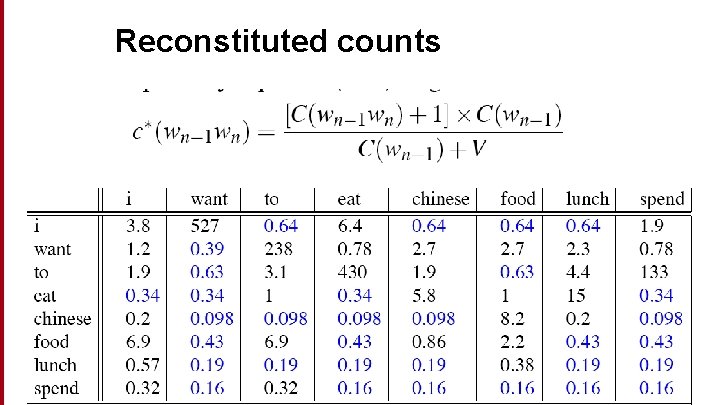
Reconstituted counts
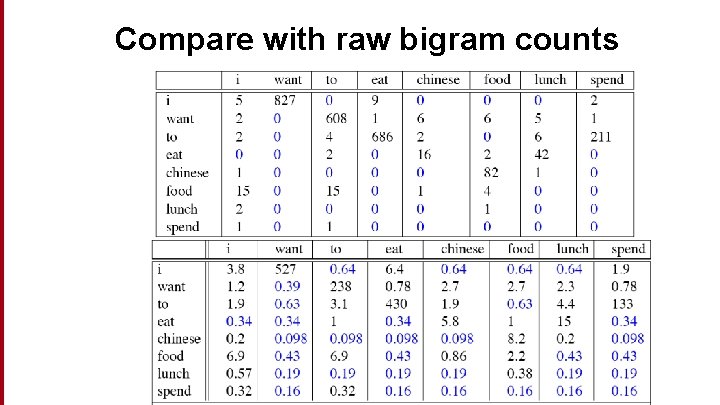
Compare with raw bigram counts
Add-1 estimation is a blunt instrument • So add-1 isn’t used for N-grams: • We’ll see better methods • But add-1 is used to smooth other NLP models • In domains where the number of zeros isn’t so huge.
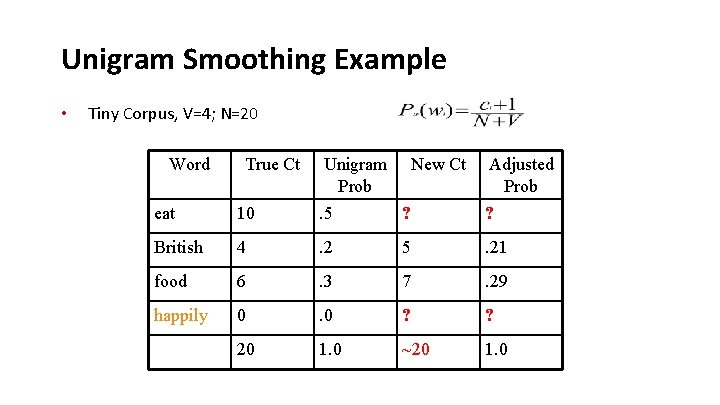
Unigram Smoothing Example • Tiny Corpus, V=4; N=20 Word True Ct Unigram Prob New Ct Adjusted Prob eat 10 . 5 ? ? British 4 . 2 5 . 21 food 6 . 3 7 . 29 happily 0 . 0 ? ? 20 1. 0 ~20 1. 0
Language Modeling Interpolation, Backoff, and Web-Scale LMs
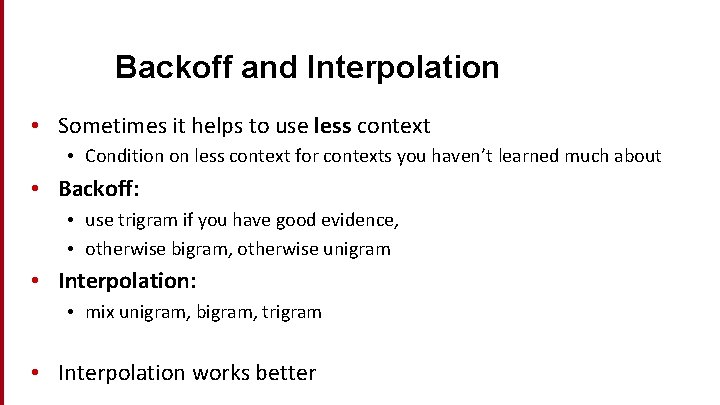
Backoff and Interpolation • Sometimes it helps to use less context • Condition on less context for contexts you haven’t learned much about • Backoff: • use trigram if you have good evidence, • otherwise bigram, otherwise unigram • Interpolation: • mix unigram, bigram, trigram • Interpolation works better
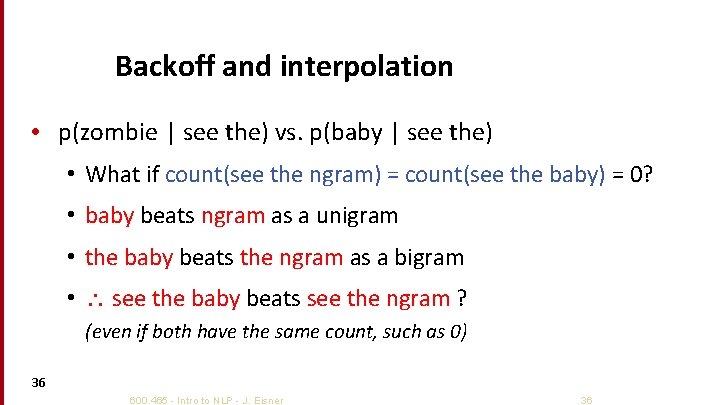
Backoff and interpolation • p(zombie | see the) vs. p(baby | see the) • What if count(see the ngram) = count(see the baby) = 0? • baby beats ngram as a unigram • the baby beats the ngram as a bigram • see the baby beats see the ngram ? (even if both have the same count, such as 0) 36 600. 465 - Intro to NLP - J. Eisner 36
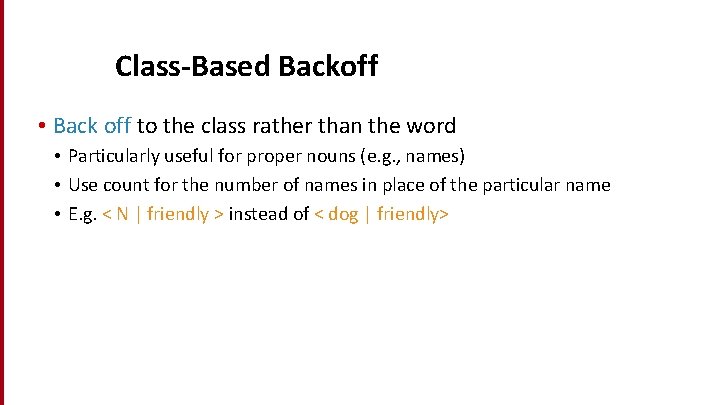
Class-Based Backoff • Back off to the class rather than the word • Particularly useful for proper nouns (e. g. , names) • Use count for the number of names in place of the particular name • E. g. < N | friendly > instead of < dog | friendly>
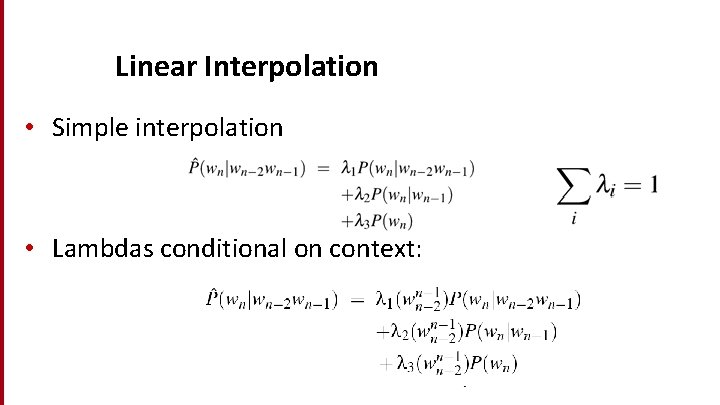
Linear Interpolation • Simple interpolation • Lambdas conditional on context:
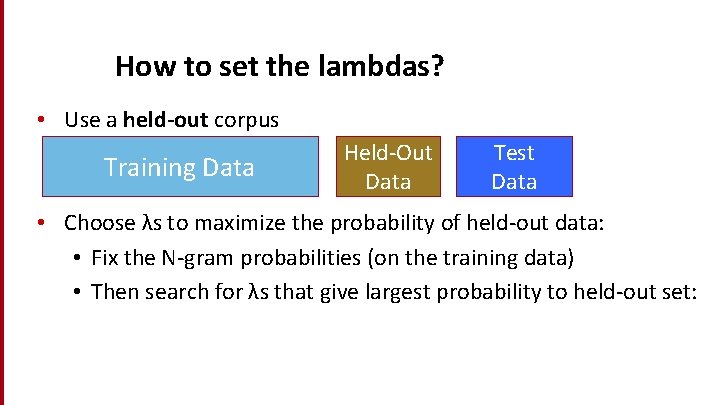
How to set the lambdas? • Use a held-out corpus Training Data Held-Out Data Test Data • Choose λs to maximize the probability of held-out data: • Fix the N-gram probabilities (on the training data) • Then search for λs that give largest probability to held-out set:
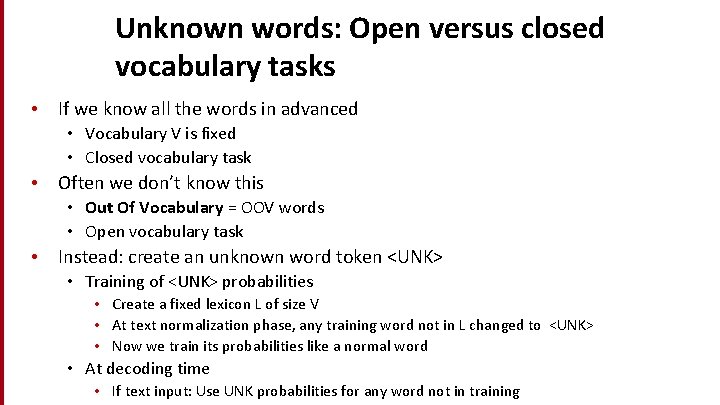
Unknown words: Open versus closed vocabulary tasks • If we know all the words in advanced • Vocabulary V is fixed • Closed vocabulary task • Often we don’t know this • Out Of Vocabulary = OOV words • Open vocabulary task • Instead: create an unknown word token <UNK> • Training of <UNK> probabilities • Create a fixed lexicon L of size V • At text normalization phase, any training word not in L changed to <UNK> • Now we train its probabilities like a normal word • At decoding time • If text input: Use UNK probabilities for any word not in training
Huge web-scale n-grams • How to deal with, e. g. , Google N-gram corpus • Pruning • E. g. , only store N-grams with count > threshold. • Remove singletons of higher-order n-grams • Efficient data structures, etc.
N-gram Smoothing Summary • Add-1 smoothing: • OK for some tasks, but not for language modeling • See text for • The most commonly used method: • Extended Interpolated Kneser-Ney • For very large N-grams like the Web: • Stupid backoff 42
Other Applications • N-grams are not only for words • Characters • Sentences 43
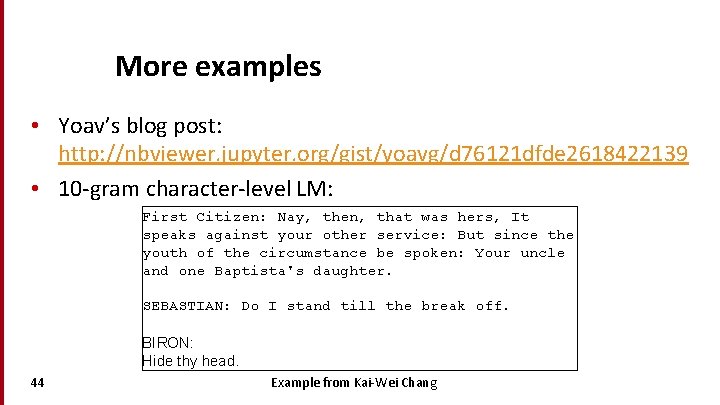
More examples • Yoav’s blog post: http: //nbviewer. jupyter. org/gist/yoavg/d 76121 dfde 2618422139 • 10 -gram character-level LM: First Citizen: Nay, then, that was hers, It speaks against your other service: But since the youth of the circumstance be spoken: Your uncle and one Baptista's daughter. SEBASTIAN: Do I stand till the break off. BIRON: Hide thy head. 44 Example from Kai-Wei Chang
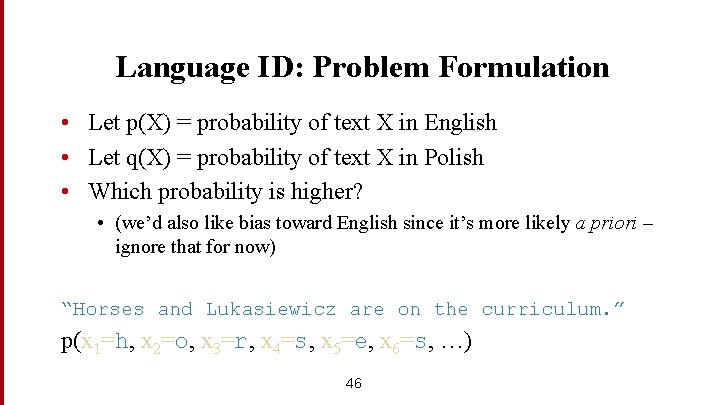
Example: Language ID • “Horses and Lukasiewicz are on the curriculum. ” • Is this English or Polish or ? ? • Let’s use n-gram models … • Space of outcomes will be character sequences (x 1, x 2, x 3, …) 45
Language ID: Problem Formulation • Let p(X) = probability of text X in English • Let q(X) = probability of text X in Polish • Which probability is higher? • (we’d also like bias toward English since it’s more likely a priori – ignore that for now) “Horses and Lukasiewicz are on the curriculum. ” p(x 1=h, x 2=o, x 3=r, x 4=s, x 5=e, x 6=s, …) 46
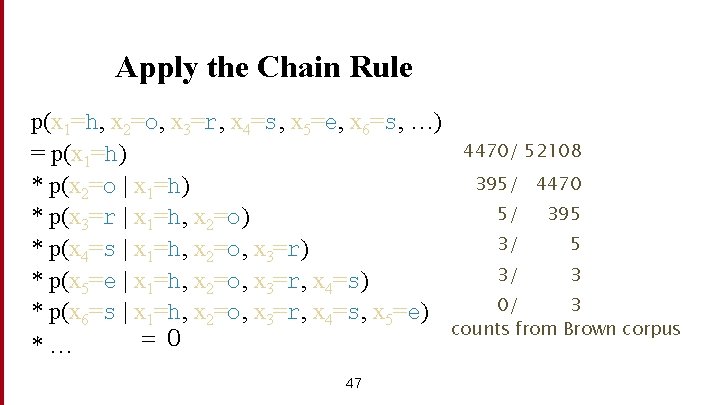
Apply the Chain Rule p(x 1=h, x 2=o, x 3=r, x 4=s, x 5=e, x 6=s, …) = p(x 1=h) * p(x 2=o | x 1=h) * p(x 3=r | x 1=h, x 2=o) * p(x 4=s | x 1=h, x 2=o, x 3=r) * p(x 5=e | x 1=h, x 2=o, x 3=r, x 4=s) * p(x 6=s | x 1=h, x 2=o, x 3=r, x 4=s, x 5=e) =0 *… 47 4470/ 52108 395/ 4470 5/ 395 3/ 3 0/ 3 counts from Brown corpus
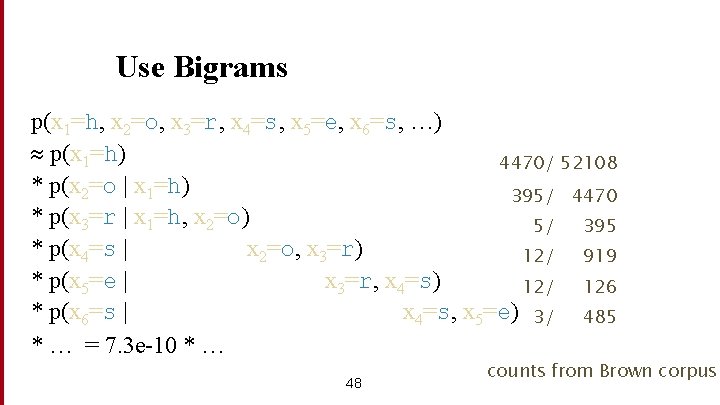
Use Bigrams p(x 1=h, x 2=o, x 3=r, x 4=s, x 5=e, x 6=s, …) p(x 1=h) 4470/ 52108 * p(x 2=o | x 1=h) 395/ 4470 * p(x 3=r | x 1=h, x 2=o) 5/ 395 * p(x 4=s | x 2=o, x 3=r) 12/ 919 * p(x 5=e | x 3=r, x 4=s) 12/ 126 * p(x 6=s | x 4=s, x 5=e) 3/ 485 * … = 7. 3 e-10 * … 48 counts from Brown corpus
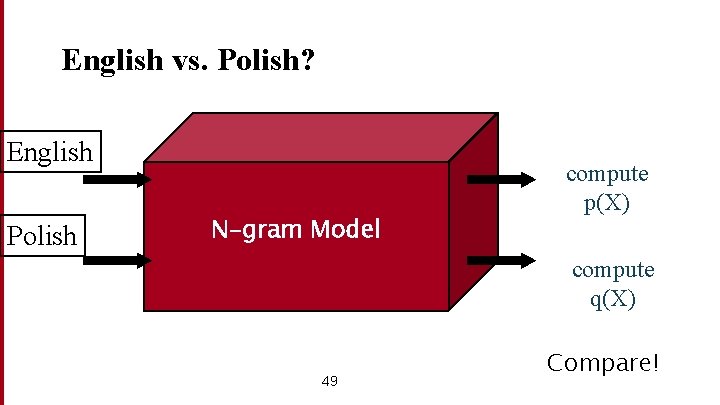
English vs. Polish? English Polish compute p(X) N-gram Model e r a p com 49 compute q(X) Compare!
Chapter Summary • N-gram probabilities can be used to estimate the likelihood • Of a word occurring in a context (N-1) • Of a sentence occurring at all • Perplexity can be used to evaluate the goodness of fit of a LM • Smoothing techniques and backoff models deal with problems of unseen words in corpus • Improvement via algorithm versus big data