
LANGUAGE MAINTENANCE VS LANGUAGE DEATH Reminder of Mid
- Slides: 24
LANGUAGE MAINTENANCE VS LANGUAGE DEATH Reminder of Mid term next week Lecture 5
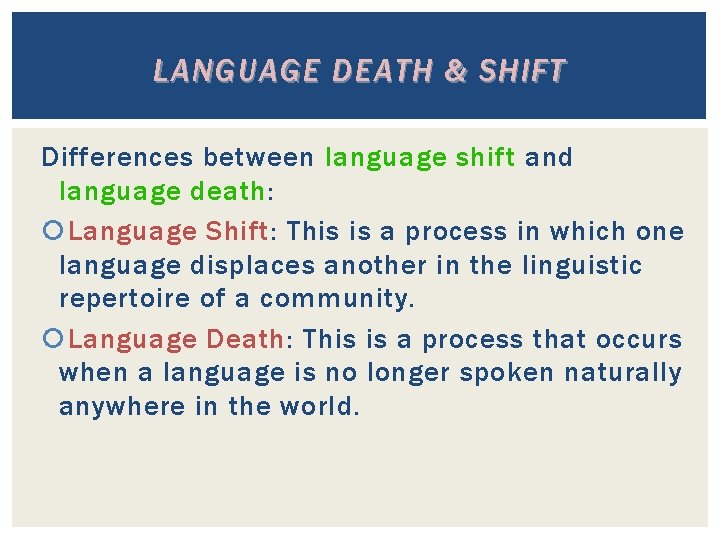
LANGUAGE DEATH & SHIFT Differences between language shift and language death: Language Shift: This is a process in which one language displaces another in the linguistic repertoire of a community. Language Death: This is a process that occurs when a language is no longer spoken naturally anywhere in the world.
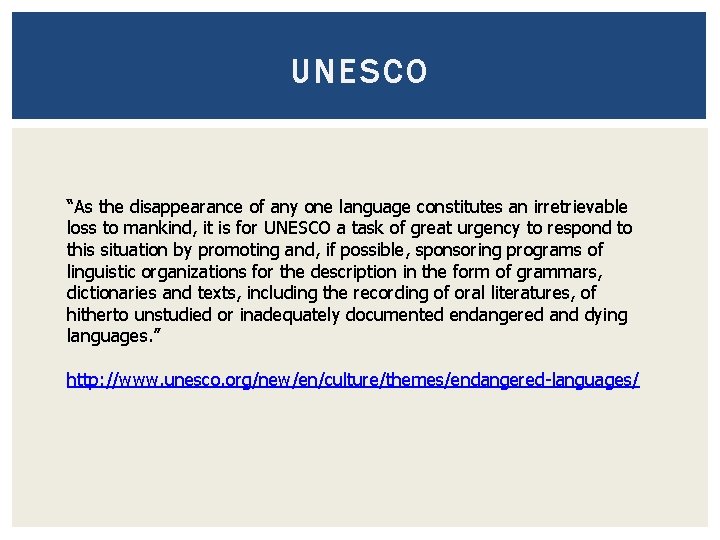
UNESCO “As the disappearance of any one language constitutes an irretrievable loss to mankind, it is for UNESCO a task of great urgency to respond to this situation by promoting and, if possible, sponsoring programs of linguistic organizations for the description in the form of grammars, dictionaries and texts, including the recording of oral literatures, of hitherto unstudied or inadequately documented endangered and dying languages. ” http: //www. unesco. org/new/en/culture/themes/endangered-languages/
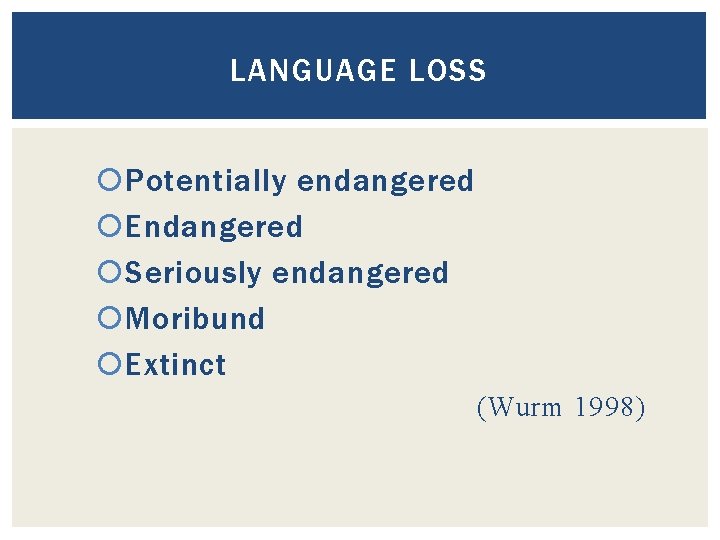
LANGUAGE LOSS Potentially endangered Endangered Seriously endangered Moribund Extinct (Wurm 1998)
POTENTIALLY ENDANGERED Socially and economically disadvantaged Under heavy pressure from a larger language Beginning to lose child speakers
ENDANGERED LANGUAGES Few or no children learning the language The youngest good speakers are young adults.
AND TOWARD EXTINCTION Seriously endangered Moribund Extinct The youngest good speakers age 50 or older n Only a handful of good speakers n No speaker
LANGUAGE LOSS Factors leading to language loss Death of speakers n Social n Cultural n Economic n Political n
DEATH OF SPEAKERS Natural disasters Starvation Diseases Genocides
SOCIAL FACTORS Young men moving to urban center Intermarriage Aging population in the community
CULTURAL FACTORS Cultural contact affects language attitude Culturally more aggressive dominant language § Religion § Modern metropolitan culture § Technology
ECONOMIC FACTORS Economic advantage associated with dominant language § Job opportunity § Material wealth
POLITICAL FACTORS Political influences Conquest Language policy: official language Recommendations and laws Assimilatory education
LANGUAGE SHIFT Language shift Language loss Forced language shift Voluntary language shift
WHY SHOULD WE CARE? Loss of a language is a loss of a culture “Every language reflects a unique worldview and culture complex” (Wurm 1991) Any other reasons?
INCENTIVES TO SPEAK INDIGENOUS LANGUAGES Secret language that their oppressors cannot speak Rallying symbol of a political and/or cultural movement Self- and Group identity Any other incentives?
PREVENTING LANGUAGE LOSS Documentation and archivization Intergenerational transmission Vernacularization Changing the society Language Use Not only traditional, but also modern context Not only in the classroom, but outside the classroom
Documentation and archivization
WHAT IS A DIGITAL LANGUAGE ARCHIVE? a forum / platform for data providers and data users to negotiate and exchange a trusted repository created and maintained by an institution with a commitment to the long-term preservation of archived material has policies and processes for materials acquisition, cataloguing, preservation, dissemination, migration to new digital formats a collection of managed materials
MODERN SOUTH ARABIAN LANGUAGES Mehri http: //en. wikipedia. org/wiki/Modern_South_Arabian_languages http: //www. youtube. com/watch? v=71 D 8 Pg. C 2 HTA http: //www. okaz. com. sa/new/Issues/20131207/Con 201312076600 43. htm Janet’s http: //www. leeds. ac. uk/arts/info/125219/modern_south_arabian_la nguages/2374/events http: //www. leeds. ac. uk/arts/info/125219/modern_south_arabian_la nguages/2372/useful_links
Ethnologue: Languages of the World is a web-based publication that contains statistics for 7, 105 languages and dialects in the 17 th edition, released in 2013. Up until the 16 th edition in 2009, the publication was a printed volume. Ethnologue provides information on the number of speakers, location, dialects, linguistic affiliations, availability of the Bible in the language, and an estimate of language viability using EGIDS. As of July 2013, it is the most comprehensive and accessible language catalog, although some information is dated or spurious. A project with similar goals that is still in development is the Linguasphere Observatory Register https: //www. ethnologue. com/
List of endangered languages in the world http: //en. wikipedia. org/wiki/Lists_of_endan gered_languages In Europe; http: //www. helsinki. fi/~tasalmin/europe_re port. html
NATIONAL LANGUAGE PLANNING 1. Selection 2. Codification / Standardization 3. Elaboration 4. Implementation (Securing acceptance) Holmes, Janet. 2013. An Introduction to Sociolinguistics, 4 th edition. London: Pearson, p. 107. 4/12