
Language Learning Symposium 2016 TUSD Language Acquisition Department

- Slides: 45
Language Learning Symposium 2016 TUSD Language Acquisition Department
Second Language Learner Strategies presented by Lourdes Vidrio & Cruz Herrera
Agenda Welcome/Norms Ice Breaker/Community Building Session Objectives What the research says Second language learner strategies in the DL classroom Unit Planning Framework Collaborative planning Closure/Questions
Session Norms Set aside preconceived notions Make application to your own work with second language learners Ask questions and use the “Parking Lot” Respect others’ viewpoint and expertise Take time to share and be ready to actively participate in all sessions Take a break from cell phones
Stipend Guidelines Participants are required to attend all 4 full day sessions in order to receive compensation. Late arrival or missing any part of a session will forfeit the entire compensation. Attendance will be taken at the beginning and at the end of each session.
“Have the courage to outgrow your best teaching. ” LUCY CALKINS
Ice Breaker Baila, Baila Discussion Topics 1. The most important thing I did this year…. 2. What I like most about myself…. 3. The thing I would most like to accomplish this year …. .
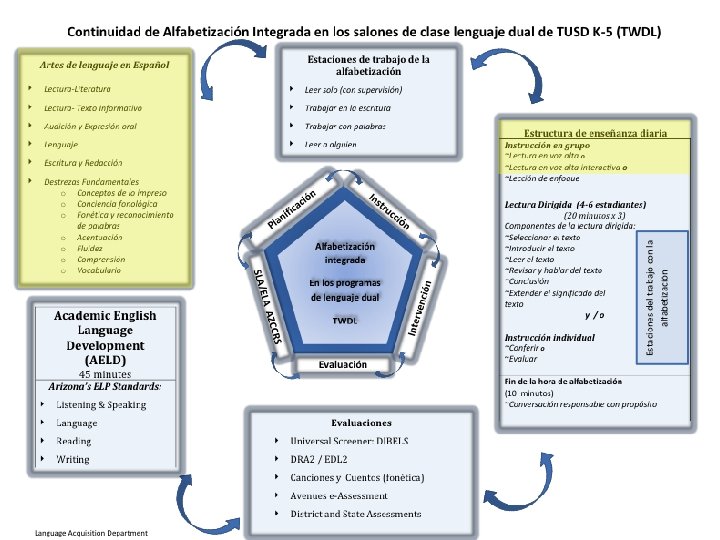
Session Objectives Given the TUSD Literacy Continuum for TWDL classrooms, participants will: Recognize the importance of the purposeful use of second language learning strategies to develop vocabulary, reading comprehension & fluency, oracy and metalanguage Explore and review effective researched based second language learning strategies Familiarize themselves with a recommended unit planning framework for the Spanish language arts block that integrates second language Learning strategies Work collaboratively to plan a portion of the unit framework
What research says are the important components of a Dual Language classroom… Classroom environment • anchor charts • word walls Materials • culturally relevant • Authenticity to the language Fidelity to the language of instruction by teacher and student (Don’t break code)
In addition, research says that DL literacy instruction should focus on the following areas: • Vocabulary development • Oracy (The Oral language skills and structures that are necessary for the child to successfully interact with the text) • Reading Fluency and Comprehension • Writing • Metalanguage
Research says that… Vocabulary development • Knowing vocabulary words is key to reading comprehension. The more words a child knows, the better he or she will understand the text. Teachers can teach vocabulary directly or indirectly. Using a variety of effective methods will increase the student's ability to learn new words. (Colorín. Colorado) Oracy • Adding specific types of oracy activities to the literacy curriculum establishs not only an extensive oral language base but also contributes to the development of literacy skills such as word recognition, grammar and comprehension (Deyson & Genishi, 1994).
Research also says that… Reading Fluency and Comprehension • Guided repeated oral reading that included guidance from teachers had a significant and positive impact on word recognition, reading fluency and comprehension across grade levels. Writing • Writing instruction should be integrated with reading, oral language and metalanguage to maximize the literacy development of all students (Schmoker, 2011).
(presenter notes) Model Cognitive Content Dictionary GLAD Strategy Use the word “metalenguaje” to model the first day of CCD on next slide; follow procedures listed on second language strategy handout; talk about procedures for day two; pass out balckline master to teachers after modeling is completed
Research also says that… Metalanguage (Cross-Language connections) • The development of metalanguage results in a an improved ability to compare languages in terms of words and sentence structures (Sneddon, 2008) and an enhanced ability to transfer conceptual knowledge and skills across languages (Cummins et al. , 2005)
(presenter notes) Model Think-Pair-Share strategy to have participants discuss the question on the next slide.
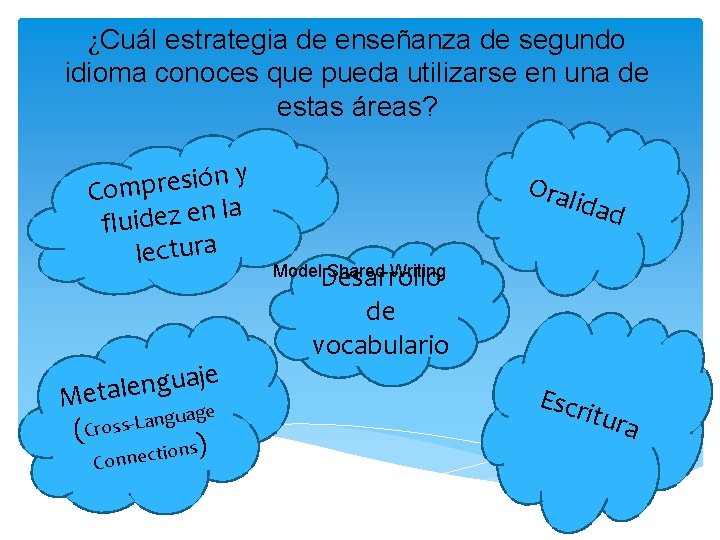
¿Cuál estrategia de enseñanza de segundo idioma conoces que pueda utilizarse en una de estas áreas? y n ó i s e r p Com la n e z e d i u l f lectura e j a u g n Metale age u g n a L s (Cros ions) t c e n n o C Oral idad Desarrollo de vocabulario Model Shared Writing Escr itura
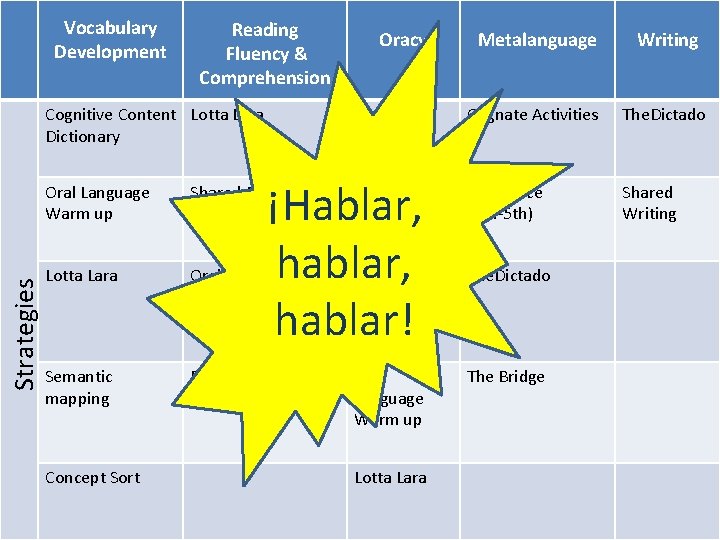
Vocabulary Development Reading Fluency & Comprehension Strategies Cognitive Content Lotta Lara Dictionary Oracy Metalanguage Writing Language Structure Cognate Activities The. Dictado Así se dice (3 rd-5 th) Shared Writing ¡Hablar, hablar! Oral Language Warm up Shared Reading Dialogue Lotta Lara Oral Language Warm up Collaborative The. Dictado Learning Strategies Semantic mapping Read Aloud Oral Language Warm up Concept Sort Lotta Lara The Bridge
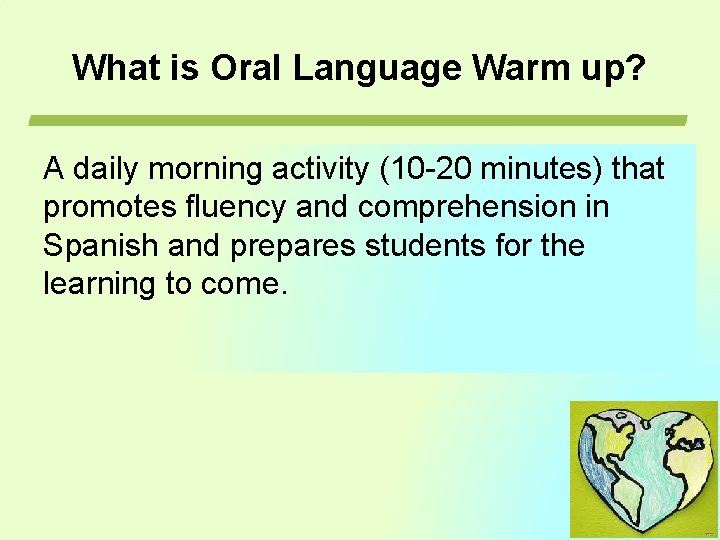
What is Oral Language Warm up? A daily morning activity (10 -20 minutes) that promotes fluency and comprehension in Spanish and prepares students for the learning to come.
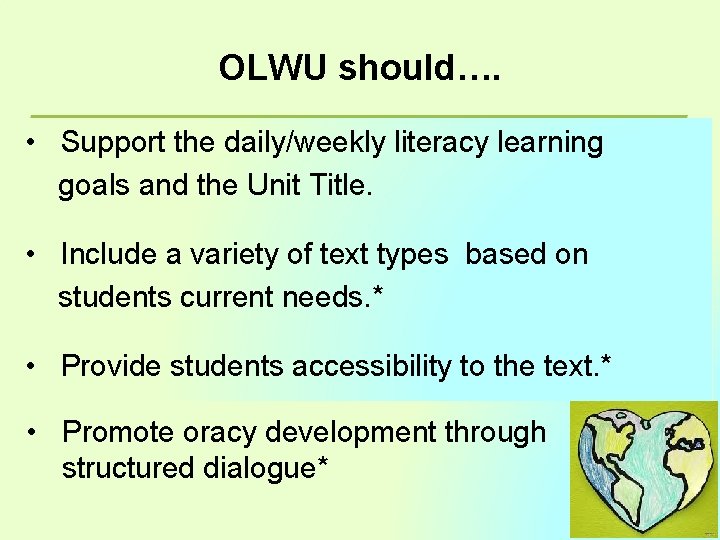
OLWU should…. • Support the daily/weekly literacy learning goals and the Unit Title. • Include a variety of text types based on students current needs. * • Provide students accessibility to the text. * • Promote oracy development through structured dialogue*
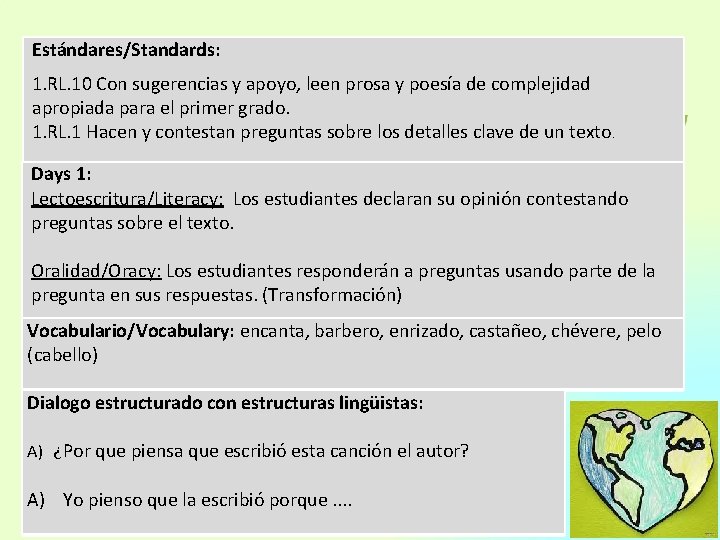
Estándares/Standards: 1. RL. 10 Con sugerencias y apoyo, leen prosa y poesía de complejidad apropiada para el primer grado. 1. RL. 1 Hacen y contestan preguntas sobre los detalles clave de un texto. Days 1: Lectoescritura/Literacy: Los estudiantes declaran su opinión contestando preguntas sobre el texto. Oralidad/Oracy: Los estudiantes responderán a preguntas usando parte de la pregunta en sus respuestas. (Transformación) Vocabulario/Vocabulary: encanta, barbero, enrizado, castañeo, chévere, pelo (cabello) Dialogo estructurado con estructuras lingüistas: A) ¿Por que piensa que escribió esta canción el autor? A) Yo pienso que la escribió porque. .
(presenter notes) Model Oral Language Warm U Use the song: Me encanta me cabello from Sesame Steet Youtube video (Refer to Hairs-Pelitos Unit LP, yellow section and lyrics in word document for more info.
What is Shared Writing ? The teacher and students compose text together, with both contributing their thoughts and ideas to the process, while the teacher acts as scribe, writing the text as it is composed.
Shared Writing allows the teacher to… • Make the writing process a visible and concrete experience for students in a safe, supportive environment. • Model the writing process, although not always all at once. • Concentrate on one or two key aspects of writing in short, focused lessons, especially at the lower grade levels.
(presenter notes) Shared Writing Use the concept map Vocabulary strategies: (Refer to Hairs-Pelitos Unit LP, writing extension listed, yellow section under writing extension for more info.
What is Lotta Lara? A strategy used to help develop comprehension, oracy, and reading fluency.
Broad Overview of Lotta Lara Spanish literacy strategy in grades K-5 Literacy-based ELD strategy beginning in 1 grade and continuing through 5 th grade Correlates with the Unit Title & SLA/ELA standards as per the quarterly curriculum maps Same text read 3 times a week (9 fluent reads) Text chosen for story quality and potential for oral language development* Recommend using at beginning of year & with one text per unit/genre
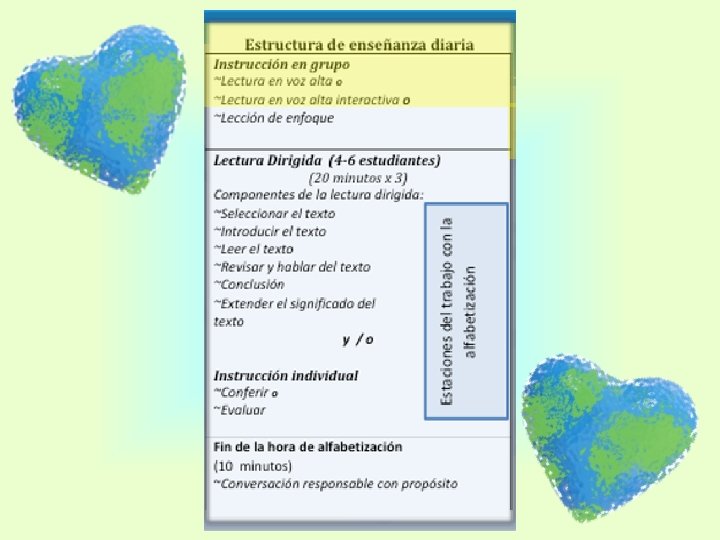
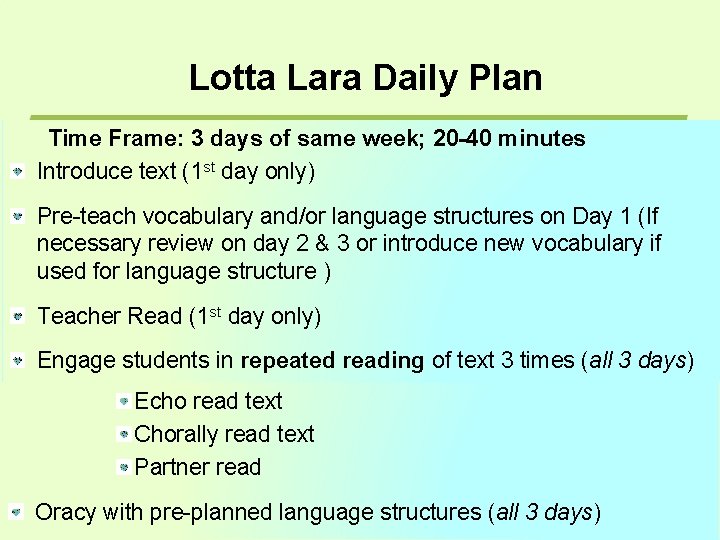
Lotta Lara Daily Plan Time Frame: 3 days of same week; 20 -40 minutes Introduce text (1 st day only) Pre-teach vocabulary and/or language structures on Day 1 (If necessary review on day 2 & 3 or introduce new vocabulary if used for language structure ) Teacher Read (1 st day only) Engage students in repeated reading of text 3 times (all 3 days) Echo read text Chorally read text Partner read Oracy with pre-planned language structures (all 3 days)
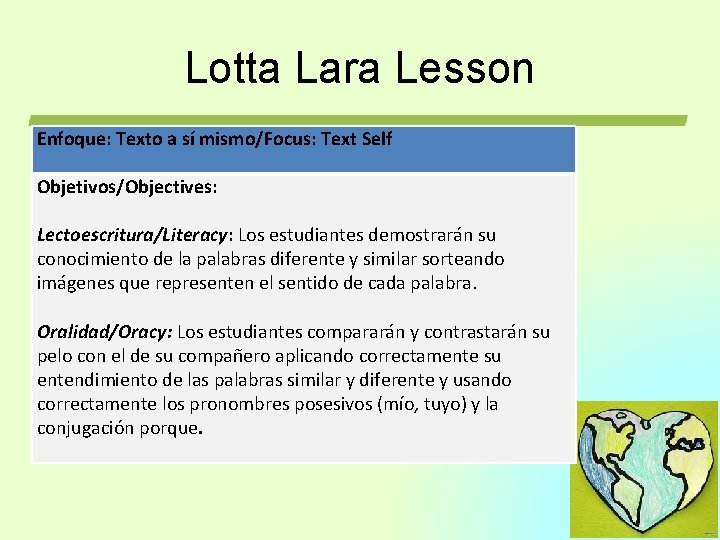
Lotta Lara Lesson Enfoque: Texto a sí mismo/Focus: Text Self Objetivos/Objectives: Lectoescritura/Literacy: Los estudiantes demostrarán su conocimiento de la palabras diferente y similar sorteando imágenes que representen el sentido de cada palabra. Oralidad/Oracy: Los estudiantes compararán y contrastarán su pelo con el de su compañero aplicando correctamente su entendimiento de las palabras similar y diferente y usando correctamente los pronombres posesivos (mío, tuyo) y la conjugación porque.
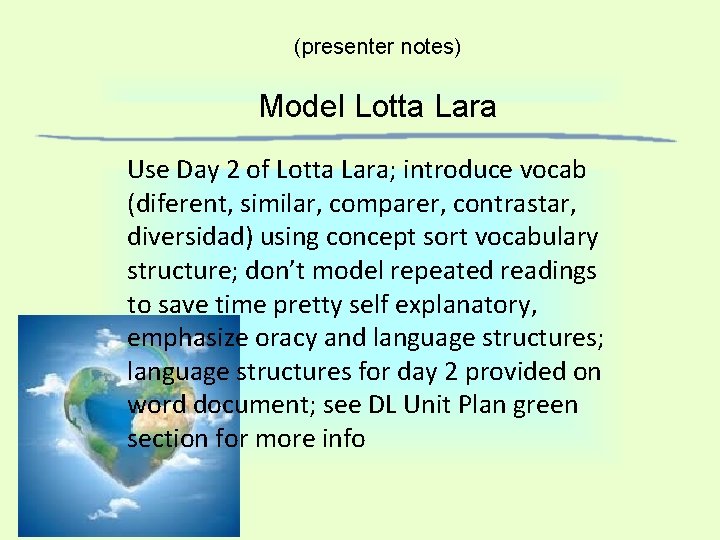
(presenter notes) Model Lotta Lara Use Day 2 of Lotta Lara; introduce vocab (diferent, similar, comparer, contrastar, diversidad) using concept sort vocabulary structure; don’t model repeated readings to save time pretty self explanatory, emphasize oracy and language structures; language structures for day 2 provided on word document; see DL Unit Plan green section for more info
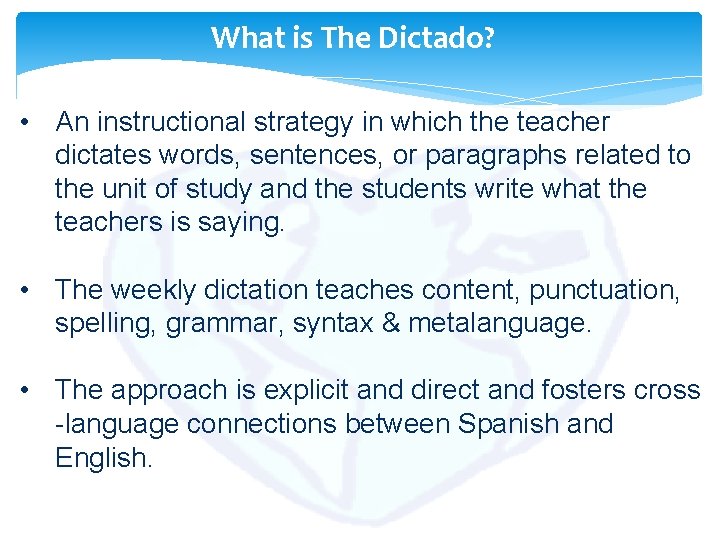
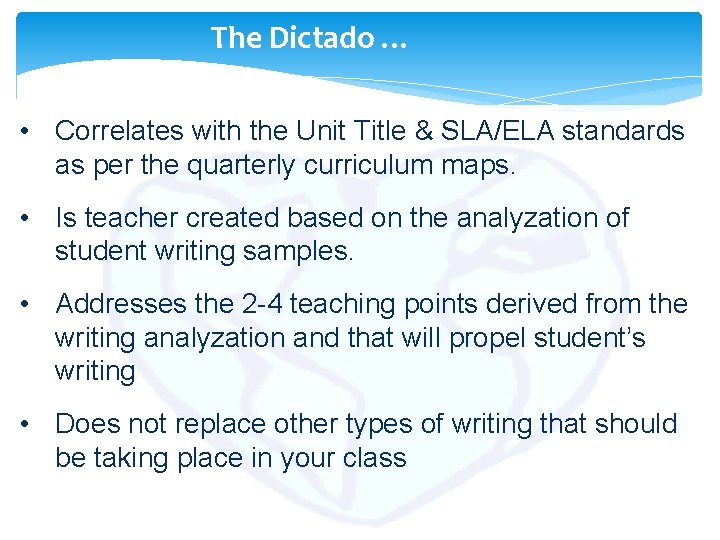
What is The Dictado? • An instructional strategy in which the teacher dictates words, sentences, or paragraphs related to the unit of study and the students write what the teachers is saying. • The weekly dictation teaches content, punctuation, spelling, grammar, syntax & metalanguage. • The approach is explicit and direct and fosters cross -language connections between Spanish and English.
The Dictado … • Correlates with the Unit Title & SLA/ELA standards as per the quarterly curriculum maps. • Is teacher created based on the analyzation of student writing samples. • Addresses the 2 -4 teaching points derived from the writing analyzation and that will propel student’s writing • Does not replace other types of writing that should be taking place in your class
(presenter notes) Analysis of Dictado Teaching point with participants Write dictado on class white board and have particpants think about what were my possible teaching points; have them share out to whole group; next provide the reasons for selection of teaching points; see DL Unit Plan Orange section for more info
What are Cross-language Connections? Purposely planned opportunities that allow students to use one language to analyze and understand a second language.
Making cross-language connections is important because… They enable children to develop metacognitive abilities and knowledge about their two languages and how the are the same and different. Examples include: The. Dictado, Asi se dice, cognate activities, The Bridge (Beeman & Urow, 2013)
(presenter notes) Model Cross Language Connections Model “The Bridge” from Teaching for Biliteracy Karen Beeman; have participants recall in Spanish the important word used in the unit (the ones listed on Cognitive Content Dictionary); make T-chart on post-it sheet; put on magic scarf begin speaking English and have them give you the English equivalent for each word; write directly across on form Spanish version on t-chart; have participants look at word to find similarities leading into discussion of cognates; have participants circle pairs of words that are cognates.
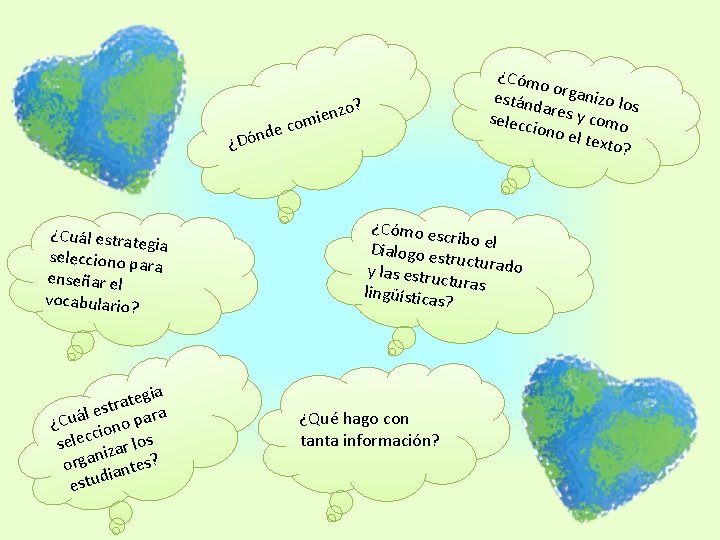
¿Cóm o estánd organizo lo s a selecc res y como iono e l texto ? zo? n e i om c de n ó D ¿ ¿Cuál estrate gia selecciono pa ra enseñar el vocabulario? ia g e t stra ra e l á ¿Cu iono pa c selec izar los n orga iantes? d estu ¿Cómo esc ribo el Dialogo es tructurado y las estru cturas lingüística s? ¿Qué hago con tanta información?
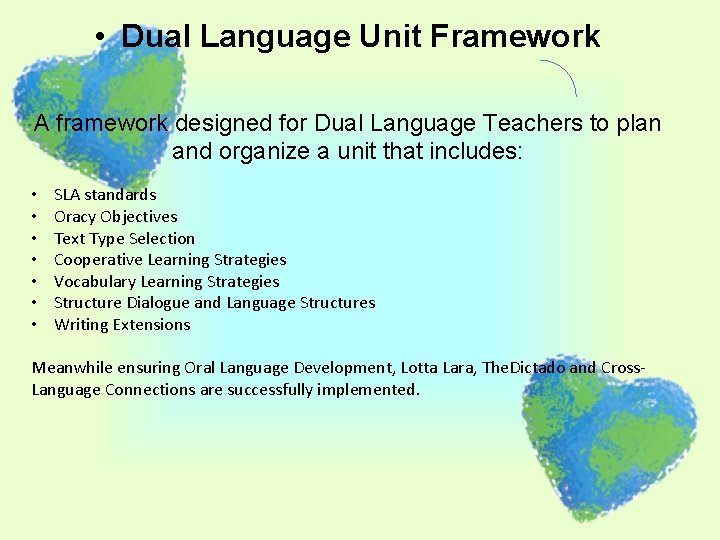
• Dual Language Unit Framework A framework designed for Dual Language Teachers to plan and organize a unit that includes: • • SLA standards Oracy Objectives Text Type Selection Cooperative Learning Strategies Vocabulary Learning Strategies Structure Dialogue and Language Structures Writing Extensions Meanwhile ensuring Oral Language Development, Lotta Lara, The. Dictado and Cross. Language Connections are successfully implemented.
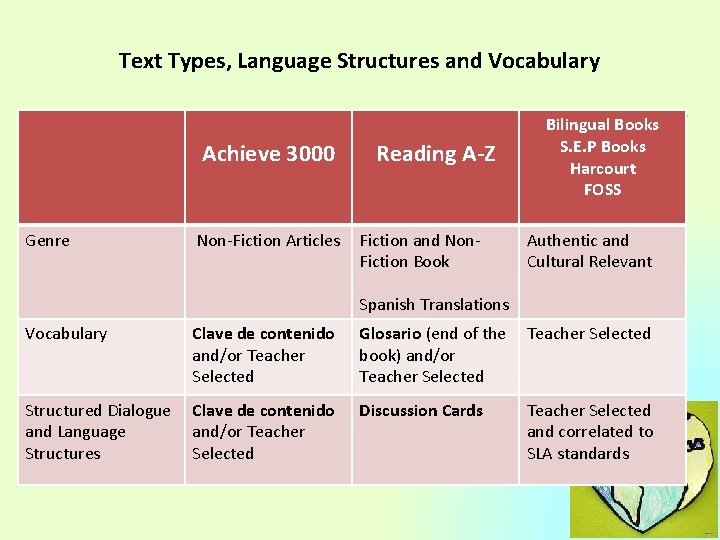
Text Types, Language Structures and Vocabulary Achieve 3000 Genre Non-Fiction Articles Reading A-Z Fiction and Non. Fiction Book Bilingual Books S. E. P Books Harcourt FOSS Authentic and Cultural Relevant Spanish Translations Vocabulary Clave de contenido Glosario (end of the Teacher Selected and/or Teacher book) and/or Selected Teacher Selected Structured Dialogue Clave de contenido and Language and/or Teacher Structures Selected Discussion Cards Teacher Selected and correlated to SLA standards
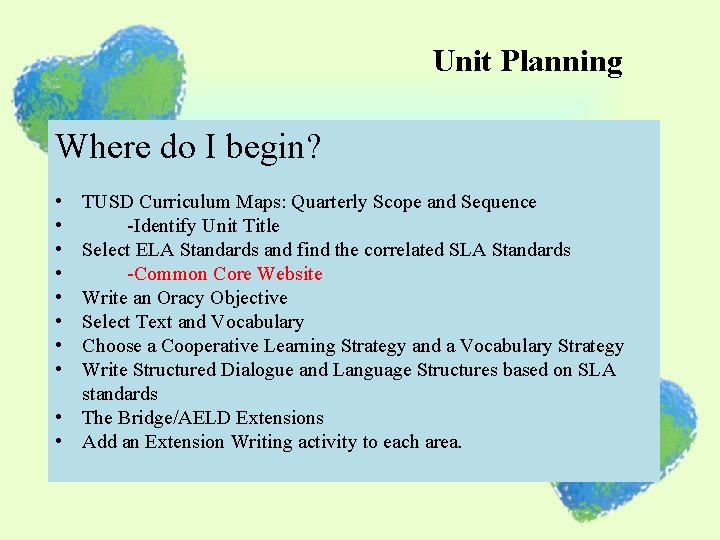
Unit Planning Where do I begin? • • TUSD Curriculum Maps: Quarterly Scope and Sequence -Identify Unit Title Select ELA Standards and find the correlated SLA Standards -Common Core Website Write an Oracy Objective Select Text and Vocabulary Choose a Cooperative Learning Strategy and a Vocabulary Strategy Write Structured Dialogue and Language Structures based on SLA standards • The Bridge/AELD Extensions • Add an Extension Writing activity to each area.
Works Cited Books: Biliteracy from the Start: Literacy Squared in Action Teaching for Biliteracy: Strengthening Bridges between Languages Website: Colorin Colorado
Questions? ?
THANK YOU FOR ATTENDING TODAY’S SESSION