
Language Learning Strategies Using Learning Strategies to Overcome




![Operational Definition • • • LLS are the [purposeful steps] used by language learners](https://slidetodoc.com/presentation_image_h2/218f23acd1a0bd00b7db4ff85ab6e4aa/image-5.jpg "Operational Definition • • • LLS are the [purposeful steps] used by language learners")






















- Slides: 64
Language Learning Strategies
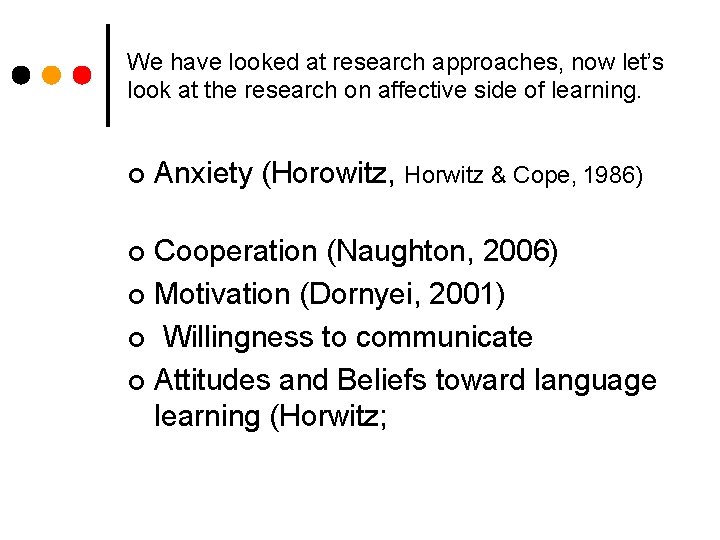
Using Learning Strategies to Overcome Affective Barriers to Efficient Learning Affective: Motivation; Anxiety; Willingness to communicate; Attitudes and Beliefs toward language learning. But what are strategies?
Definition Learning strategies are "operations…to aid the: • acquisition, • storage, • retrieval, and • use of information. . . ” (Oxford, 1990, p. 8)
Definition LLS are the specific actions…to make learning • easier, • faster, • more enjoyable, • more self-directed, • more effective, and • more transferable to new situations. (Oxford, 1990, p. 8).
Operational Definition • • • LLS are the [purposeful steps] used by language learners to comprehend and process new information more deeply, to help to recall old information, and apply knowledge and skills to facilitate problem-solving. (Nyikos, 1991/[2003], p. 25).
Definition LLS are "behaviors or thoughts that a learner engages in during… the learner's encoding process. " These strategies "are the techniques for the learner's conscious construction of language rules, vocabulary, pronunciation, discourse, and sociocultural understanding. (Weinstein & Mayer, 1986, p. 315).
Definition Language learning strategies are steps the learner takes to: n n Facilitate the Storage Retrieval --- Use of language. What about stress, anxiety, lack of motivation?
Focus on the Learner Students are rarely shown HOW to learn and study (modeling) n Just told: “You must learn +memorize” n In reality, they must n listen and read meaningfully, n speak and write… so others can understand
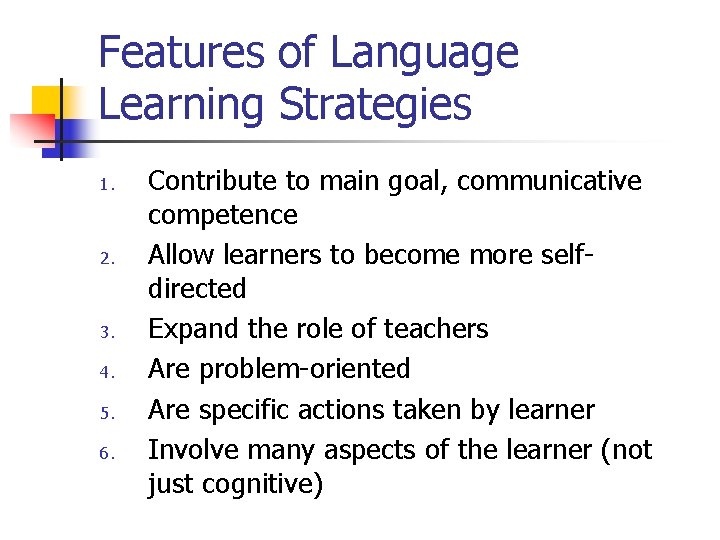
Features of Language Learning Strategies 1. 2. 3. 4. 5. 6. Contribute to main goal, communicative competence Allow learners to become more selfdirected Expand the role of teachers Are problem-oriented Are specific actions taken by learner Involve many aspects of the learner (not just cognitive)
Features of Language Learning Strategies 7. 8. 9. 10. 11. 12. Support learning both directly and indirectly Are not always observable Are often conscious Can be taught Flexible Influenced by a variety of factors
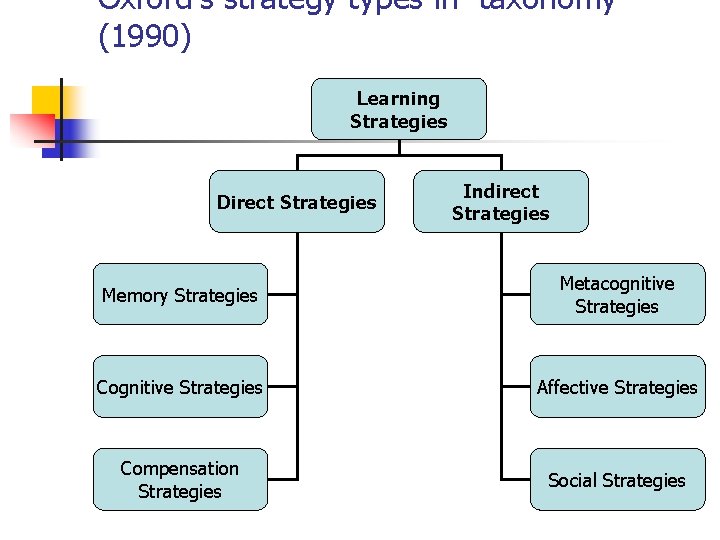
Oxford’s strategy types in taxonomy (1990) Learning Strategies Direct Strategies Indirect Strategies Memory Strategies Metacognitive Strategies Cognitive Strategies Affective Strategies Compensation Strategies Social Strategies
Memory Strategi es Creating mental images Applying images and sounds Reviewing well Employing action
Memory Strategies Creating mental images Grouping Associating/ Elaborating Placing new words into context
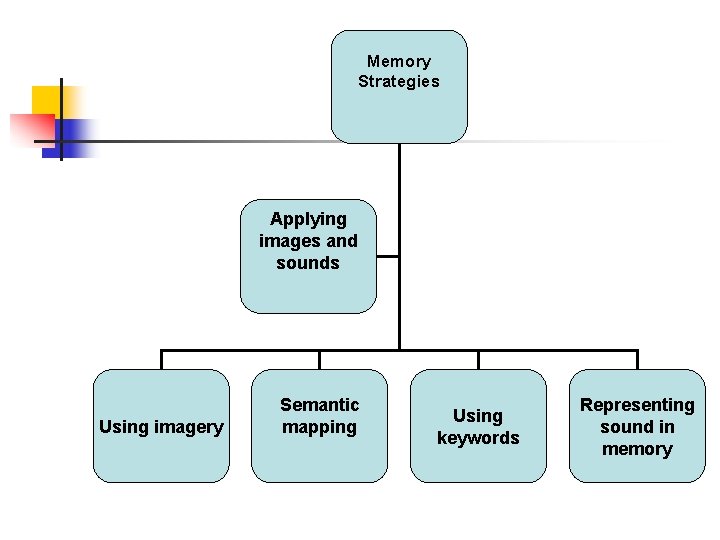
Memory Strategies Applying images and sounds Using imagery Semantic mapping Using keywords Representing sound in memory
Memory Strategies Reviewing well Structured Reviewing
Memory Strategies Employing actions Using physical response or sensation Using mechanical techniques
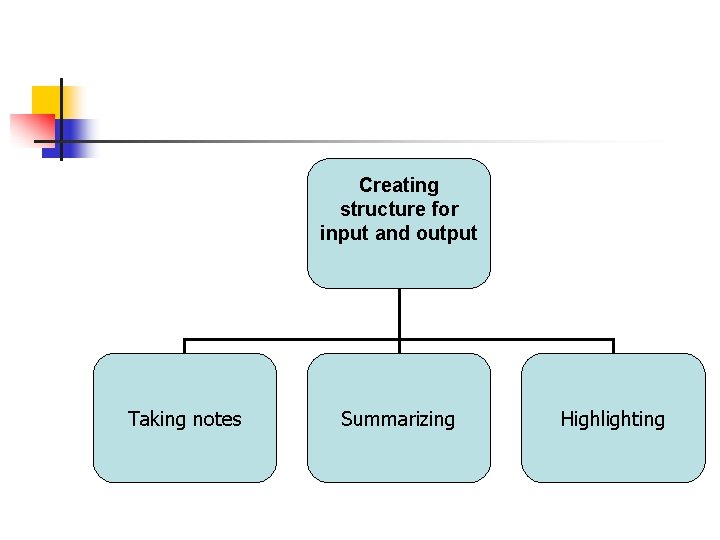
Cognitive Strategies Practising Receiving and sending messages Analyzing and reasoning Creating structure for input and output
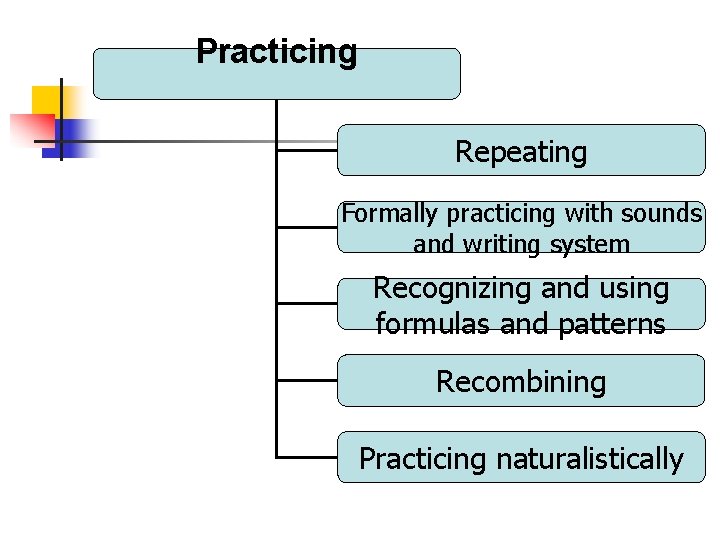
Practicing Repeating Formally practicing with sounds and writing system Recognizing and using formulas and patterns Recombining Practicing naturalistically
Receiving and sending messages Getting the idea quickly Using resources for receiving and sending messages
Analyzing and reasoning Reasoning deductively Analyzing expressions Analyzing contrastively (across language) Translating Transferring
Creating structure for input and output Taking notes Summarizing Highlighting
Compensation strategies Guessing intelligently Overcoming limitations in speaking and writing
Guessing intelligently Using linguistic clues Using other clues
Overcoming limitations in speaking and writing Switching to mother tongue Getting help Using mime or gesture Avoiding communication partially or totally Selecting the topic Adjusting or approximating the message Coining words Using a circumlocution or synonym
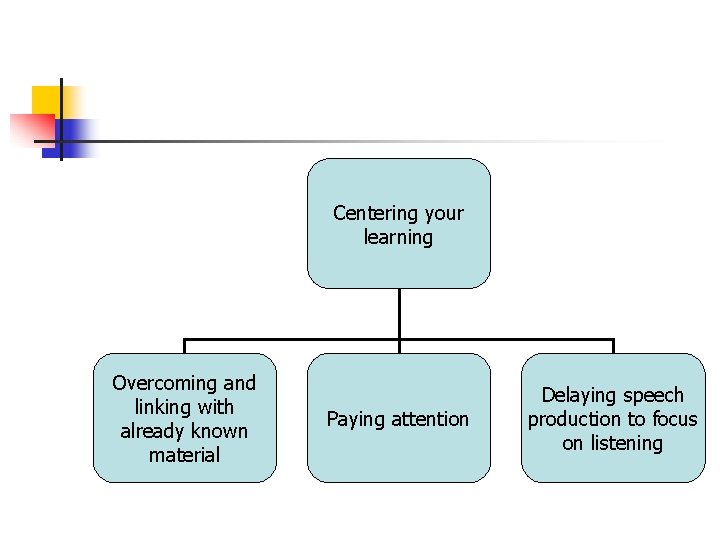
Metacognitive Strategies Centering your learning Arranging and planning your learning Evaluating your learning
Centering your learning Overcoming and linking with already known material Paying attention Delaying speech production to focus on listening
Arranging and planning your learning Finding out about language learning Organizing Setting goals and objectives Identifying the purpose Planning for language task Seeking practice opportunities
Evaluating your learning Self-monitoring Self-evaluating
Affective Strategies Lowering your anxiety Encouraging yourself Taking your emotional temperature
Lowering your anxiety Using progressive relaxation, deep breathing or mediation Using music Using laughter
Encouraging yourself Making positive statements Taking risks wisely Rewarding yourself
Taking your emotional temperature Listening to your body Using a checklist Writing a language learning diary Discussing your feelings with somone else
Social strategies Asking questions Cooperating with others Empathizing with others
Asking questions Asking for clarification or verification Asking for correction
Cooperating with others Cooperating with peers Cooperating with proficient users
Empathizing with others Developing cultural understanding Becoming aware of others’ thoughts and feelings
The good language learner: § is guesser, but an accurate guesser! § has a strong drive to communicate. § is not often inhibited (a risk-taker). §focuses on communication, but also attends to form. §practices—and creates opportunities to do so. §knows what is appropriate. §monitors his own and the speech of others. §attends to meaning. §Actively participates (aloud and silently). Rubin, 1975, p. 45 -47
Learner Autonomy By using selected, taskappropriate strategies, language students are viewed as being: in transition to be autonomous, self-regulated learners, that is, learners who take significant responsibility for their own learning.
Research has demonstrated That learners are actively involved in their learning n Use different kinds of strategies n Have different beliefs about strategy use and learning approaches n That several factors have powerful influence on strategy choice/use: Motivation, proficiency, years of study, sex, major, if requirement n
Major findings related to successful language learning: §The learner must be active in learning and practice. §must begin to view the language as a system. §must use the language in real communication. § must monitor his interlanguage. § must come to terms with the affective demands of language learning. Adapted from Naiman et al (1978), p. 103
¢ All Learning VARIES with TASK (Skehan) ¢ Age ¢ LEARNING STYLE (Reid) ¢ GENDER (Nyikos) ¢ CULTURE (Peacock & Ho) ¢ MOTIVATION (Dornyei) ¢ PROFICIENCY (Oxford & Nyikos) ¢
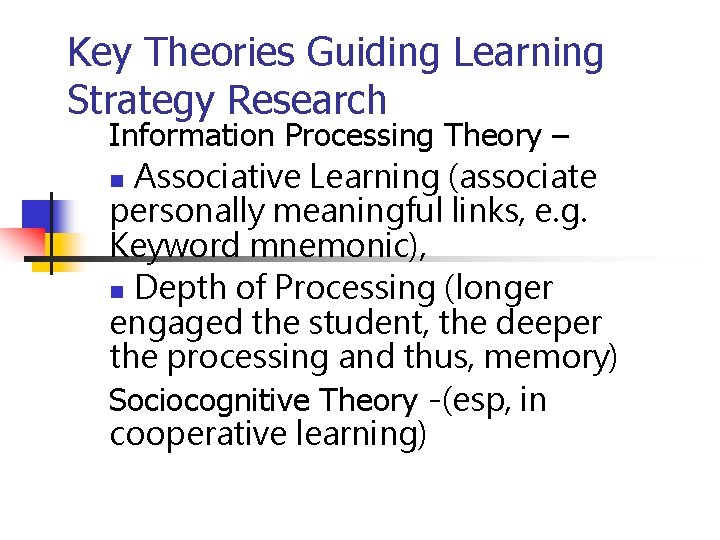
Key Theories Guiding Learning Strategy Research Information Processing Theory – n Associative Learning (associate personally meaningful links, e. g. Keyword mnemonic), n Depth of Processing (longer engaged the student, the deeper the processing and thus, memory) Sociocognitive Theory -(esp, in cooperative learning)
Research approaches to discover students’ strategies through tasks TASK- Must Memorize Given List ¢ While memorizing ask ss. to write down what they notice they are doing to memorize. ¢ (1) in a NARRATIVE form; and ¢ (2) in STEP-BY-STEP fashion. ¢ OR: Diagram the process graphically (picture, arrows). ¢
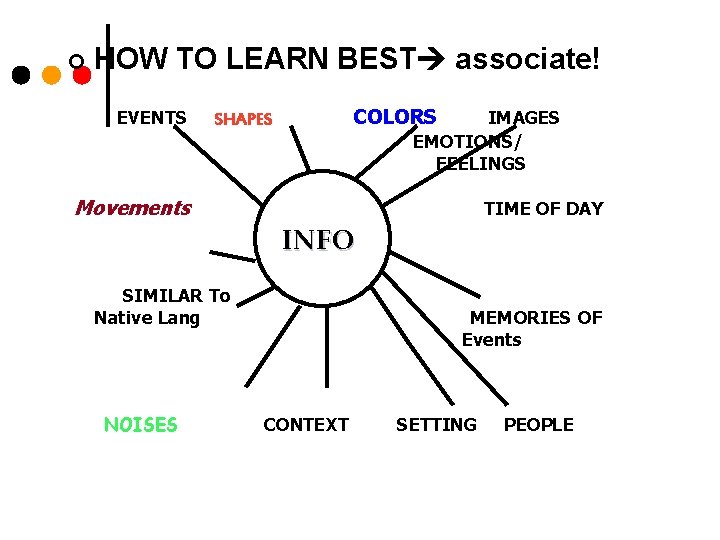
¢ HOW TO LEARN BEST associate! EVENTS COLORS IMAGES EMOTIONS/ FEELINGS SHAPES Movements TIME OF DAY INFO SIMILAR To Native Lang NOISES MEMORIES OF Events CONTEXT SETTING PEOPLE
Research Approaches to discovering learner strategies ¢ Oral interviews and Questionnaires ¢ Observation ¢ Verbal Report via Think Aloud ¢ Diaries and dialogue journals ¢ Retrospective studies via interviews or stimulated recall
Oral Interviews and Questionnaires Degree of Structure High Low Advantages lends itself to statistical analysis respondents free to pursue personal interest Disadvantages too simplistic may suggest a “preferred” response High Number (e. g. , group interview or of respondents questionnaire) Advantages time and cost potential for generating and testing hypotheses Disadvantages responses influenced by social desirability or shyness may not transfer well from one setting to another too much information too individualized, therefore difficult to determine patterns Low (e. g. , case study) more detail useful insights difficult to generalize unless a large number are gathered
Observation Advantages impartial, objective likely to be more quantitative Disadvantages inability to produce descriptions of internal or mentalistic strategies likely to derive data only on more verbal students bias inherent in an observer’s description student behavior may change with observer’s presence
Verbal Report (e. g. Think-aloud protocol) Advantages dependent on the information processing model as a frameworks best as a complement to other means of research has a strong, historical foundation of use high correlations with subsequent behavior reveal what information is attended to while performing tasks Disadvantages cognitive processing is inaccessible because it is unconscious, therefore researchers must raise respondents’ level of awareness or only measure consciously accessible processes probes may force the subject to produce a verbal response not closely related to actual thought processes because of a lack of verbal skills or L 2 ability intrusive effect take too much time, e. g. , 20 minutes to explain 1. 5 second of thought
Diaries & Dialogue Journals Advantages find out what is significant to learners information may be inaccessible through other research techniques can be kept anywhere by anyone Disadvantages volume of data potentially random nature of the entries ss. may not mention language learning strategies at all small number of subjects restricts generalizability
Retrospective Studies Advantages more objective because of distance from experience more likely to be summary students can gain important personal insights about language learning strategies that worked for them Disadvantages memory deterioration between the experience and the study, therefore should be considered anecdotal individualistic and possibly distorted
We have looked at research approaches, now let’s look at the research on affective side of learning. ¢ Anxiety (Horowitz, Horwitz & Cope, 1986) Cooperation (Naughton, 2006) ¢ Motivation (Dornyei, 2001) ¢ Willingness to communicate ¢ Attitudes and Beliefs toward language learning (Horwitz; ¢
Social Strategies ¢ ¢ Join the group Pretend you understand everything Count on your friends to help Also called Communication Strategies Used by Children (Wong-Filmore 1976 /79)
More Social strategies Suggestions for the classroom ¢ Cooperating with Others increases performance, fluency awareness and self-concept Strategies: l Cooperate with peers l Cooperate with proficient users and native speakers (who can scaffold, negotiate meaning, provide i+1) l
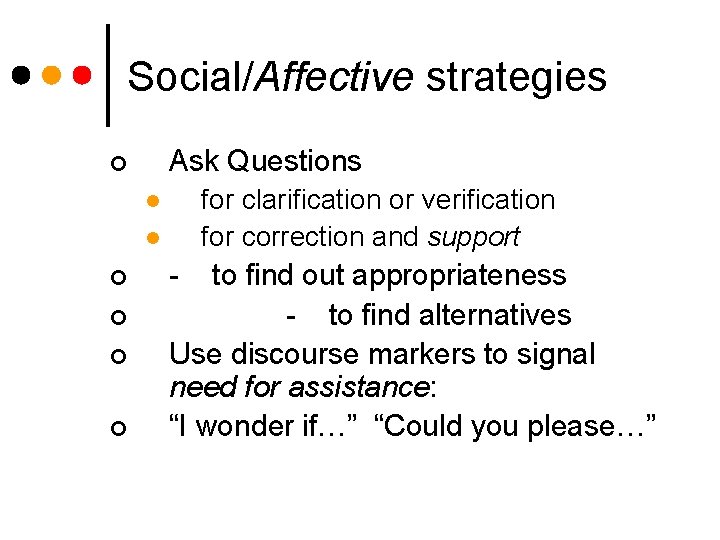
Social/Affective strategies Ask Questions ¢ for clarification or verification for correction and support l l ¢ ¢ - to find out appropriateness - to find alternatives Use discourse markers to signal need for assistance: “I wonder if…” “Could you please…”
Affective support strategies Empathizing with Others ¢ l l l to develop cultural awareness and understanding become aware of own and others’ feelings Takes off stress and anxiety when empathy gained
Affective: In the classroom: ¢ Lower the anxiety level – learner plays music while studying ¢ Use encouragement – Give the students a social reward (smile, praise, handshake, high 5) ¢ Have them reward themselves for successfully completing a task
Social + Affective Ask questions Encourage learners to always ask for clarification or verification ¢ Cooperation and Empathy Invite students to develop understanding of others ¢ “If anyone can do this, you can!” ¢ “Good job!” “Nice try!” ¢
Speaking strategies Teacher: “it is OK to make mistakes” Model to ss how to say: ¢ “please slow down” ¢ Say that again, please ¢ Could you repeat that again? Conversation Management Strategies ¢ “Ok, I think you are saying…” ¢ “so in other words…” ¢
Metacognitive The KEY! n n n Center the learning –> Show the student how to link new information with already known material Arrange and Plan –> Help student to set outlines, goals Identify –> Ask the learner “How did you learn that? ” This enables them to know their own learning strategies.
How to find out your students’ language learning strategies n n - n n Ask ss to write a short essay or simply ask: How do you study vocabulary? grammar? What do you do when you need to talk to a partner in class? How often read? What enjoy reading? * What are tips for fellow students?
Discover n n cont. Give a TASK: Ask students to tell you or a partner how they complete the task. memorize vocablary Give students a quiz or test, when done, ask them to write down next to the item how they remembered the item, What did you do to write better or read correctly?
Ask students to reflect on how they completed the task: n n memorize vocabulary study grammar jot down next to reading passage study and/or take a quiz
Strategies promote: n n n Language competence Risk-taking + confidence Memory and retention Self-monitoring Good study habits Awareness of strengths and individual differences
Resources-Websites n Prof. Andrew Cohen’s Strategies-based Instruction web page: http: //www. carla. umn. edu/bibliography/strategies. html n n n Styles-and Strategies-Based Instruction: A Teachers' Guide http: //www. carla. umn. edu/resources/working-papers/index. html http: //www. nclrc. org/essentials/motivati ng/strategytable. htm