
LANGUAGE LEARNING AND TEACHING PROCESSES IN YOUNG CHILDREN



- Slides: 36
LANGUAGE LEARNING AND TEACHING PROCESSES IN YOUNG CHILDREN (chapter 6)
Power. Point Outline** • I. The Role of the Environment in Language Development • II. Cognition and Language • III. Toddler Learning Strategies • IV. Adult Conversational Learning Techniques • V. Print vs. E-Books for Preschoolers
I. THE ROLE OF THE ENVIRONMENT IN LANGUAGE DEVELOPMENT** • Development of language rests upon several major variables that interact with one another • 1. The child’s cultural and linguistic environment is a big influence upon language learning • 2. Each child has unique characteristics that she brings to the language learning situation
For a child to develop language optimally…** • She needs language stimulation from her environment • In many cultures, adult interaction with infants and young children differs from mainstream U. S. expectations
For example…
Mainstream Americans…
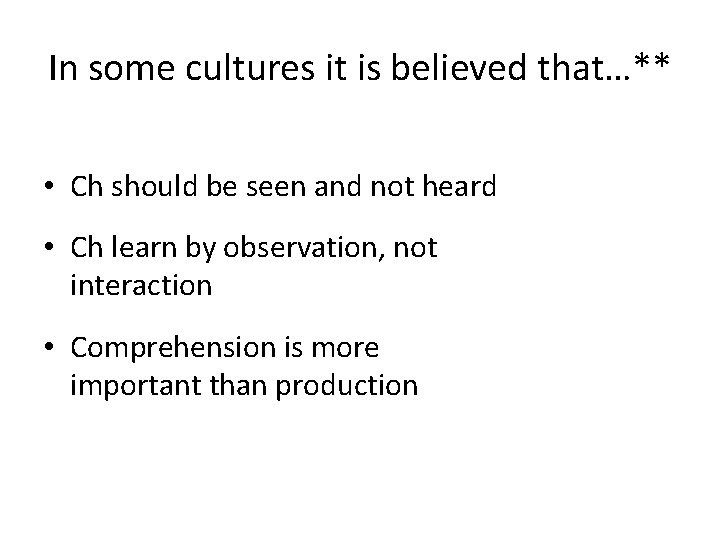
In some cultures it is believed that…** • Ch should be seen and not heard • Ch learn by observation, not interaction • Comprehension is more important than production
Socioeconomic status makes a difference…
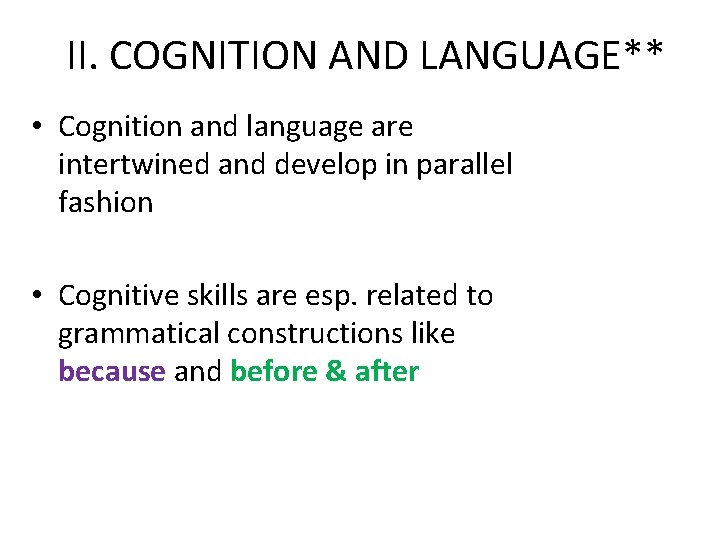
II. COGNITION AND LANGUAGE** • Cognition and language are intertwined and develop in parallel fashion • Cognitive skills are esp. related to grammatical constructions like because and before & after
Word acquisition is guided by 2 types of knowledge structures** • Event-based knowledge: sequences of events or routines that are temporal or causal and organized toward a goal For example, if a child goes to daycare, takes swimming lessons, or goes to Sunday school, she has knowledge of those events Preschoolers especially rely on this type of knowledge
Taxonomic knowledge: (kindergarteners)
III. TODDLER LEARNING STRATEGIES** • A. Formula • Verbal routine or unanalyzed chunk of language—memorized units • Mark Mc. Kibbin at 2 years old: “Thanks, and have a nice day!”
• B. Selective Imitation • Youtube: Cute funny baby imitating his father
• C. Evocative Utterance
• D. Interrogative Utterance** • The child is unsure of the word, and asks “what’s that? ” • They are requesting an answer
IV. ADULT CONVERSATIONAL TEACHING TECHNIQUES** • A. General Facts • Children learn language faster when parents converse (as opposed to teaching and instructing) • There are definite language-learning advantages for children who attend preschools where the curriculum emphasizes language and literacy
B. Expansions and Extensions
C. Turnabouts
Types of turnabouts are in Table 6. 6 on p. 162—just know these: ** • Fill-ins (My dog likes to _______) • Wh-questions (Why does the dog scratch himself? ) • Yes-no questions (Do you think the dog has fleas? )
D. Prompting
Youtube** • I poo in my pants funny toddler at Disney World • You will hear yes-no and wh-questions
Hulit, Fahey, & Howard 2015—summary of new research on child-directed speech:
Hulit et al 2015 continued:
The more TV in a ch’s day…
**Christakis and colleagues studied the impact of TV and its noise on parent-child interactions in homes
Christakis et al. found that:
Constant noise in the home is also associated with:
V. PRINT VS. E-BOOKS FOR PRESCHOOLERS** • A. Premise • The American Academy of Pediatricians (2014) clearly states no screen time for children from 0 -2 years • Research shows that school-aged children may benefit from e-book advantages (e. g. , dictionaries, highlighting key words)
In terms of paper vs. e-books for preschool children (2 -5 years)
But…. ** • What is their effect on dialogic reading and children’s comprehension? • Dialogic reading: interactive reading between caregivers and children
Disadvantages: (Willoughby, Evans, & Nowak, 2015; http: //www. eetconference. org/wp-contentuploads/
Parrish-Morris, Mahajan, Hirsh-Pasek, Golinkoff, & Collins (2013). Once upon a time: Parent-child dialogue and storybook reading in the electronic era. Mind, Brain, and Education, 7(3), 200 -211. ** • Studied 165 parent-child dyads reading e-books and traditional paper books • Children’s story comprehension and parent-child dialogic reading were negatively affected by the presence of electronic features
Parrish-Morris et al. 2013 continued:
Conclusions from current scientific research: (Deem, 2015: E-books vs. print: what parents need to know. http: //www. scholastic. com)
Power. Point Outline • I. The Role of the Environment in Language Development • II. Cognition and Language • III. Toddler Learning Strategies • IV. Adult Conversational Learning Techniques • V. Print vs. E-Books for Preschoolers