
LANGUAGE INTERACTION IN THE CLASSROOM THROUGH QUESTIONING PRESENTED


- Slides: 15
LANGUAGE INTERACTION IN THE CLASSROOM THROUGH QUESTIONING PRESENTED BY SUMANA SAHA ROLL NO. 48 B. ED 1 st SEM UNIVERSITY B T & EVENING COLLEGE
INTRODUCTION A question is considerer to be an expression of an ‘instinct of curiosity’ , desire to know , desire for social contact and interrogative statement , and so forth. Question is an important tool for teaching in the classroom and thereby developing language proficiency of the student. In the development of intelligence, nothing can be more “ basic” than learning how to ask productive questions.
WHY , HOW, WHEN ? • PURPOSE OF QUESTIONING • REASONS FOR ASKING QUESTION • IMPORTENCE OF QUESTIONING • TIMINING OF QUESTIONING Questioning provides opportunities to students to organize their own learning participation in their learning process.
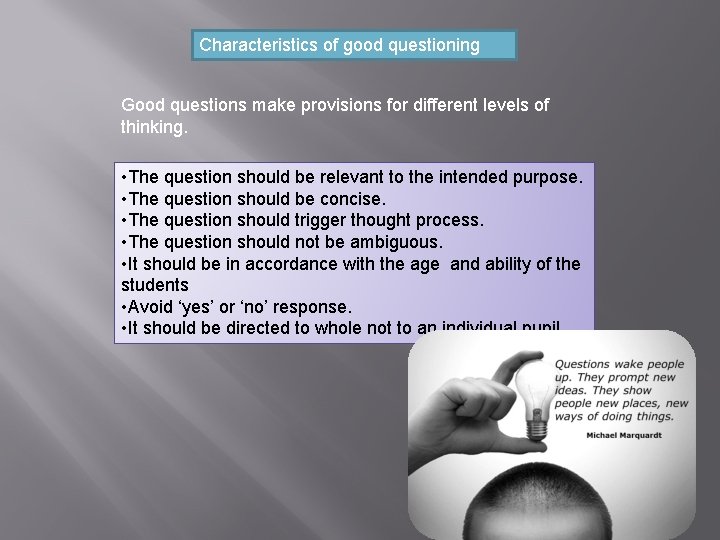
Characteristics of good questioning Good questions make provisions for different levels of thinking. • The question should be relevant to the intended purpose. • The question should be concise. • The question should trigger thought process. • The question should not be ambiguous. • It should be in accordance with the age and ability of the students • Avoid ‘yes’ or ‘no’ response. • It should be directed to whole not to an individual pupil.
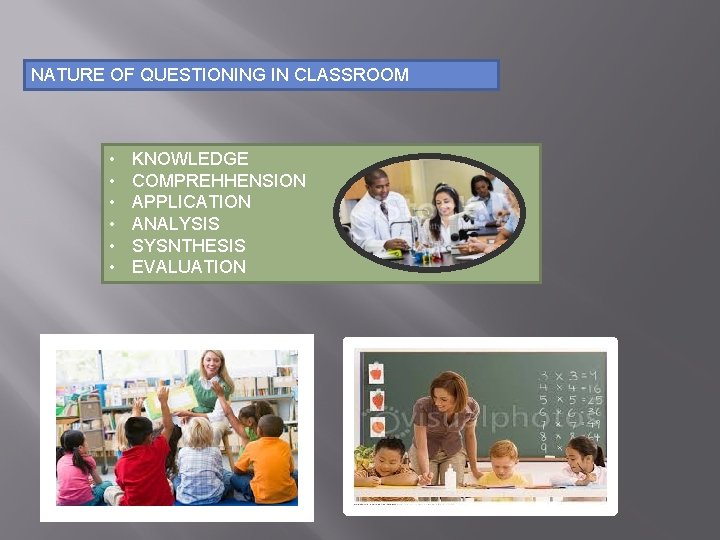
NATURE OF QUESTIONING IN CLASSROOM • • • KNOWLEDGE COMPREHHENSION APPLICATION ANALYSIS SYSNTHESIS EVALUATION
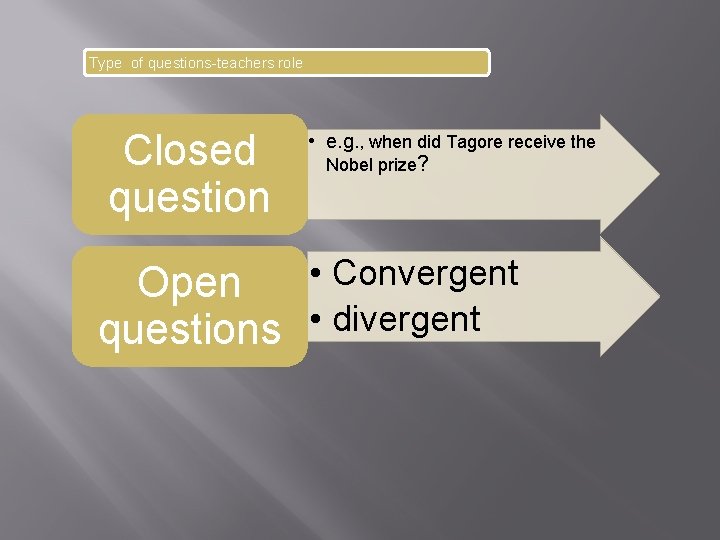
Type of questions-teachers role Closed question • e. g. , when did Tagore receive the Nobel prize? • Convergent Open questions • divergent
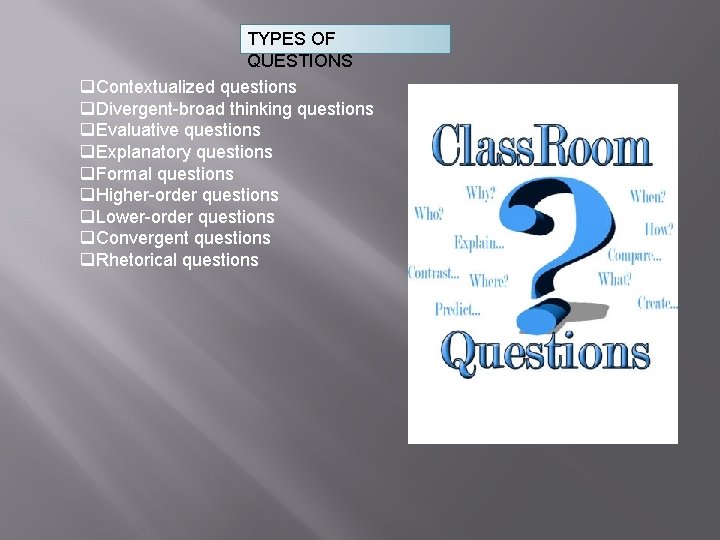
TYPES OF QUESTIONS q. Contextualized questions q. Divergent-broad thinking questions q. Evaluative questions q. Explanatory questions q. Formal questions q. Higher-order questions q. Lower-order questions q. Convergent questions q. Rhetorical questions
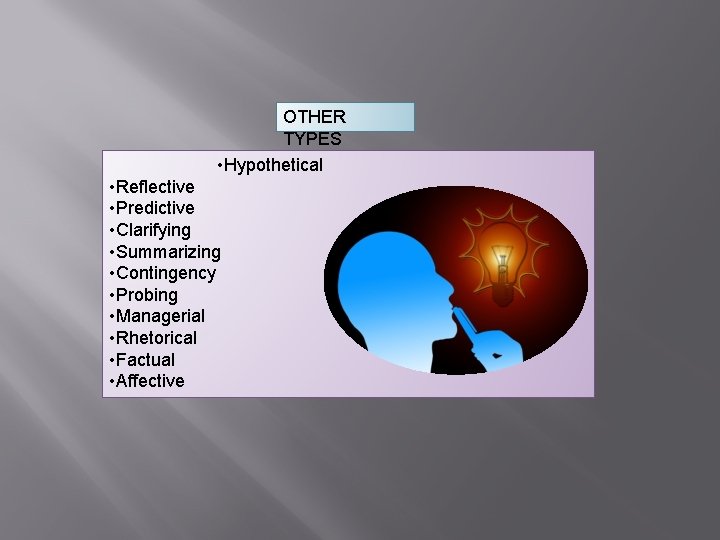
OTHER TYPES • Hypothetical • Reflective • Predictive • Clarifying • Summarizing • Contingency • Probing • Managerial • Rhetorical • Factual • Affective
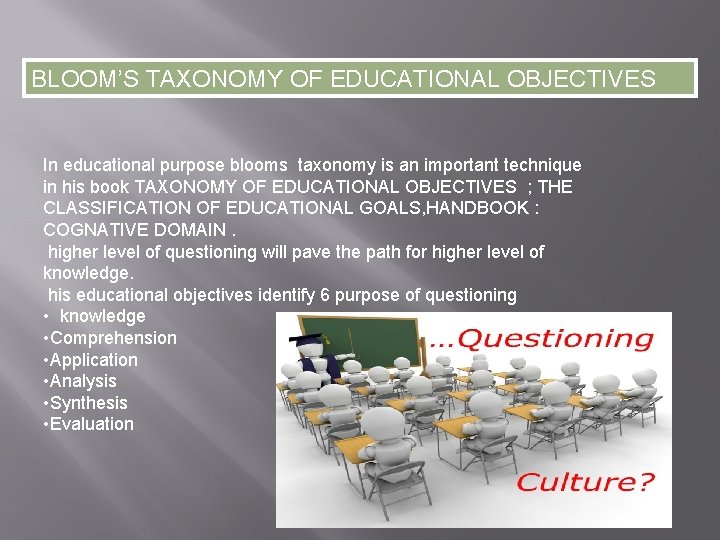
BLOOM’S TAXONOMY OF EDUCATIONAL OBJECTIVES In educational purpose blooms taxonomy is an important technique in his book TAXONOMY OF EDUCATIONAL OBJECTIVES ; THE CLASSIFICATION OF EDUCATIONAL GOALS, HANDBOOK : COGNATIVE DOMAIN. higher level of questioning will pave the path for higher level of knowledge. his educational objectives identify 6 purpose of questioning • knowledge • Comprehension • Application • Analysis • Synthesis • Evaluation
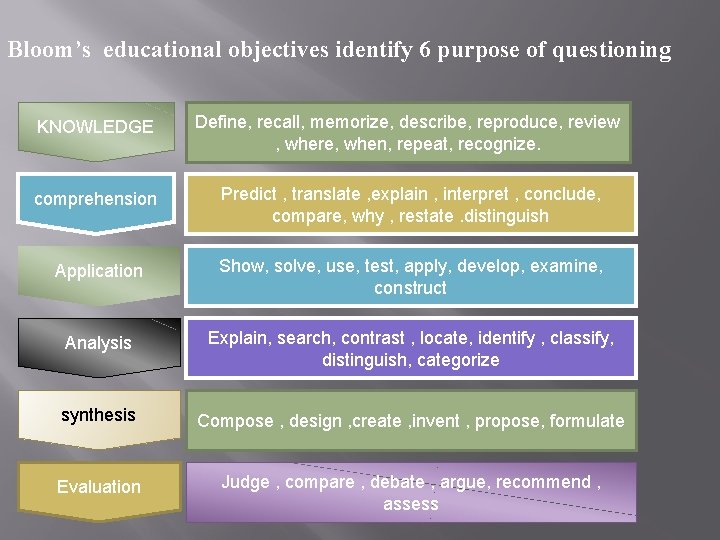
Bloom’s educational objectives identify 6 purpose of questioning KNOWLEDGE Define, recall, memorize, describe, reproduce, review , where, when, repeat, recognize. comprehension Predict , translate , explain , interpret , conclude, compare, why , restate. distinguish Application Show, solve, use, test, apply, develop, examine, construct Analysis Explain, search, contrast , locate, identify , classify, distinguish, categorize synthesis Compose , design , create , invent , propose, formulate Evaluation Judge , compare , debate , argue, recommend , assess
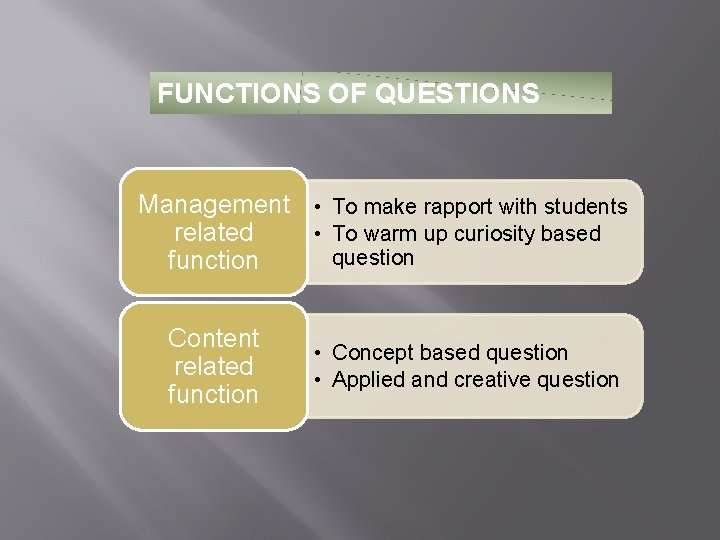
FUNCTIONS OF QUESTIONS Management • To make rapport with students related • To warm up curiosity based question function Content related function • Concept based question • Applied and creative question
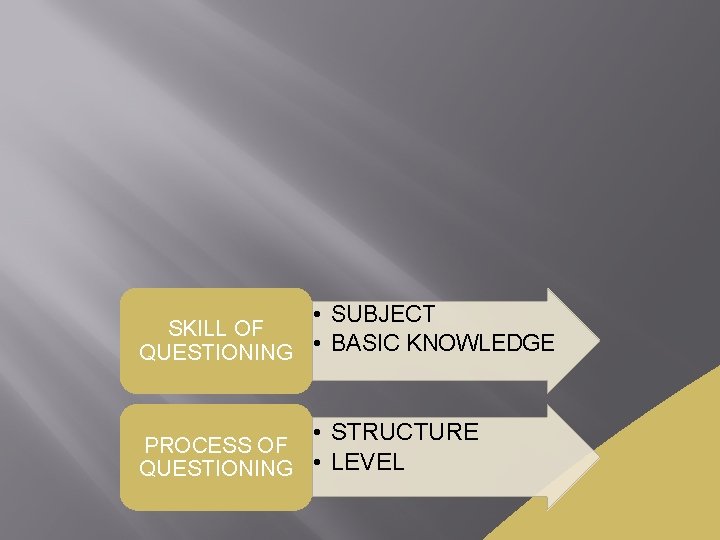
• SUBJECT SKILL OF QUESTIONING • BASIC KNOWLEDGE • STRUCTURE PROCESS OF QUESTIONING • LEVEL
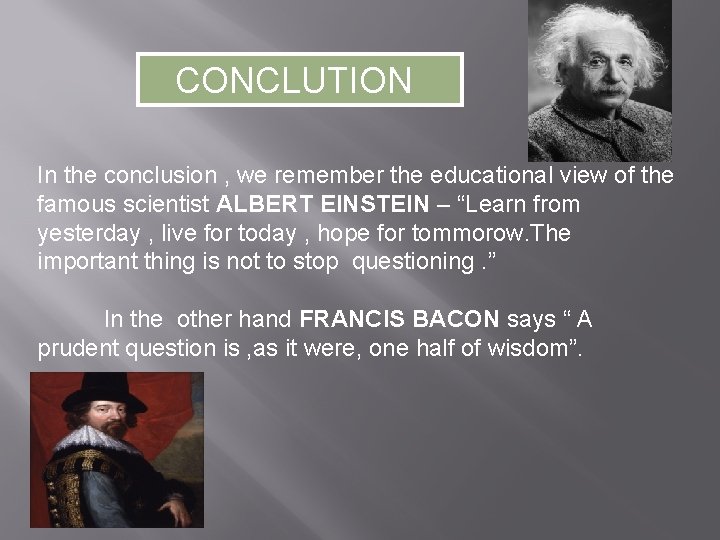
CONCLUTION In the conclusion , we remember the educational view of the famous scientist ALBERT EINSTEIN – “Learn from yesterday , live for today , hope for tommorow. The important thing is not to stop questioning. ” In the other hand FRANCIS BACON says “ A prudent question is , as it were, one half of wisdom”.
REFERENCES Majhi, Shambhunath and dr. Birbal Saha: language across the curriculum, page – 129 to 143. Sannyal, Shraboni and dr. mukherjee Utpal: language across the curriculum, page-64 -71. Dinda , malayendu. (2015) : language across the curriculum , page – 174 - 193