
Language innateness and the brain LING 200 Spring

Language, innateness and the brain LING 200 Spring 2006 Prof. Sharon Hargus
Organization • Innateness hypothesis • Neurolinguistics – Lateralization – Localization
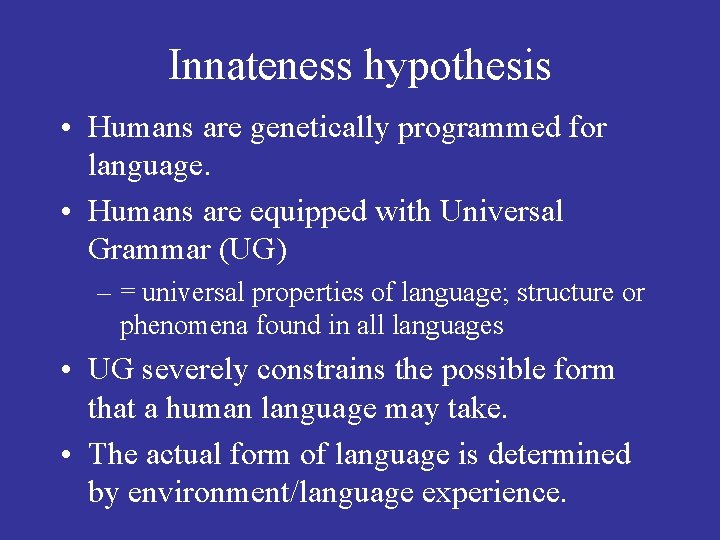
Innateness hypothesis • Humans are genetically programmed for language. • Humans are equipped with Universal Grammar (UG) – = universal properties of language; structure or phenomena found in all languages • UG severely constrains the possible form that a human language may take. • The actual form of language is determined by environment/language experience.

Noam Chomsky • . . . language appears to be a true species property, unique to the human species in its essentials and a common part of our shared biological endowment, with little variation among humans apart from rather serious pathology. (p. 2)

Evidence for innateness hypothesis • lg has characteristics of innate behavior • no other species has a communication system like human lg • brain (and vocal tract) show evidence of specialization for lg

Some innate human behaviors innate not innate walking skating, playing football speaking or signing a language reading or writing a language
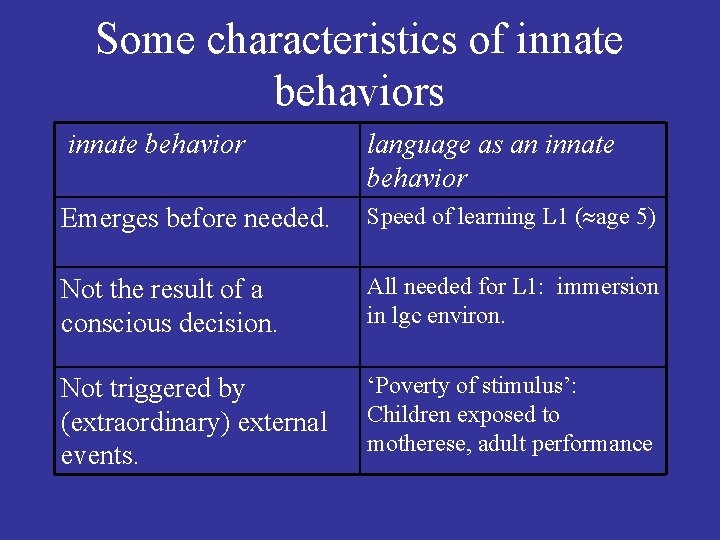
Some characteristics of innate behaviors innate behavior language as an innate behavior Emerges before needed. Speed of learning L 1 ( age 5) Not the result of a conscious decision. All needed for L 1: immersion in lgc environ. Not triggered by (extraordinary) external events. ‘Poverty of stimulus’: Children exposed to motherese, adult performance
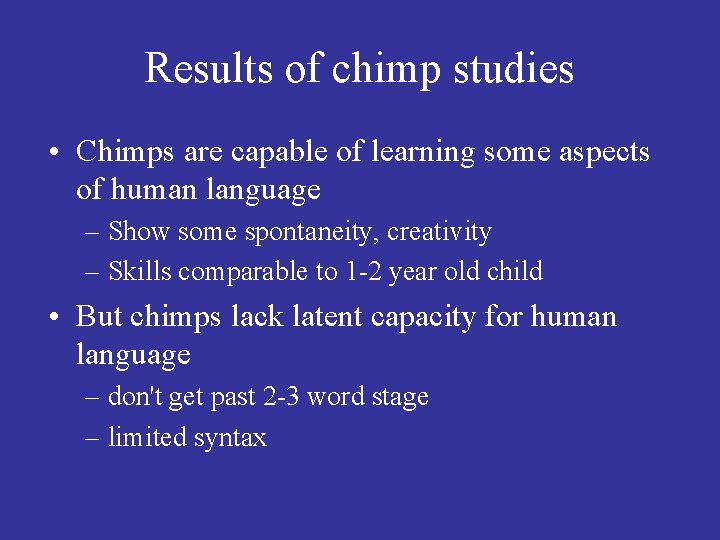
Results of chimp studies • Chimps are capable of learning some aspects of human language – Show some spontaneity, creativity – Skills comparable to 1 -2 year old child • But chimps lack latent capacity for human language – don't get past 2 -3 word stage – limited syntax
Neurolinguistics
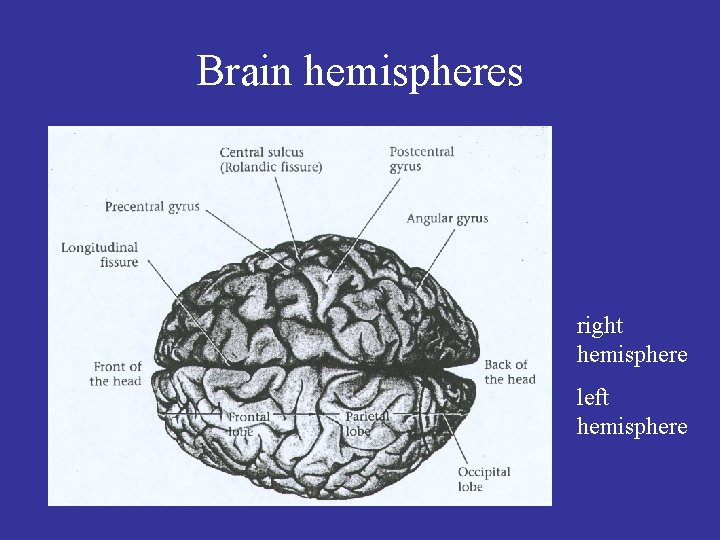
Brain hemispheres right hemisphere left hemisphere
Lateralization • Contra-lateral control – a given hemisphere controls opposite side of body • Left hemisphere controls right side of body • Right hemisphere controls left side of body • Other hemispheric specializations:
Right hemisphere specialties • Holistic, spatial processing – pattern-matching (e. g. recognizing faces) – spatial relations – emotional reactions – music (processing by musically naive individuals)
Left hemisphere specialties • Sequential processing – – rhythm temporal relations analytical thinking music (as processed by musically sophisticated individuals) – mathematics – intellectual reasoning – language, speech sounds • especially so for adult, male, right-handed, literate, monolingual subjects
Language processing as a left hemisphere task • Aphasia • Dichotic listening experiments • Split-brain patients
Aphasia • Brain injury locations resulting in speech deficits are almost always in left hemisphere
Dichotic listening experiments • I. e. stimuli presented to different ears – linguistic sounds: right ear (left brain) advantage – environmental sounds: left ear (right brain) advantage • advantage = correctly identified more often, identified more quickly, etc.
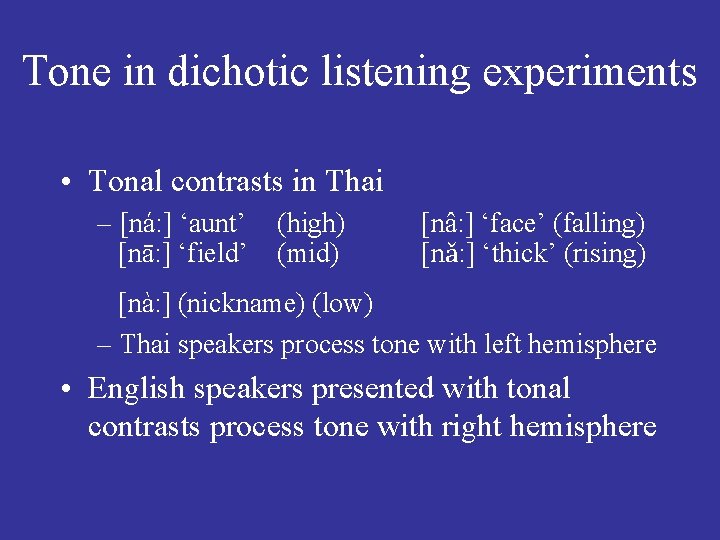
Tone in dichotic listening experiments • Tonal contrasts in Thai – [ná: ] ‘aunt’ [nā: ] ‘field’ (high) (mid) [nâ: ] ‘face’ (falling) [nǎ: ] ‘thick’ (rising) [nà: ] (nickname) (low) – Thai speakers process tone with left hemisphere • English speakers presented with tonal contrasts process tone with right hemisphere
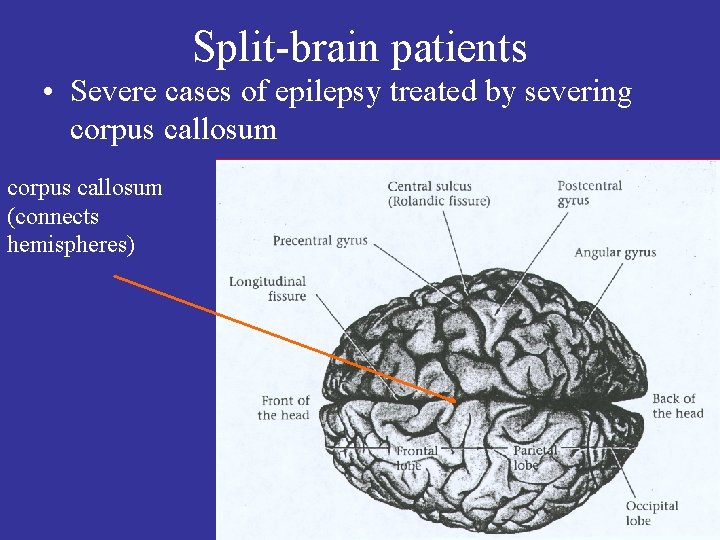
Split-brain patients • Severe cases of epilepsy treated by severing corpus callosum (connects hemispheres)
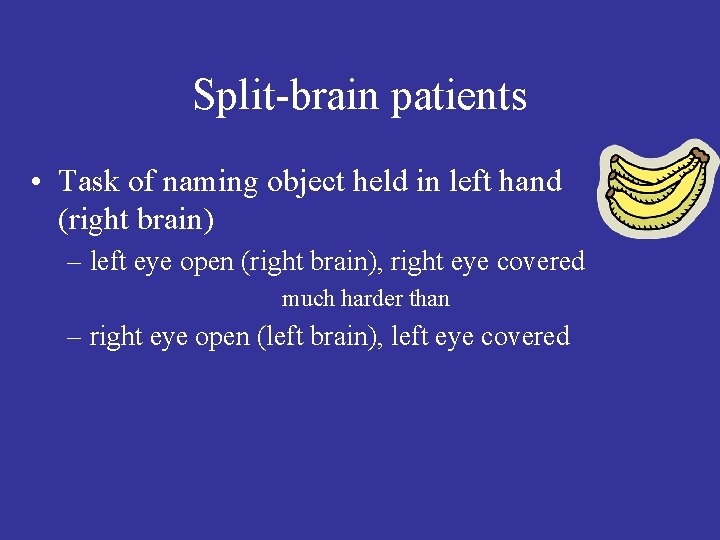
Split-brain patients • Task of naming object held in left hand (right brain) – left eye open (right brain), right eye covered much harder than – right eye open (left brain), left eye covered
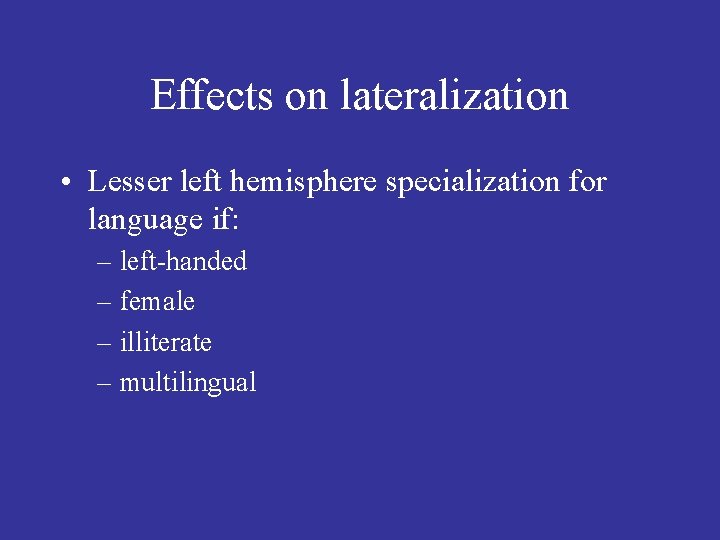
Effects on lateralization • Lesser left hemisphere specialization for language if: – left-handed – female – illiterate – multilingual
Lateralization and handedness • General population – 90% predominantly right-handed – 10% strongly left-handed or ambidextrous • Lateralization in right-handed individuals – 90% left hemisphere specialization for language – 10% right hemisphere specialization
Lateralization and handedness • Lateralization in left-handed individuals – most (65 -70%) have left hemisphere specialization for language, like right-handed – a larger percentage (30 -35%) have right hemisphere specialization or apparently bilateral • Aphasia in left handed individuals – 8 x more likely to get aphasia if right hemisphere is damaged than right handed individual
Lateralization and gender • In women, language may be bilateral more often – if left hemisphere damage, milder aphasia or less likely to result in aphasia – dichotic listening tests don't show right ear advantage as often as for men
Lateralization and literacy • Language more symmetrically located in illiterate speakers • Aphasia just as likely with right-hemisphere injury
Lateralization and multilingualism • More right hemisphere language dominance than in monolinguals • If right hemisphere damage, multilingual individuals 5 x more likely to develop aphasia than monolinguals • Recovery from aphasia – 50% recover both languages to same extent – 25% do not regain 1 or more languages
An aphasic French-Arabic bilingual • French-Arabic bilingual nun in Morocco became severely aphasic after moped accident • initially lost speech altogether • 4 days after accident, could speak a few words of Arabic, no French • 14 days after accident, could speak French fluently • 15 days after accident, could speak only Arabic fluently
Lateralization and modality • Sign languages use visual-spatial mode of transmission • How is lateralization for language affected by modality? • Results of a study of aphasia and other problems in 6 ASL signers – 3 left brain damage, 3 right brain damage • No effect of language modality on lateralization for language; left hemisphere specialization for language even for signed languages
If left hemisphere was damaged • Sign language aphasia resulted – GD: ‘halting and effortful signing, ’ reduced to single sign utterances – KL: ‘selection errors’ in formation of ASL signs, ‘sign comprehension loss’ – PD: fluent signing but impairment in sentence structure
If right hemisphere was damaged • Non-aphasic problems resulted • Right-hemisphere damaged signer – avoided left side of signing space • describing furniture in a room: ‘furniture piled in helter -skelter fashion on the right, and the entire left side of signing space left bare. . . ’ – but used left side of signing space better when such uses were linguistically required
Localization for language • I. e. localization within hemisphere • Hypothesis: specific parts of brain control specific parts of body or bodily functions, including language
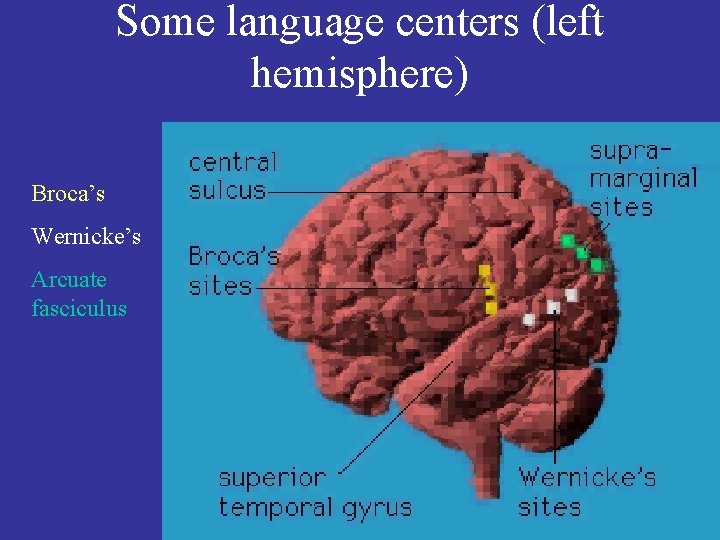
Some language centers (left hemisphere) Broca’s Wernicke’s Arcuate fasciculus
Broca’s area • Lesions to Broca’s area result in Broca's aphasia (a. k. a. expressive aphasia, motor aphasia) • Characteristics of Broca’s aphasia – – basic message of meaning clear, but speech is not fluent phrases are telegraphic (absence of function words) incorrect production of sounds • Cinderella, as told by a Broca’s aphasic – Cinderella. . . poor. . . um ‘dopted her. . . scrubbed floor, um, tidy. . . poor, um. . . ’dopted. . . si-sisters and mother. . . ball. Ball, prince um. . . shoe.
Wernicke’s area • Lesions to Wernicke’s area result in Wernicke’s aphasia • Characteristics of Wernicke’s aphasia – speech is fluent, but – often nonsensical or circuitous • Description of a knife by a Wernicke’s aphasic – ‘That’s a resh. Sometimes I get one around here that I can cut a couple regs. There’s no rugs around here and nothing cut right. But that’s a rug and I had some nice rekebz. I wish I had one now. Say how Wishi idaw, uh windy, look how windy. It’s really window isn’t it? ’
Arcuate fasciculus • Subcortex nerve fibers connecting Broca’s, Wernicke’s areas • Lesions at this area result in: – Conductive/conduction aphasia – Characteristics • • usually good comprehension, fluent speech but difficulty repeating difficulty reading out loud difficulty writing
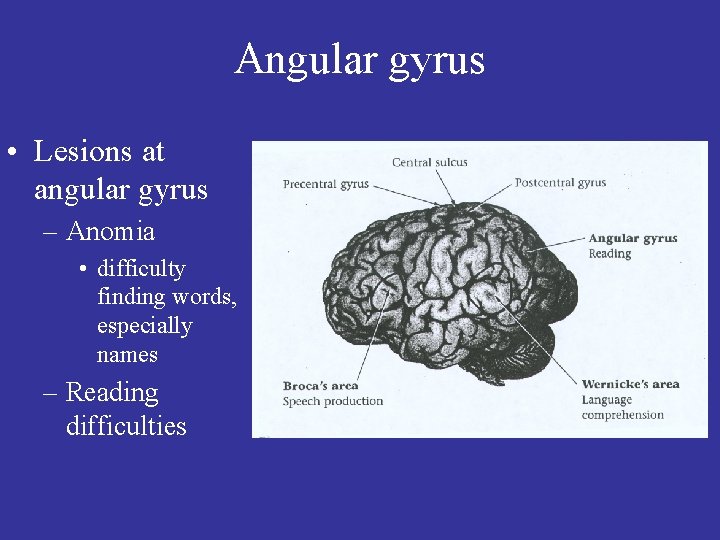
Angular gyrus • Lesions at angular gyrus – Anomia • difficulty finding words, especially names – Reading difficulties
Other evidence for localization • Electrical stimulation of brain – Normal reaction: numbness, twitching, movement of contralateral body part • Electrical stimulation at ‘language centers’ – Results in • difficulty talking • some kind of vocalization
Further complexities in localization • Factors: spoken vs. written language, parts of speech • Johns Hopkins study of 2 female aphasics – both found it easy to read, speak and write nouns – one could speak verbs but not write them – one could write verbs but not speak them
More than language centers in the brain • Broca's aphasics – damage to Broca’s area results in • language deficits • motor control problems • problems with cognitive and perceptual tasks • Alzheimer’s disease – non-localized neurological problems result in language deficits (among other problems)
Neurolinguistics summary • Hemispheres of brain have different specialties, including language (most clearly for right-handed (etc. ) individuals) • Lateralization is not affected by language modality • Language centers within the brain: Broca's, Wernicke's areas especially important • Neurolinguistics provides evidence for human specialization for language

Next time • Announcements
- Slides: 40