
Language in Context Week 1 Introduction Today were


- Slides: 35
Language in Context Week 1 Introduction
Today we’re going to talk about Language t x nte n o i t a c i n Commu Co Drama Pra gm atic s
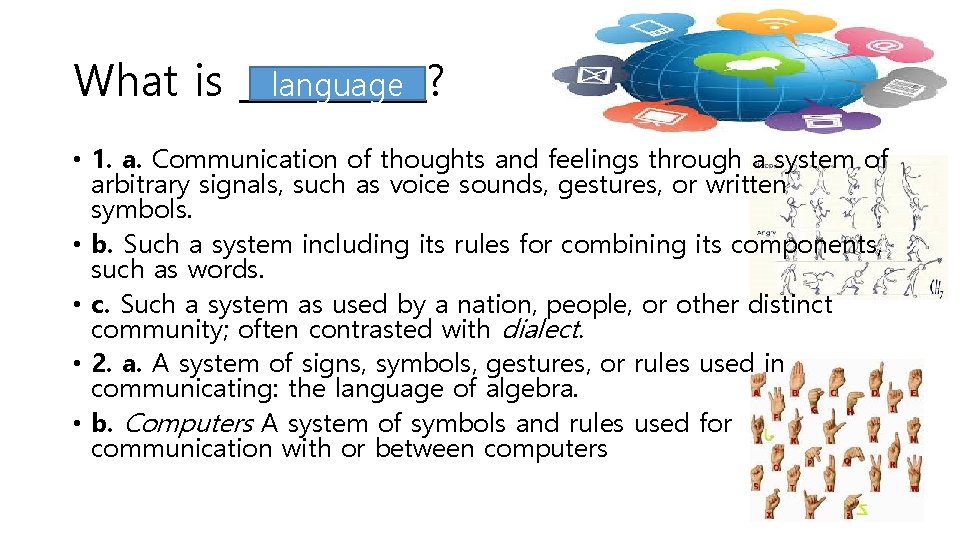
language What is _____? • 1. a. Communication of thoughts and feelings through a system of arbitrary signals, such as voice sounds, gestures, or written symbols. • b. Such a system including its rules for combining its components, such as words. • c. Such a system as used by a nation, people, or other distinct community; often contrasted with dialect. • 2. a. A system of signs, symbols, gestures, or rules used in communicating: the language of algebra. • b. Computers A system of symbols and rules used for communication with or between computers
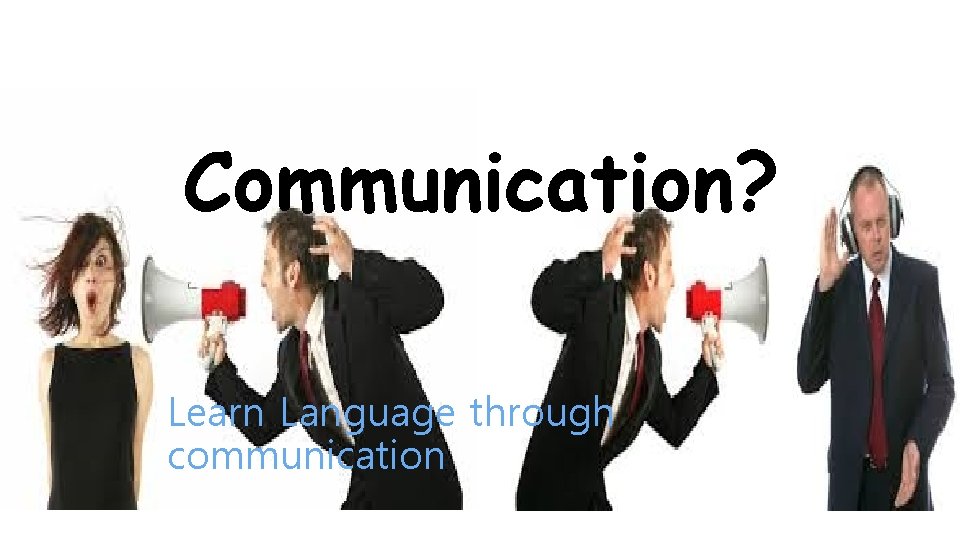
Communication? Learn Language through communication
What is it?
What is Communication? 1. The act of communicating; transmission. 2. a. The exchange of thoughts, messages, or information, as by speech, signals, writing, or behavior. b. Interpersonal rapport. 3. communications (used with a sing. or pl. verb)a. The art and technique of using words effectively to impart information or ideas. b. The field of study concerned with the transmission of information by various means, such as print or broadcasting. c. Any of various professions involved with the transmission of information, such as advertising, broadcasting, or journalism. 4. Something communicated; a message. 5. communications A means of communicating, especially a. A system, such as mail, telephone, or television, for sending and receiving messages. b. A network of routes for sending messages and transporting troops and supplies. 6. communications The technology employed in transmitting messages.
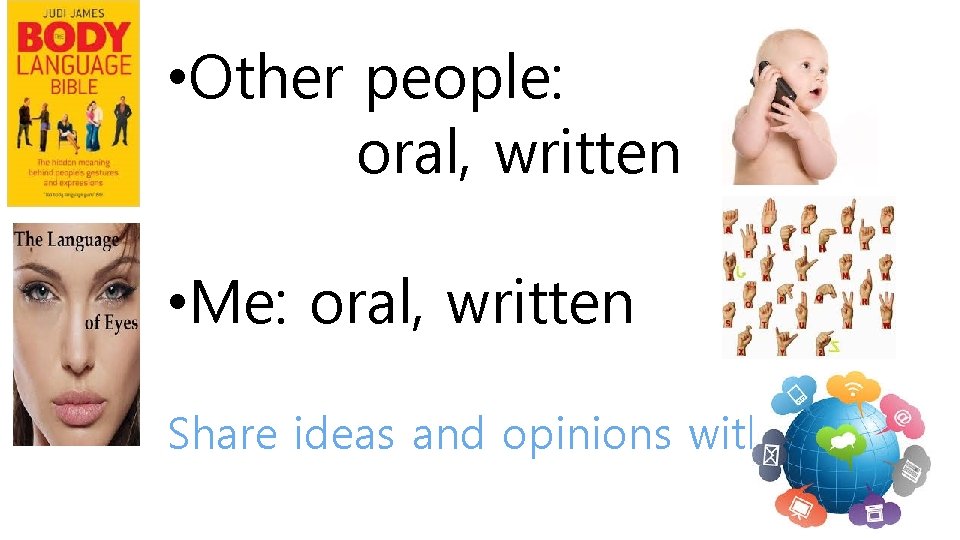
• Other people: oral, written • Me: oral, written Share ideas and opinions with
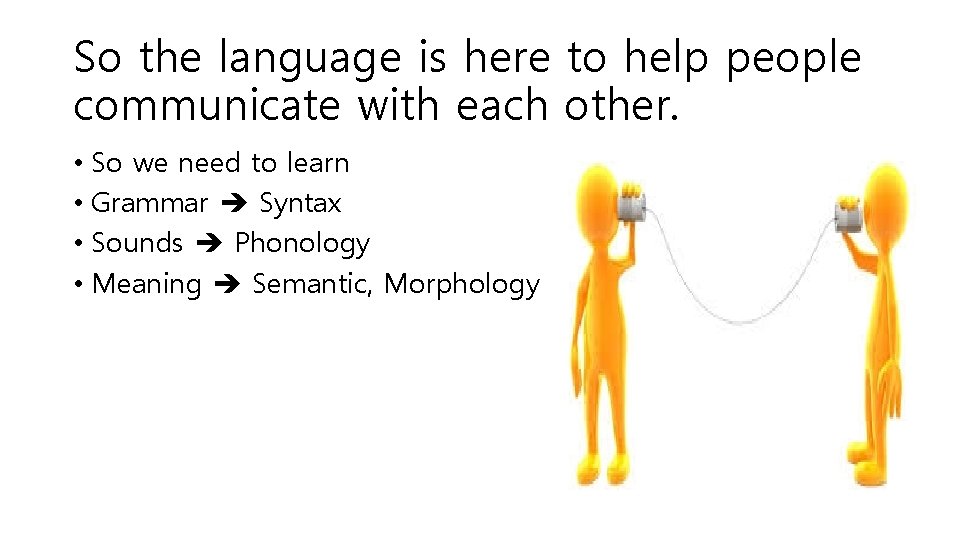
So the language is here to help people communicate with each other. • So we need to learn • Grammar Syntax • Sounds Phonology • Meaning Semantic, Morphology
Why?
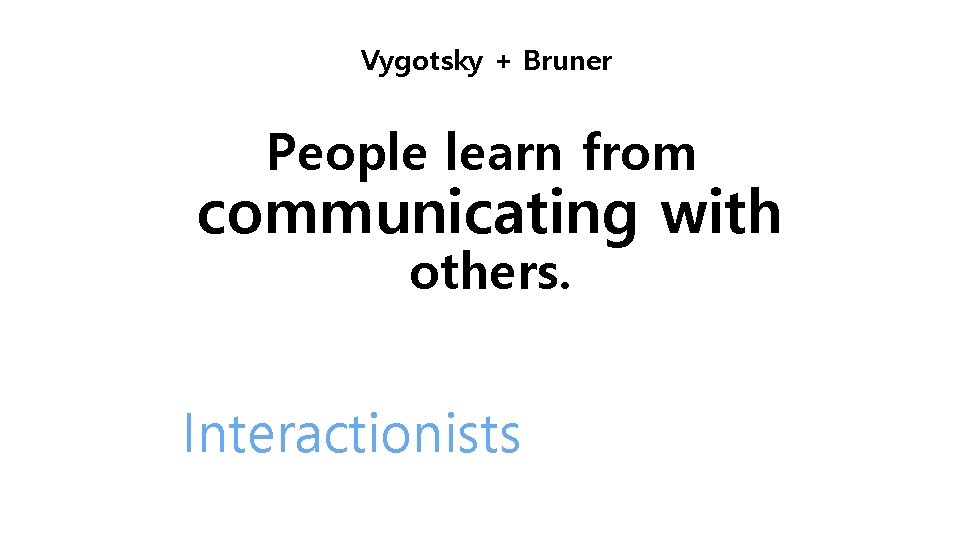
Vygotsky + Bruner People learn from communicating with others. Interactionists
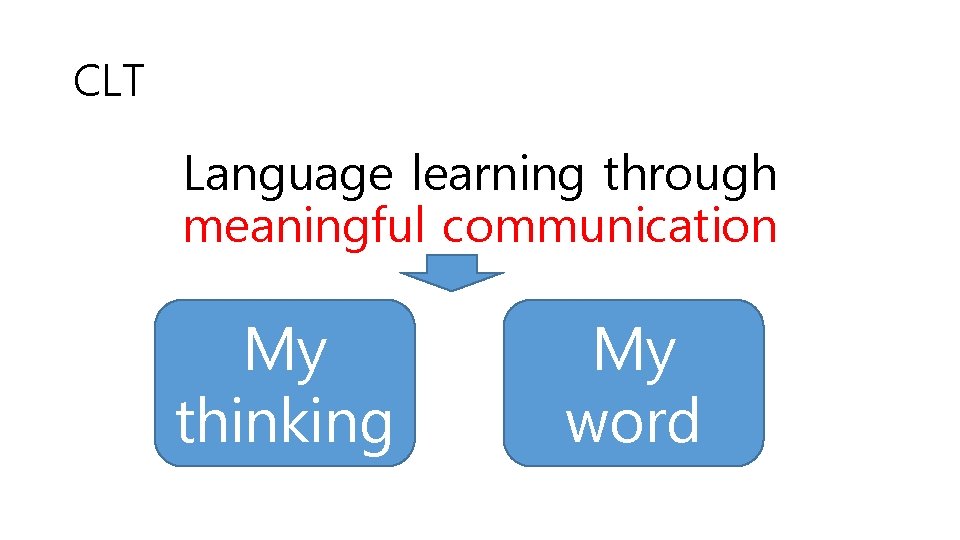
CLT Language learning through meaningful communication My thinking My word
Communicative competence?
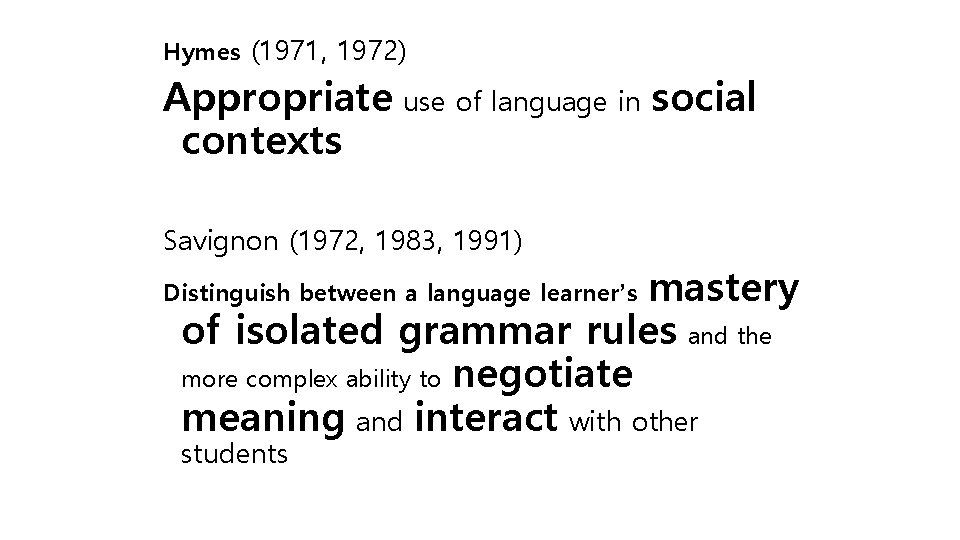
Hymes (1971, 1972) Appropriate use of language in social contexts Savignon (1972, 1983, 1991) mastery of isolated grammar rules and the more complex ability to negotiate meaning and interact with other Distinguish between a language learner’s students
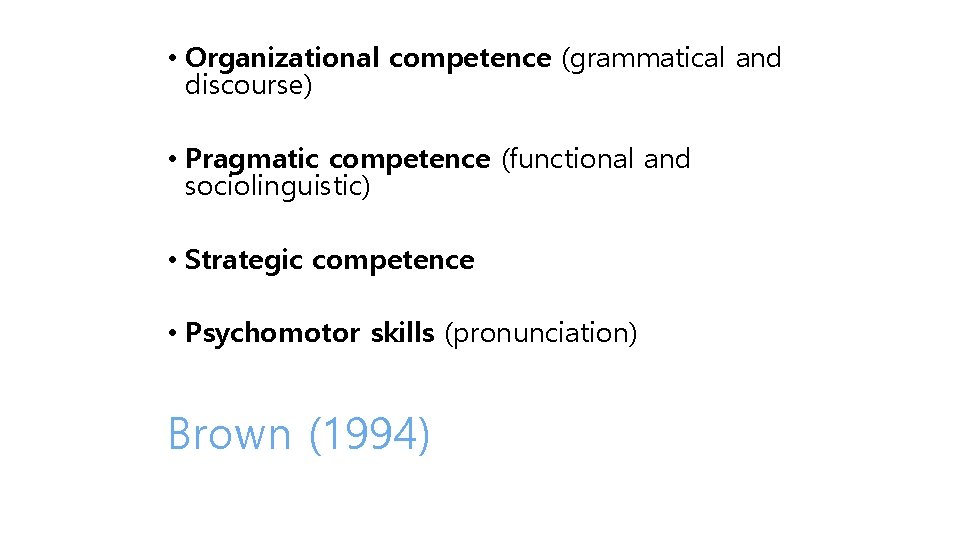
• Organizational competence (grammatical and discourse) • Pragmatic competence (functional and sociolinguistic) • Strategic competence • Psychomotor skills (pronunciation) Brown (1994)
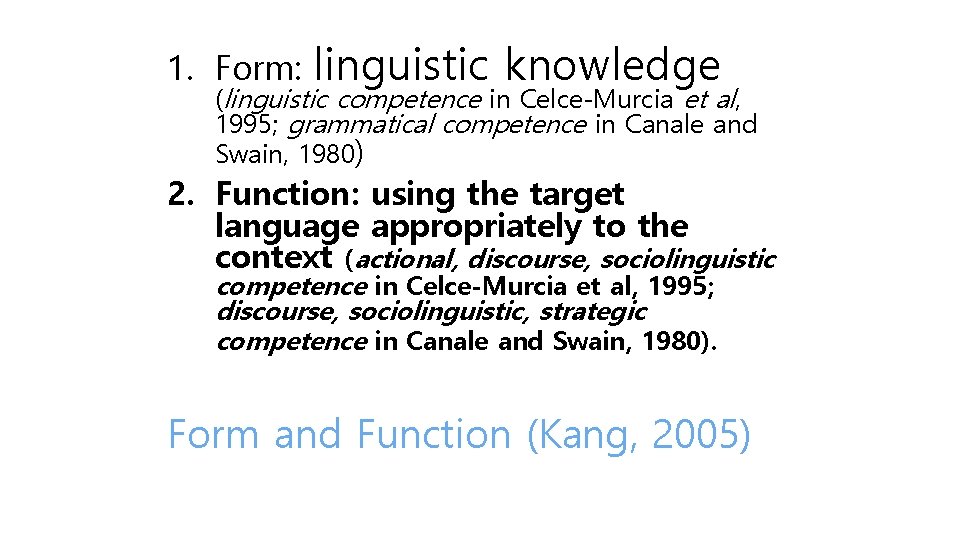
1. Form: linguistic knowledge (linguistic competence in Celce-Murcia et al, 1995; grammatical competence in Canale and Swain, 1980) 2. Function: using the target language appropriately to the context (actional, discourse, sociolinguistic competence in Celce-Murcia et al, 1995; discourse, sociolinguistic, strategic competence in Canale and Swain, 1980). Form and Function (Kang, 2005)
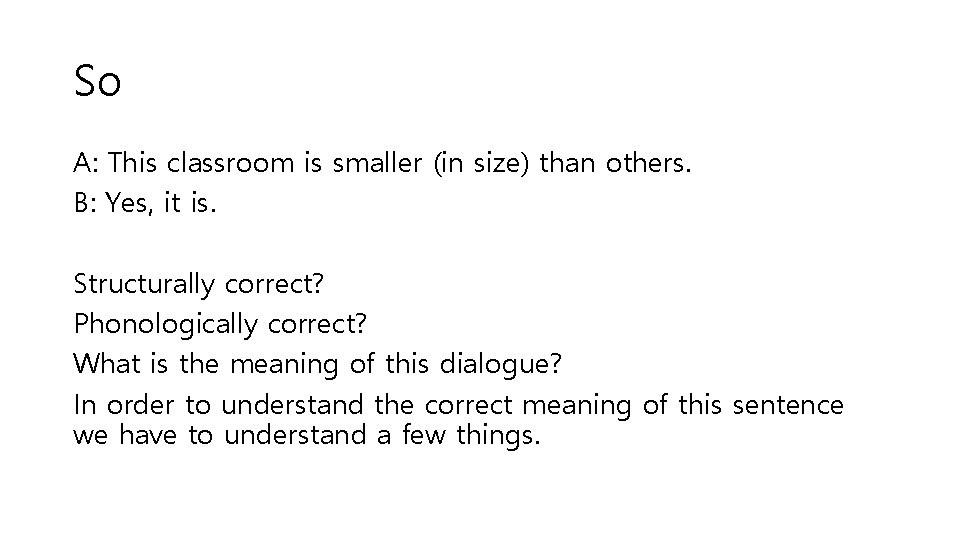
So A: This classroom is smaller (in size) than others. B: Yes, it is. Structurally correct? Phonologically correct? What is the meaning of this dialogue? In order to understand the correct meaning of this sentence we have to understand a few things.
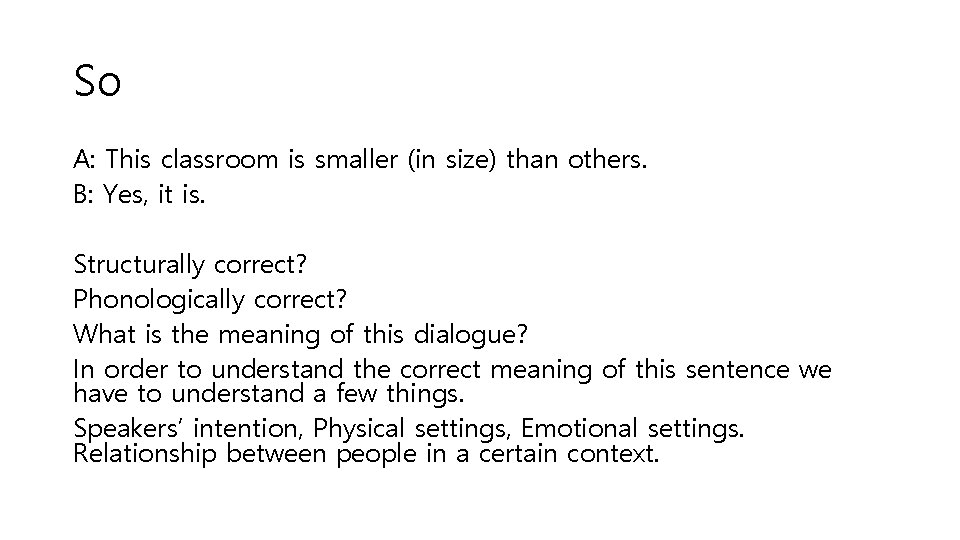
So A: This classroom is smaller (in size) than others. B: Yes, it is. Structurally correct? Phonologically correct? What is the meaning of this dialogue? In order to understand the correct meaning of this sentence we have to understand a few things. Speakers’ intention, Physical settings, Emotional settings. Relationship between people in a certain context.
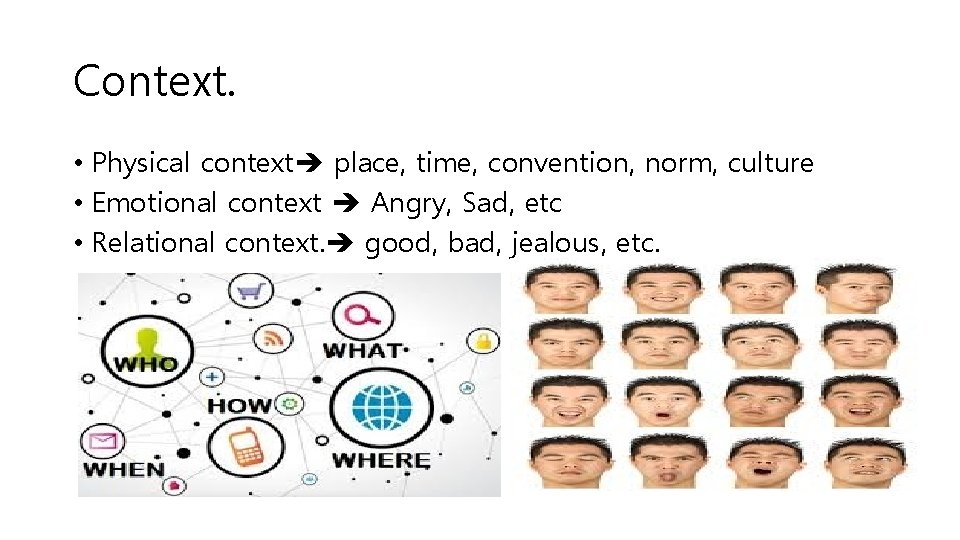
Context. • Physical context place, time, convention, norm, culture • Emotional context Angry, Sad, etc • Relational context. good, bad, jealous, etc.
So Let’s practice A: This classroom is smaller (in size) than others. B: Yes, it is. A: What is it? B: It’s a pen. A: Oh! Thanks. • Physical context place, time, convention, norm, culture • Emotional context Angry, Sad, etc • Relational context. good, bad, jealous, etc.
Pragmatic competence?
What is pragmatics? • The users in their social context; it cannot limit itself to the grammatically encoded aspects of contexts, • In a modern, communication-oriented terminology, we prefer to talk about messages and language users; in contrast to traditional linguistics, which first and foremost concentrates on the elements and structures (such as sounds and sentences) that the language users produce, pragmatics focuses on the language –using humans. • Language as a human product vs language in its human use • Description of its structure and a description of its use.
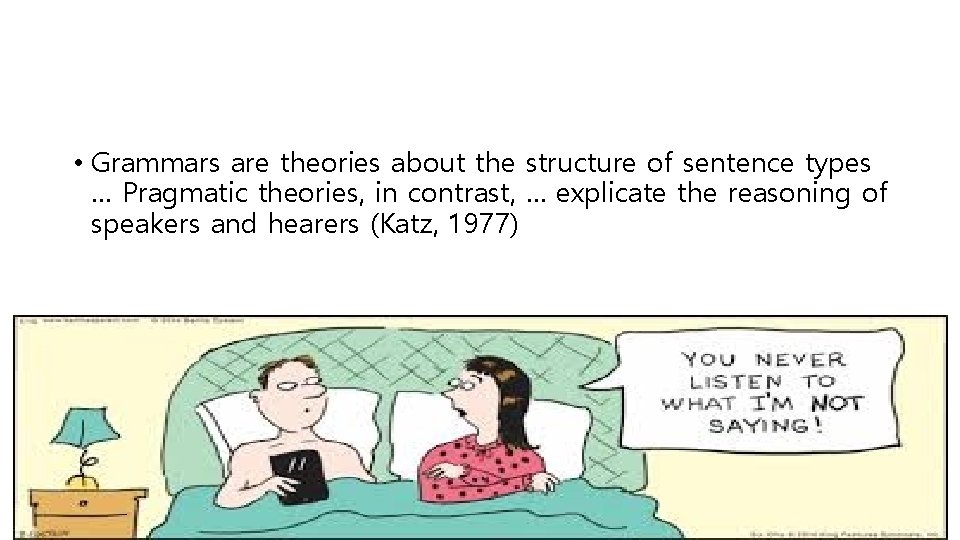
• Grammars are theories about the structure of sentence types … Pragmatic theories, in contrast, … explicate the reasoning of speakers and hearers (Katz, 1977)
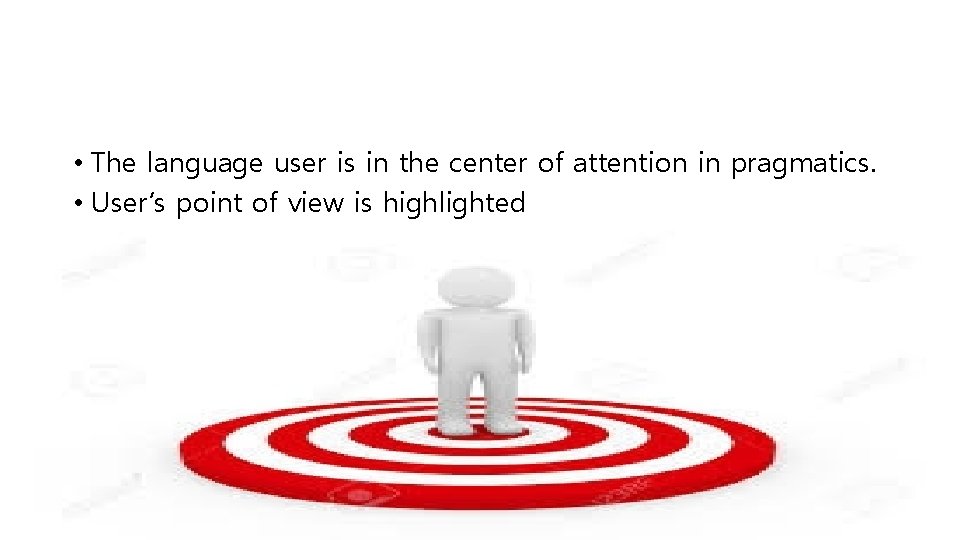
• The language user is in the center of attention in pragmatics. • User’s point of view is highlighted
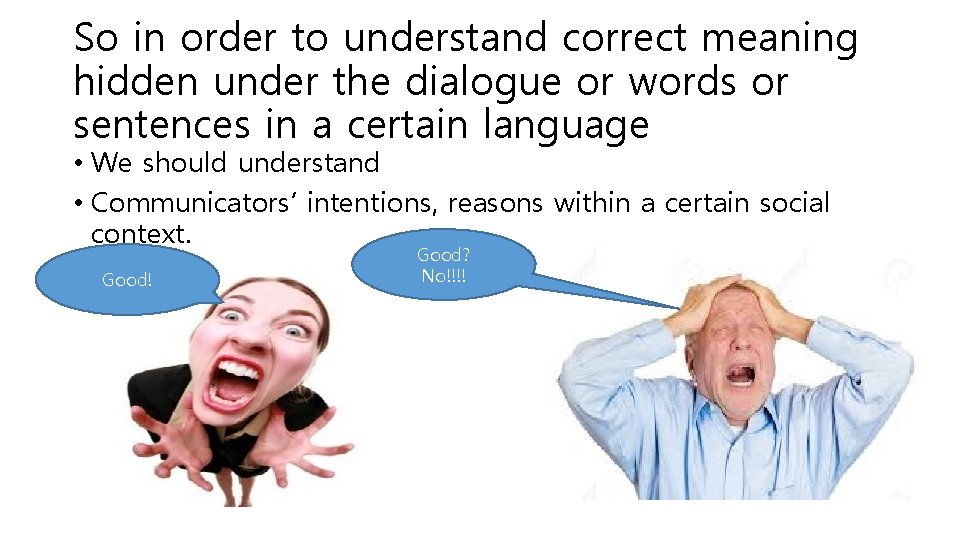
So in order to understand correct meaning hidden under the dialogue or words or sentences in a certain language • We should understand • Communicators’ intentions, reasons within a certain social context. Good! Good? No!!!!
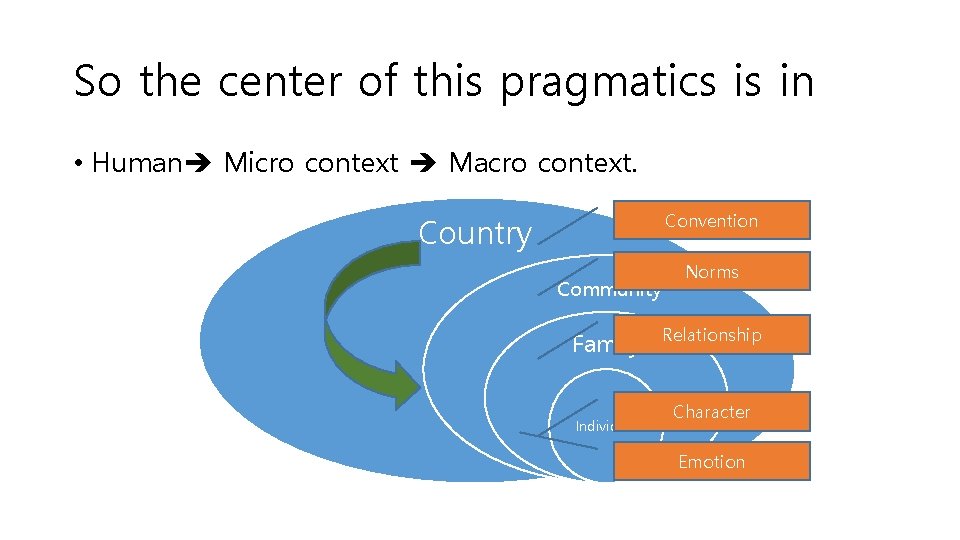
So the center of this pragmatics is in • Human Micro context Macro context. Convention Country Community Family Individual Norms Relationship Character Emotion
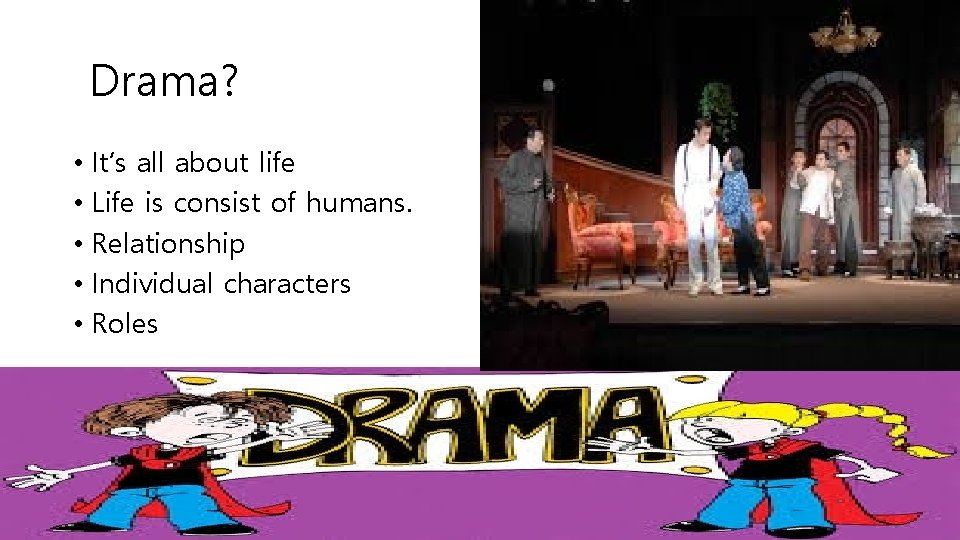
Drama? • It’s all about life • Life is consist of humans. • Relationship • Individual characters • Roles
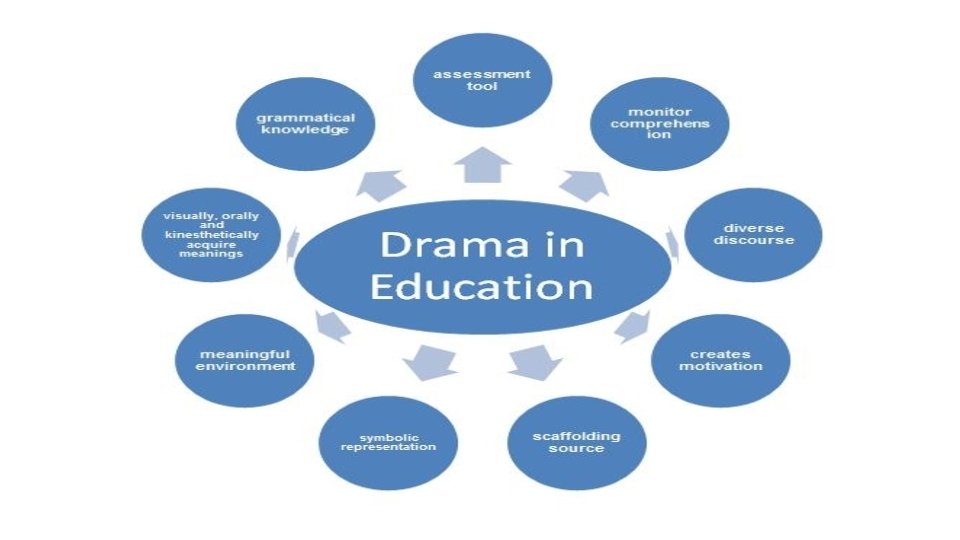
Drama in Education
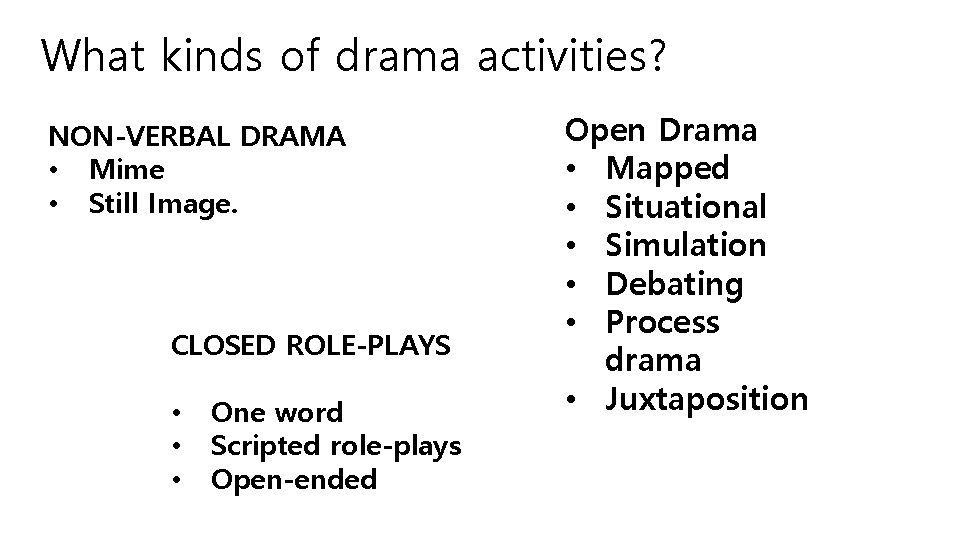
What kinds of drama activities? 3. 3. OPEN DR NON-VERBAL DRAMA • Mime • Still Image. CLOSED ROLE-PLAYS • • • One word Scripted role-plays Open-ended Open Drama • Mapped • Situational • Simulation • Debating • Process drama • Juxtaposition
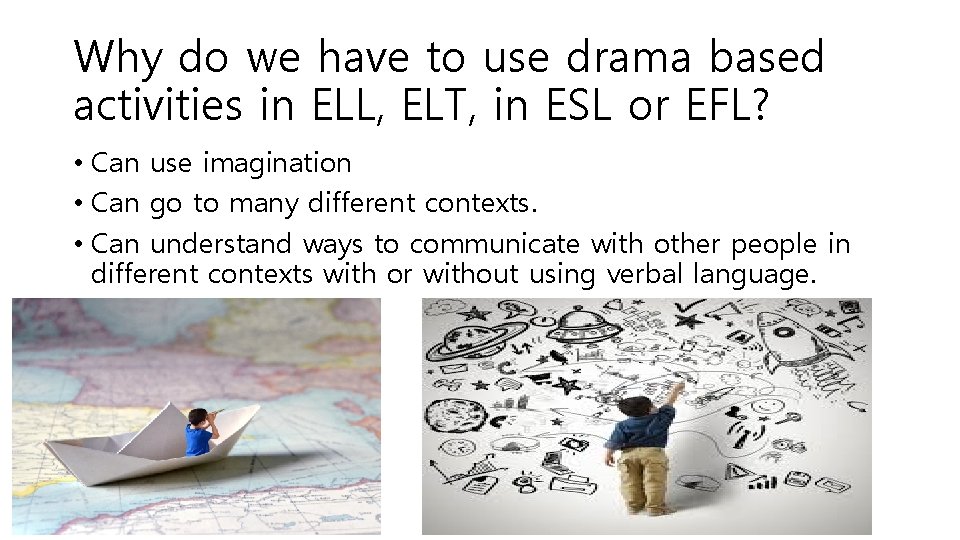
Why do we have to use drama based activities in ELL, ELT, in ESL or EFL? • Can use imagination • Can go to many different contexts. • Can understand ways to communicate with other people in different contexts with or without using verbal language.
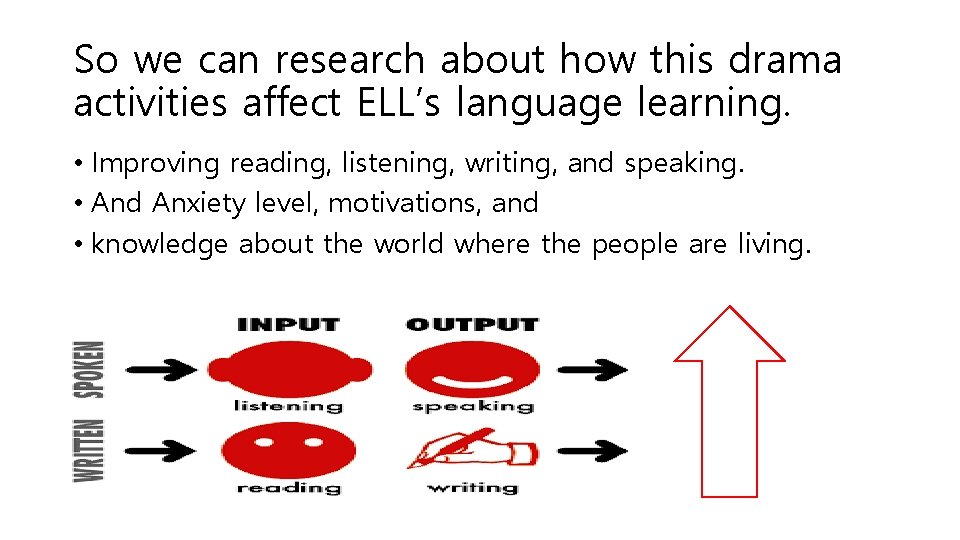
So we can research about how this drama activities affect ELL’s language learning. • Improving reading, listening, writing, and speaking. • And Anxiety level, motivations, and • knowledge about the world where the people are living.
Each week in this class we are going to • Have fun acting activities using both brain and body. • Have fun reading and discussing with each other about how the drama based activities would benefit ELL in Korean context. • Have fun designing an exciting drama based lesson plans. • Ultimately we are going to have fun.
So each week we have to • Read one or half of a chapter from one of the two books • Every other week you will read one article. • As a homework, you have to answer to a few focused questions about your reading. • Design a lesson plan. • Every other week from the 3 rd week, one person present the findings from an article to the class.
So in the end of this semester • Research • Midterm: literature review and a lesson plan. • Final: a research base report.
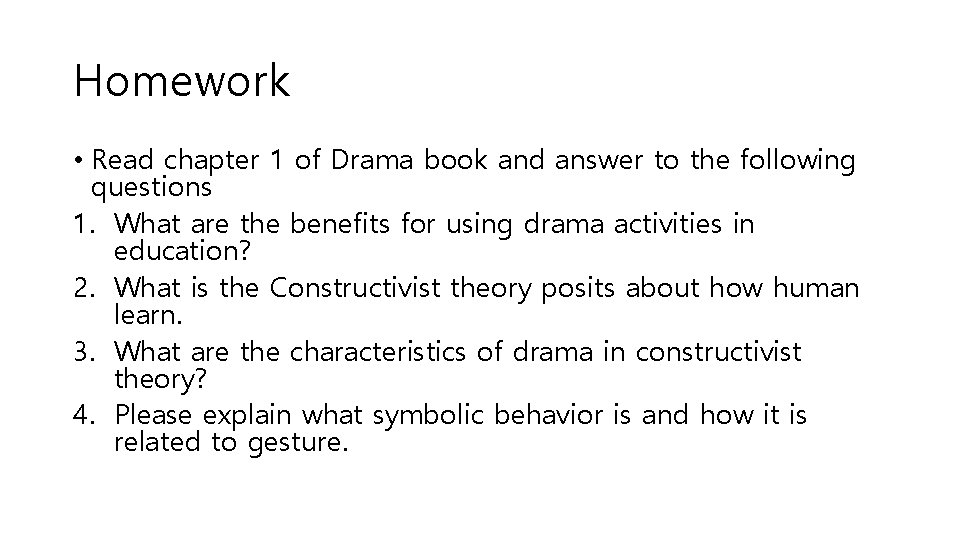
Homework • Read chapter 1 of Drama book and answer to the following questions 1. What are the benefits for using drama activities in education? 2. What is the Constructivist theory posits about how human learn. 3. What are the characteristics of drama in constructivist theory? 4. Please explain what symbolic behavior is and how it is related to gesture.
THANKS