
Language ideology and how they are linked What




- Slides: 43
Language, ideology. . . and how they are linked
What is power? � Simpson and Mayr p 2: power comes from the privileged access to social resources such as education, knowledge and wealth. Access to these resources provides authority, status and influence, which is an enabling mechanism for the domination, coercion and control of subordinate groups.
What is power? - but… � Simpson and Mayr p 2: However, power can also be seen as something more than simply dominance from above; in many situations, for example, power is ‘jointly produced’ because people are led to believe that dominance is legitimate in some way or other. This second, more consensual, understanding of power suggests a two-way distinction: power through dominance and power by consent.
Power by consent – Simpson and Mayr p 3 � Gramsci’s (1971) concept of hegemony: the mechanisms through which dominant groups in society succeed in persuading subordinate groups to accept the former’s own moral, political and cultural values and institutions. Within this framework, discourse constructs hegemonic attitudes, opinions and beliefs and (…) does so in such a way as to make these beliefs appear ‘natural’ and ‘common sense’.
Power in and behind discourse (Fairclough) � Power in discourse: what influence a linguistic event may have on recipients. e. g. a political speech; an advertisement � Power behind discourse: what the relationships are in general terms between producer and recipient. e. g. the dominance of the media; ubiquity
Ideology (vs. rhetoric) � Classical rhetoric: a consciously acquired skill intended to help writers persuade and influence their audience � Ideology: › a universal fact of human language. The accepted ideas of a group of people who (usually) share a language. Not always harmful or manipulative. › in the hands of the powerful, though, can be influential – particularly if hidden.
Naturalisation and common sense � Ideologies that are common/universal: may be seen as ‘true’ or ‘common sense’ e. g. killing people is wrong sending children out to work is wrong � The process by which new or different ideas gain this status is ‘naturalisation’ � It can be affected by discourses repeating it
Contexts of production/reception � Producer has power over recipient: always, by the nature of language? sometimes more than others? � What kind of power does the recipient have? critical reading resistance to ideology response/feedback
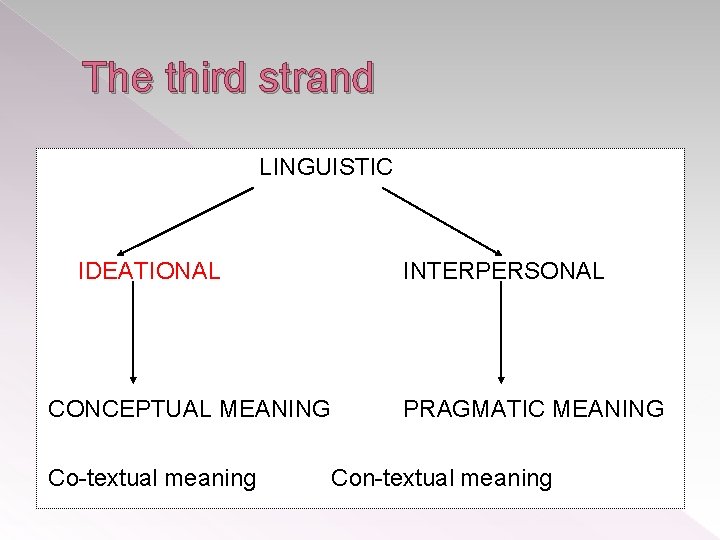
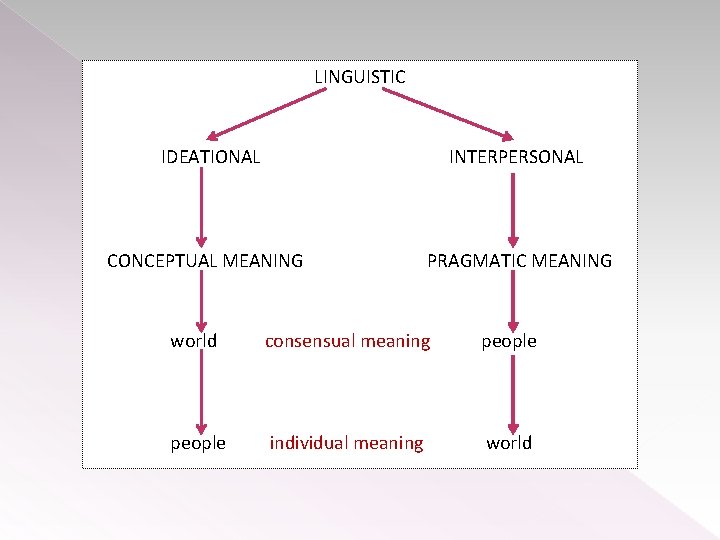
The third strand LINGUISTIC IDEATIONAL CONCEPTUAL MEANING Co-textual meaning INTERPERSONAL PRAGMATIC MEANING Con-textual meaning
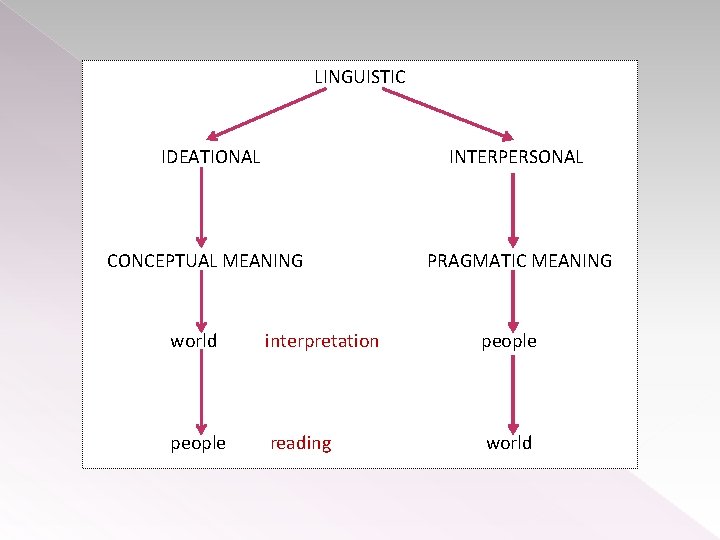
The third strand LINGUISTIC IDEATIONAL CONCEPTUAL MEANING Co-textual meaning INTERPERSONAL PRAGMATIC MEANING Con-textual meaning
Ideation and ideology � At one extreme, ideology is just the views that people you disagree with hold! � At the other extreme, ideology is everywhere. � Don’t take the second view too far! It is not the same as the meaning of the sentences. � Some sentences have pretty low levels of ideological interest.
Examples No gay couples welcome here. � Those children ought to be told to behave properly. � I had fish and chips for dinner last night. � Do you like my new coat? �
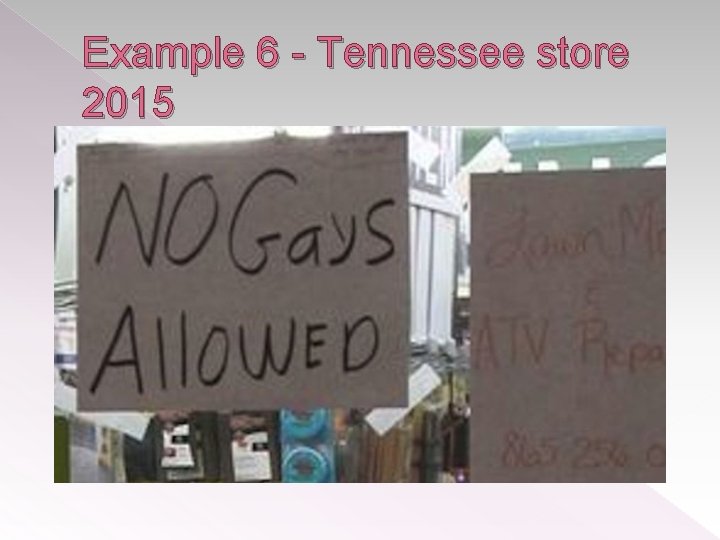
No gay couples welcome here. � Notice on a B&B door? › Easy to link to anti-homosexual ideology › Probably held in tandem with a range of other ideologies such as the need for children to be raised by heterosexual couple – ideally their biological parents etc. � Not legal in the UK › Ideologies are not linked to legality/illegality – they are linked to opinions, not actions.
Those children ought to be told to behave properly. �A little less clearly ideological � Seems to imply that › Adults in charge of children have a duty to other adults to control them so that they are not a nuisance › Could be that there is an underlying ideology about children being naturally anarchic › The alternative ideology (of the parents? ) might be that children should be allowed to express themselves…
I had fish and chips for dinner last night. � At first sight seems not to be ideological � However, there assumptions being made › Eating fish is acceptable › Resources of the world are for human beings to consume � The speaker is not consciously trying to influence the listener – s/he is simply stating a fact � But the repetition of assumptions is a naturalising force.
Do you like my new coat? � This sentence is hard to link to ideology at all. � At a push you could say that it demonstrates the ideology that one’s looks are an important part of valuing human beings. � Notice that the ideology of this sentence is NOT ‘whether the speaker’s new coat is nice’!
Ideology: more specific than ideation � Ideation is the creation of a text world along a number of dimensions. � It shows what the world looks like and who inhabits it and how they behave. � This works for fictional and non-fictional texts because our views of the ‘real’ world differ. � It is in the difference between our world views that ideological values may become important.
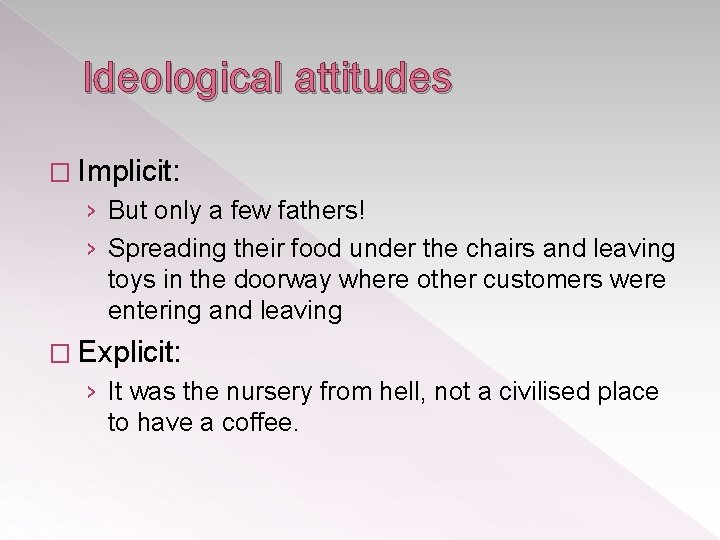
Ideation and ideology � I was in the café at the community centre last week and the place was heaving with young mothers (but only a few fathers!) with small babies and toddlers. The children were all crawling around on the floor, spreading their food under the chairs and leaving toys in the doorway where other customers were entering and leaving. It was the nursery from hell, not a civilised place to have a coffee.
The world of the text �A place – the café � People – mothers, fathers, babies, toddlers � Actions – crawling, spreading, leaving � Position of items – under the chairs, in the doorway � So far, ideational and not (particularly) ideological.
Ideological attitudes � Implicit: › But only a few fathers! › Spreading their food under the chairs and leaving toys in the doorway where other customers were entering and leaving � Explicit: › It was the nursery from hell, not a civilised place to have a coffee.
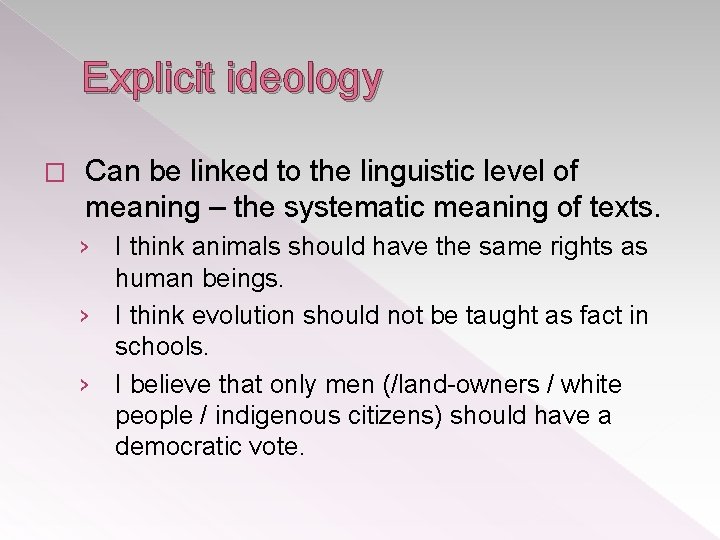
Explicit ideology � Can be linked to the linguistic level of meaning – the systematic meaning of texts. › I think animals should have the same rights as human beings. › I think evolution should not be taught as fact in schools. › I believe that only men (/land-owners / white people / indigenous citizens) should have a democratic vote.
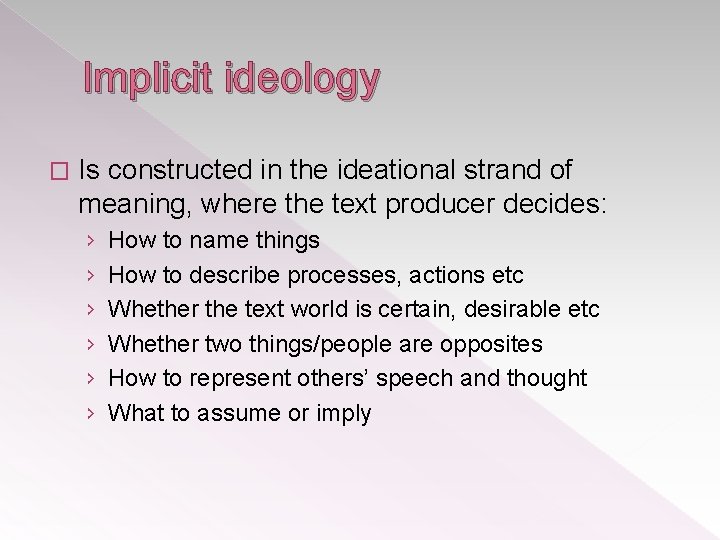
Implicit ideology � Is constructed in the ideational strand of meaning, where the text producer decides: › › › How to name things How to describe processes, actions etc Whether the text world is certain, desirable etc Whether two things/people are opposites How to represent others’ speech and thought What to assume or imply
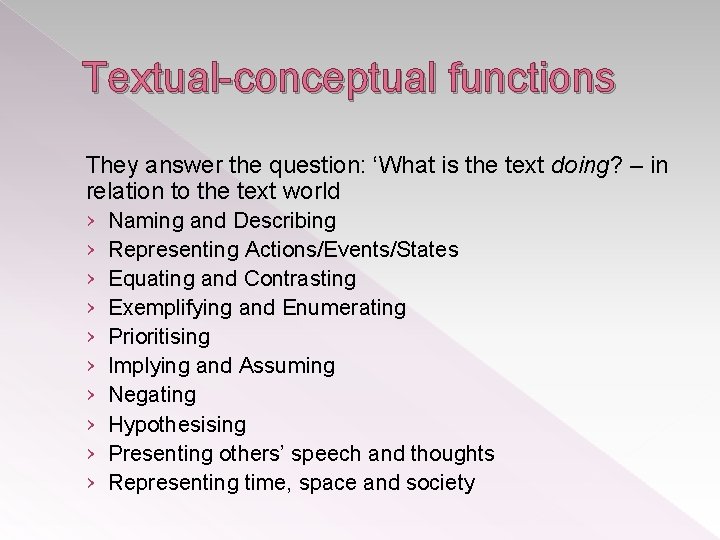
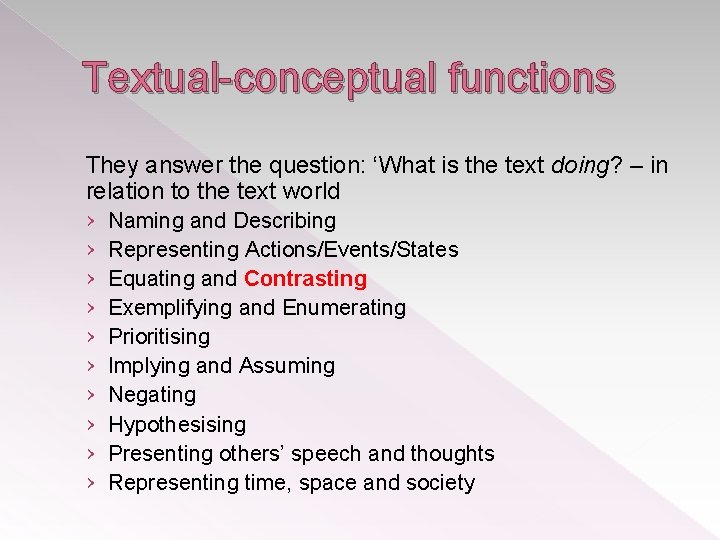
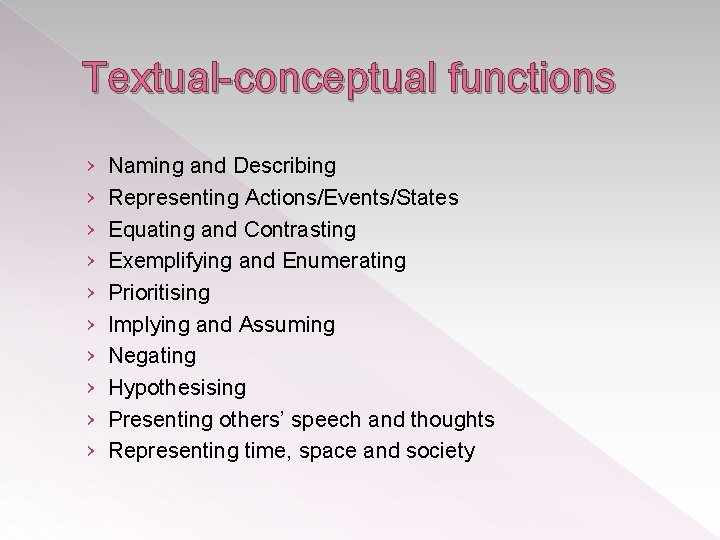
Textual-conceptual functions They answer the question: ‘What is the text doing? – in relation to the text world › › › › › Naming and Describing Representing Actions/Events/States Equating and Contrasting Exemplifying and Enumerating Prioritising Implying and Assuming Negating Hypothesising Presenting others’ speech and thoughts Representing time, space and society
Textual-conceptual functions They answer the question: ‘What is the text doing? – in relation to the text world › › › › › Naming and Describing Representing Actions/Events/States Equating and Contrasting Exemplifying and Enumerating Prioritising Implying and Assuming Negating Hypothesising Presenting others’ speech and thoughts Representing time, space and society
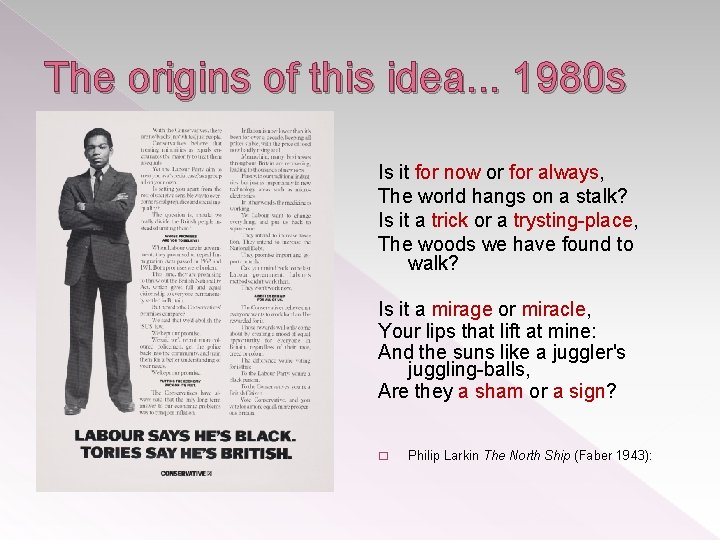
The origins of this idea. . . 1980 s Is it for now or for always, The world hangs on a stalk? Is it a trick or a trysting-place, The woods we have found to walk? Is it a mirage or miracle, Your lips that lift at mine: And the suns like a juggler's juggling-balls, Are they a sham or a sign? � Philip Larkin The North Ship (Faber 1943):
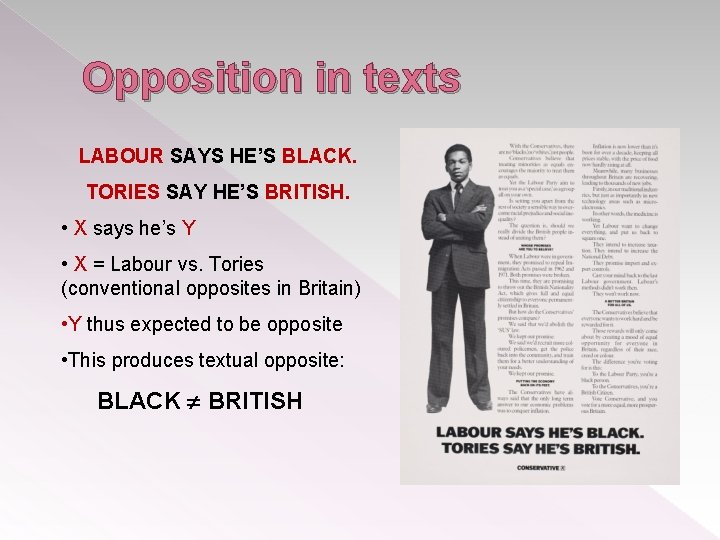
Opposition in texts LABOUR SAYS HE’S BLACK. TORIES SAY HE’S BRITISH. • X says he’s Y • X = Labour vs. Tories (conventional opposites in Britain) • Y thus expected to be opposite • This produces textual opposite: BLACK BRITISH
Opposition: background knowledge Context-free opposites are essential Conventional agreement as to what they are Not set in stone (otherwise texts couldn’t produce new ones) � But new ones are dependent for their meaning on the idea of opposition, if not on actual opposites � � A prime example of the phenomenon of textualconceptual functions (TCFs)
2. Opposition: examples � Big Bang Theory (U. S. sitcom): › A bit like but with nerdy scientists… � I’m a physicist, not a hippy: � http: //www. youtube. com/watch? feature=play er_detailpage&v=b 5 V 0 QY 1 d 904
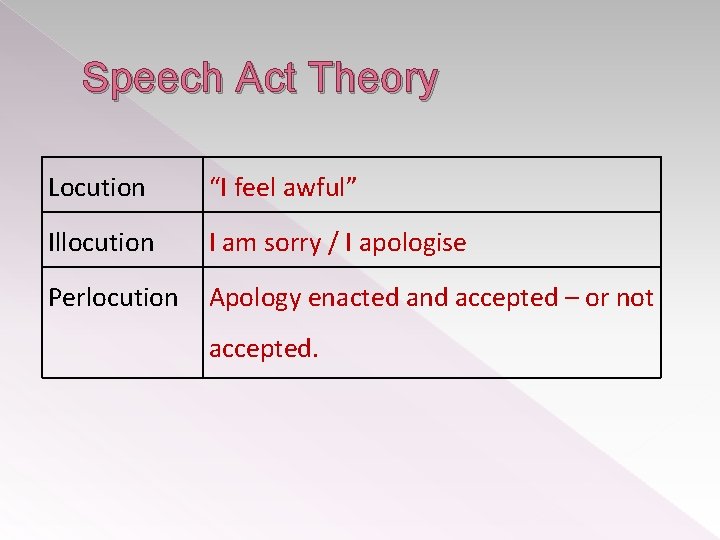
Speech Act Theory Locution “I feel awful” Illocution I am sorry / I apologise Perlocution Apology enacted and accepted – or not accepted.
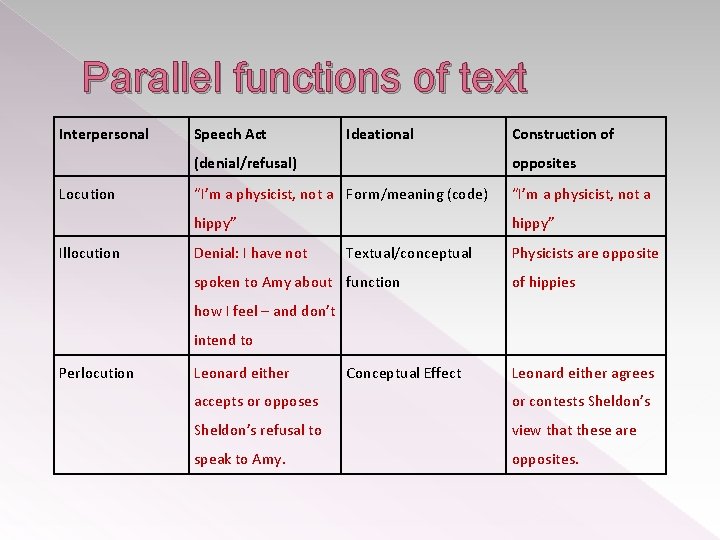
Parallel functions of text Interpersonal Locution Illocution Speech Act Ideational Construction of (denial/refusal) opposites “I’m a physicist, not a Form/meaning (code) “I’m a physicist, not a hippy” Denial: I have not Textual/conceptual spoken to Amy about function Physicists are opposite of hippies how I feel – and don’t intend to Perlocution Leonard either Conceptual Effect Leonard either agrees accepts or opposes or contests Sheldon’s refusal to view that these are speak to Amy. opposites.
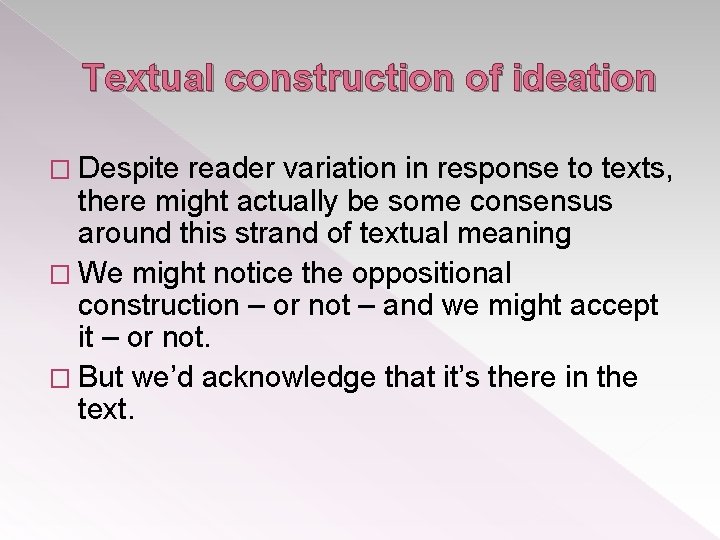
Textual construction of ideation � Despite reader variation in response to texts, there might actually be some consensus around this strand of textual meaning � We might notice the oppositional construction – or not – and we might accept it – or not. � But we’d acknowledge that it’s there in the text.
LINGUISTIC IDEATIONAL INTERPERSONAL CONCEPTUAL MEANING PRAGMATIC MEANING world consensual meaning people individual meaning world
LINGUISTIC IDEATIONAL INTERPERSONAL CONCEPTUAL MEANING PRAGMATIC MEANING world interpretation people reading world
Textual-conceptual functions These are textually-based meanings which construct a particular (set of) mental image(s) of the text world � Such images may be – and often are – ideological. � Author-intention is not implied because it is often subconscious (particularly if naturalised ideology) � reader acceptance not implied either, though the reader does have to engage with it (if only to reject) �
Textual-conceptual functions › › › › › Naming and Describing Representing Actions/Events/States Equating and Contrasting Exemplifying and Enumerating Prioritising Implying and Assuming Negating Hypothesising Presenting others’ speech and thoughts Representing time, space and society
Example 1 (Metro 28. 6. 16) �Rise in race hate since vote ‘must be stamped out’.
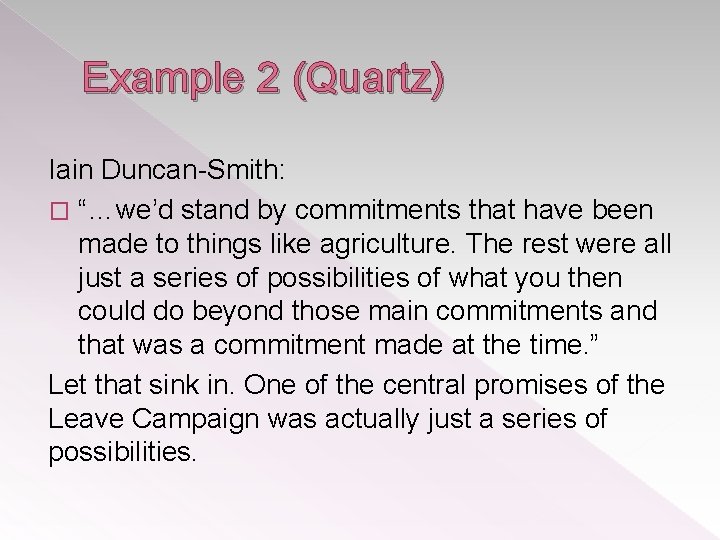
Example 2 (Quartz) Iain Duncan-Smith: � “…we’d stand by commitments that have been made to things like agriculture. The rest were all just a series of possibilities of what you then could do beyond those main commitments and that was a commitment made at the time. ” Let that sink in. One of the central promises of the Leave Campaign was actually just a series of possibilities.
Example 3(Metro 28. 6. 16) � Who’s strong enough to lead us to success?
Example 4 1920 s New York
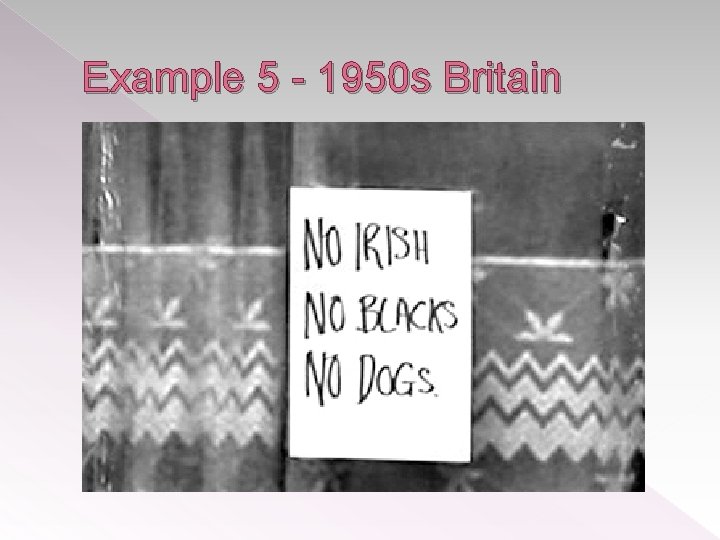
Example 5 - 1950 s Britain
Example 6 - Tennessee store 2015
Example 7 � Naming: ‘Brexit’ � Contrasting: Leave vs. Remain
References � Fairclough, Norman (2013 2 nd edn) Language and Power. Routledge. � Jeffries, Lesley (2010) Critical stylistics: the power of English. Palgrave. � Simpson, Paul and Mayr, Andrea(2010) Language and Power: A Resource Book for Students. Routledge.