
Language Identity in the Balkans Chapter 1 Introduction
Language & Identity in the Balkans Chapter 1: Introduction
1. 0 Overview • Dramatic changes in the status of what used to be called Serbo-Croatian • This study addresses specific controversies surrounding the codification of the four successor languages to Serbo-Croatian: Serbian, Montenegrin, Croatian, and Bosnian • Examines link between national image, personal & group identity, and the spoken word
What do you know about the Former Yugoslavia? • What republics did it contain? • What were the titular languages of the republics? • What other languages were present? • What are the successor states?

1. 1 Goals & methodology • Works on the subject of Serbo-Croatian published in former Yugoslavia are subjective & lack scholarly rigor • Experts from outside Yugoslavia have focused only on individual successor languages, without attempting to incorporate data from the entire Serbo. Croatian speech territory
1. 1 Goals & methodology, cont’d. • Outline of book – – – – Ch 2: history of joint literary language Successor languages: Ch 3: Serbian Ch 4: Montenegrin Ch 5: Croatian Ch 6: Bosnian Ch 7: Conclusion -- language controversies of the past continue to destabilize standardization process
1. 1 Goals & methodology, cont’d. • We will examine: – codification instruments (dictionaries, grammars, etc. -- these have political rather than linguistic significance) – work by indigenous scholars (focus on main controversies) – blueprints for new successor languages – popular press (to gauge wider implications of emergence of successor languages)
1. 1 Goals & methodology, cont’d. • Main themes: – Trends in process of birth & re-birth within former Serbo-Croatian territory – How language planners attempt to differentiate among various languages – Political motivations and social forces that brought about linguistic transformations among 20 M people who once spoke a unified langauge – Relationship between language, ethnicity, nationalism
1. 2 Language as a marker of ethnic identity • Ethnicity (Fishman 1989): – Collective, intergenerational cultural continuity – Links to one’s own people – Shared ancestral origins and the gifts, responsibilities, rights, and obligations deriving therefrom
1. 2 Language as a marker of ethnic identity, cont’d. • In former Yugoslavia: – Administrative boundaries have never corresponded with ethnic ones – Ethnic distribution looks like a jigsaw puzzle – Ethnic terms have been fluid, members have switched allegiance, ethnic labels have changed (esp Muslim > Bosniac)
1. 2 Language as a marker of ethnic identity, cont’d. • Ethnicity (Edwards 1985): – Based on both objective and subjective considerations – Objective: language, race, geography, religion, ancestry BUT: Are these really “objective”? – Subjective: ethnic belonging is voluntary, mutable, and a reflection of belief, sense of groupness (but must relate to something real in the past)
1. 2 Language as a marker of ethnic identity, cont’d. • Two flaws in Edwards’ definition as a description of Yugoslav identities: – Religion and ancestry have been insufficient in determining group identity – Language has proven to be neither an objective factor nor an immutable one – How can language be a subjective factor?
1. 2 Language as a marker of ethnic identity, cont’d. • Croats are Catholic, Serbs & Montenegrins are Orthodox Christians, but they all speak mutually intelligible dialects • Language as a ”flag” – 1944 Establishment of Macedonian literary language – 1995 -96 Codification of Bosnian language
1. 2 Language as a marker of ethnic identity, cont’d. • Language is NOT an ”objective” marker of ethnic identity in former Yugoslavia – They all speak ”the same” language, but cannot agree on what to call it, what dialects should be official, or what orthography to use – Language choices are subjective and politically motivated
1. 3 Language in the context of Balkan nationalism • Balkan peoples began national revivals in 19 th & early 20 th c • Herder’s principle that a nation required its own language was enthusiastically received in Eastern Europe • 1850 Literary Agreement by Serb and Croat intellectuals asserted that Catholic, Orthodox, and Muslim Central Southern Slavs were one people with a single language
1. 3 Language in the context of Balkan nationalism, cont’d. • The two Yugoslav states (1918 -41 & 1945 -91) recognized these same people as 2, 3, or 4 separate peoples (who still spoke the same language) • This fact violated the belief that a group with national pretensions was incomplete without its own language -- groups sought to ”correct” this after 1991 • How could this be ”corrected”?
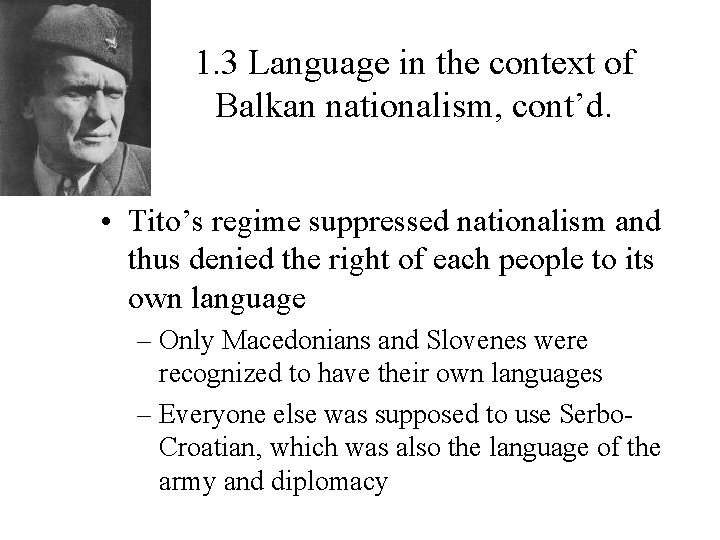
1. 3 Language in the context of Balkan nationalism, cont’d. • Tito’s regime suppressed nationalism and thus denied the right of each people to its own language – Only Macedonians and Slovenes were recognized to have their own languages – Everyone else was supposed to use Serbo. Croatian, which was also the language of the army and diplomacy
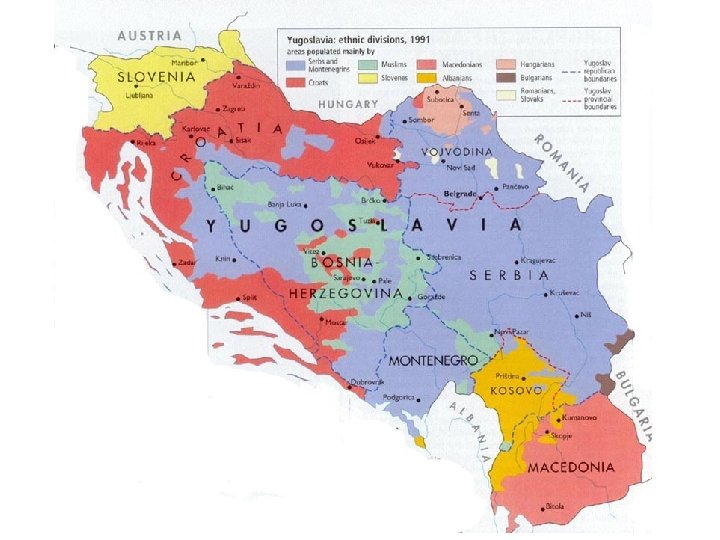
1. 3 Language in the context of Balkan nationalism, cont’d. • 1960 s Croats began openly calling their language ”Croatian” • Bosnia-Herzegovina used a variant different from standard S-C and Latin letters • 1986 Serbian ”Memorandum” expressed distress at the lack of protection for Serbian outside Serbia proper
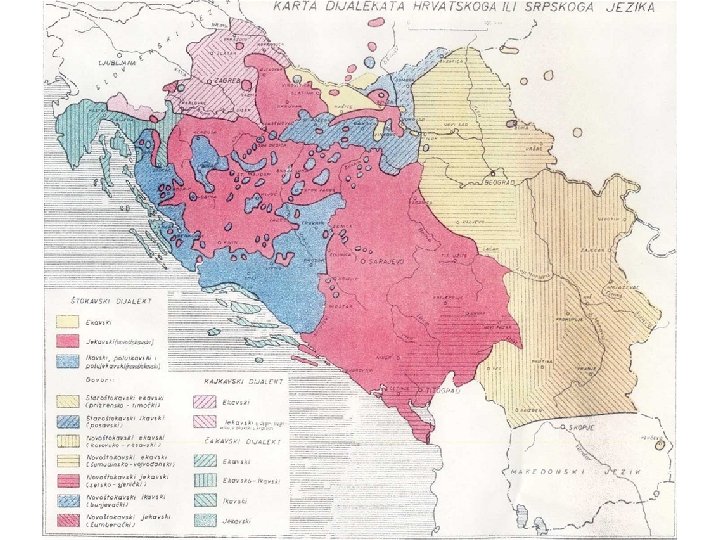
1. 3 Language in the context of Balkan nationalism, cont’d. • 1968 Kosovo Albanians abandoned their native Gheg dialect in favor of the Tosk standard used in Albania, and Serbs regarded this as a move toward a unified Albanian state • 1990 s Croatians initiated a campaign to purge ”Serbian” words and replace them with ”Croatian” ones • In 1990 s Serbs living in Croatia attempted to use Cyrillic as a marker of identity
1. 3 Language in the context of Balkan nationalism, cont’d. • Language planners set up barriers for communication instead of facilitating mutual intelligibility • Language birth in Balkans results in part from explosive nationalist policies in Croatia, Bosnia. Herzegovina, Serbia, Montenegro • But the unity of the language was threatened before this as well
1. 4 Serbo-Croatian: A dying tongue? • Language death for S-C is not conventional, since it was not brought on by the death of the last speaker or language shift • Maybe S-C never really existed, but was just a collection of diverse dialects
1. 4 Serbo-Croatian: A dying tongue? , cont’d. • Languages can differentiate – Abstand: by ”naturally” drifting apart (e. g. , English and German) – Ausbau: through the active intervention of language planners, linguists, and policy makers (e. g. , Hindi & Urdu, Scandinavian) – Dialects in Bulgarian and Macedonian area drifted apart via Abstand, but their literary languages are the products of Ausbau
1. 4 Serbo-Croatian: A dying tongue? , cont’d. • Mutual intelligibility is NOT the determining factor in language differentiation • As of 1991 -2 Serbo-Croatian officially ceased to exist in the Yugoslav successor states • The splitting of the language occurred along ethnic lines, rather than geographic or political boundaries, and was neither orderly nor planned
1. 4 Serbo-Croatian: A dying tongue? , cont’d. • Today: – Serbs and Croats do not accept the existence of Bosnian language – Serbs and some Montenegrins do not accept the existence of Montenegrin – Serbs living in Croatia do not accept Croatian language reforms (despite speaking a similar dialect) – Bosniacs accept neither Serbian nor Croatian
1. 4 Serbo-Croatian: A dying tongue? , cont’d. • Linguistics has been highly politicized in the Balkans (even before break-up of Yugoslavia) • In ex-Yugoslavia, linguists have been major actors on the political stage
- Slides: 27