
LANGUAGE FOCUS TERMS AND PRAGAMTICS By Livania Sa
LANGUAGE FOCUS TERMS AND PRAGAMTICS By: Livania Sa’
BACKGROUND RESEARCH • The theory of Pragmatic Terms relate to the use of language in social context , or the ability to use language to get things done in the world (Berko Gleason, Mac Gibbon & Zaretsky, 2001). • Language: a skill which is acquired over an extensive period of time through daily interaction and every day dialogue. (Ely, Berko Gleason, Mac Gibbon & Zaretsky, 2001: Beal's, 1993). • Parents engage in explanatory talk with their children providing information about the function and the adjusting language to fit different circumstances, using pragmatic terms (Beal's, 1993; 2001).
Continue • Explanatory talk, positively relates to the acquisition of literacy skills in young children • The meal time conversations allows children to think and gain information about a wide variety of topics and learn the forms in which people talk about them with several topics such as words, actions, and motives. (Beginning Literacy with Language. Balesp. 7592; 2001). • Children in low income families don’t do as well as middle income children with their peers (Bales, 1993).
Gaps in research • Unfortunately to date, their has been no examination on the use of pragmatic terms and explanatory talk by low income and middle income parents, with their children.
Purpose • This study was designed to replicate the findings of Ely, et al , (2001)with middle income and low income families, while simultaneously examining the use of pragmatic terms in particular explanatory talk and repetitive talk.
Research Questions • What relationship exists between parents’ and children use of language pragmatic term within every discourse? • To what extent does the us of pragmatic terms relate to explanatory talk?
Methods • The participants were fourteen children from elementary schools in in New York. One represented the advanced children population from high/middle income backgrounds while the other represented the average children from low income backgrounds. • For the purpose of this study only the transcripts of the dinner-time conversations of four families were examined, one from families with high/middle income children and one from families with low/average income children.
Design and procedure • Transcripts of the dinner time conversations of four families were tested. One from the families with middle income children including their parents and another from the families with average/low income children including their parents. • The transcripts were transcribed according to the Child Language Data Exchange System (CHILDES) guidelines ( Mac Whinney & Snow, 1990). • Transcripts were coded for pragmatic terms and explanatory talk.
Coding scheme • The coding scheme was divided into two categories : (1)Explantory talk versus repetitive talk (2)Language focus Terms (PRAGAMTIC TERMS) • Each category was operationally defined and focused on pragmatic terms.

Table 1 Operational Definitions Language Focused-Terms • Pragmatics Codes • Control: a speaker attempts to control if when another person speaks or listens. • Clarification: a listener requests clarification of what has just been said. • Elicitation: a listener elicits a narrative or other from another
Operational Definitions (continue) Explanatory Talk: is a form of decontextualized discourse that often provides information but rich vocabulary. Types of explanatory talk • Intentional/action segments: these segments were most often discussions and actions or behavior in the immediate context of the mealtime.
Operational definition (continue) • Repetitive Talk: tend to repeat very similar questions without necessary providing additional information. Types of repetitive talk • Child repetitive talk –child repeats adult exactly Child : when it’s finished • Parent repetitive talk-adult repeats child exactly Mother: when it’s finished
Preliminary results • Number for words in each transcript were calculated. • Number of words in average family dialogue=403 • Number of words in gifted family dialogue=1, 805
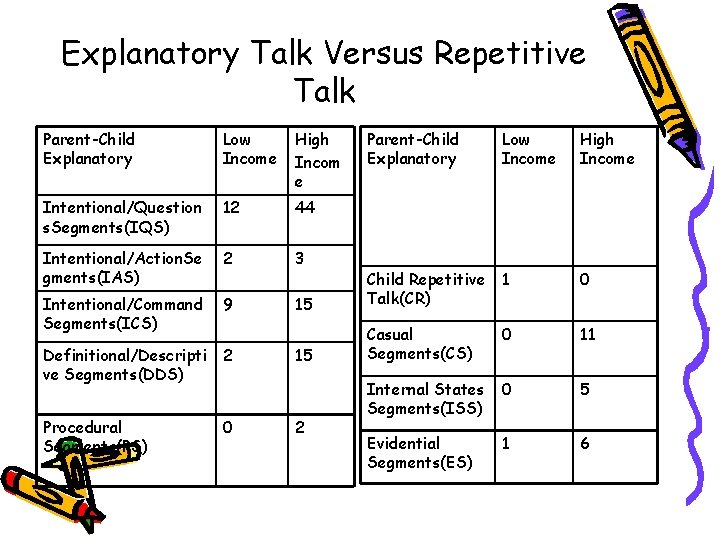
Explanatory Talk Versus Repetitive Talk Parent-Child Explanatory Low Income High Incom e Parent-Child Explanatory Low Income High Income Intentional/Question s. Segments(IQS) 12 44 Intentional/Action. Se gments(IAS) 2 3 1 0 15 Child Repetitive Talk(CR) Intentional/Command Segments(ICS) 9 Definitional/Descripti 2 ve Segments(DDS) 15 Casual Segments(CS) 0 11 0 5 Procedural Segments(PS) 2 Internal States Segments(ISS) Evidential Segments(ES) 1 6 0
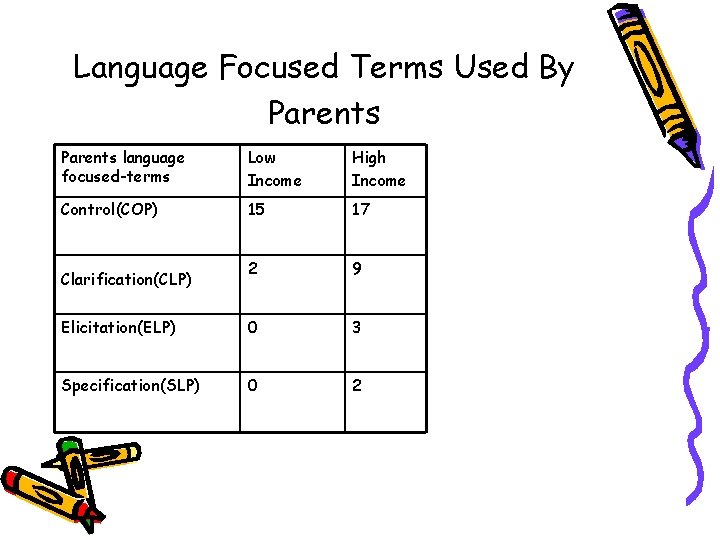
Language Focused Terms Used By Parents language focused-terms Low Income High Income Control(COP) 15 17 2 9 Elicitation(ELP) 0 3 Specification(SLP) 0 2 Clarification(CLP)
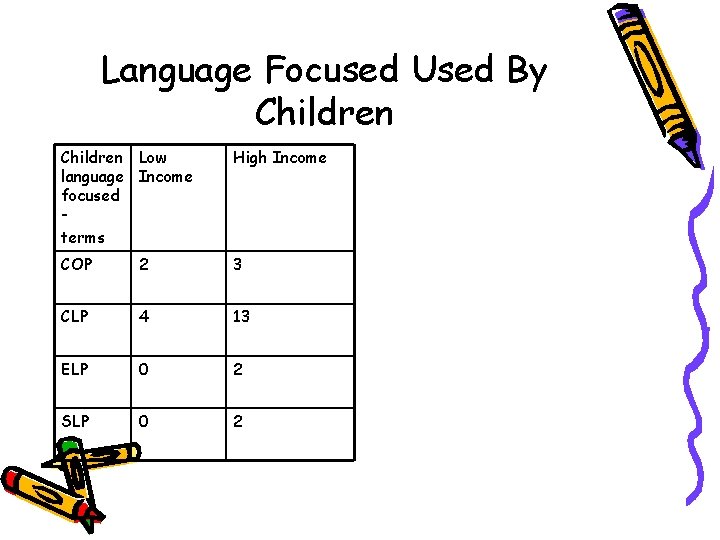
Language Focused Used By Children Low language Income focused terms High Income COP 2 3 CLP 4 13 ELP 0 2 SLP 0 2
Results • Presently, our study has shown that parents and children within high/middle income families use more forms of explanatory talk as well as pragmatic terms than their low income peers.
Conclusion • Children from both groups are shown to be using language focused-terms more than the average population. • Parents and children in the high/middle income population uses more language focused-terms than the average population
References • • Beals, d. e. (1993). Explanatory Talk in low-income families’ mealtime conversations. Applied psycholiinguistics, 14, 489 -513. Ely, R. , Gleason, J. B. , Mac. Gibbon, A. , & Zeartsky, E. (2001). Attention to language : Lessons Learned at the Dinner Table. Social Development, 10(3), 355 -373. Anthony D. Pellegrini & David F. Bjorklund (1998). Applied Child Study A Development Approach(3 rd Edition p. 146 -166) David K. Dickinson & Patlon O. Tobors. Brookcs. Beginning Literacy with Language. Publishing Company (2001).
Acknowledgements I would specially like to thank • Dr. Roseanne L. Flores for offering guidance and being a great mentor as well as a wonderful role model. • Mari F. Tineo and Arjan Sopoti who are my amazing colleagues for their support and suggestions throughout the extensive research process. • My mother Lucinda Da. Silva Sa’ for always pushing and supporting me. • Dr. Sat B. the founder and director of Harlem Children Society, For making this experience possible • The Harlem Children Society STAFF • And all of you for listening
- Slides: 20