
Language Differences By Katy Emerick and Daniela Denis
+ Language Differences By Katy Emerick and Daniela Denis
+ Definition n Language: n the system of words or signs that people use to express thoughts and feelings to each other n any one of the systems of human language that are used and understood by a particular group of people n words of a particular kind n Language Difference: n How communication, both verbal and nonverbal, varies in different cultures
+ Nonverbal Communication n Extraordinary powerful n Five categories of nonverbal communication n Gestures n Facial Expressions n Voice and Paralanguage n Body and Space n Practical Applications
+ Gestures n Happen subconsciously and they are done while talking n Used for n Complementing n Substituting n Regulating n Contradicting n Gestures vary within culture and can be different in different cultures. n https: //www. youtube. com/watch? v=UTE 0 G 9 am. ZNk
+ Facial Expressions n Eight primary emotions that can be communicated by face n Anger n Happiness n Surprised n Sadness n Fear n Disgust n Contempt n Interest
+ Facial Expressions n Eyes n Monitor feedback from others n Gain attention of others n Control a conversation n Define the nature of relationships n Overcome physical distance. n Eye contact differs in each culture
+ Voice and Paralanguage n Voice is to speak n Paralanguage is the nonverbal dimensions of speech n Volume, Pitch, Language, Accent, Silence n Silence is a form of paralanguage that differs greatly within cultures n Africa- Strategic n Eastern Traditions- Truthfulness n USA- Suspect
+ Body and Space n Important part of interpersonal relationships n Intimate, Social, Personal, Public n High Contact Cultures n Closer, Social distances are customary n Russians, Latin Americans and Arabs. n Low Contact Cultures n More Social Distance n Asians, North Americans and Northern Europeans
+ Practical Applications n Communicate better perception n Better to understand meetings of nonverbal communication n Important to read a persons nonverbal cues individually as opposed to looking at the majority
+ How nonverbal communication effects the classrooms n When completing the lesson you can tell if the students understand it by their facial expressions that they are doing sub consciously n Gives you insight as a teacher n Facial expressions also give a better idea of what type of the mood the student is in
+ Non verbal Activity Student A- Verbal How are you feeling today? Are you hungry? Do you want me to get you something to eat? What time is it? Student B- Non Verbal How was it communicating with someone who could not answer you in a way that you were use to? Were you able to know what they were saying? How or Why not?
+ Verbal Communication n Language which can be done face to face, phone, even social media n Includes how clear your language is n EX. Clarity, Tone, Speaking etiquette
+ Cultural Differences in Language • Cultural differences have also been noted in the ways in which language is used pragmatically. In our American culture, new skills are typically taught and learned through verbal instruction (Slobin, 1979). In some cultures, new skills are learned through nonverbal observation. A distinction has also been made between cultures that encourage independent learning and those that encourage cooperative learning (Mc. Leod, 1994).
+ How does culture affect the Language Development of a child? n Children in all cultures are born with the capability for language acquisition, and acquire language in roughly the same way: by learning from and imitating the adults around them. Children are capable of learning any language; they will imitate the sounds and learn the vocabulary of adults, and experiment with syntax and grammar as they develop, until they can speak with fluency. While children around the world acquire language in the same way, environmental factors including culture, socioeconomic status and parenting styles can influence the rate of language development in children. n Article by Erika Wells, Demand Media
+ Four ways culture affects the Language Development of a child n Environmental Factors n Children acquire language by listening to and interacting with the adults around them, and in cultures where adults do not speak to children, the children may acquire language at a later age. n Baby Talk n When parents use baby talk with their children, it helps to reinforce child language acquisition by providing positive feedback for the child n in some cultures, parents may choose to use baby talk long after it is useful, when children should be learning how to use the correct grammar and syntax instead of the incorrect version that results from child experimentation during acquisition
+ Four ways culture affects the Language Development of a child n n Socioeconomics and Race n Researchers concluded that the correlation between low socioeconomic status and race in the U. S. often led to higher rates of depression in African American mothers, which led to more negative parenting styles than those of affluent European Americans. n Socioeconomic status also correlates with fewer literacy resources in the home and a lower rate of literacy among adults, so that children born into a family of low socioeconomic status tend to learn fewer vocabulary words before preschool than affluent children. n Often, the difference in language acquisition between children is not about culture, but about socioeconomic status and the many factors associated with disempowerment. Cross- Cultural Similarities n Socioeconomic status played the largest role in environmental factors and language development. n Children from affluent families had higher rates of language development than children from families of low socioeconomic status, even when cultural factors were controlled
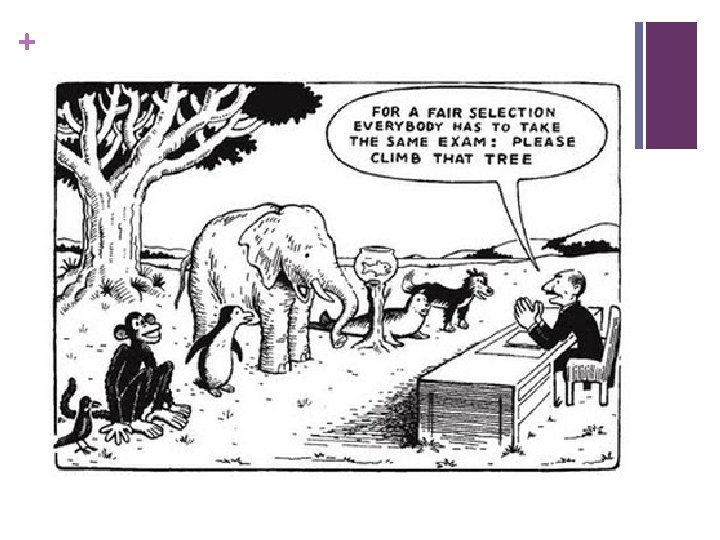
+ Language Differences And Test Bias n In addition to biases within the test itself, language differences also affect n performance on standardized testing, which causes bias against nonnative English test-takers. n Non-native English test-takers may struggle with reading comprehension n Hinders their ability to understand questions and answers. n They may also struggle with writing samples, which are intended to assess writing ability and levels.
+ New Language Learners n ELL- English Language Learner n ESL- English as a Second Language n Learning a new language while also learning subject matter in a language that was not their first language
+ Statistics n 10 Percent of all Public School Students are ELLs n There are more then 150 languages spoken by ELL Students in Public Schools (Spanish being the most populous language spoken other then English)
+ Tips for Teaching ELL Students n Use a lot of visual aids n Incorporate hands on activities n Allow wait time n Model spoken language n Avoid making them speak. Encourage them to speak when they are ready.
+ English Language Learners: Culture, Equity and Language n https: //www. youtube. com/watch? v=5 HU 80 Axm. P-U ". . . in diversity there is strength. " ~ Maya Angelou ~
+ Important things to Remember as Teachers n Find out what your students already know. n Positive feedback n Be diverse and culturally correct with your students. n Learn about where the student has come from and allow them to share things with the class or to yourself about their culture and their language.
+ Bibliography n Nonverbal Communication and Culture Distributed by Insight media n http: //education-portal. com/academy/lesson/testing-bias-culturalbias-language-differences-in-assessments. html#lesson n http: //www. education. com/reference/article/culture-language/ n http: //everydaylife. globalpost. com/culture-affect-languagedevelopment-child-15856. html n http: //www. merriam-webster. com/dictionary/language n http: //www. glencoe. com/sec/teachingtoday/subject/help_ELL. pht ml
- Slides: 24