
Language Development through Movement Games and Dance Adding
- Slides: 27
Language Development through Movement, Games, and Dance Adding Kinesthetic Strategies to the Educational Tool Box Martha Eddy, CMA, Ed. D. (c) Dr Martha Eddy 2010 www. Wellness. CKE. net
Center for Kinesthetic Education 49 West 27 th St New York City n n n www. Wellness. CKE. net Kinesthetic - Learning through Doing CKE – At CKE we Design and Implement Lessons using Movement (body language, movement exploration, games & dance) CKE integrates Socio-Emotional Learning (SEL) with all Learning Activities SEL links to Body Language (NVC) Verbal Language can be learned through Bodily Engagement – NVC, Movement exploration, Games and Dance – too! (c) Dr Martha Eddy 2010 www. Wellness. CKE. net
Defining Kinesthetic Awareness n The ability to perceive our bodies n Knowing when we are moving n Knowing where we are in space n Knowing about self and how we are feeling n What senses are used? (c) Dr Martha Eddy 2010 www. Wellness. CKE. net
How do we perceive our bodies? We sense our bodily: n n n n Position Movement Balance Stopping Starting Changes of each of the above Each affects attention and learning (c) Dr Martha Eddy 2010 www. Wellness. CKE. net
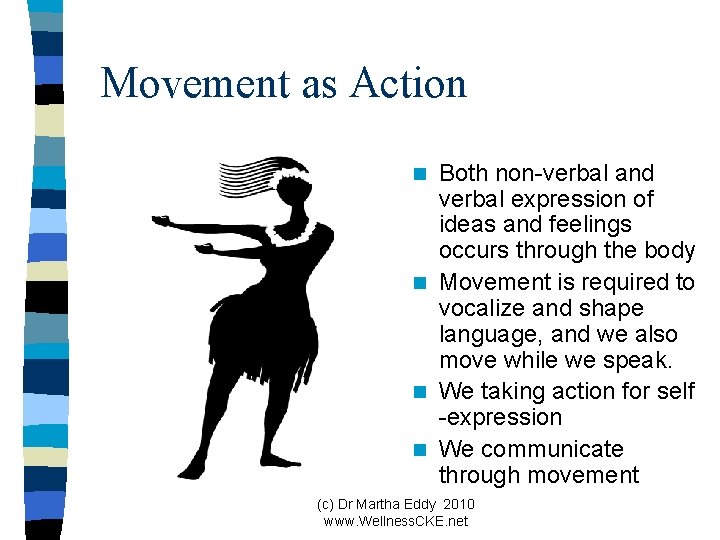
Movement as Action Both non-verbal and verbal expression of ideas and feelings occurs through the body n Movement is required to vocalize and shape language, and we also move while we speak. n We taking action for self -expression n We communicate through movement n (c) Dr Martha Eddy 2010 www. Wellness. CKE. net
Developmental Aspects of Language n Our earliest movements (e. g. nursing) activate 3 D movement patterns that foreshadow speech and may ‘teach’ complex movement to the rest of our bodies (Bainbridge Cohen). n Our speech is predicated on being able to shape our vocal mechanism in diverse ways. (c) Dr Martha Eddy 2010 www. Wellness. CKE. net
Developmental Aspects of Language (continued) n Whole body movement and the articulation of the vocal apparatus interact to explore language concepts during early childhood and again with every new language. n Movement is the mechanism for speech and of non-verbal communication. These movements become embedded in our nervous systems pathways. (c) Dr Martha Eddy 2010 www. Wellness. CKE. net
Movement and Language n n n Movement is needed to speak Whole body movement accompanies early speech; gestures accompany adult speech. Movement observation helps in communication. Movement is critical as we investigate our environment and learn new concepts. We move as we explore and find words. (c) Dr Martha Eddy 2010 www. Wellness. CKE. net
Use Movement While Teaching Language Acquisition To support Non-Verbal Communication (reading cues) n To increase student engagement (Enjoyable and creative bodily activities) n To help diverse types of learners (feeling with their bodies as they learn new concepts) n Arts and games provide contexts for speaking: Interact Physical Education and Dance Education programming n (c) Dr Martha Eddy 2010 www. Wellness. CKE. net
Movement in Schools Benefits of Movement Challenges n We are designed to n Movement can be move. disorderly n Movement is part of n Movement needs recuperation (important space for attention). n Movement focuses n Movement brings up attention (Moving eyes feelings to pay attention) n Movement is engaging stimulating (and enhance memory) n Movement can reinforce Dr Martha Eddy 2010 cultural learning (c)www. Wellness. CKE. net
Can Movement Be Classroom Friendly? Challenges n Movement can be disorderly n Movement needs space n Movement brings up feelings n Movement is stimulating Classroom management guidelines Use movement cues & games (hand clapping, modulation of sound and rhythm) Acknowledge feelings (c) Dr Martha Eddy 2010 www. Wellness. CKE. net
Movement Description as a Pedagogical Framework for Learning Language n n n Description of movement is description of behavior Movement description also teaches youth about body cues, socialization and expression – all support verbal language Movement activities support more types of individual learning styles Using a developmental model for movement supports brain connections Movement offers exciting, integrative (c) Dr Martha Eddy 2010 curricular design components www. Wellness. CKE. net
Laban Movement Analysis (LMA) – a language for movement n n n Body (What parts move and in what sequence? With what organization? ) Space (Where does the movement go? ) Effort/Motivation (What dynamics or feelings are present? ) Shape (What is the process of changing shape – how do we relate to our environment) Inter-Relationships (What comes with what, and whom? ) (c) Dr Martha Eddy 2010 www. Wellness. CKE. net
Laban Movement Analysis (LMA) Non-verbal Observation/Intervention Movement Observation helps us to see nonverbal signals accurately n Movement language (LMA)provides an exciting inroad to learning many types of words (body parts, actions, adjectives, adverbs all working together) n ‘Movement sentences’ support spoken sentences, paragraphs, conversations. n LMA is tested for Observer Reliability n (c) Dr Martha Eddy 2010 www. Wellness. CKE. net
Acknowledging the Body Highlights Emotions n n n School can be scary, challenging, relieving Acknowledge the importance of the body in dealing with fears, hopes, and being stuck Kids experience failure, loneliness, hunger, abuse, bullying, and/or unmet hopes. All are somatic – psychophysical; involve the body, mind and emotions We move while we speak; movement is an access to feelings; movement deepens learning – limbic system Ideally we allow for physical exploration without judgment Set rules of respectful interaction/boundaries (c) Dr Martha Eddy 2010 www. Wellness. CKE. net
CKE Approach to Teaching Children with Learning Challenges Engage as we would with any other children n Observe with all senses; attune & build trust n Create a caring environment for exploration of both verbal and non-verbal language n n *At CKE we create prompts to elicit new language. We call the resulting language responses – ‘responsive language. ’ (c) Dr Martha Eddy 2010 www. Wellness. CKE. net
Language Acquistion for Diverse Learners continued n Use awareness of body language to assess intention and comprehension (watch for movement support for receptive, responsive, * and expressive language). n Create tailored strategies based on movement assessment for engagement & goals. (c) Dr Martha Eddy 2010 www. Wellness. CKE. net
Use of Dance in Teaching Language n Research shows – that exercise, movement and play are health-enhancing (Now required by law for children’s mental health as well. ) – that listening to music is healing for trauma and depression – learning songs may help in memory retrieval. (c) Dr Martha Eddy 2010 www. Wellness. CKE. net
Value of Dance continued n Dance activities often bring together MUSIC and MOVEMENT. n Dance is a non-verbal symbolic system n Dance provides a rich multi-sensory learning context for language acquisition and conversation. (c) Dr Martha Eddy 2010 www. Wellness. CKE. net
Teacher Reminders n Include the bodily experience n Use positive “teaching tactics” (Eddy, 1998) n Try the team approach n Encourage greater expressiveness through multiple modalities n Explore in new strategies n Build bridges with family, colleagues and the school community (c) Dr Martha Eddy 2010 www. Wellness. CKE. net
Eddy’s Best Practices: Teaching Tactics for Effective Communication* n n n n MODEL GOALS ENGAGE STUDENTS SHARE FEELINGS PROVIDE CHOICES SENSITIVE TO INCLUSION TEAM TEACH ACKNOWLEDGE COMPLEXITY PROVIDES SYNTHESIS n BUILD RELATIONSHIPS n PRACTICE CONFLICT RESOLUTION n USE HOLISTIC APPROACHES n COUNTER THE MEDIA *From Martha Eddy 1998 n (c) Dr Martha Eddy 2010 www. Wellness. CKE. net
Summary n n n Society is demanding, challenging, shifting and we need all resources to communicate within and across cultures Children learn through doing – moving! (Bandura/Dewey/Piaget). All language has physical components. Be advocates for bodily expression and movement during language acquisition. Children thrive when arts-based approaches to learning languages are included. (c) Dr Martha Eddy 2010 www. Wellness. CKE. net
References Center for Kinesthetic Education: www. Wellness. CKE. net n n n n Bainbridge Cohen (1993) Sensing, Feeling and Action. Northampton, MA: Contact Editions. Eddy, M. (2000). Movement Activities for Conflict Resolution. The Fourth R. Washington DC: CREnet. Vol 92, pgs. 13 -14, 15 -16. Eddy, M. (1998). The Role of Physical Activity in Educational Violence Prevention for Youth. Michigan: UMI Press. Guest, A. (1983). Your Move A New Approach to the Study of Movement and Dance NY: Gordon and Breach. Hellison, D. (1995) Teaching responsibility through physical activity. Champaign, IL: Human Kinetics. Kreidler (1994) Creative Conflict Resolution: More than 200 Activities for Keeping peace in the Classroom K -6. Glenview, IL: Scott, Foresman and Company. Kreidler W. & Furlong, L. (1995) Adventures in Peacemaking – A Conflict Resolution Activity Guide for School Age Programs. Hamilton, MA: Project Adventure, Inc. (c) Dr Martha Eddy 2010 www. Wellness. CKE. net
Movement Resources for Adapting Language Lessons: SEL, Anatomy, Ecology Conflict Resolution and Body Language http: //www. wellnesscke. net/downloadables/Body-Cues-Conflict. pdf Using Movement to Teach about Erosion and Recycling http: //www. wellnesscke. net/downloadables/CKERecycling. pdf (c) Dr Martha Eddy 2010 www. Wellness. CKE. net
Websites For Movement Resources Balancing the Brain through Movement Awareness (English&Spanish article) http: //www. wellnesscke. net/downloadables/spins. pdf http: //www. wellnesscke. net/downloadables/SPINSSPANISH. pdf Using Movement Coordination Activities to Connect Different Pathways in the Brain http: //www. wellnesscke. net/downloadables/relax-to-focus. pdf (c) Dr Martha Eddy 2010 www. Wellness. CKE. net
Movement DVDs and CDs Music and DVDs: n CHOOSY RESOURCES: I’m Moving I’m Learning A+. CD. Choosy Kids. 2009. www. choosykids. com; Meet Choosy and Linda. DVD. Choosy Kids; This is My Body. CD. Choosy Kids. 2005. n Kids Get Moving. DVD. The Center for Movement Education and Research. 2005. www. movement-education. org (c) Dr Martha Eddy 2010 www. Wellness. CKE. net
CKE Resources n n n Contact Information Martha Eddy, CMA, RSMT, Ed. D. Director, Center for Kinesthetic Education www. Wellness. CKE. net Martha. Eddy@Wellness. CKE. net 212 -414 -2921 Teacher Supervision Groups for Designing Lessons Using Movement in Schools n CKE Dances! NYC DOE contracted student workshops on diverse topics n Lectures and Professional Development n (c) Dr Martha Eddy 2010 www. Wellness. CKE. net