
Language Culture Music By Neha Naveen Nick Language

Language, Culture, & Music By: Neha, Naveen, & Nick
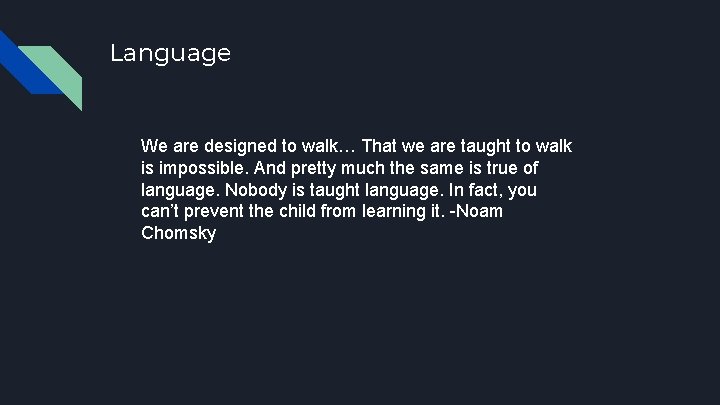
Language We are designed to walk… That we are taught to walk is impossible. And pretty much the same is true of language. Nobody is taught language. In fact, you can’t prevent the child from learning it. -Noam Chomsky
Language
Language
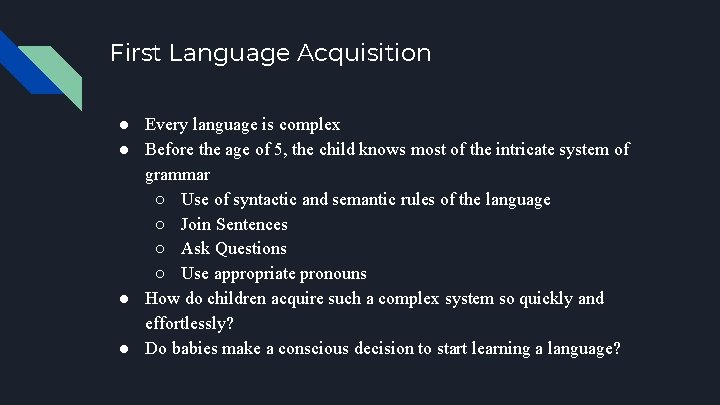
First Language Acquisition ● Every language is complex ● Before the age of 5, the child knows most of the intricate system of grammar ○ Use of syntactic and semantic rules of the language ○ Join Sentences ○ Ask Questions ○ Use appropriate pronouns ● How do children acquire such a complex system so quickly and effortlessly? ● Do babies make a conscious decision to start learning a language?
Theories of First Language Acquisition ● Nature vs. Nurture ○ Children learn language through imitation, reinforcement and analogy ● Innateness hypothesis ○ Children are equipped with an innate template for language ● Evidence ○ We end up knowing more about language than what we hear around us
First Language Acquisition Schedule ● Most children follow the same milestones in acquiring language, in spite of different backgrounds, locations and upbringings ● The biological schedule is related to the maturation of the infant’s brain to cope with the linguistic input ● Young children acquire language by identifying the regularities in what is heard and applying that in what they say
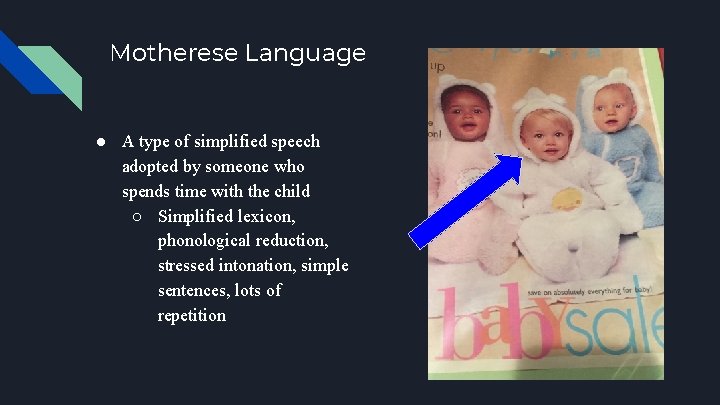
Motherese Language ● A type of simplified speech adopted by someone who spends time with the child ○ Simplified lexicon, phonological reduction, stressed intonation, simple sentences, lots of repetition
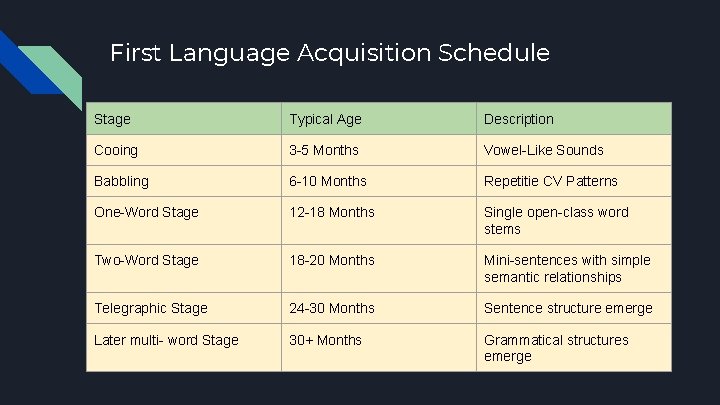
First Language Acquisition Schedule Stage Typical Age Description Cooing 3 -5 Months Vowel-Like Sounds Babbling 6 -10 Months Repetitie CV Patterns One-Word Stage 12 -18 Months Single open-class word stems Two-Word Stage 18 -20 Months Mini-sentences with simple semantic relationships Telegraphic Stage 24 -30 Months Sentence structure emerge Later multi- word Stage 30+ Months Grammatical structures emerge
Culture: “an amalgam of values, meanings, conventions and artifacts that constitute daily social realities. ”
Cultural Neuroscience
Related Research Implications of brain plasticity: ● larger hippocampus - a region that is intimately involved in spatial memory - of London taxi drivers ● increased cortical density in the motor cortex of jugglers
Importance of Cultural Neuroscience ● About 90% of f. MRI studies have come from countries of Western origin (Chiao, 2009). ● Most psychological studies have been conducted with Westerners, who only account for about 12% of the world population (Arnett, 2008). ● Not related to how individuals are ‘hardwired’ but how individuals are ‘molded’. ● Analogous situation to research studies and medications based on similar types of bodies, (e. g. preponderance of male research. )
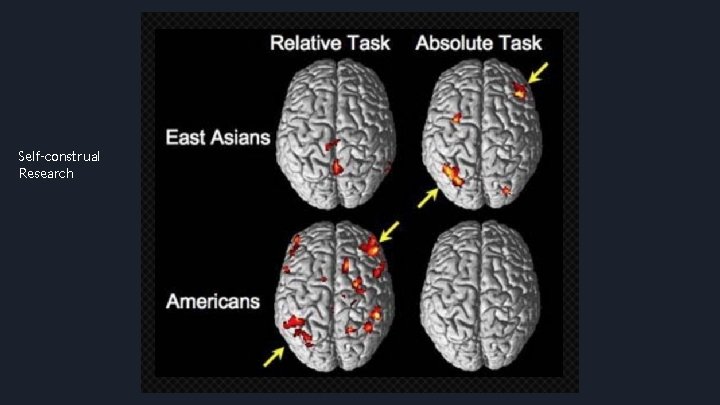
Self-construal Research
Discussion: ● Implications for diverse working teams in the workplace and in research ● Ethics of altering how schooling and parenting is conducted (optimization of a child) ● Denoting some cultural effects as being ‘superior’ towards others
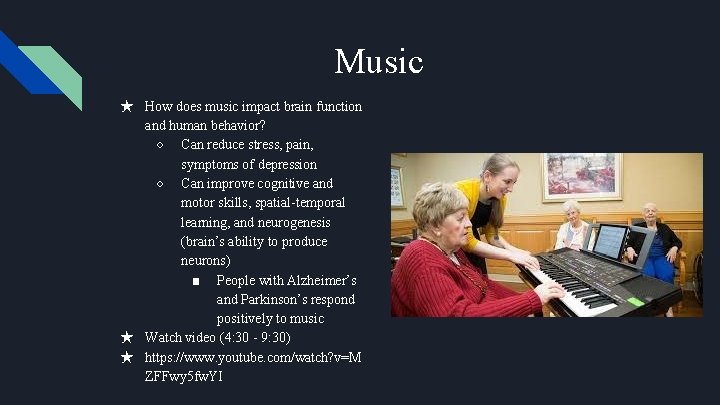
Music ★ How does music impact brain function and human behavior? ○ Can reduce stress, pain, symptoms of depression ○ Can improve cognitive and motor skills, spatial-temporal learning, and neurogenesis (brain’s ability to produce neurons) ■ People with Alzheimer’s and Parkinson’s respond positively to music ★ Watch video (4: 30 - 9: 30) ★ https: //www. youtube. com/watch? v=M ZFFwy 5 fw. YI
Music ★ Adding on to everything else: ○ Adolescents’ choice of music and their reactions to/interpretations of it vary with age, culture, and ethnicity ○ Females - more likely to use music to reflect emotional state ○ Males - more likely to use music as a stimulant (energy or confidence) ○ Preference for certain types of music could be correlated with certain behaviors ■ Example: heavy metal is associated with increased depression, delinquency, men who listened to misogynistic lyrics → increased aggressive responses
Parts of the Brain Affected ● ● ● Frontal Lobe - thinking, decisionmaking, planning ○ Enhanced w/ Music Temporal Lobe - processes what we hear ○ Use this to appreciate music, language/words are interpreted in left hemisphere, music/sounds are interpreted in right hemisphere Broca’s Area ○ Used to express music, playing an instrument might improve ability to communicate ● ● Wernicke’s Area - comprehends written/spoken language ○ Used to analyze music Occipital Lobe- processes what we see ○ Professional musicians use occipital cortex (visual cortex) when they listen to music while normal people use the temporal lobe (auditory/language center) ○ This suggests that musicians might visualize a music score when they are listening to music
Parts of the Brain Affected ● ● ● Cerebellum - coordinates movement + stores physical memory ○ People who have memory loss/Alzheimer’s can’t recognize family but can remember to play music because muscle memory Nucleus Accumbens - seeks pleasure + reward ○ Increases dopamine in nucleus accumbens, similar to cocaine Amygdala - emotions ○ Can control fear, activate fight or flight ● ● Hippocampus - memory, navigation ○ May increase neurogenesis in the hippocampus → new neurons + memory Hypothalamus Corpus Callosum Putamen
Music Therapy ● ● What is it? ○ Clinical and evidence-based use of music interventions to accomplish individualized goals or address physical, emotional, cognitive, and social needs (grief, anxiety, depression, after a stroke/traumatic head injury, Parkinson’s/Alzheimer’s) Forms of treatment can include: ○ Creating music ○ Singing/listening music ○ Moving to music ○ Guided imagery ○ Playing instruments ● ● Two kinds of processes that can be used ○ Creative - creating/producing music (engagement) ○ Receptive - music listening experiences (relaxation) Does it work? ○ A growing field ○ A sense of empowerment
Questions relevant to us! ● Is studying with music a benefit or drawback? ○ Benefits ■ soothing/relaxing music can help with stress/anxiety ■ Can improve focus on task by providing motivation and improving mood ■ Can improve endurance ■ Helps with memorization (positive mood → memory formation) ● Drawbacks ○ Can be distracting ○ Music with lyrics while reading/writing → less efficient, absorbed less information ○ loud/agitated music can make reading comprehension hard ○ Students who use music to help memorize have a hard time recalling in test-taking environment
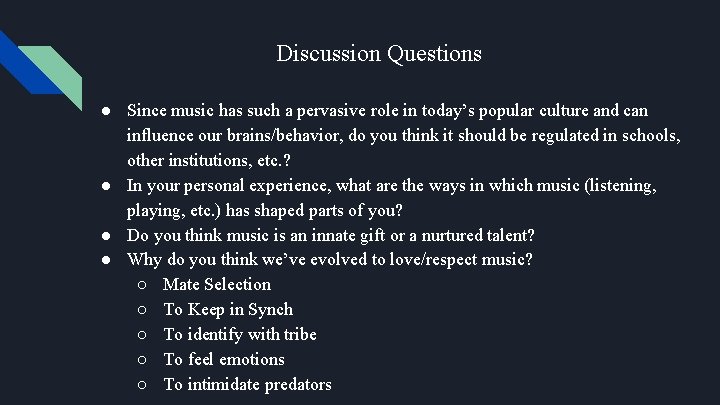
Discussion Questions ● Since music has such a pervasive role in today’s popular culture and can influence our brains/behavior, do you think it should be regulated in schools, other institutions, etc. ? ● In your personal experience, what are the ways in which music (listening, playing, etc. ) has shaped parts of you? ● Do you think music is an innate gift or a nurtured talent? ● Why do you think we’ve evolved to love/respect music? ○ Mate Selection ○ To Keep in Synch ○ To identify with tribe ○ To feel emotions ○ To intimidate predators
- Slides: 22