
Language complexity and the semantic memory University of
- Slides: 24
Language complexity and the semantic memory University of applied science Darmstadt Informationscience Yannick Schladt Content, examples and sources are based on the research book „Leichte Sprache – Einfache Sprache“ by Andreas Baumert
Table of contents 1. 2. Complexity of language • • • Basic aspects Measure language complexity • Flesch-Reading-Index Requirements to understand a language The semantic memory • • • Model Schemes Semantic Networks Frames Scripts 08. 03. 2021 Yannick Schladt
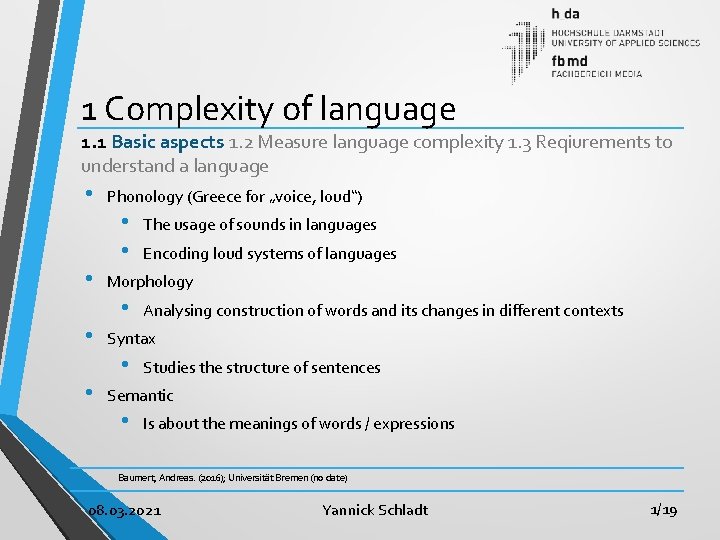
1 Complexity of language 1. 1 Basic aspects 1. 2 Measure language complexity 1. 3 Reqiurements to understand a language • Phonology (Greece for „voice, loud“) • • • Analysing construction of words and its changes in different contexts Syntax • • Encoding loud systems of languages Morphology • • The usage of sounds in languages Studies the structure of sentences Semantic • Is about the meanings of words / expressions Baumert, Andreas. (2016); Universität Bremen (no date) 08. 03. 2021 Yannick Schladt 1/19
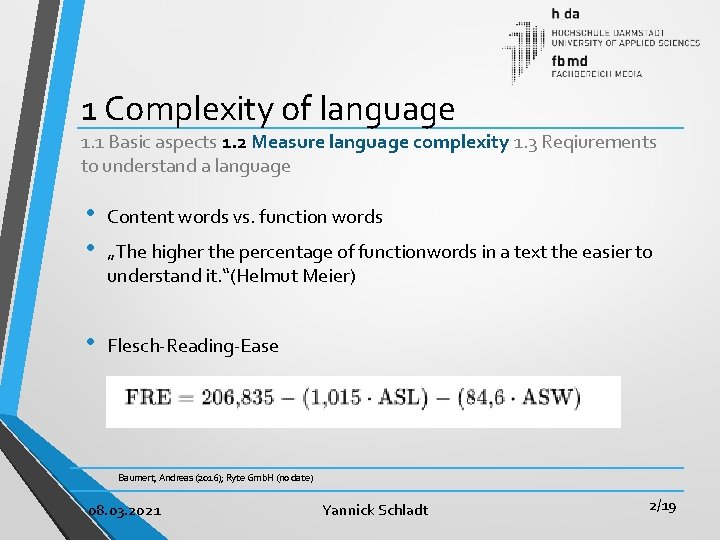
1 Complexity of language 1. 1 Basic aspects 1. 2 Measure language complexity 1. 3 Reqiurements to understand a language • • Content words vs. function words • Flesch-Reading-Ease „The higher the percentage of functionwords in a text the easier to understand it. “(Helmut Meier) Baumert, Andreas (2016); Ryte Gmb. H (no date) 08. 03. 2021 Yannick Schladt 2/19
1 Complexity of language 1. 1 Basic aspects 1. 2 Measure language complexity 1. 3 Reqiurements to understand a language • • Cognitive competences and capacity Understanding of senses and grammar Ability to Categorise words and sentences Attentiveness and endurance Baumert, Andreas (2016) 08. 03. 2021 Yannick Schladt 3/19
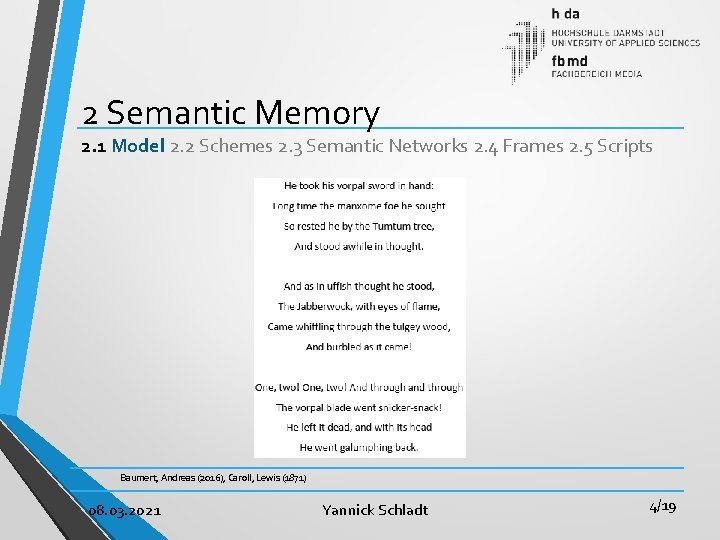
2 Semantic Memory 2. 1 Model 2. 2 Schemes 2. 3 Semantic Networks 2. 4 Frames 2. 5 Scripts Baumert, Andreas (2016), Caroll, Lewis (1871) 08. 03. 2021 Yannick Schladt 4/19
2 Semantic Memory 2. 1 Model 2. 2 Schemes 2. 3 Semantic Networks 2. 4 Frames 2. 5 Scripts • • • A human ability to read and understand texts Requires factual and conceptual knowledge about the world A way to understand / learn • Schemes -> Networking -> Frames -> Scripts Baumert, Andreas (2016) 08. 03. 2021 Yannick Schladt 5/19
2 Semantic Memory 2. 1 Model 2. 2 Schemes 2. 3 Semantic Networks 2. 4 Frames 2. 5 Scripts • • Organized and structured environment Representing knowledge about reality • • • Cars, libraries, computer etc. Consist of concepts Addition material to create non-existent schemes Baumert, Andreas (2016) 08. 03. 2021 Yannick Schladt 6/19
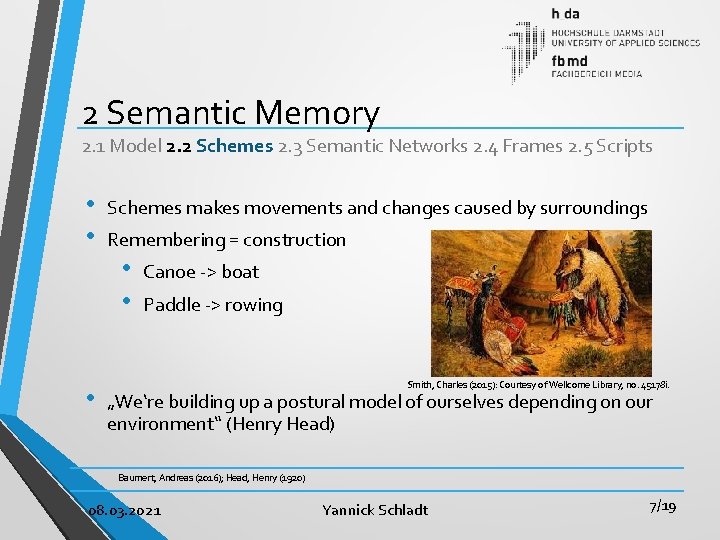
2 Semantic Memory 2. 1 Model 2. 2 Schemes 2. 3 Semantic Networks 2. 4 Frames 2. 5 Scripts • • • Schemes makes movements and changes caused by surroundings Remembering = construction • • Canoe -> boat Paddle -> rowing Smith, Charles (2015): Courtesy of Wellcome Library, no. 45178 i. „We‘re building up a postural model of ourselves depending on our environment“ (Henry Head) Baumert, Andreas (2016); Head, Henry (1920) 08. 03. 2021 Yannick Schladt 7/19
2 Semantic Memory 2. 1 Model 2. 2 Schemes 2. 3 Semantic Networks 2. 4 Frames 2. 5 Scripts • Declaratively knowledge (facts) • • Procedually knowledge (processes) • • Learned simple multiplication tables by heart Addition -> multiplication of big pairs of numbers Readers need schemes to understand a text Baumert, Andreas (2016) 08. 03. 2021 Yannick Schladt 8/19
2 Semantic Memory 2. 1 Model 2. 2 Schemes 2. 3 Semantic Networks 2. 4 Frames 2. 5 Scripts • Build up formal models based on schemes • • Including elements and there relations Need to be compatible in readable code for programming languages Baumert, Andreas (2016) 08. 03. 2021 Yannick Schladt 9/19
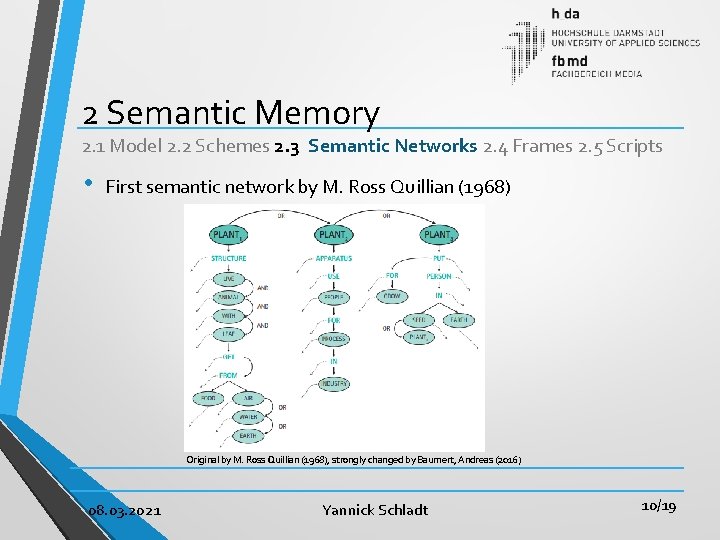
2 Semantic Memory 2. 1 Model 2. 2 Schemes 2. 3 Semantic Networks 2. 4 Frames 2. 5 Scripts • First semantic network by M. Ross Quillian (1968) Original by M. Ross Quillian (1968), strongly changed by Baumert, Andreas (2016) 08. 03. 2021 Yannick Schladt 10/19
2 Semantic Memory 2. 1 Model 2. 2 Schemes 2. 3 Semantic Networks 2. 4 Frames 2. 5 Scripts „When one encounters a new situation (or makes a substantial change in one‘s view of a problem), one selects from memory a structure called a frame. (…)“ (Marvin Minsky) Baumert, Andreas (2016) , Minsky, Marvin Lee (1980): 08. 03. 2021 Yannick Schladt 11/19
2 Semantic Memory 2. 1 Model 2. 2 Schemes 2. 3 Semantic Networks 2. 4 Frames 2. 5 Scripts • • • Data-structure Represents a stereotyped situation Has attachments of additional information Baumert, Andreas (2016) 08. 03. 2021 Yannick Schladt 12/19
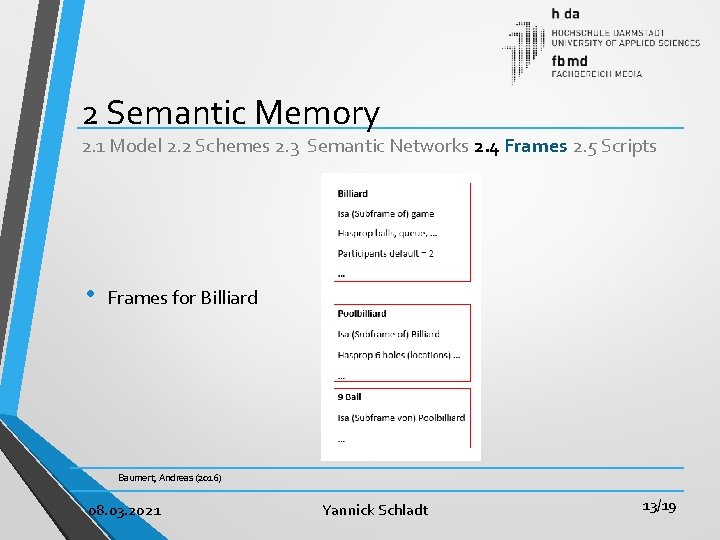
2 Semantic Memory 2. 1 Model 2. 2 Schemes 2. 3 Semantic Networks 2. 4 Frames 2. 5 Scripts • Frames for Billiard Baumert, Andreas (2016) 08. 03. 2021 Yannick Schladt 13/19
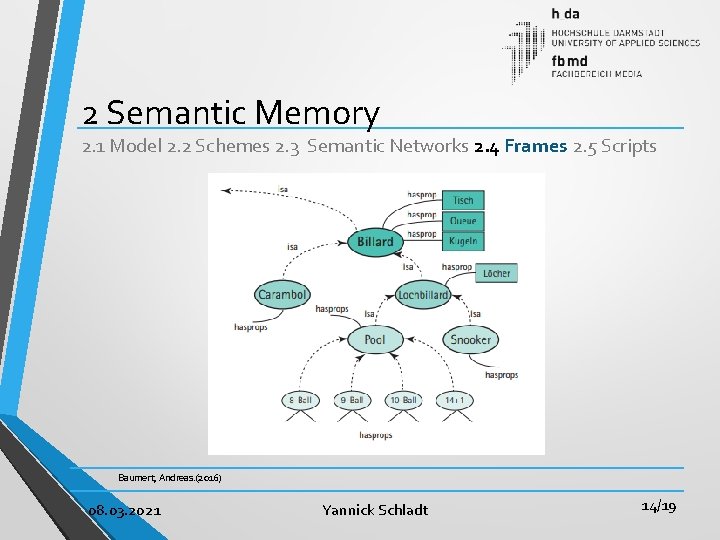
2 Semantic Memory 2. 1 Model 2. 2 Schemes 2. 3 Semantic Networks 2. 4 Frames 2. 5 Scripts Baumert, Andreas. (2016) 08. 03. 2021 Yannick Schladt 14/19
2 Semantic Memory 2. 1 Model 2. 2 Schemes 2. 3 Semantic Networks 2. 4 Frames 2. 5 Scripts • Do you need a queue for 8 -Ball? Baumert, Andreas (2016) 08. 03. 2021 Yannick Schladt 15/19
2 Semantic Memory 2. 1 Model 2. 2 Schemes 2. 3 Semantic Networks 2. 4 Frames 2. 5 Scripts • Humans need favorites: • „Twenty or so birds often perch on the telephone wires outside my window and twitter in the morning. “ (Eleanor Rosch) • „A bowl of fruit makes a nice centre-piece“ (Eleanor Rosch) Baumert, Andreas. (2016), S. 28 – 45, In: Rosch, Human Categorization, S. 25. 08. 03. 2021 Yannick Schladt 16/19
2 Semantic Memory 2. 1 Model 2. 2 Schemes 2. 3 Semantic Networks 2. 4 Frames 2. 5 Scripts • Contain keywords • • • Short and concise Necessary for the understanding of speech Programs help to verify and optimize scripts Baumert, Andreas. (2016) 08. 03. 2021 Yannick Schladt 17/19
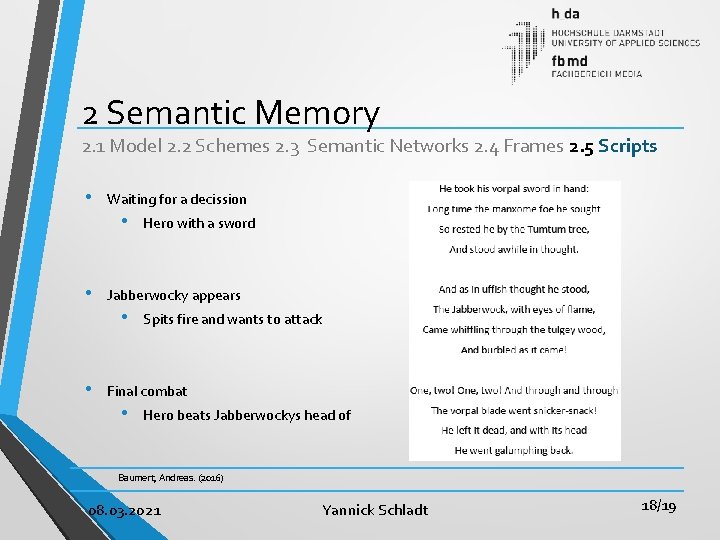
2 Semantic Memory 2. 1 Model 2. 2 Schemes 2. 3 Semantic Networks 2. 4 Frames 2. 5 Scripts • • • Waiting for a decission • Hero with a sword Jabberwocky appears • Spits fire and wants to attack Final combat • Hero beats Jabberwockys head of Baumert, Andreas. (2016) 08. 03. 2021 Yannick Schladt 18/19
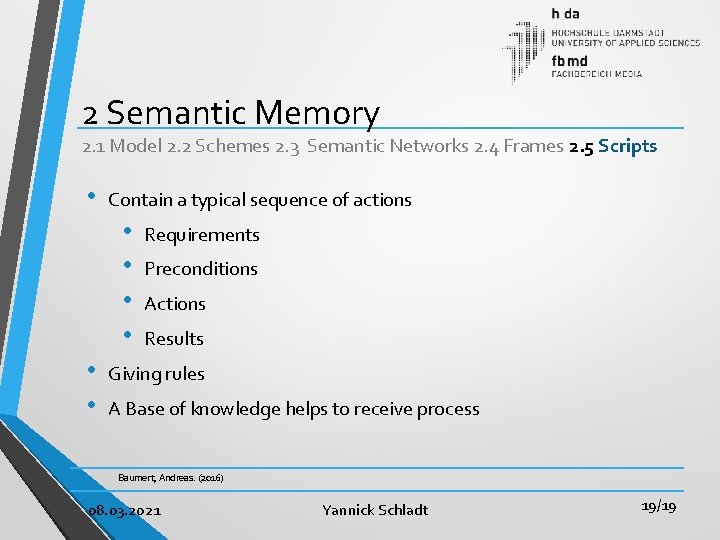
2 Semantic Memory 2. 1 Model 2. 2 Schemes 2. 3 Semantic Networks 2. 4 Frames 2. 5 Scripts • Contain a typical sequence of actions • • • Requirements Preconditions Actions Results Giving rules A Base of knowledge helps to receive process Baumert, Andreas. (2016) 08. 03. 2021 Yannick Schladt 19/19
Thank you for your attention! 08. 03. 2021 Yannick Schladt
Sources Baumert, Andreas. (2016). Leichte Sprache – Einfache Sprache. Abgerufen am 6. Mai 2018, von https: //d-nb. info/1097572382/34. S. 28 -45. Universität Bremen. (no date). Phonetik und Phonologie. Abgerufen am 6. Mai 2018, von http: //www. fb 10. unibremen. de/khwagner/phonetik/kapitel 1. aspx Ryte Gmb. H. (no date). Flesch-Reading-Ease. Abgerufen am 6. Mai 2018, von https: //de. ryte. com/wiki/Flesch-Reading-Ease. Caroll, Lewis (1871). Jabberwocky. Abgerufen am 6. Mai 2018, von https: //www. poetryfoundation. org/poems/42916/jabberwocky Head, Henry (1920): Studies in Neurology. 2 Bände. London: Oxford University Press (2). https: //archive. org/details/studiesinneurolo 02 headiala 08. 03. 2021 Yannick Schladt
Sources Quillian, M. Ross (1980): Semantic Memory. In: Marvin Lee Minsky (Hg. ): Semantic information processing. 3. Aufl. London: The MIT Press, S. 227– 270. Rosch, Eleanor (1977): Human Categorization. In: Neil Warren (Hg. ): Advances in Cross-Cultural Psychology, Bd. 1. London: Academic Press, S. 1 – 48. Minsky, Marvin Lee (1980): A Framework for Representing Knowledge. In: Dieter Metzing (Hg. ): Frame conceptions and text understanding. Berlin: de Gruyter (Research in text theory, 5), S. 1– 25. Smith, Charles (2015): Courtesy of Wellcome Library, no. 45178 i. http: //www. thedifferentialdx. com/native-american-history-a-tale-ofmedicine/ 08. 03. 2021 Yannick Schladt