
Language change All spoken languages change Some change











- Slides: 33
Language change • All spoken languages change • Some change faster than others
Continued • Written languages can be fixed – but will no longer be used in everyday life • Common if a language has cultural or religious significance • Latin in Western Europe for 1, 500+ years • Hebrew among Jews
continued • • Classical Arabic – Muslims Pali – Buddhists Sanskrit – Hindus Coptic – Egyptian Christians • Often used on special occasions but not understood
continued • Often such languages are part of speech community • Even non- or semi- speakers insist they are used on certain occasions
Prayer Book rebellion 1549 • “and so we the Cornyshe men (whereof certen of us understande no Englyshe) utterly refuse thyse newe Englyshe” • Duke of Somerset – they did not understand Latin either so what’s the problem?
continued • • • Many reasons for change Phonological Structural economic and technical change Contact with other speakers sociolinguistic
Ideas about language change • Decline – ignorance and laziness before 1786 • Family tree – descent with modification
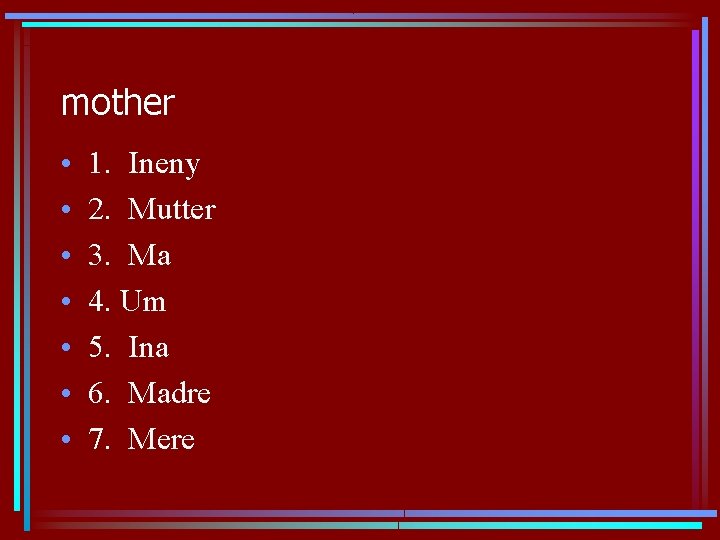
mother • • 1. Ineny 2. Mutter 3. Ma 4. Um 5. Ina 6. Madre 7. Mere
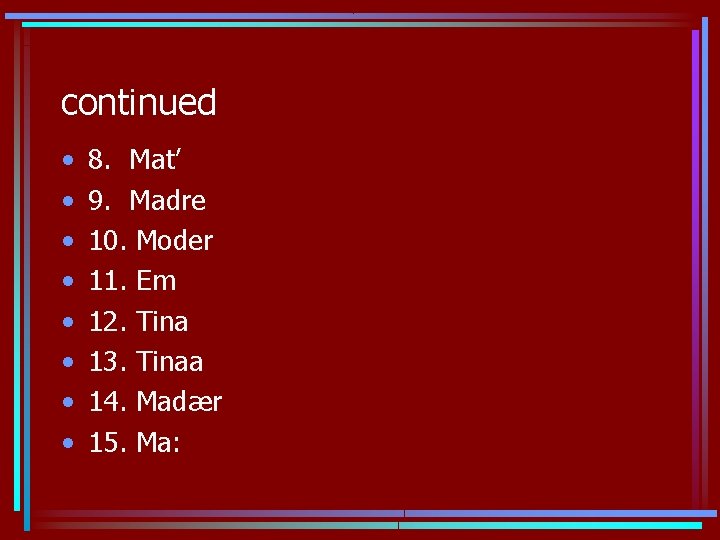
continued • • 8. Mat’ 9. Madre 10. Moder 11. Εm 12. Tina 13. Tinaa 14. Madær 15. Ma:
Key • • 1. 2. 3. 4. 5. 6. 7. Malagasy German Bengali Arabic Tagalog Italian French • • 8. Russian 9. Spanish 10. Swedish 11. Hebrew 12. Fijian 13. Samoan 14. Persian 15. Gujerati
Family Tree Model • William Jones – observed similarities of Latin, Greek and Sanskrit – suggested common (and extinct) ancestor • Reconstruction of ancestral languages – Proto-Indo-European, sometimes helped by documentary evidence • Later Bantu, Austronesian
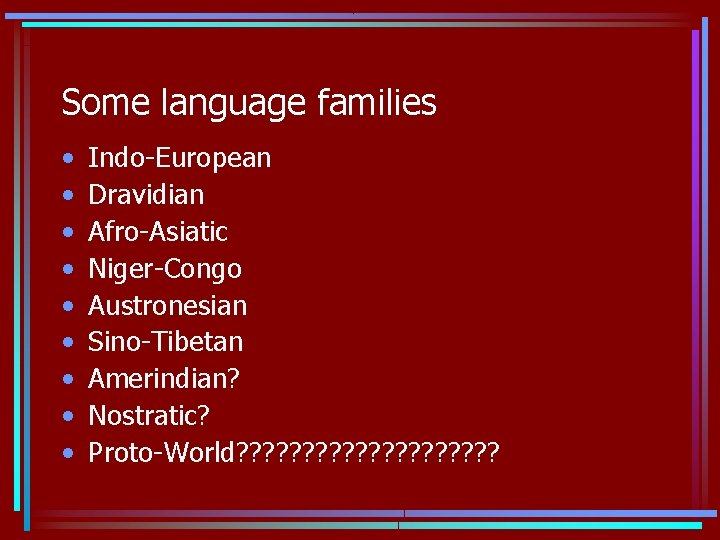
Some language families • • • Indo-European Dravidian Afro-Asiatic Niger-Congo Austronesian Sino-Tibetan Amerindian? Nostratic? Proto-World? ? ? ? ?
Wave Model • Wave model – languages influence neighbours • How else to explain taxi and OK ? • Sprachbunde – SE Asia, SE Europe, NE Europe Maybe most of Europe
continued • 19 th century – • Words, structures, forms spread like waves • Unpopular until late 20 th century • But explains PNG and Australia • now “punctuated equilibrium”
Why do languages change? Wrong Ideas • Running up German mountains • Noisy factories in Northern England • Stiff Chinese tongues
Structural changes • Why did Nemo’s father say “jangan sentuh punggung”?
continued • Language is a system • – one change leads to another – • Vowel shifts in England, US Northern Cities, China and English speaking southern hemisphere
continued • Australian front vowels are moving up • Central vowels are moving down • Boat becomes Buutt
Phonological • Glottal fricatives deleted • Consonant clusters reduced • Diphthongs monophthongised
BUT • Not satisfactory • Structural – how did first change get started? • Contact – why is influence usually one way? • Ease of articulation – why difficult sounds in the first place
Sociolinguistic change • Provides an adequate exalanation • Languages change because of the relationship between social groups
continued • First there must be variation – I. e. differences • But variation does not always lead to change • -n, -ng – differences for centuries but no change
Continue • Variation acquires a social function • Differences indicate social status or prestige • Forms vary according to social status • Forms will spread or disappear because they are linked to social characteristics
Language change and society • Linguistic forms may spread downwards -- post vocalic /r/ in New York • -- may spread upwards – glottalisation in English – reached Diana but not Charles • May spread from one ethnic group to another – ‘makan’ ‘bohsia’, ‘innit’
Continued • May spread geographical ly– postvocalic /r/ deletion in English • May spread from one age group to another – “grotty”, “sus out” • Gender very important – women pioneers in downward change, men in upward change
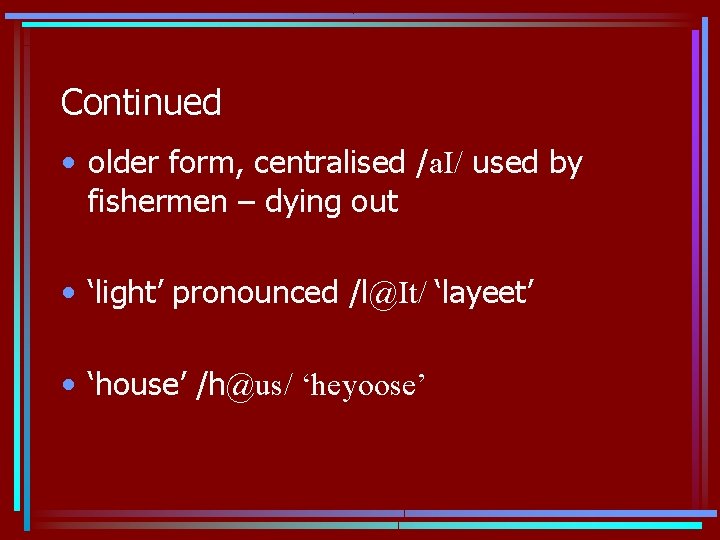
Example • Often – all factors contributing to change • Martha’s Vineyard, Massachusetts • Fishing community became a tourist centre • 1950 s Young men began imitating the phonology of older fishermen
Continued • older form, centralised /a. I/ used by fishermen – dying out • ‘light’ pronounced /l@It/ ‘layeet’ • ‘house’ /h@us/ ‘heyoose’
continued • But – now became a marker of local identity – locals versus summer people – esp Portuguese and Amerindians • But by 1990 s disappeared – younger people left the island or got jobs in the tourist business
Rates of change • • Why does the rate of change vary? Network theory Dense network – slow change In Belfast, women introduced high status forms – worked in shops in city centre
Politics and language change • In Berlin local dialect (BUV) declined rapidly in middle class West Berlin • Fairly rapidly in Working class West Berlin • not in Working Class East Berlin – symbol of identity – before reunification Saxon dialect used by unpopular government
continued • Divergence of Serbo-Croat since 1991 • Divergence of Hindi and Urdu since independence • Convergence (standard forms) of Malay and Indonesian • Individual case – Sadat’s Egyptian Arabic response to Arab criticism
continued • Divergence of Palestinian Arabic in one village since between 1948 and 1967 (Spolsky)
Conclusion • • • Languages change At different rates For different reasons Including social reasons And it cannot be stopped