
Language Barriers in Annual Wellness Visit Cognitive Screening
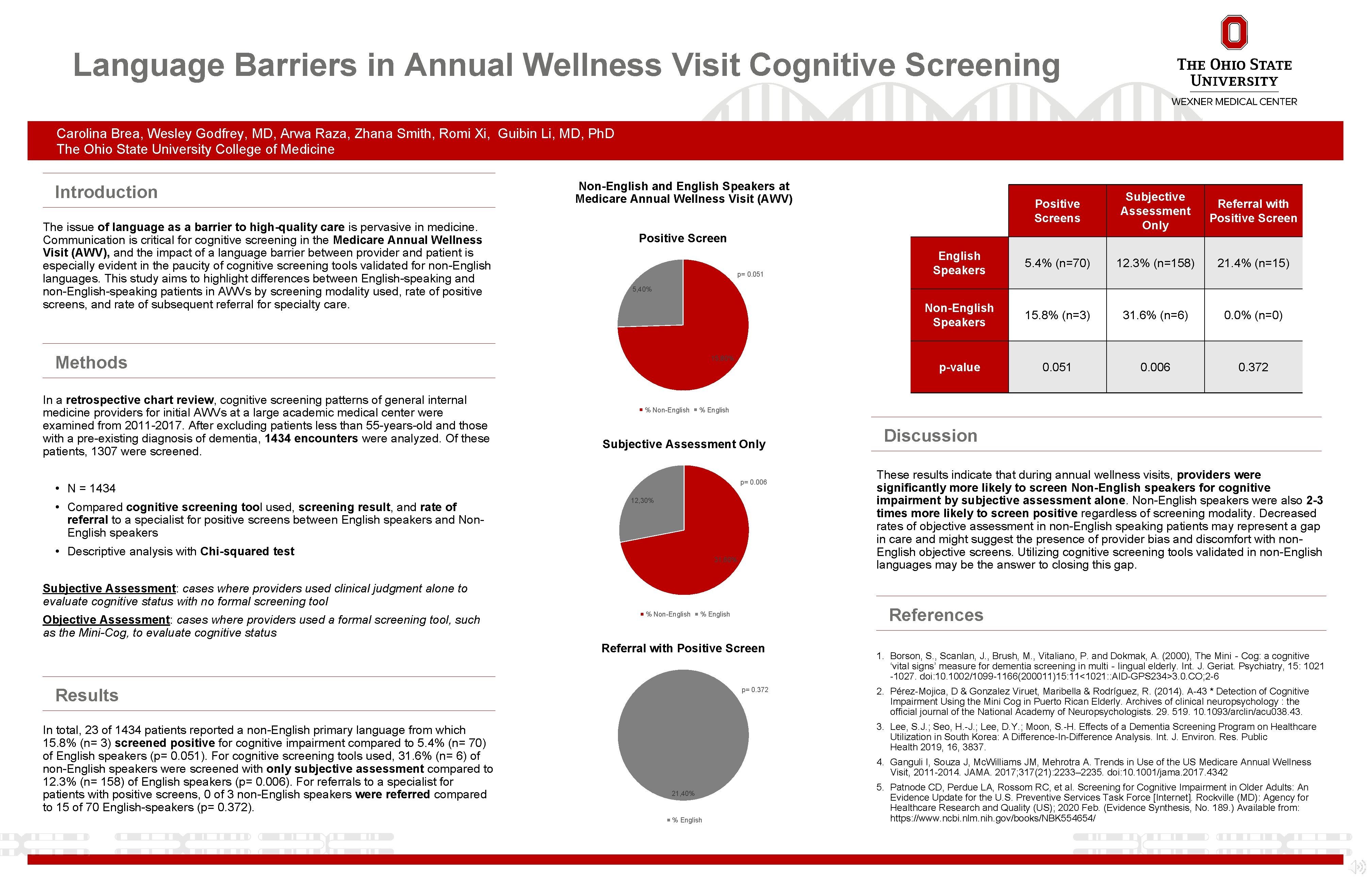
Language Barriers in Annual Wellness Visit Cognitive Screening Carolina Brea, Wesley Godfrey, MD, Arwa Raza, Zhana Smith, Romi Xi, Guibin Li, MD, Ph. D The Ohio State University College of Medicine Introduction The issue of language as a barrier to high-quality care is pervasive in medicine. Communication is critical for cognitive screening in the Medicare Annual Wellness Visit (AWV), and the impact of a language barrier between provider and patient is especially evident in the paucity of cognitive screening tools validated for non-English languages. This study aims to highlight differences between English-speaking and non-English-speaking patients in AWVs by screening modality used, rate of positive screens, and rate of subsequent referral for specialty care. Non-English and English Speakers at Medicare Annual Wellness Visit (AWV) p= 0. 051 15, 80% % Non-English Subjective Assessment Only p= 0. 006 12, 30% 31, 60% Subjective Assessment: cases where providers used clinical judgment alone to evaluate cognitive status with no formal screening tool % Non-English 12. 3% (n=158) 21. 4% (n=15) Non-English Speakers 15. 8% (n=3) 31. 6% (n=6) 0. 0% (n=0) p-value 0. 051 0. 006 0. 372 Results Discussion These results indicate that during annual wellness visits, providers were significantly more likely to screen Non-English speakers for cognitive impairment by subjective assessment alone. Non-English speakers were also 2 -3 times more likely to screen positive regardless of screening modality. Decreased rates of objective assessment in non-English speaking patients may represent a gap in care and might suggest the presence of provider bias and discomfort with non. English objective screens. Utilizing cognitive screening tools validated in non-English languages may be the answer to closing this gap. References % English Referral with Positive Screen In total, 23 of 1434 patients reported a non-English primary language from which 15. 8% (n= 3) screened positive for cognitive impairment compared to 5. 4% (n= 70) of English speakers (p= 0. 051). For cognitive screening tools used, 31. 6% (n= 6) of non-English speakers were screened with only subjective assessment compared to 12. 3% (n= 158) of English speakers (p= 0. 006). For referrals to a specialist for patients with positive screens, 0 of 3 non-English speakers were referred compared to 15 of 70 English-speakers (p= 0. 372). 5. 4% (n=70) % English • Descriptive analysis with Chi-squared test Objective Assessment: cases where providers used a formal screening tool, such as the Mini-Cog, to evaluate cognitive status English Speakers 5, 40% • N = 1434 • Compared cognitive screening tool used, screening result, and rate of referral to a specialist for positive screens between English speakers and Non. English speakers Referral with Positive Screen Methods In a retrospective chart review, cognitive screening patterns of general internal medicine providers for initial AWVs at a large academic medical center were examined from 2011 -2017. After excluding patients less than 55 -years-old and those with a pre-existing diagnosis of dementia, 1434 encounters were analyzed. Of these patients, 1307 were screened. Positive Screens Subjective Assessment Only p= 0. 372 1. Borson, S. , Scanlan, J. , Brush, M. , Vitaliano, P. and Dokmak, A. (2000), The Mini‐Cog: a cognitive ‘vital signs’ measure for dementia screening in multi‐lingual elderly. Int. J. Geriat. Psychiatry, 15: 1021 -1027. doi: 10. 1002/1099 -1166(200011)15: 11<1021: : AID-GPS 234>3. 0. CO; 2 -6 2. Pérez-Mojica, D & Gonzalez Viruet, Maribella & Rodríguez, R. (2014). A-43 * Detection of Cognitive Impairment Using the Mini Cog in Puerto Rican Elderly. Archives of clinical neuropsychology : the official journal of the National Academy of Neuropsychologists. 29. 519. 1093/arclin/acu 038. 43. 3. Lee, S. J. ; Seo, H. -J. ; Lee, D. Y. ; Moon, S. -H. Effects of a Dementia Screening Program on Healthcare Utilization in South Korea: A Difference-In-Difference Analysis. Int. J. Environ. Res. Public Health 2019, 16, 3837. 4. Ganguli I, Souza J, Mc. Williams JM, Mehrotra A. Trends in Use of the US Medicare Annual Wellness Visit, 2011 -2014. JAMA. 2017; 317(21): 2233– 2235. doi: 10. 1001/jama. 2017. 4342 21, 40% % English 5. Patnode CD, Perdue LA, Rossom RC, et al. Screening for Cognitive Impairment in Older Adults: An Evidence Update for the U. S. Preventive Services Task Force [Internet]. Rockville (MD): Agency for Healthcare Research and Quality (US); 2020 Feb. (Evidence Synthesis, No. 189. ) Available from: https: //www. ncbi. nlm. nih. gov/books/NBK 554654/
- Slides: 1