
Language Barriers in a Classroom of First Generation
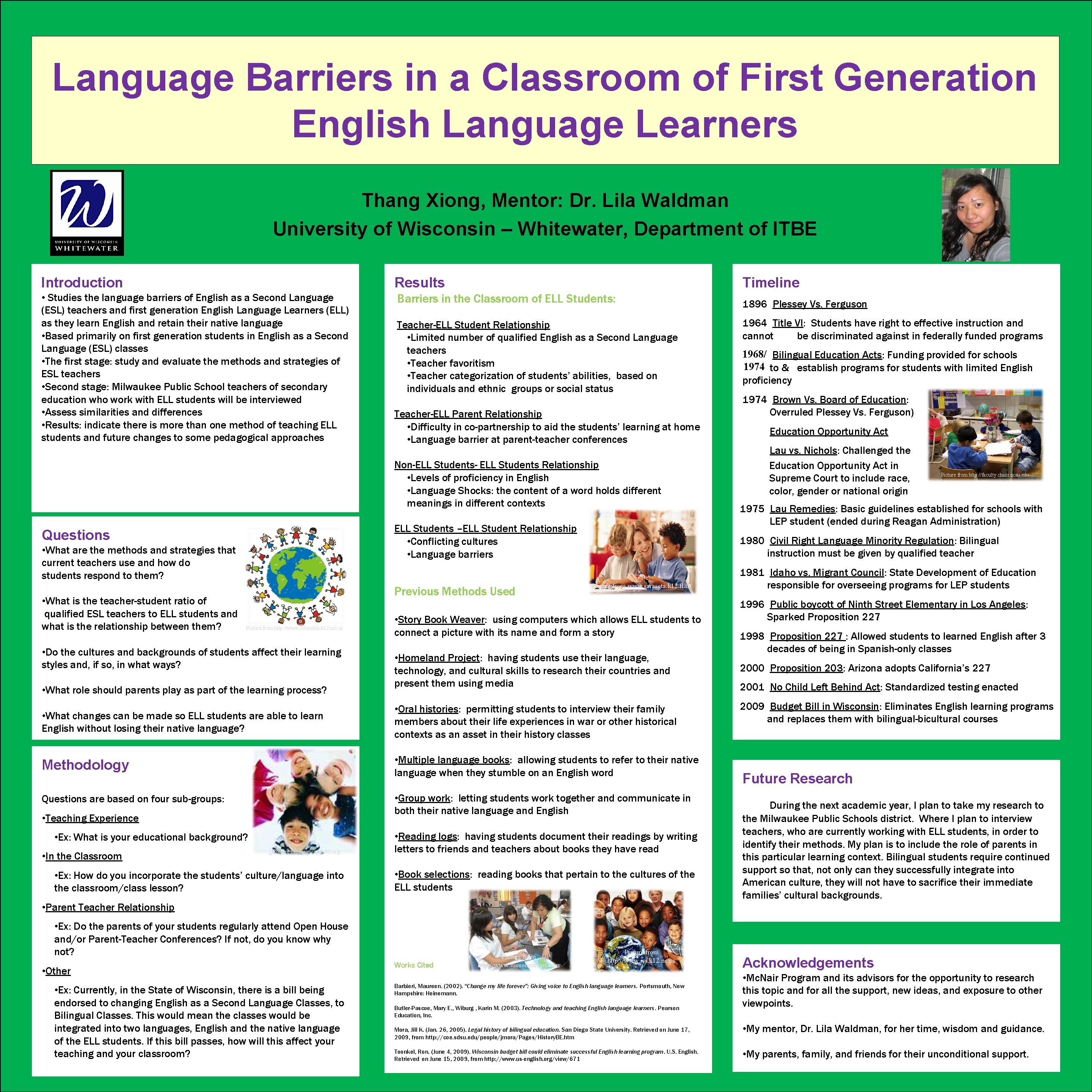
Language Barriers in a Classroom of First Generation English Language Learners Thang Xiong, Mentor: Dr. Lila Waldman University of Wisconsin – Whitewater, Department of ITBE Introduction Results Timeline • Studies the language barriers of English as a Second Language (ESL) teachers and first generation English Language Learners (ELL) as they learn English and retain their native language • Based primarily on first generation students in English as a Second Language (ESL) classes • The first stage: study and evaluate the methods and strategies of ESL teachers • Second stage: Milwaukee Public School teachers of secondary education who work with ELL students will be interviewed • Assess similarities and differences • Results: indicate there is more than one method of teaching ELL students and future changes to some pedagogical approaches Barriers in the Classroom of ELL Students: 1896 Plessey Vs. Ferguson Teacher-ELL Student Relationship • Limited number of qualified English as a Second Language teachers • Teacher favoritism • Teacher categorization of students’ abilities, based on individuals and ethnic groups or social status Teacher-ELL Parent Relationship • Difficulty in co-partnership to aid the students’ learning at home • Language barrier at parent-teacher conferences Non-ELL Students- ELL Students Relationship • Levels of proficiency in English • Language Shocks: the content of a word holds different meanings in different contexts ELL Students –ELL Student Relationship • Conflicting cultures • Language barriers Questions • What are the methods and strategies that current teachers use and how do students respond to them? • What is the teacher-student ratio of qualified ESL teachers to ELL students and what is the relationship between them? Previous Methods Used Picture from http: //www. columbia. k 12. mo. us • Do the cultures and backgrounds of students affect their learning styles and, if so, in what ways? • What role should parents play as part of the learning process? Picture from www. sarasota. k 12. fl. us • Story Book Weaver: using computers which allows ELL students to connect a picture with its name and form a story • Homeland Project: having students use their language, technology, and cultural skills to research their countries and present them using media • What changes can be made so ELL students are able to learn English without losing their native language? Methodology • Multiple language books: allowing students to refer to their native language when they stumble on an English word Questions are based on four sub-groups: • Group work: letting students work together and communicate in both their native language and English • Ex: What is your educational background? • In the Classroom Picture from www. u-46. org. • Ex: How do you incorporate the students’ culture/language into the classroom/class lesson? • Reading logs: having students document their readings by writing letters to friends and teachers about books they have read • Book selections: reading books that pertain to the cultures of the ELL students • Parent Teacher Relationship • Ex: Do the parents of your students regularly attend Open House and/or Parent-Teacher Conferences? If not, do you know why not? • Other • Ex: Currently, in the State of Wisconsin, there is a bill being endorsed to changing English as a Second Language Classes, to Bilingual Classes. This would mean the classes would be integrated into two languages, English and the native language of the ELL students. If this bill passes, how will this affect your teaching and your classroom? Works Cited Picture from http: //www. tucsoncitizen. com 1968/ Bilingual Education Acts: Funding provided for schools 1974 to & establish programs for students with limited English proficiency 1974 Brown Vs. Board of Education: Overruled Plessey Vs. Ferguson) Education Opportunity Act Lau vs. Nichols: Challenged the Education Opportunity Act in Supreme Court to include race, color, gender or national origin Picture from http: //faculty. chass. ncsu. edu 1975 Lau Remedies: Basic guidelines established for schools with LEP student (ended during Reagan Administration) 1980 Civil Right Language Minority Regulation: Bilingual instruction must be given by qualified teacher • Oral histories: permitting students to interview their family members about their life experiences in war or other historical contexts as an asset in their history classes • Teaching Experience 1964 Title VI: Students have right to effective instruction and cannot be discriminated against in federally funded programs Picture from http: //www. iss. k 12. nc. us Barbieri, Maureen. (2002). “Change my life forever”: Giving voice to English language learners. Portsmouth, New Hampshire: Heinemann. Butler-Pascoe, Mary E. , Wiburg , Karin M. (2003). Technology and teaching English language learners. Pearson Education, Inc. Mora, Jill K. (Jan. 26, 2005). Legal history of bilingual education. San Diego State University. Retrieved on June 17, 2009, from http: //coe. sdsu. edu/people/jmora/Pages/History. BE. htm Toonkel, Ron. (June 4, 2009). Wisconsin budget bill could eliminate successful English learning program. U. S. English. Retrieved on June 15, 2009, from http: //www. us-english. org/view/671 1981 Idaho vs. Migrant Council: State Development of Education responsible for overseeing programs for LEP students 1996 Public boycott of Ninth Street Elementary in Los Angeles: Sparked Proposition 227 1998 Proposition 227 : Allowed students to learned English after 3 decades of being in Spanish-only classes 2000 Proposition 203: Arizona adopts California’s 227 2001 No Child Left Behind Act: Standardized testing enacted 2009 Budget Bill in Wisconsin: Eliminates English learning programs and replaces them with bilingual-bicultural courses Future Research During the next academic year, I plan to take my research to the Milwaukee Public Schools district. Where I plan to interview teachers, who are currently working with ELL students, in order to identify their methods. My plan is to include the role of parents in this particular learning context. Bilingual students require continued support so that, not only can they successfully integrate into American culture, they will not have to sacrifice their immediate families’ cultural backgrounds. Acknowledgements • Mc. Nair Program and its advisors for the opportunity to research this topic and for all the support, new ideas, and exposure to other viewpoints. • My mentor, Dr. Lila Waldman, for her time, wisdom and guidance. • My parents, family, and friends for their unconditional support.
- Slides: 1