
Language as a Foundation for Reading Dr Fiona
- Slides: 36
Language as a Foundation for Reading Dr. Fiona Duff University of Oxford
The Importance of Reading • Reading is the gateway to academic learning • A significant minority fails to achieve sufficient levels of literacy – 15% of adults in England at/below 11 -year-old level; 5% at 5 - to 7 -year-old level (Department for Business, Innovation and Skills, 2011) • Dyslexia is associated with lower educational, employment and economic outcomes (Government Office for Science, 2008)
The Importance of Language • Vital for expressing and encountering ideas, accessing the education system, and building relationships • Language Impairment is associated with poorer educational and psychosocial outcomes (Conti-Ramsden et al. , 2009; Snowling et al. , 2006) • Language is also important because it provides a foundation for reading
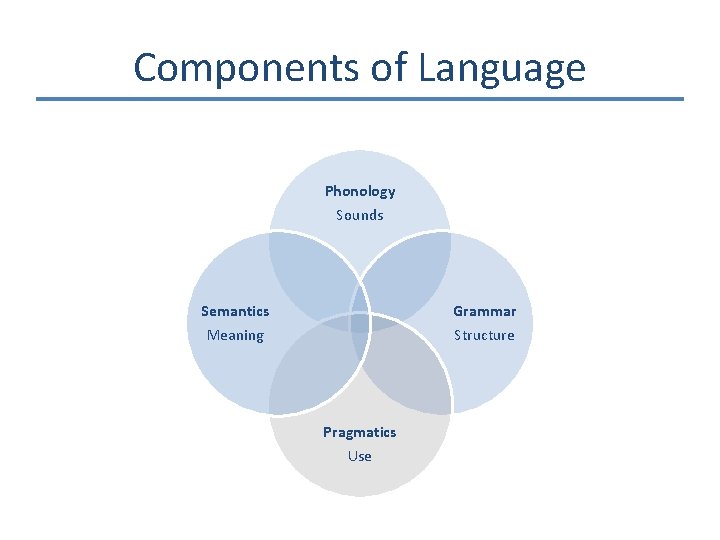
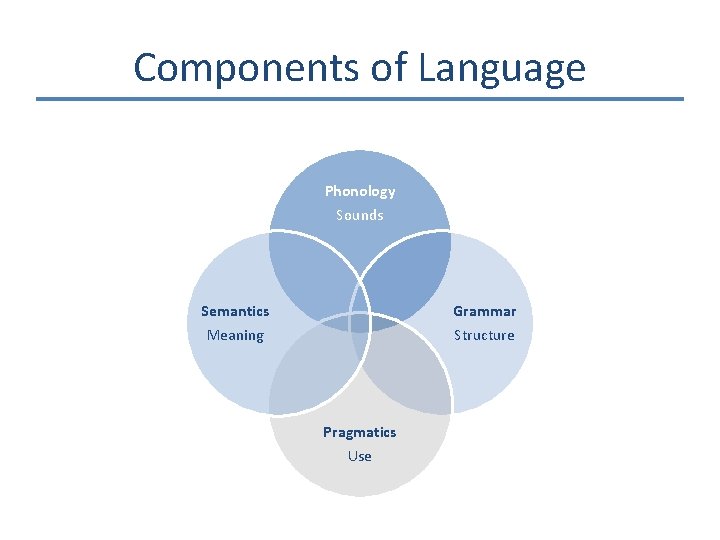
Components of Language Phonology Sounds Semantics Meaning Grammar Structure Pragmatics Use
Components of Language Phonology Sounds Semantics Meaning Grammar Structure Pragmatics Use
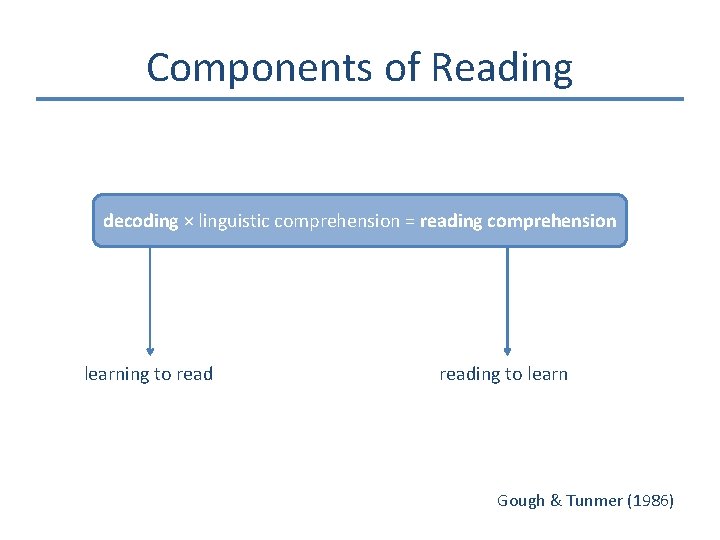
Components of Reading decoding × linguistic comprehension = reading comprehension learning to reading to learn Gough & Tunmer (1986)
How Language and Reading Relate • Causal theory: Development of reading builds on a foundation of spoken language
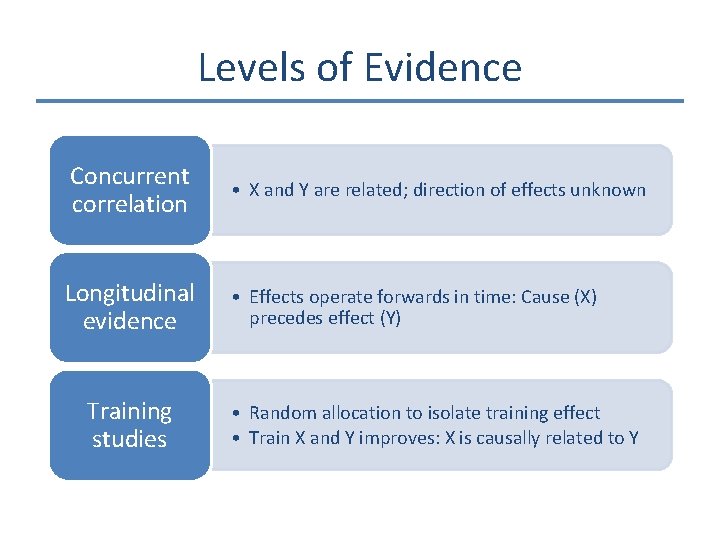
Levels of Evidence Concurrent correlation • X and Y are related; direction of effects unknown Longitudinal evidence • Effects operate forwards in time: Cause (X) precedes effect (Y) Training studies • Random allocation to isolate training effect • Train X and Y improves: X is causally related to Y
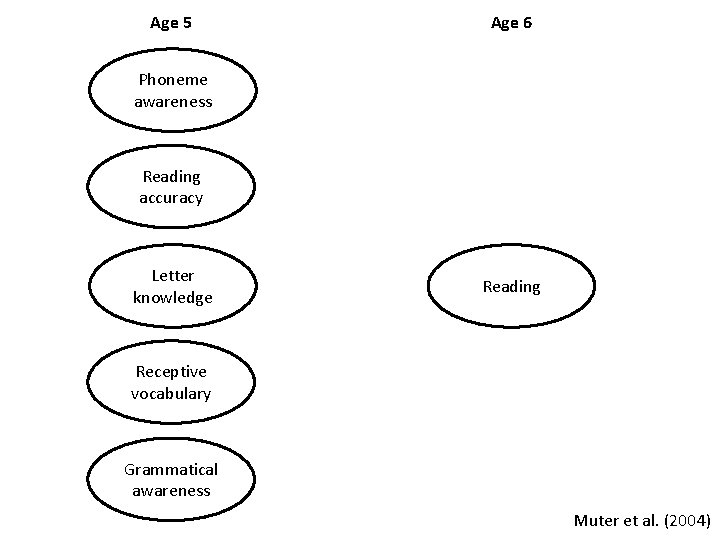
How Language and Reading Relate • Muter et al. (2004): Longitudinal evidence from school-age children – 90 children tested in first term of formal schooling (4; 09 years), and 1 and 2 years later – What skills early on in schooling predict later reading accuracy and comprehension?
Age 5 Age 6 Phoneme awareness Reading accuracy Letter knowledge Reading Receptive vocabulary Grammatical awareness Muter et al. (2004)
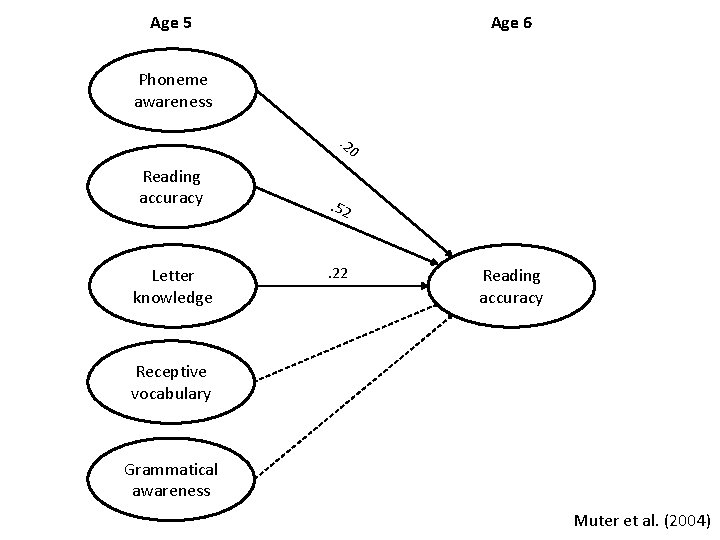
Age 5 Age 6 Phoneme awareness. 2 0 Reading accuracy Letter knowledge . 52 . 22 Reading accuracy Receptive vocabulary Grammatical awareness Muter et al. (2004)
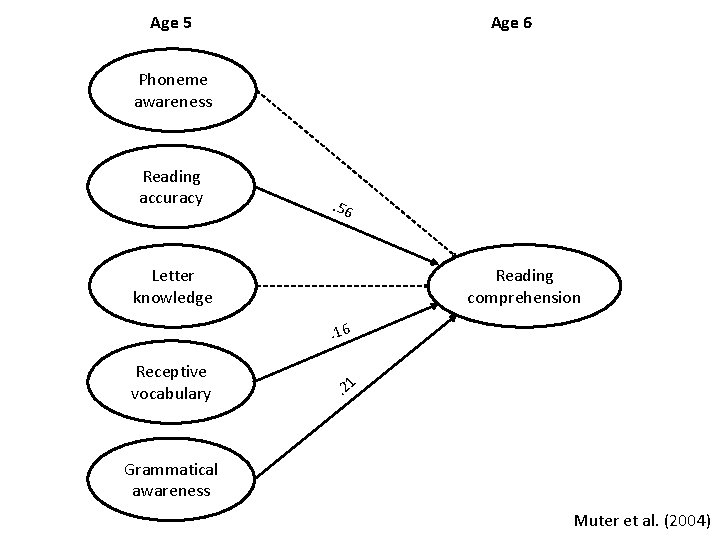
Age 5 Age 6 Phoneme awareness Reading accuracy . 56 Reading comprehension Letter knowledge. 16 Receptive vocabulary 1 . 2 Grammatical awareness Muter et al. (2004)
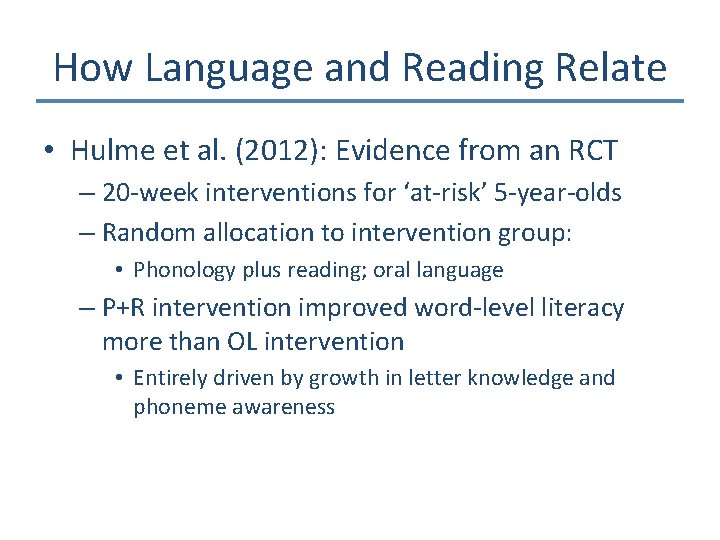
How Language and Reading Relate • Hulme et al. (2012): Evidence from an RCT – 20 -week interventions for ‘at-risk’ 5 -year-olds – Random allocation to intervention group: • Phonology plus reading; oral language – P+R intervention improved word-level literacy more than OL intervention • Entirely driven by growth in letter knowledge and phoneme awareness
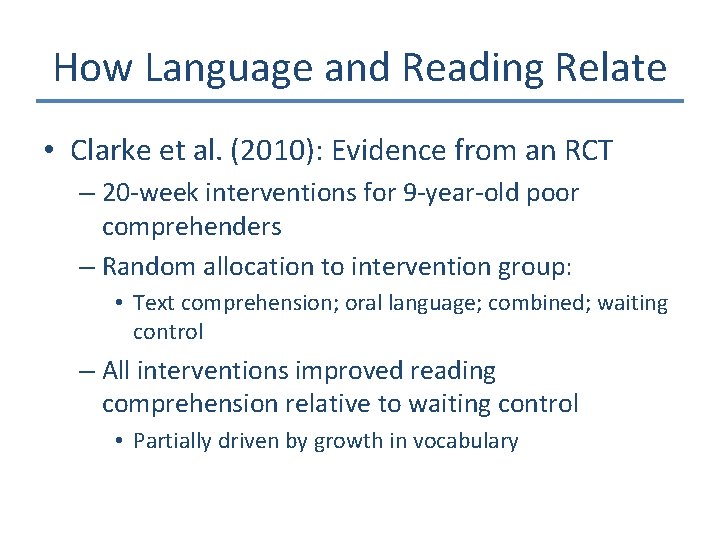
How Language and Reading Relate • Clarke et al. (2010): Evidence from an RCT – 20 -week interventions for 9 -year-old poor comprehenders – Random allocation to intervention group: • Text comprehension; oral language; combined; waiting control – All interventions improved reading comprehension relative to waiting control • Partially driven by growth in vocabulary
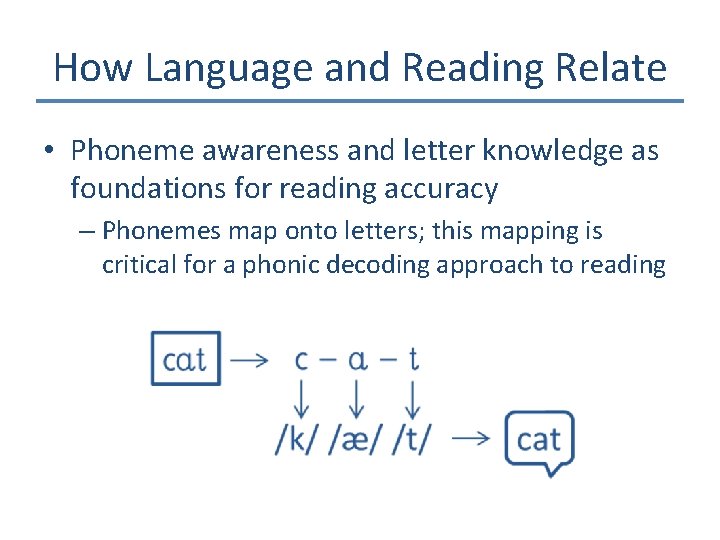
How Language and Reading Relate • Phoneme awareness and letter knowledge as foundations for reading accuracy – Phonemes map onto letters; this mapping is critical for a phonic decoding approach to reading
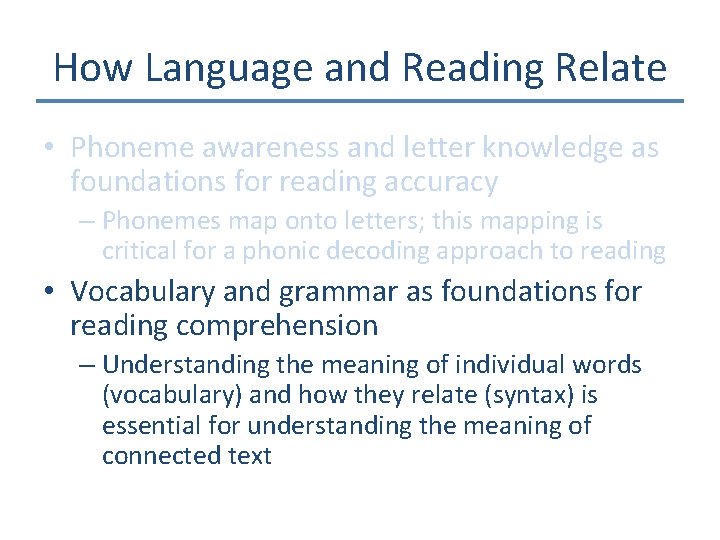
How Language and Reading Relate • Phoneme awareness and letter knowledge as foundations for reading accuracy – Phonemes map onto letters; this mapping is critical for a phonic decoding approach to reading • Vocabulary and grammar as foundations for reading comprehension – Understanding the meaning of individual words (vocabulary) and how they relate (syntax) is essential for understanding the meaning of connected text
Reading and Language • Good oral language leads to good reading – Phonological skills critical for reading accuracy – Nonphonological skills critical for reading comprehension • Poor oral language leads to poor reading – Children with dyslexia have impairments in phonological aspects of language (Snowling et al. , 2003) – Children who are poor comprehenders have impairments in semantic and grammatical aspects of language (Nation et al. , 2004)
Reading and Language • An obvious implication: – Poor oral language skills could be used to identify children at risk for reading difficulties, and candidates for preventative language intervention • A critical question: – How early does language reliably predict reading?
Reading and Language • An obvious implication: – Poor oral language skills could be used to identify children at risk for reading difficulties, and candidates for preventative language intervention • A critical question: – How early does language reliably predict reading? • A slight problem: – Infant vocabulary is not an especially reliable predictor even of later vocabulary
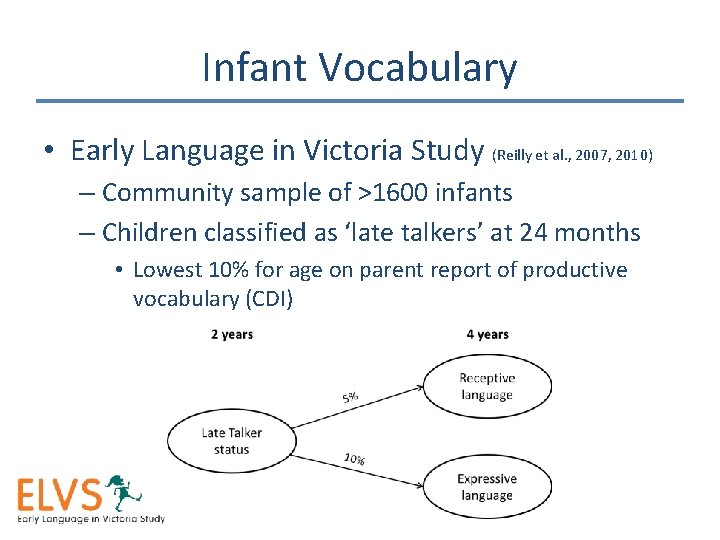
Infant Vocabulary • Early Language in Victoria Study (Reilly et al. , 2007, 2010) – Community sample of >1600 infants – Children classified as ‘late talkers’ at 24 months • Lowest 10% for age on parent report of productive vocabulary (CDI)
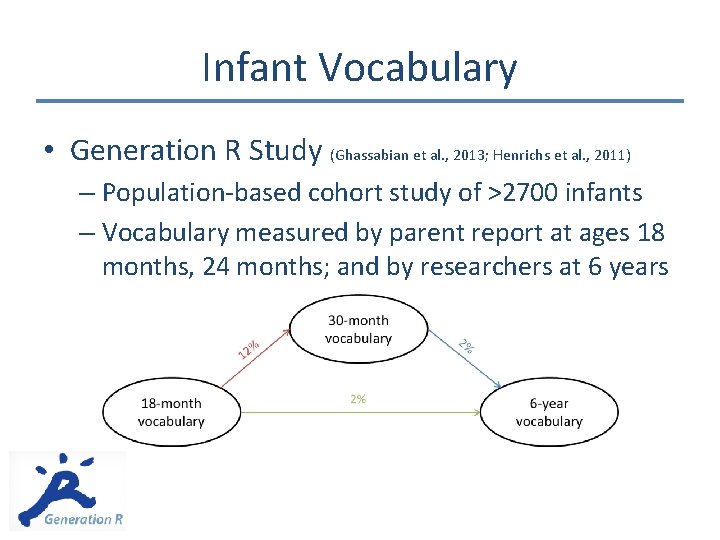
Infant Vocabulary • Generation R Study (Ghassabian et al. , 2013; Henrichs et al. , 2011) – Population-based cohort study of >2700 infants – Vocabulary measured by parent report at ages 18 months, 24 months; and by researchers at 6 years
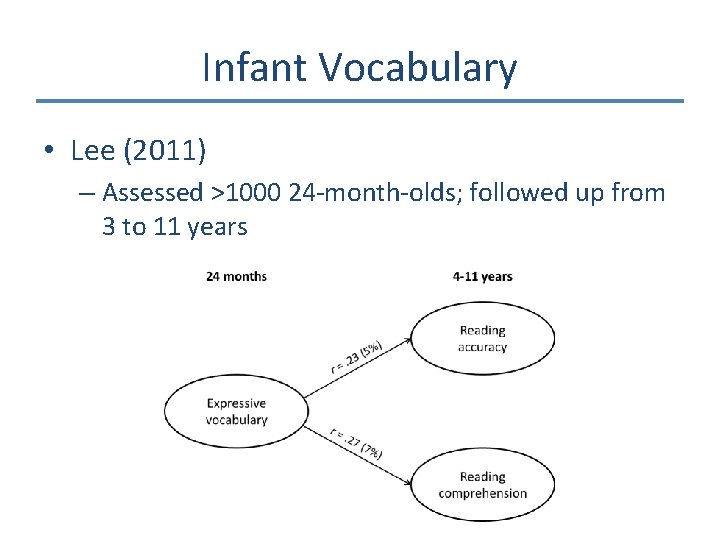
Infant Vocabulary • Lee (2011) – Assessed >1000 24 -month-olds; followed up from 3 to 11 years
Infant Vocabulary • “Expressive vocabulary at age 2 is… crucial to subsequent literacy development” (Lee, 2011, p. 83) • “Research findings also are frequently overinterpreted… Significant statistical differences are equated with clinically meaningful differences” (Paul & Roth, 2011, p. 333) • Carried out our own study in the UK context to critically evaluate statistical and practical significance
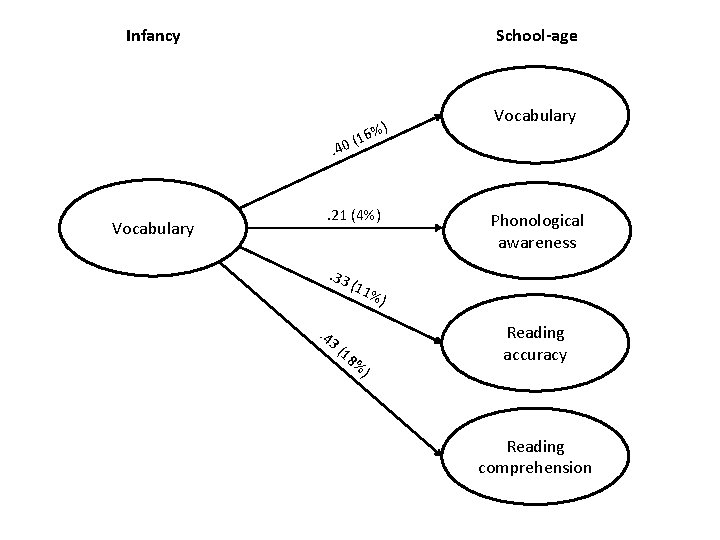
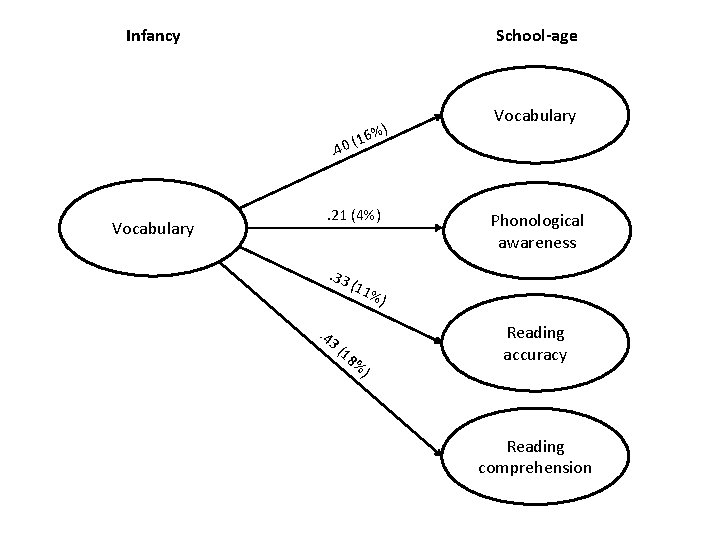
Learning to Read Project • Followed 300 children from infancy (16 -24 months) to school-age (4 -9 years) • In infancy, vocabulary measured with OCDI – Parental checklist of 416 words • At school-age, measured vocabulary, phonological awareness and reading • Research question: Does infant vocabulary predict language and reading outcomes?
Infancy School-age . 40 %) 6 1 ( Vocabulary . 21 (4%) . 33 Vocabulary Phonological awareness (11 %) . 4 3( 18 %) Reading accuracy Reading comprehension
Learning to Read Project • Infant vocabulary is a significant predictor of language and reading outcomes approximately 5 years later – Vocabulary a plausible antecedent of reading development • However, it is not sufficiently reliable to be predictive at the individual level – Infant vocabulary only accounted for 16% of variance in later vocabulary – Indicates instability in language development pre-2 years – Fits with the observation that the majority of ‘late talkers’ catch up by school-age (Rescorla, 2011)
Learning to Read Project • What might explain additional variance in outcomes? • Family risk of reading/language difficulties − Better predictor of language outcomes at 4 years than ‘late talker’ status at 18 months (Bishop et al. , 2012) − 35% of our sample had a first-degree relative with reading/language difficulties
Infancy School-age 6%) (1 . 40 Vocabulary . 21 (4%) . 33 Vocabulary Phonological awareness (11 %) . 4 3( 18 %) Reading accuracy Reading comprehension
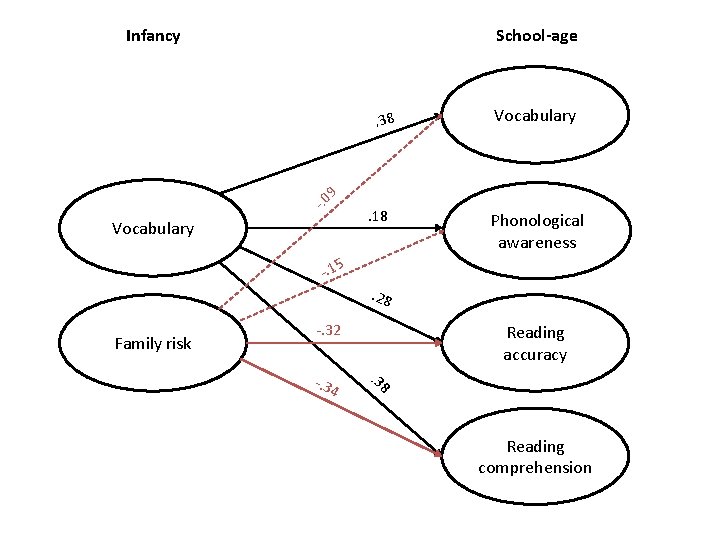
Infancy School-age -. 0 9 . 38 . 18 Vocabulary -. 1 Vocabulary Phonological awareness 5. 28 Family risk -. 32 -. 34 Reading accuracy. 3 8 Reading comprehension
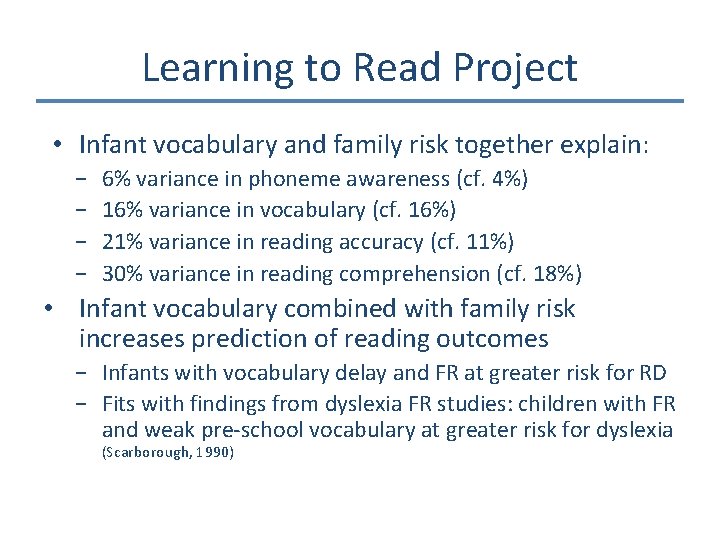
Learning to Read Project • Infant vocabulary and family risk together explain: − − 6% variance in phoneme awareness (cf. 4%) 16% variance in vocabulary (cf. 16%) 21% variance in reading accuracy (cf. 11%) 30% variance in reading comprehension (cf. 18%) • Infant vocabulary combined with family risk increases prediction of reading outcomes − Infants with vocabulary delay and FR at greater risk for RD − Fits with findings from dyslexia FR studies: children with FR and weak pre-school vocabulary at greater risk for dyslexia (Scarborough, 1990)
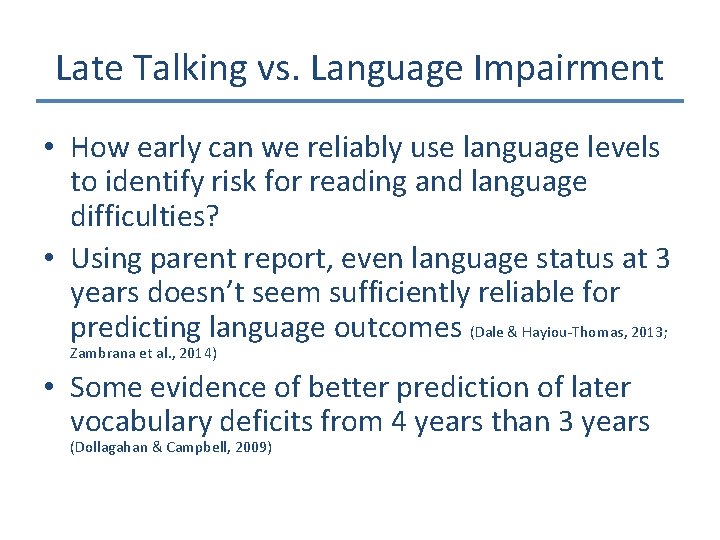
Late Talking vs. Language Impairment • How early can we reliably use language levels to identify risk for reading and language difficulties? • Using parent report, even language status at 3 years doesn’t seem sufficiently reliable for predicting language outcomes (Dale & Hayiou-Thomas, 2013; Zambrana et al. , 2014) • Some evidence of better prediction of later vocabulary deficits from 4 years than 3 years (Dollagahan & Campbell, 2009)
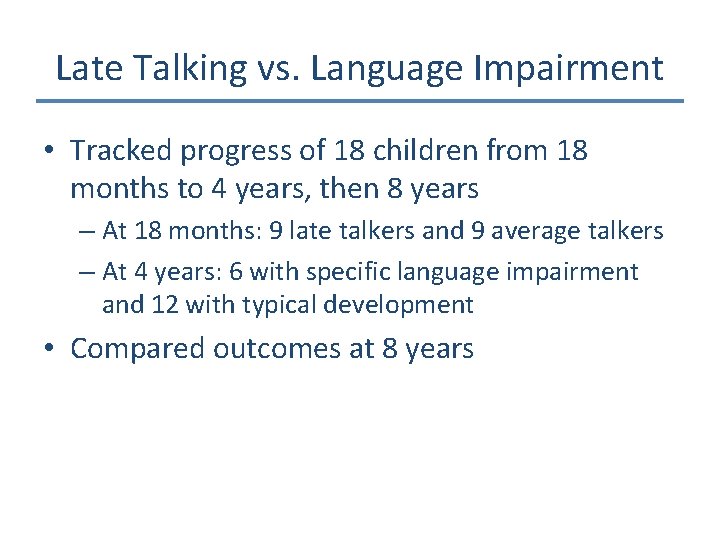
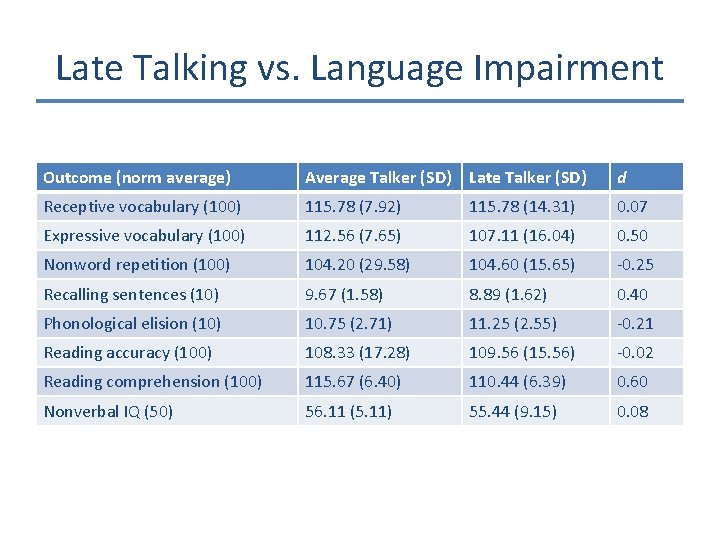
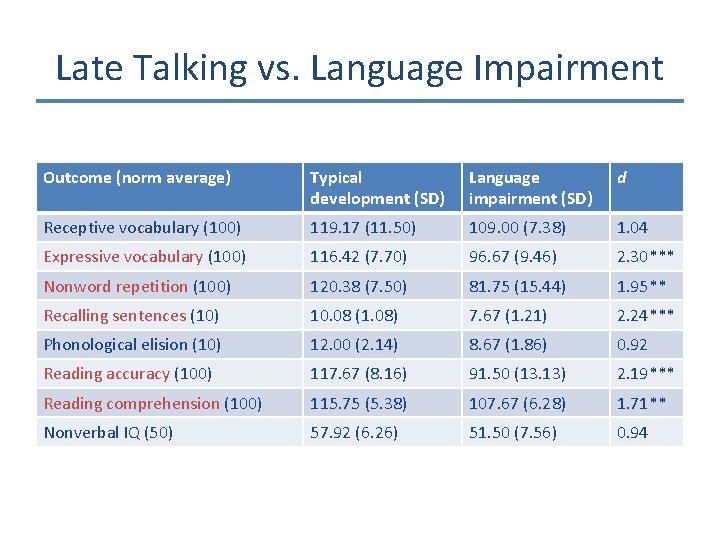
Late Talking vs. Language Impairment • Tracked progress of 18 children from 18 months to 4 years, then 8 years – At 18 months: 9 late talkers and 9 average talkers – At 4 years: 6 with specific language impairment and 12 with typical development • Compared outcomes at 8 years
Late Talking vs. Language Impairment Outcome (norm average) Average Talker (SD) Late Talker (SD) d Receptive vocabulary (100) 115. 78 (7. 92) 115. 78 (14. 31) 0. 07 Expressive vocabulary (100) 112. 56 (7. 65) 107. 11 (16. 04) 0. 50 Nonword repetition (100) 104. 20 (29. 58) 104. 60 (15. 65) -0. 25 Recalling sentences (10) 9. 67 (1. 58) 8. 89 (1. 62) 0. 40 Phonological elision (10) 10. 75 (2. 71) 11. 25 (2. 55) -0. 21 Reading accuracy (100) 108. 33 (17. 28) 109. 56 (15. 56) -0. 02 Reading comprehension (100) 115. 67 (6. 40) 110. 44 (6. 39) 0. 60 Nonverbal IQ (50) 56. 11 (5. 11) 55. 44 (9. 15) 0. 08
Late Talking vs. Language Impairment Outcome (norm average) Typical development (SD) Language impairment (SD) d Receptive vocabulary (100) 119. 17 (11. 50) 109. 00 (7. 38) 1. 04 Expressive vocabulary (100) 116. 42 (7. 70) 96. 67 (9. 46) 2. 30*** Nonword repetition (100) 120. 38 (7. 50) 81. 75 (15. 44) 1. 95** Recalling sentences (10) 10. 08 (1. 08) 7. 67 (1. 21) 2. 24*** Phonological elision (10) 12. 00 (2. 14) 8. 67 (1. 86) 0. 92 Reading accuracy (100) 117. 67 (8. 16) 91. 50 (13. 13) 2. 19*** Reading comprehension (100) 115. 75 (5. 38) 107. 67 (6. 28) 1. 71** Nonverbal IQ (50) 57. 92 (6. 26) 51. 50 (7. 56) 0. 94
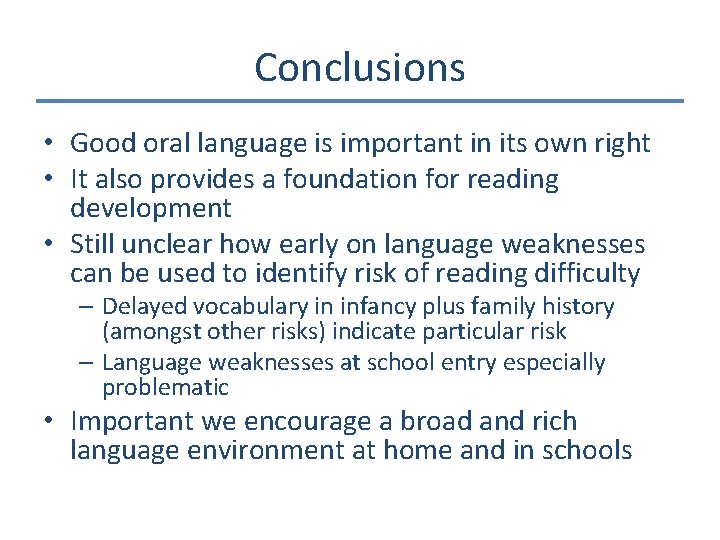
Conclusions • Good oral language is important in its own right • It also provides a foundation for reading development • Still unclear how early on language weaknesses can be used to identify risk of reading difficulty – Delayed vocabulary in infancy plus family history (amongst other risks) indicate particular risk – Language weaknesses at school entry especially problematic • Important we encourage a broad and rich language environment at home and in schools
Acknowledgements • • • Professor Kate Nation, University of Oxford Professor Kim Plunkett, University of Oxford Professor Dorothy Bishop, University of Oxford Gurpreet Reen, Royal Holloway University of London Julia Dilnot, University of Oxford Jane Ralph, University of Oxford