
Language Arts Final Exam Review What is a

- Slides: 32
Language Arts Final Exam Review
What is a noun? ¬A noun is a person, place, thing or idea
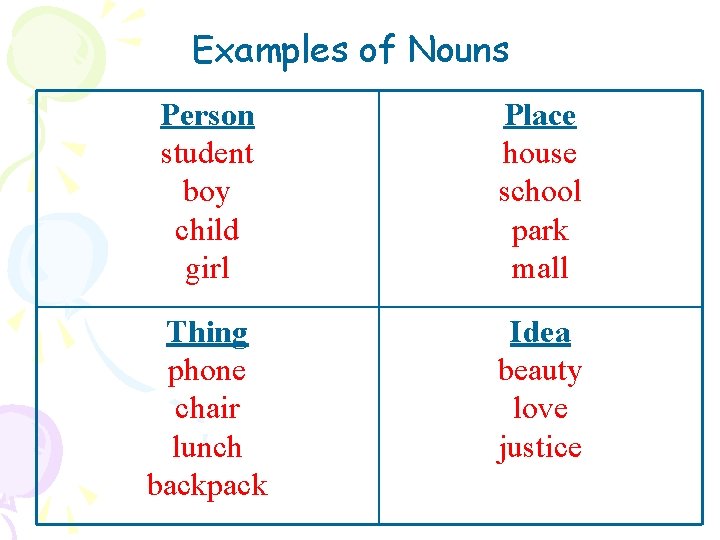
Examples of Nouns Person student boy child girl Place house school park mall Thing phone chair lunch backpack Idea beauty love justice
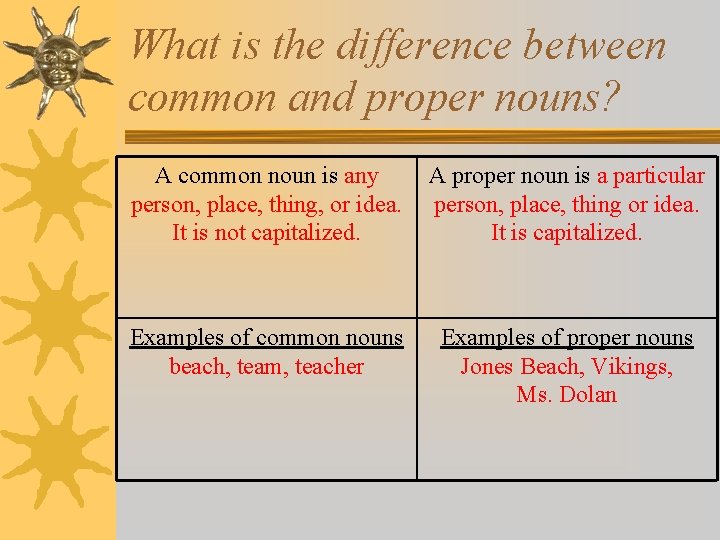
What is the difference between common and proper nouns? A common noun is any person, place, thing, or idea. It is not capitalized. A proper noun is a particular person, place, thing or idea. It is capitalized. Examples of common nouns beach, team, teacher Examples of proper nouns Jones Beach, Vikings, Ms. Dolan
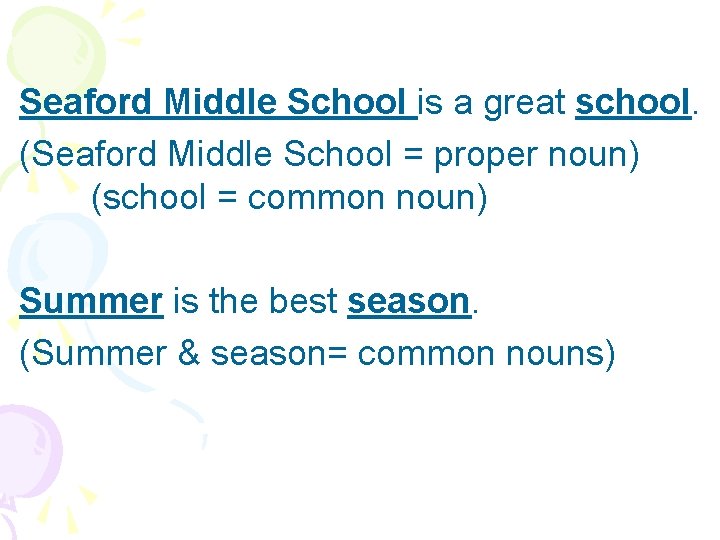
Seaford Middle School is a great school. (Seaford Middle School = proper noun) (school = common noun) Summer is the best season. (Summer & season= common nouns)
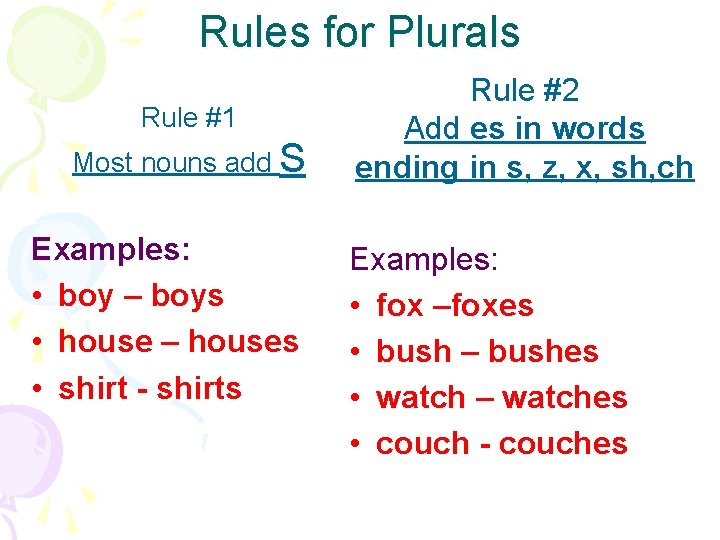
Rules for Plurals Rule #1 Most nouns add S Examples: • boy – boys • house – houses • shirt - shirts Rule #2 Add es in words ending in s, z, x, sh, ch Examples: • fox –foxes • bush – bushes • watch – watches • couch - couches
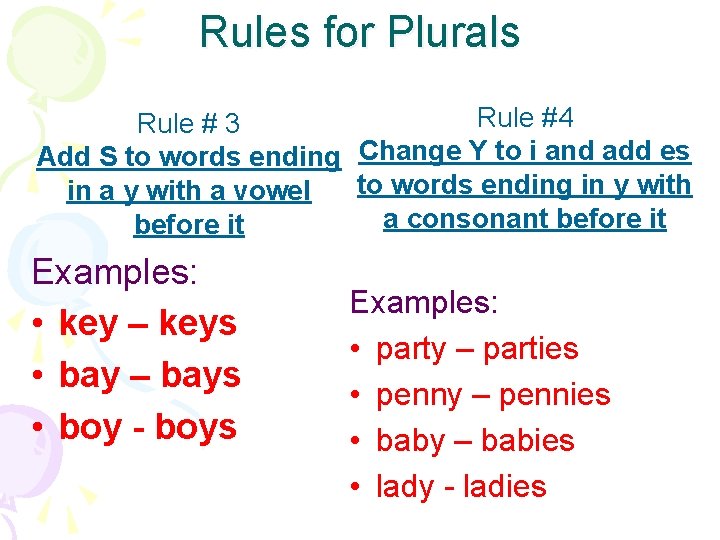
Rules for Plurals Rule #4 Rule # 3 Add S to words ending Change Y to i and add es to words ending in y with in a y with a vowel a consonant before it Examples: • key – keys • bay – bays • boy - boys Examples: • party – parties • penny – pennies • baby – babies • lady - ladies
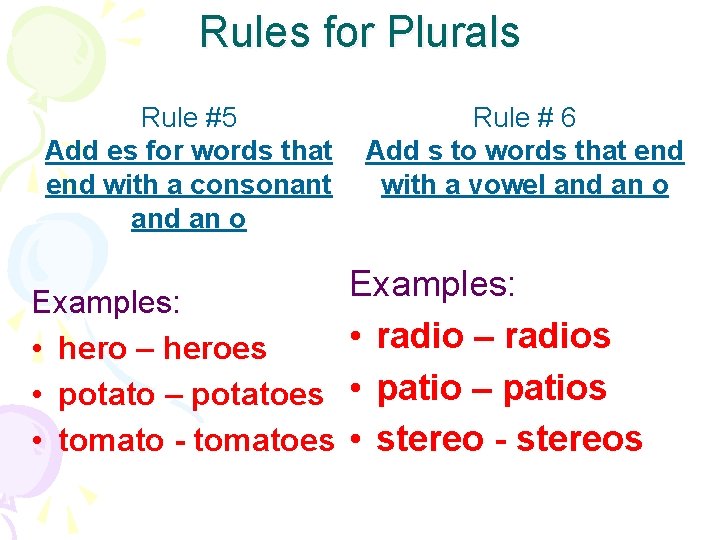
Rules for Plurals Rule #5 Add es for words that end with a consonant and an o Rule # 6 Add s to words that end with a vowel and an o Examples: • radio – radios • hero – heroes • potato – potatoes • patio – patios • tomato - tomatoes • stereo - stereos
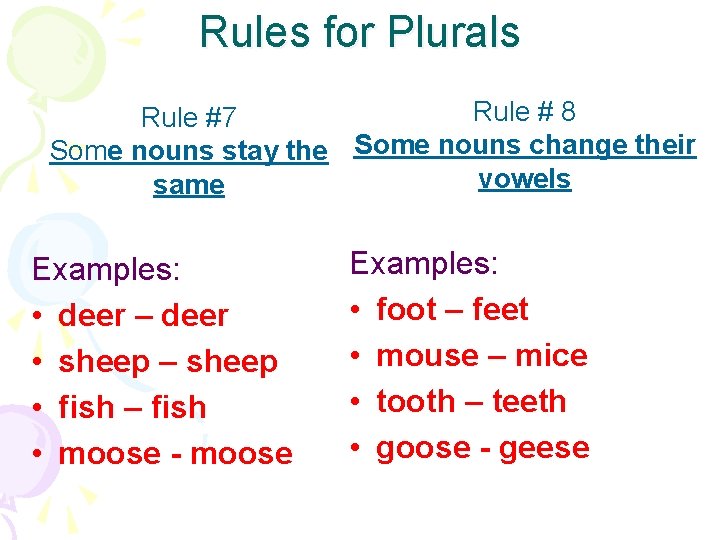
Rules for Plurals Rule # 8 Rule #7 Some nouns stay the Some nouns change their vowels same Examples: • deer – deer • sheep – sheep • fish – fish • moose - moose Examples: • foot – feet • mouse – mice • tooth – teeth • goose - geese
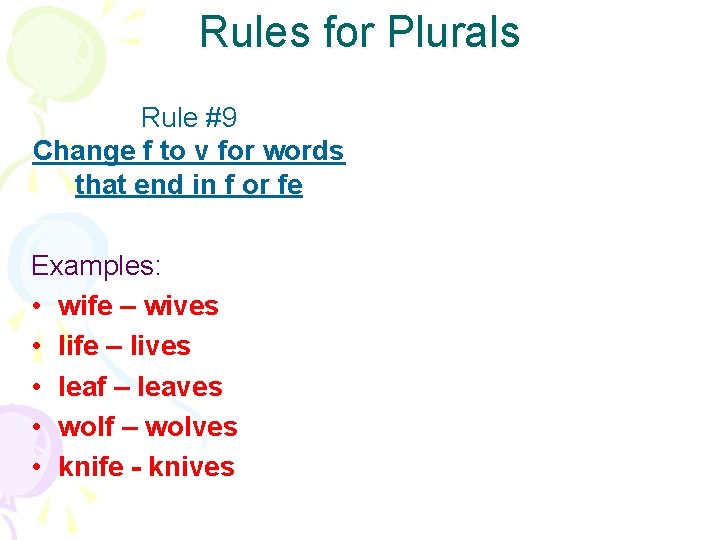
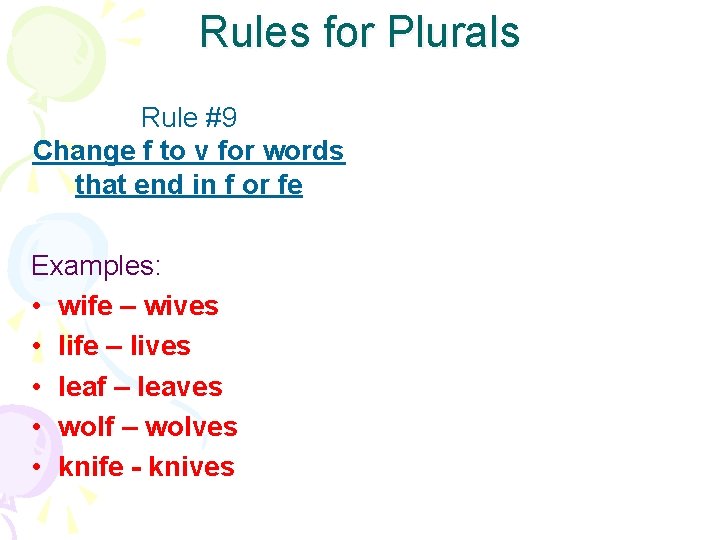
Rules for Plurals Rule #9 Change f to v for words that end in f or fe Examples: • wife – wives • life – lives • leaf – leaves • wolf – wolves • knife - knives
Rules for Plurals Rule #9 Change f to v for words that end in f or fe Examples: • wife – wives • life – lives • leaf – leaves • wolf – wolves • knife - knives
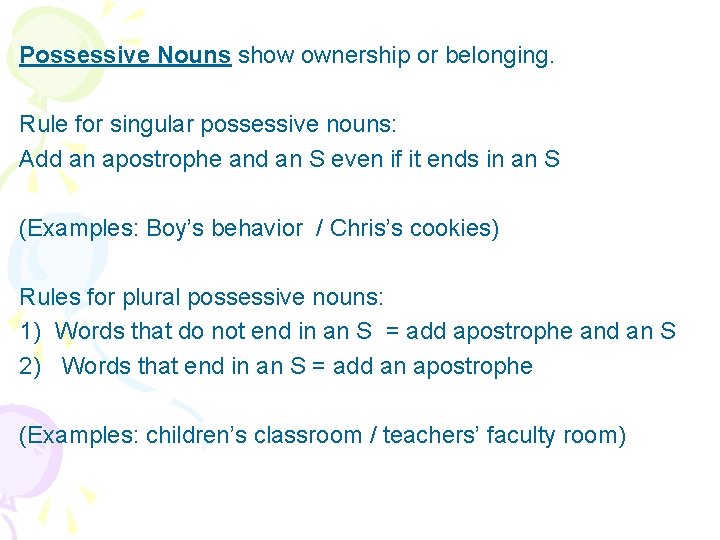
Possessive Nouns show ownership or belonging. Rule for singular possessive nouns: Add an apostrophe and an S even if it ends in an S (Examples: Boy’s behavior / Chris’s cookies) Rules for plural possessive nouns: 1) Words that do not end in an S = add apostrophe and an S 2) Words that end in an S = add an apostrophe (Examples: children’s classroom / teachers’ faculty room)
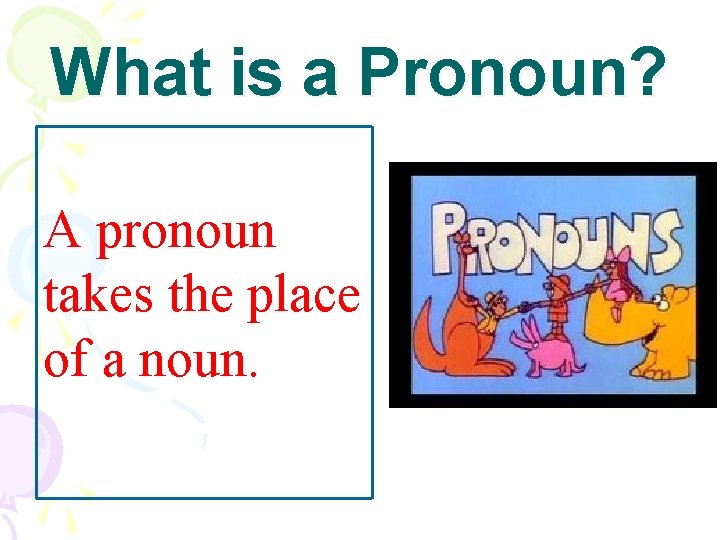
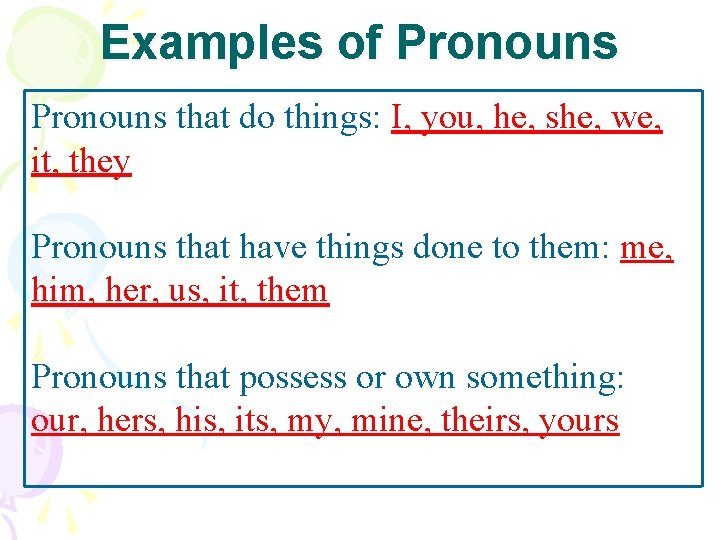
What is a Pronoun? A pronoun takes the place of a noun.
Examples of Pronouns that do things: I, you, he, she, we, it, they Pronouns that have things done to them: me, him, her, us, it, them Pronouns that possess or own something: our, hers, his, its, my, mine, theirs, yours
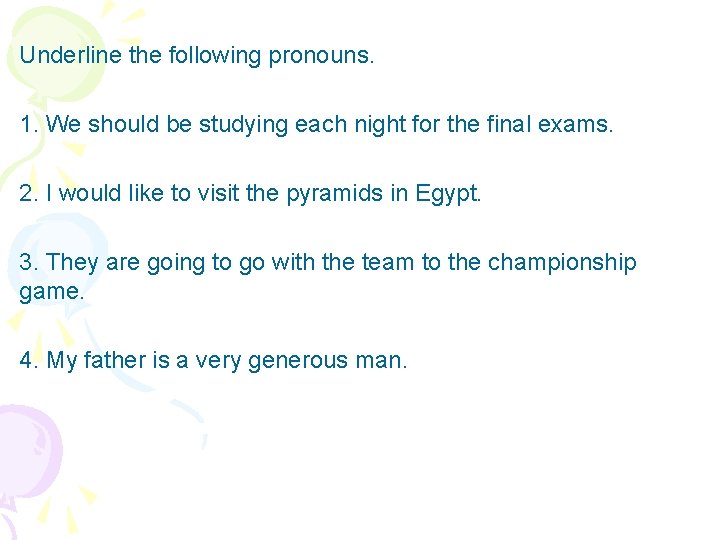
Underline the following pronouns. 1. We should be studying each night for the final exams. 2. I would like to visit the pyramids in Egypt. 3. They are going to go with the team to the championship game. 4. My father is a very generous man.
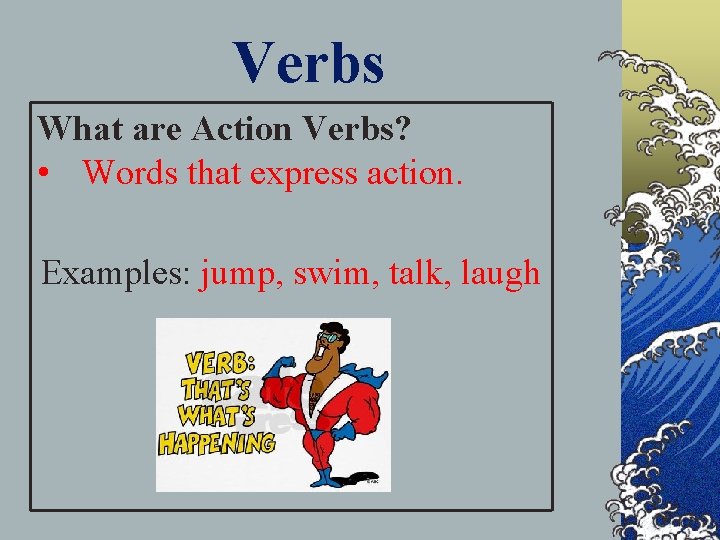
Verbs What are Action Verbs? • Words that express action. Examples: jump, swim, talk, laugh
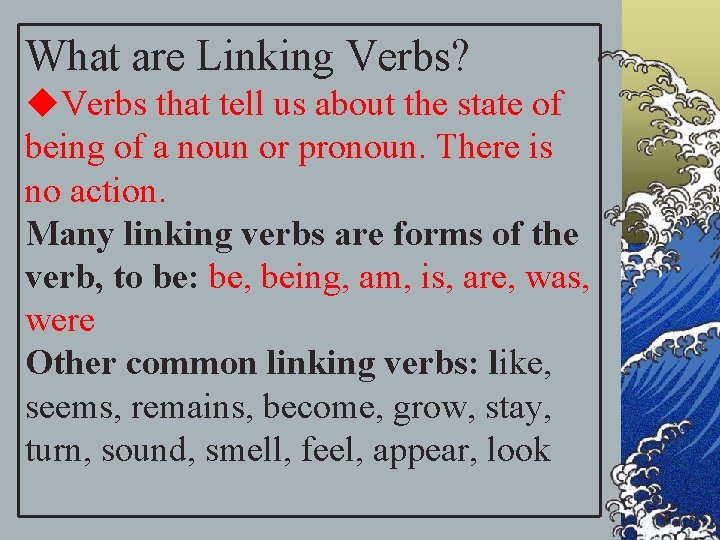
What are Linking Verbs? u. Verbs that tell us about the state of being of a noun or pronoun. There is no action. Many linking verbs are forms of the verb, to be: be, being, am, is, are, was, were Other common linking verbs: like, seems, remains, become, grow, stay, turn, sound, smell, feel, appear, look
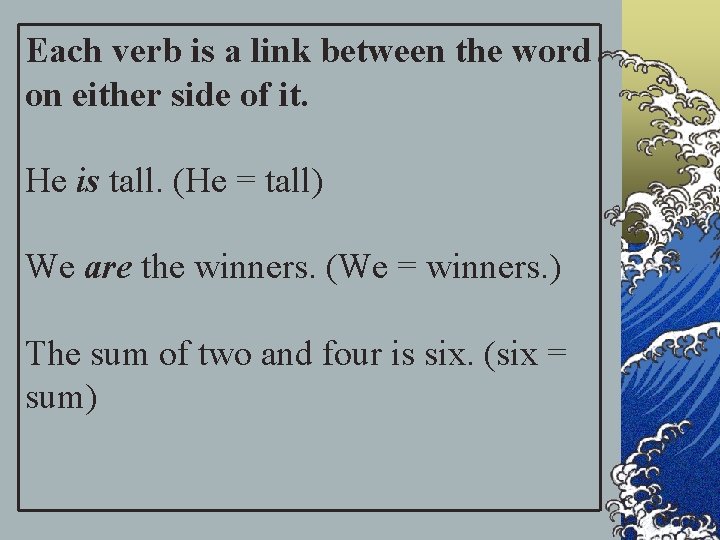
Each verb is a link between the word on either side of it. He is tall. (He = tall) We are the winners. (We = winners. ) The sum of two and four is six. (six = sum)
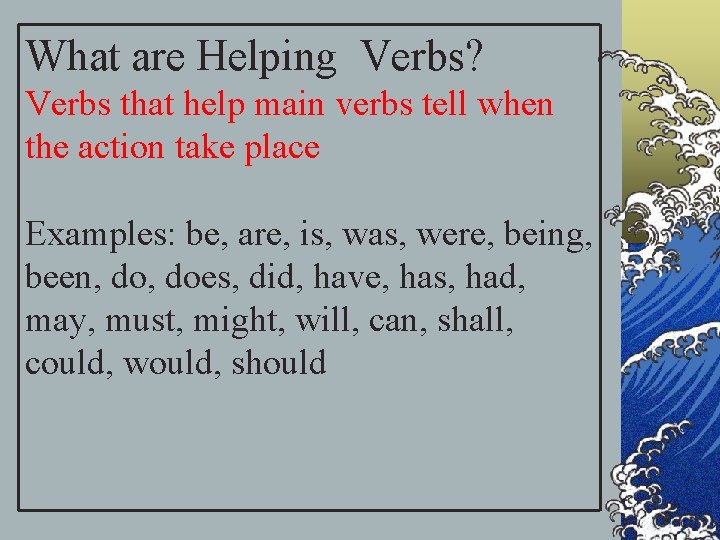
What are Helping Verbs? Verbs that help main verbs tell when the action take place Examples: be, are, is, was, were, being, been, does, did, have, has, had, may, must, might, will, can, shall, could, would, should
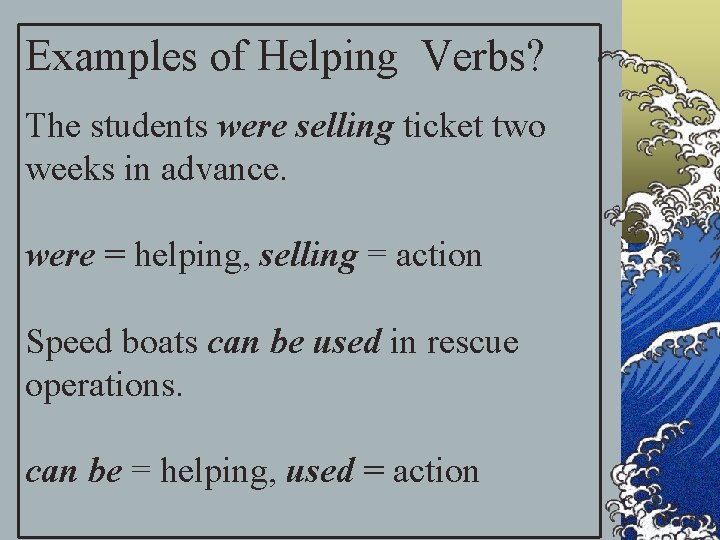
Examples of Helping Verbs? The students were selling ticket two weeks in advance. were = helping, selling = action Speed boats can be used in rescue operations. can be = helping, used = action
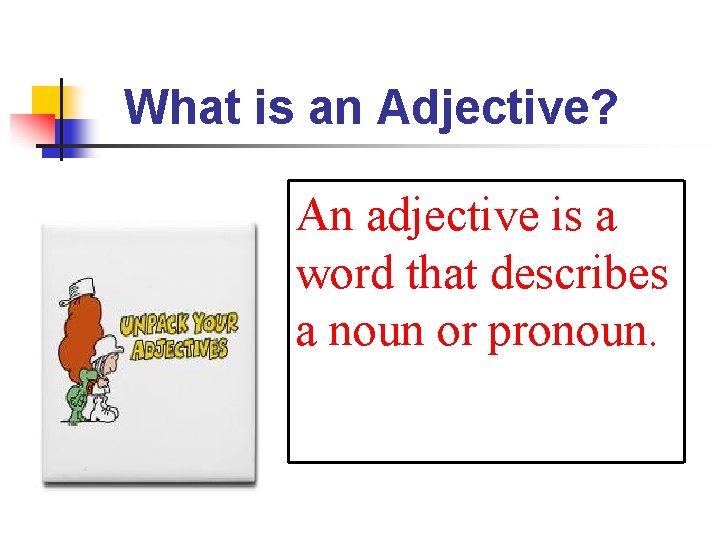
What is an Adjective? An adjective is a word that describes a noun or pronoun.
Adjective Examples - hairy, scary, red, large, big
Adjective The girl has long, beautiful hair. (long and beautiful = adjectives) It describes the hair.
Adjective Underline the adjectives. The boy is wearing a large orange sweatshirt. The family enjoyed the hot delicious soup.
What is an Adverb? An adverb modifies a verb, adverb, or adjective. Examples slowly, early, carefully
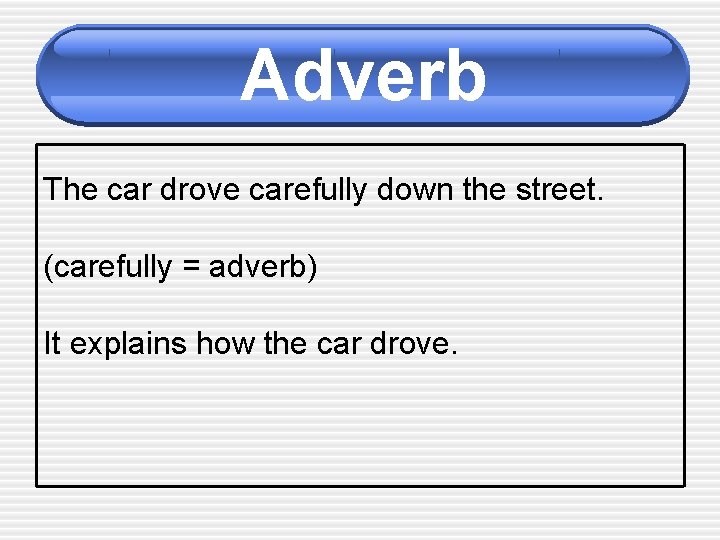
Adverb The car drove carefully down the street. (carefully = adverb) It explains how the car drove.
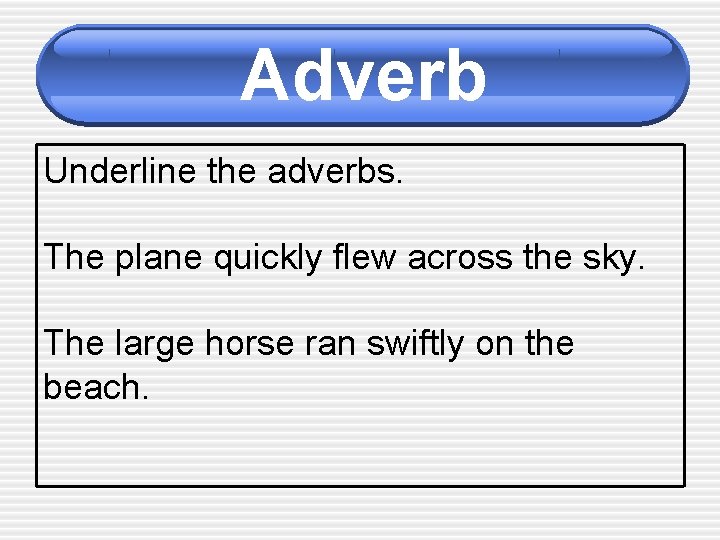
Adverb Underline the adverbs. The plane quickly flew across the sky. The large horse ran swiftly on the beach.
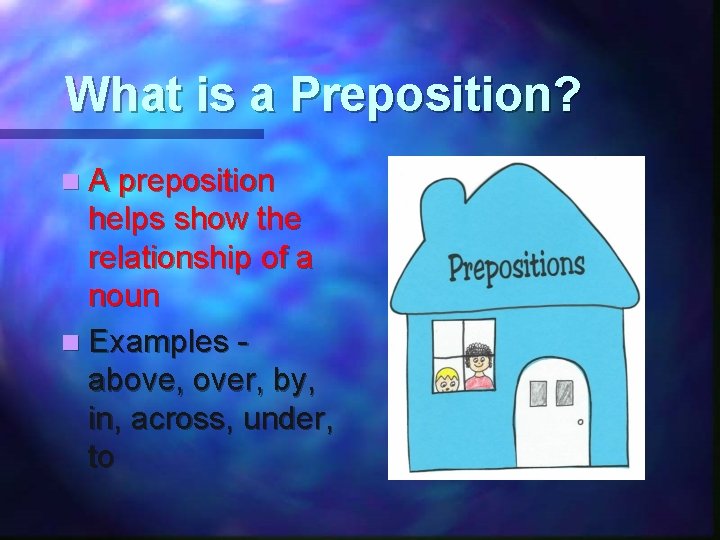
What is a Preposition? n A preposition helps show the relationship of a noun n Examples above, over, by, in, across, under, to
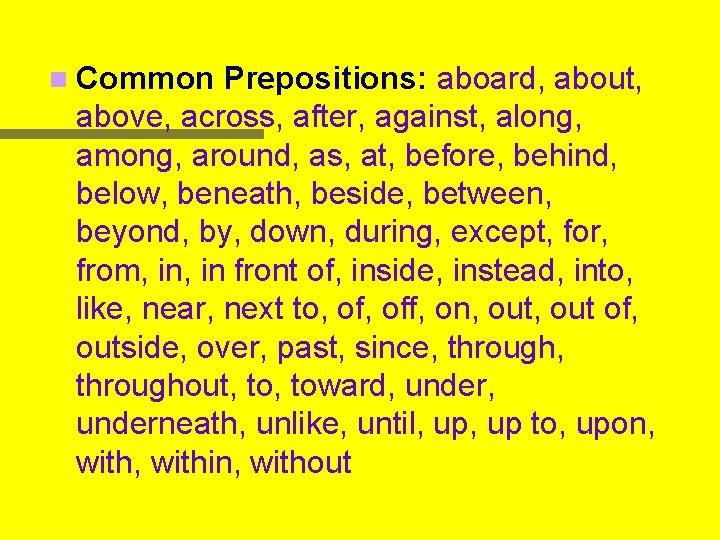
n Common Prepositions: aboard, about, above, across, after, against, along, among, around, as, at, before, behind, below, beneath, beside, between, beyond, by, down, during, except, for, from, in front of, inside, instead, into, like, near, next to, off, on, out of, outside, over, past, since, throughout, toward, underneath, unlike, until, up to, upon, within, without
Prepositions n Example: *He jumped over the mountain. n The phrase is over the mountain. n The preposition is over, and its object is mountain. n The preposition over shows the relationship between He and mountain.
What is a Conjunction? u u a word that connects words or sentences Examples: and, or, but
What is an Interjection? An interjection is a word that expresses a strong feeling. Examples - Wow! Holy Cow! Ouch!