
Language Anxiety in Second Language Acquisition Elald 2016
- Slides: 10
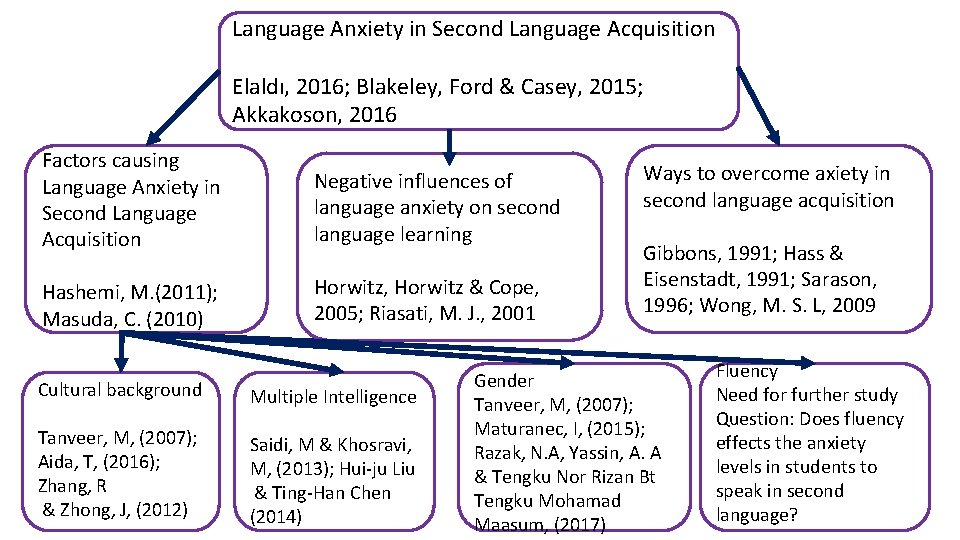
Language Anxiety in Second Language Acquisition Elaldı, 2016; Blakeley, Ford & Casey, 2015; Akkakoson, 2016 Factors causing Language Anxiety in Second Language Acquisition Negative influences of language anxiety on second language learning Hashemi, M. (2011); Masuda, C. (2010) Horwitz, Horwitz & Cope, 2005; Riasati, M. J. , 2001 Cultural background Multiple Intelligence Tanveer, M, (2007); Aida, T, (2016); Zhang, R & Zhong, J, (2012) Saidi, M & Khosravi, M, (2013); Hui-ju Liu & Ting-Han Chen (2014) Ways to overcome axiety in second language acquisition Gibbons, 1991; Hass & Eisenstadt, 1991; Sarason, 1996; Wong, M. S. L, 2009 Gender Tanveer, M, (2007); Maturanec, I, (2015); Razak, N. A, Yassin, A. A & Tengku Nor Rizan Bt Tengku Mohamad Maasum, (2017) Fluency Need for further study Question: Does fluency effects the anxiety levels in students to speak in second language?
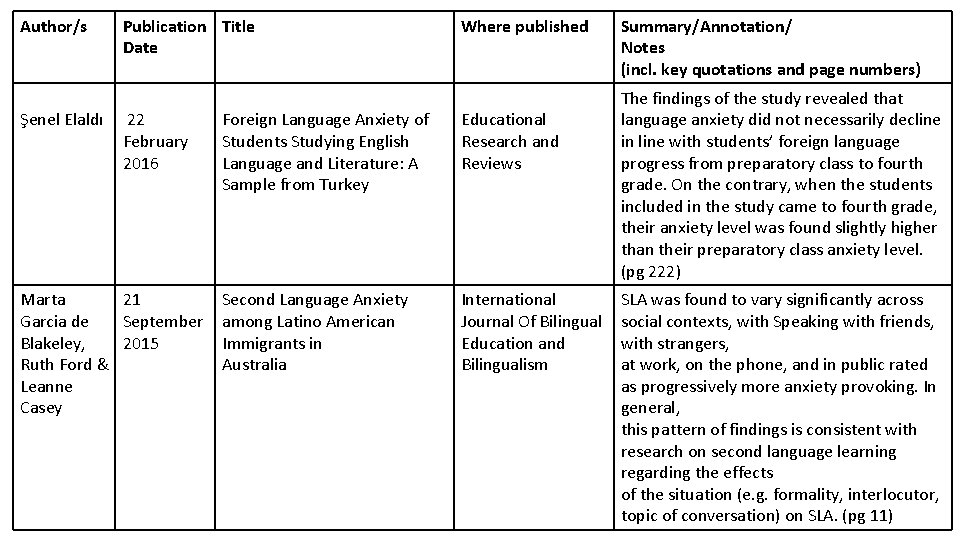
Author/s Şenel Elaldı Publication Title Date 22 February 2016 Marta 21 Garcia de September Blakeley, 2015 Ruth Ford & Leanne Casey Where published Foreign Language Anxiety of Students Studying English Language and Literature: A Sample from Turkey Educational Research and Reviews Second Language Anxiety among Latino American Immigrants in Australia International Journal Of Bilingual Education and Bilingualism Summary/Annotation/ Notes (incl. key quotations and page numbers) The findings of the study revealed that language anxiety did not necessarily decline in line with students’ foreign language progress from preparatory class to fourth grade. On the contrary, when the students included in the study came to fourth grade, their anxiety level was found slightly higher than their preparatory class anxiety level. (pg 222) SLA was found to vary significantly across social contexts, with Speaking with friends, with strangers, at work, on the phone, and in public rated as progressively more anxiety provoking. In general, this pattern of findings is consistent with research on second language learning regarding the effects of the situation (e. g. formality, interlocutor, topic of conversation) on SLA. (pg 11)
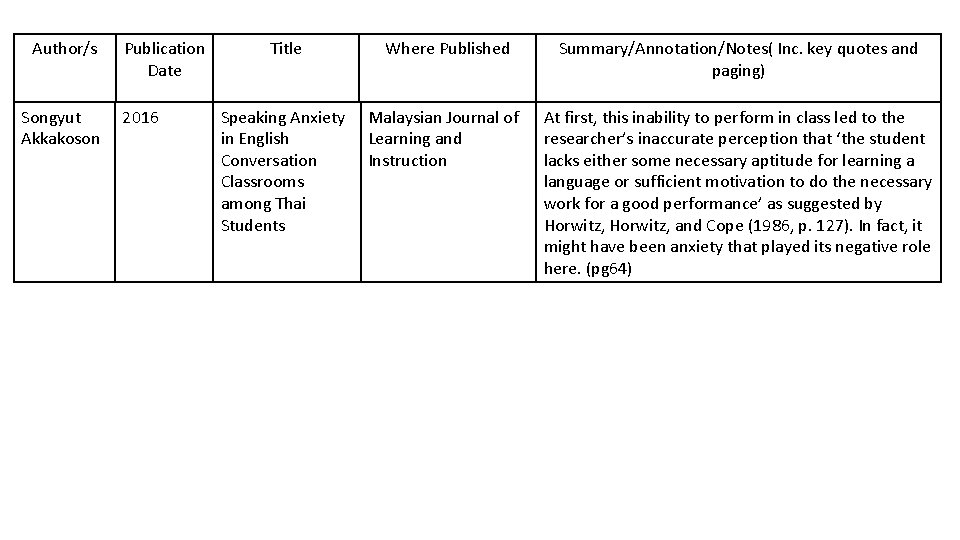
Author/s Songyut Akkakoson Publication Date 2016 Title Where Published Summary/Annotation/Notes( Inc. key quotes and paging) Speaking Anxiety in English Conversation Classrooms among Thai Students Malaysian Journal of Learning and Instruction At first, this inability to perform in class led to the researcher’s inaccurate perception that ‘the student lacks either some necessary aptitude for learning a language or sufficient motivation to do the necessary work for a good performance’ as suggested by Horwitz, and Cope (1986, p. 127). In fact, it might have been anxiety that played its negative role here. (pg 64)
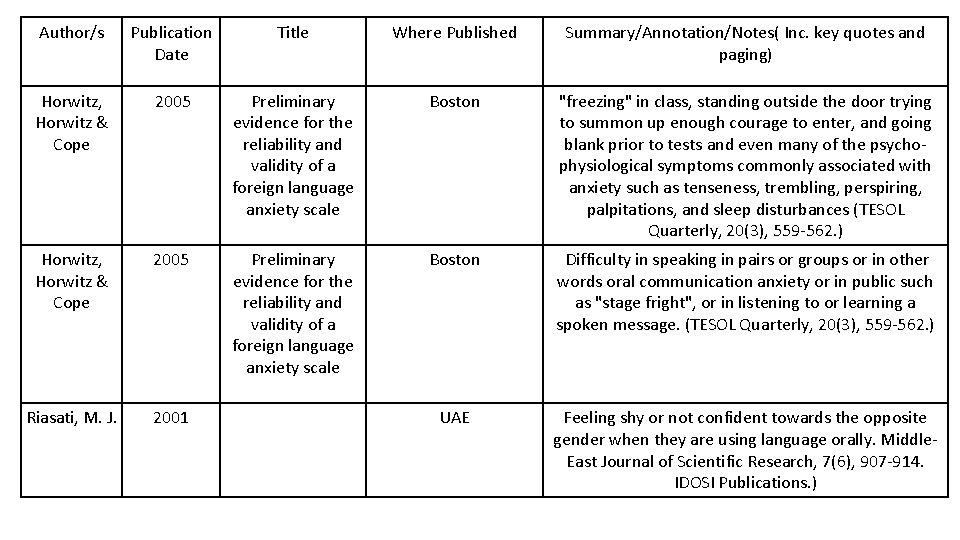
Author/s Publication Date Title Where Published Summary/Annotation/Notes( Inc. key quotes and paging) Horwitz, Horwitz & Cope 2005 Preliminary evidence for the reliability and validity of a foreign language anxiety scale Boston "freezing" in class, standing outside the door trying to summon up enough courage to enter, and going blank prior to tests and even many of the psychophysiological symptoms commonly associated with anxiety such as tenseness, trembling, perspiring, palpitations, and sleep disturbances (TESOL Quarterly, 20(3), 559 -562. ) Horwitz, Horwitz & Cope 2005 Preliminary evidence for the reliability and validity of a foreign language anxiety scale Boston Difficulty in speaking in pairs or groups or in other words oral communication anxiety or in public such as "stage fright", or in listening to or learning a spoken message. (TESOL Quarterly, 20(3), 559 -562. ) Riasati, M. J. 2001 UAE Feeling shy or not confident towards the opposite gender when they are using language orally. Middle. East Journal of Scientific Research, 7(6), 907 -914. IDOSI Publications. )
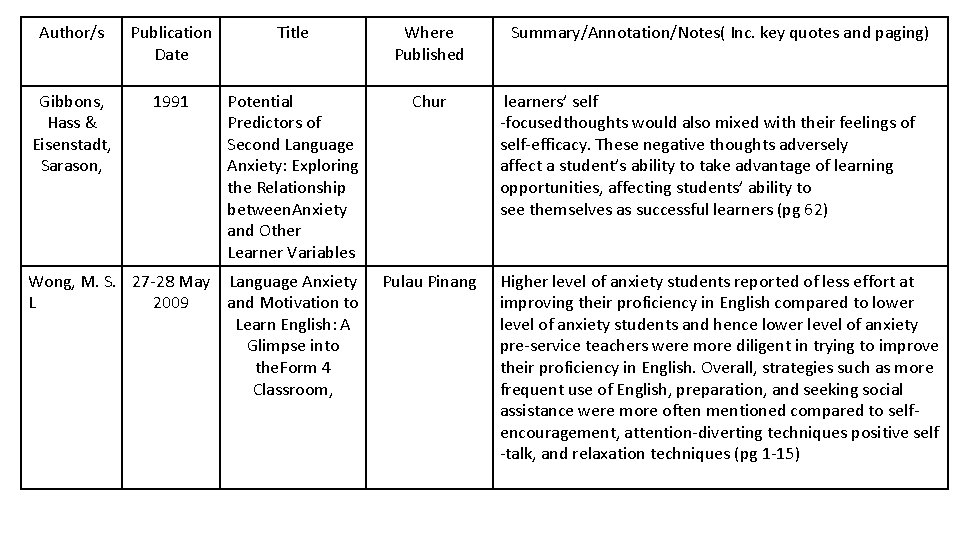
Author/s Publication Date Title Where Published Gibbons, Hass & Eisenstadt, Sarason, 1991 Potential Predictors of Second Language Anxiety: Exploring the Relationship between. Anxiety and Other Learner Variables Chur Wong, M. S. 27 -28 May Language Anxiety L 2009 and Motivation to Learn English: A Glimpse into the. Form 4 Classroom, Pulau Pinang Summary/Annotation/Notes( Inc. key quotes and paging) learners’ self -focusedthoughts would also mixed with their feelings of self-efficacy. These negative thoughts adversely affect a student’s ability to take advantage of learning opportunities, affecting students’ ability to see themselves as successful learners (pg 62) Higher level of anxiety students reported of less effort at improving their proficiency in English compared to lower level of anxiety students and hence lower level of anxiety pre-service teachers were more diligent in trying to improve their proficiency in English. Overall, strategies such as more frequent use of English, preparation, and seeking social assistance were more often mentioned compared to selfencouragement, attention-diverting techniques positive self -talk, and relaxation techniques (pg 1 -15)
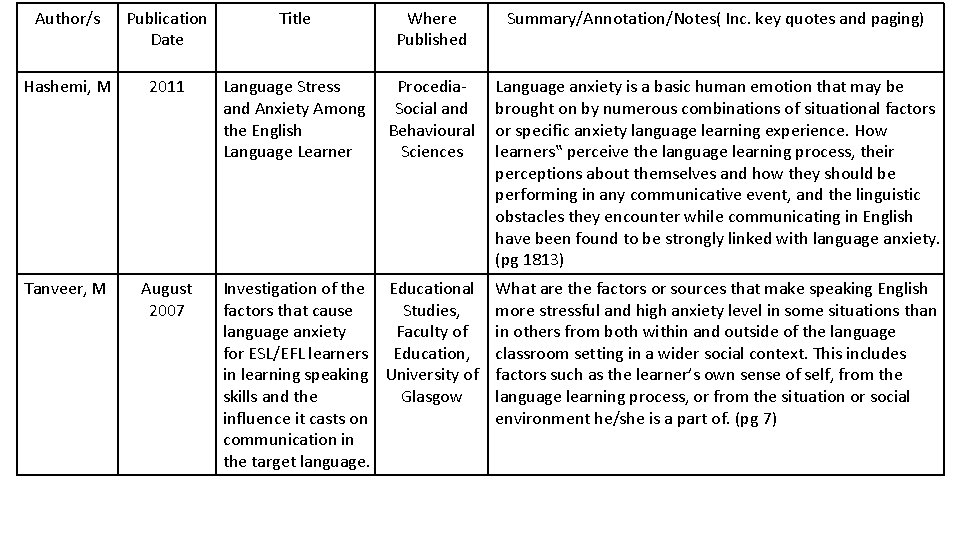
Author/s Publication Date Title Where Published Summary/Annotation/Notes( Inc. key quotes and paging) Hashemi, M 2011 Language Stress and Anxiety Among the English Language Learner Procedia. Social and Behavioural Sciences Language anxiety is a basic human emotion that may be brought on by numerous combinations of situational factors or specific anxiety language learning experience. How learners‟ perceive the language learning process, their perceptions about themselves and how they should be performing in any communicative event, and the linguistic obstacles they encounter while communicating in English have been found to be strongly linked with language anxiety. (pg 1813) Tanveer, M August 2007 Investigation of the Educational factors that cause Studies, language anxiety Faculty of for ESL/EFL learners Education, in learning speaking University of skills and the Glasgow influence it casts on communication in the target language. What are the factors or sources that make speaking English more stressful and high anxiety level in some situations than in others from both within and outside of the language classroom setting in a wider social context. This includes factors such as the learner’s own sense of self, from the language learning process, or from the situation or social environment he/she is a part of. (pg 7)
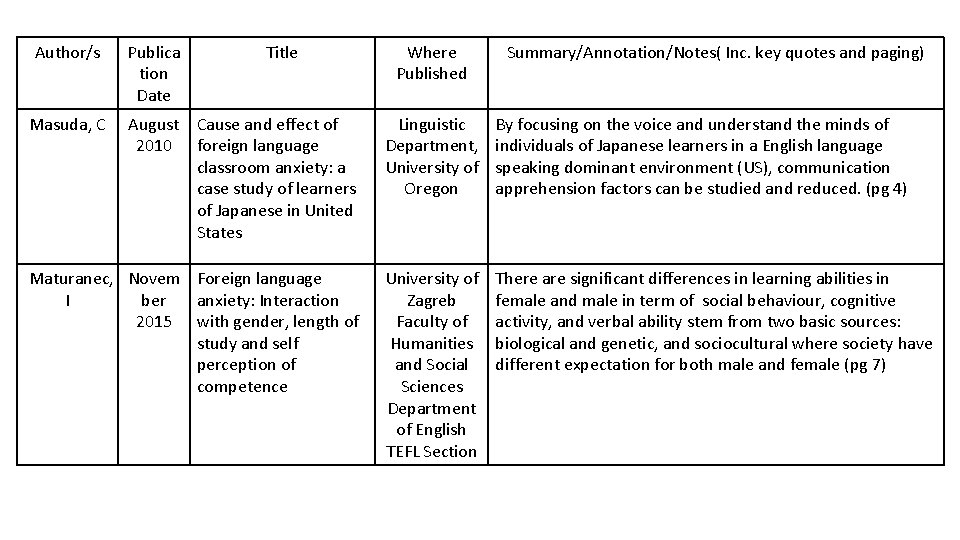
Author/s Masuda, C Publica tion Date Title Where Published Summary/Annotation/Notes( Inc. key quotes and paging) August Cause and effect of 2010 foreign language classroom anxiety: a case study of learners of Japanese in United States Linguistic Department, University of Oregon By focusing on the voice and understand the minds of individuals of Japanese learners in a English language speaking dominant environment (US), communication apprehension factors can be studied and reduced. (pg 4) Maturanec, Novem Foreign language I ber anxiety: Interaction 2015 with gender, length of study and self perception of competence University of Zagreb Faculty of Humanities and Social Sciences Department of English TEFL Section There are significant differences in learning abilities in female and male in term of social behaviour, cognitive activity, and verbal ability stem from two basic sources: biological and genetic, and sociocultural where society have different expectation for both male and female (pg 7)
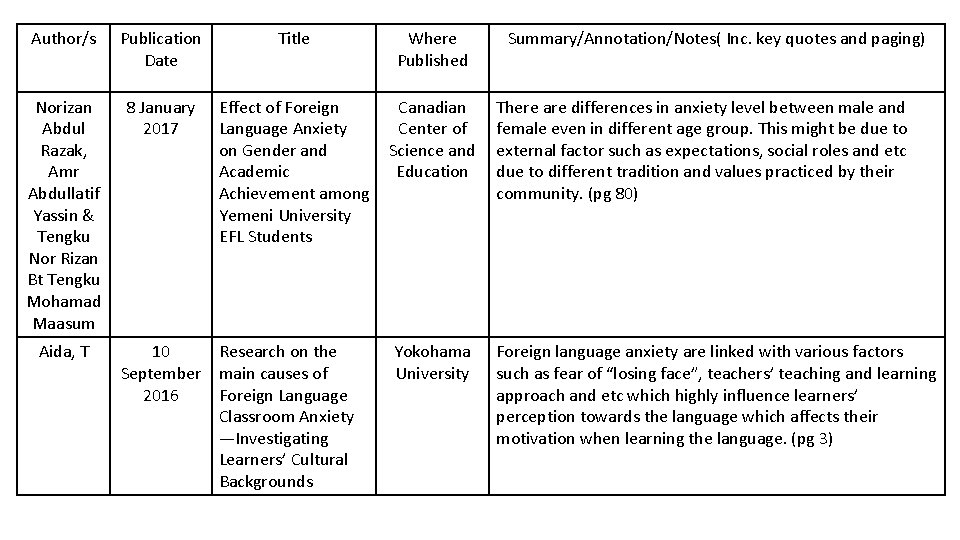
Author/s Publication Date Title Where Published Norizan Abdul Razak, Amr Abdullatif Yassin & Tengku Nor Rizan Bt Tengku Mohamad Maasum 8 January 2017 Effect of Foreign Language Anxiety on Gender and Academic Achievement among Yemeni University EFL Students Canadian Center of Science and Education There are differences in anxiety level between male and female even in different age group. This might be due to external factor such as expectations, social roles and etc due to different tradition and values practiced by their community. (pg 80) Yokohama University Foreign language anxiety are linked with various factors such as fear of “losing face”, teachers’ teaching and learning approach and etc which highly influence learners’ perception towards the language which affects their motivation when learning the language. (pg 3) Aida, T 10 Research on the September main causes of 2016 Foreign Language Classroom Anxiety ―Investigating Learners’ Cultural Backgrounds Summary/Annotation/Notes( Inc. key quotes and paging)
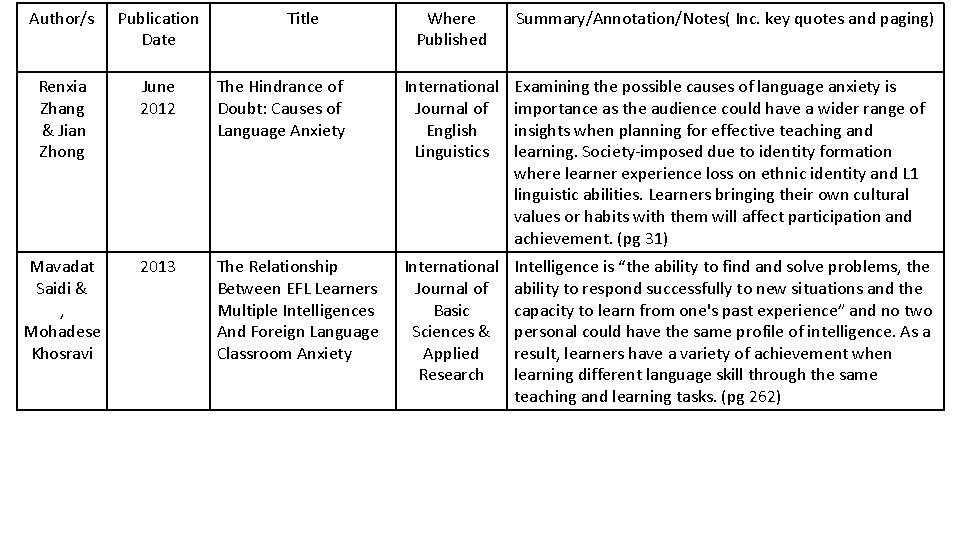
Author/s Publication Date Title Where Published Summary/Annotation/Notes( Inc. key quotes and paging) Renxia Zhang & Jian Zhong June 2012 The Hindrance of Doubt: Causes of Language Anxiety International Journal of English Linguistics Examining the possible causes of language anxiety is importance as the audience could have a wider range of insights when planning for effective teaching and learning. Society-imposed due to identity formation where learner experience loss on ethnic identity and L 1 linguistic abilities. Learners bringing their own cultural values or habits with them will affect participation and achievement. (pg 31) Mavadat Saidi & , Mohadese Khosravi 2013 The Relationship Between EFL Learners Multiple Intelligences And Foreign Language Classroom Anxiety International Journal of Basic Sciences & Applied Research Intelligence is “the ability to find and solve problems, the ability to respond successfully to new situations and the capacity to learn from one's past experience” and no two personal could have the same profile of intelligence. As a result, learners have a variety of achievement when learning different language skill through the same teaching and learning tasks. (pg 262)
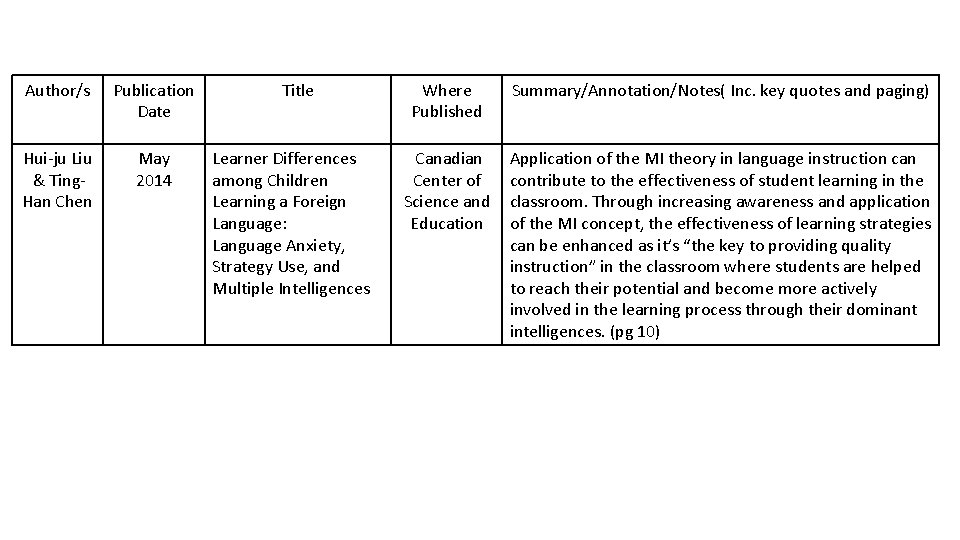
Author/s Publication Date Hui-ju Liu & Ting. Han Chen May 2014 Title Learner Differences among Children Learning a Foreign Language: Language Anxiety, Strategy Use, and Multiple Intelligences Where Published Summary/Annotation/Notes( Inc. key quotes and paging) Canadian Center of Science and Education Application of the MI theory in language instruction can contribute to the effectiveness of student learning in the classroom. Through increasing awareness and application of the MI concept, the effectiveness of learning strategies can be enhanced as it’s “the key to providing quality instruction” in the classroom where students are helped to reach their potential and become more actively involved in the learning process through their dominant intelligences. (pg 10)