
Language and Thought Module 36 Thinking Language Intelligence


- Slides: 40
Language and Thought Module 36
Thinking, Language, & Intelligence Language and Thought § Language Development § Thinking and Language § Animal Thinking and Language
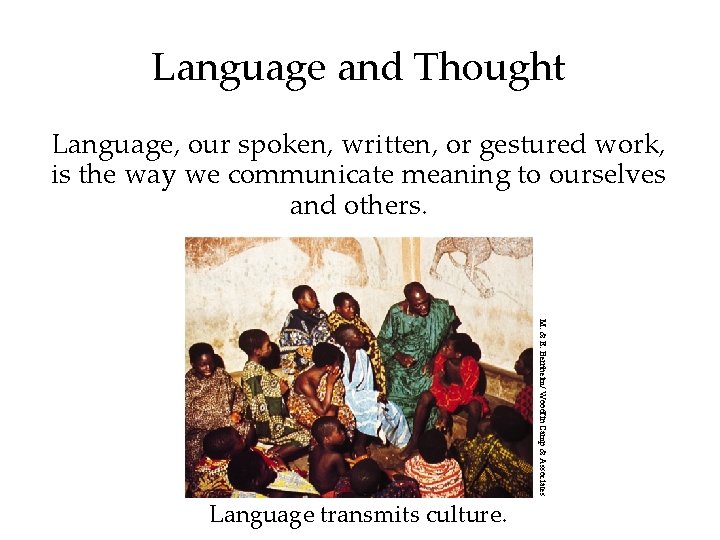
Language and Thought Language, our spoken, written, or gestured work, is the way we communicate meaning to ourselves and others. M. & E. Bernheim/ Woodfin Camp & Associates Language transmits culture.
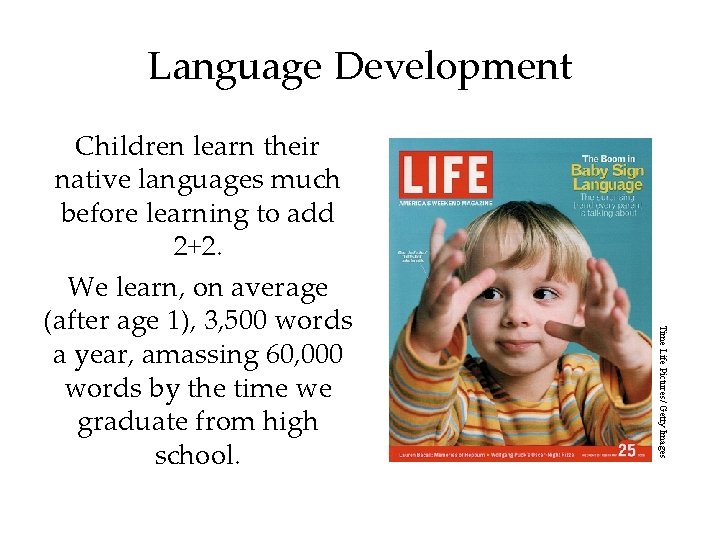
Language Development Time Life Pictures/ Getty Images Children learn their native languages much before learning to add 2+2. We learn, on average (after age 1), 3, 500 words a year, amassing 60, 000 words by the time we graduate from high school.
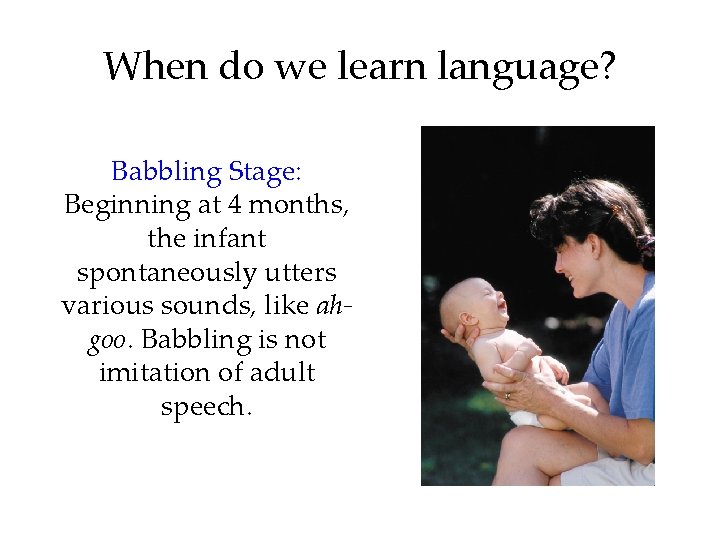
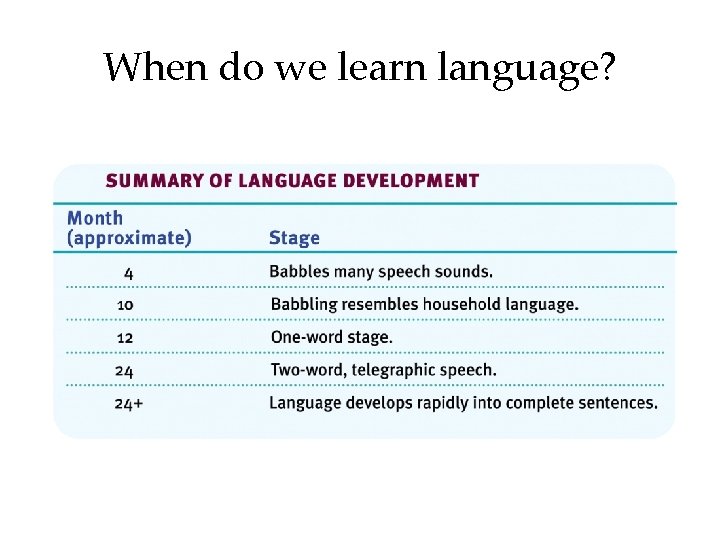
When do we learn language? Babbling Stage: Beginning at 4 months, the infant spontaneously utters various sounds, like ahgoo. Babbling is not imitation of adult speech.
When do we learn language? One-Word Stage: Beginning at or around his first birthday, a child starts to speak one word at a time and is able to make family members understand him. The word doggy may mean look at the dog out there.
When do we learn language? Two-Word Stage: Before the 2 nd year, a child starts to speak in two-word sentences. This form of speech is called telegraphic speech because the child speaks like a telegram: “Go car, ” means I would like to go for a ride in the car.
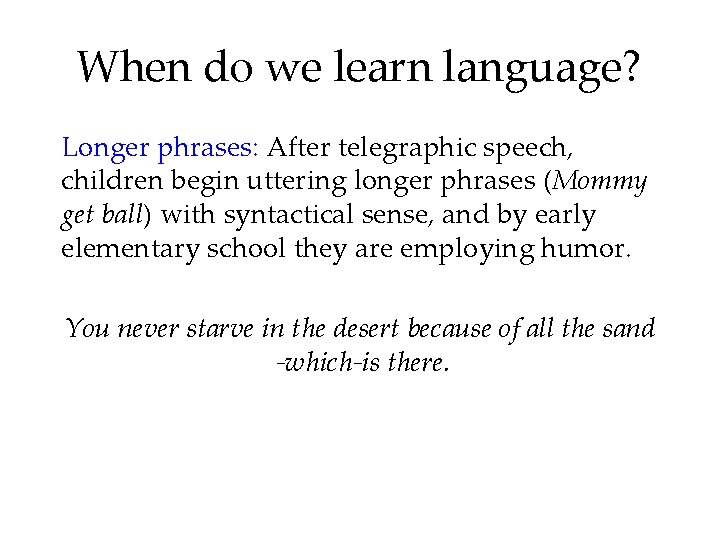
When do we learn language? Longer phrases: After telegraphic speech, children begin uttering longer phrases (Mommy get ball) with syntactical sense, and by early elementary school they are employing humor. You never starve in the desert because of all the sand -which-is there.
When do we learn language?
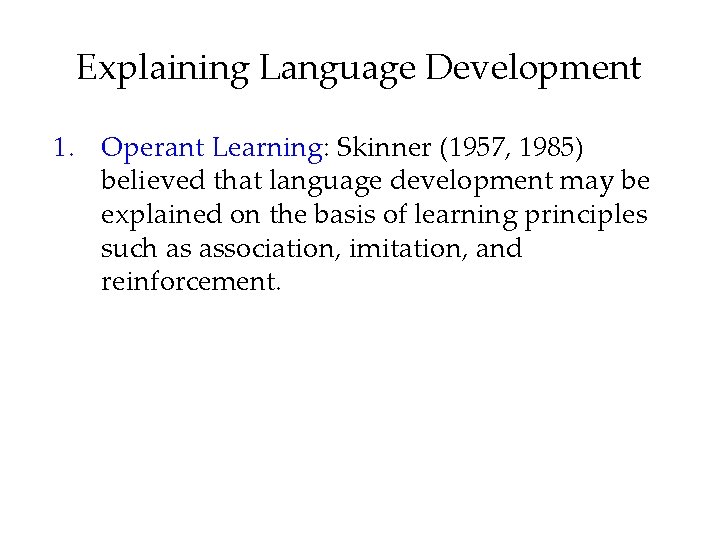
Explaining Language Development 1. Operant Learning: Skinner (1957, 1985) believed that language development may be explained on the basis of learning principles such as association, imitation, and reinforcement.
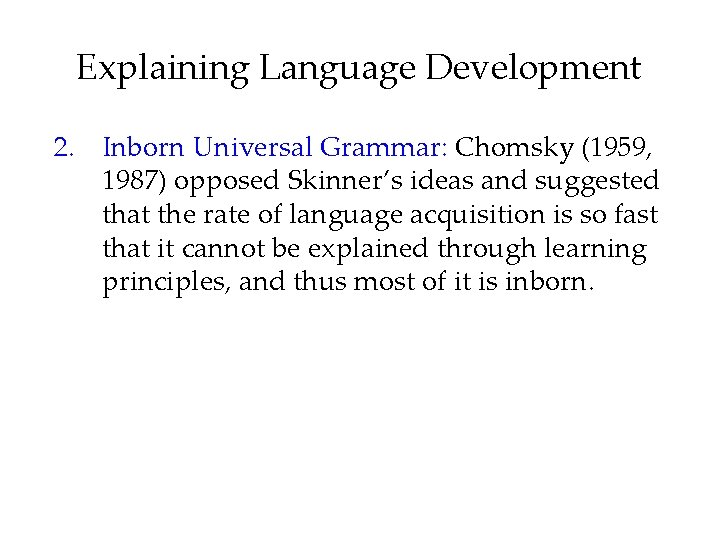
Explaining Language Development 2. Inborn Universal Grammar: Chomsky (1959, 1987) opposed Skinner’s ideas and suggested that the rate of language acquisition is so fast that it cannot be explained through learning principles, and thus most of it is inborn.
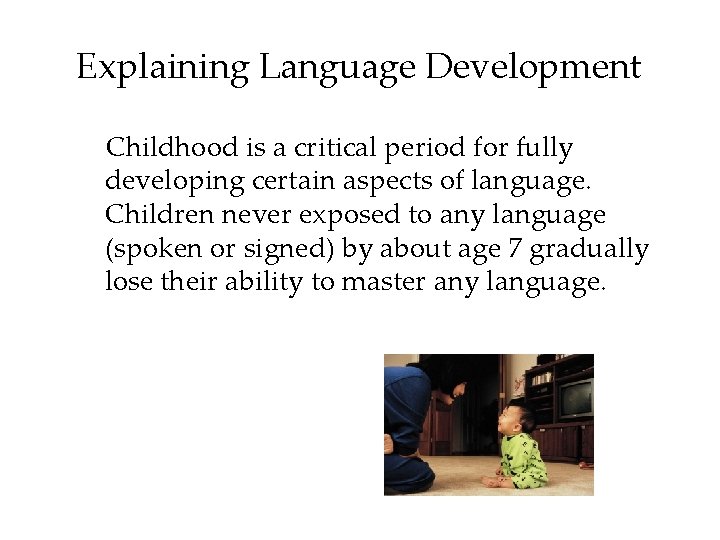
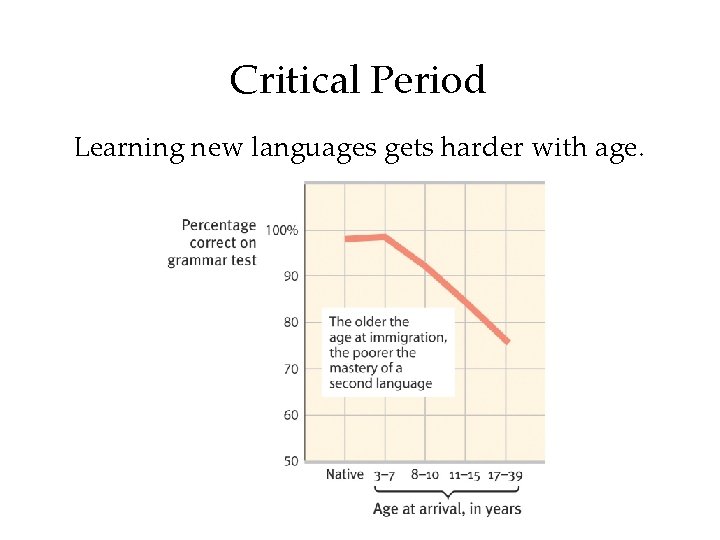
Explaining Language Development Childhood is a critical period for fully developing certain aspects of language. Children never exposed to any language (spoken or signed) by about age 7 gradually lose their ability to master any language.
Language Structure • Phonemes: the smallest distinctive SOUND units in a language – English uses about 40 • Morphemes: the smallest units that carry meaning • Grammar: system of rules that enables communication – Syntax: order of words into sentences – Semantics: deriving meaning from sounds
Receptive vs. Productive Language • Receptive Language: The ability to understand what is said – Begins as early as four months old • Productive Language: The ability to produce words
Noam Chomsky • Universal Grammar: all languages share some characteristics – Nouns, verbs, and adjectives – We’re born with predisposition to learn grammatical rules • We readily learn our native language’s grammar and vocabulary • We start speaking mostly in nouns
Noam Chomsky • Infants display ability to recognize word breaks and analyze which syllables most often occur together
Critical Period Learning new languages gets harder with age.
Aphasia: An impairment of language • Broca’s Area Aphasia: patient struggles to speak works, but can still comprehend • Wernicke’s Area Aphasia: patient could only speak meaningless words, comprehension damaged
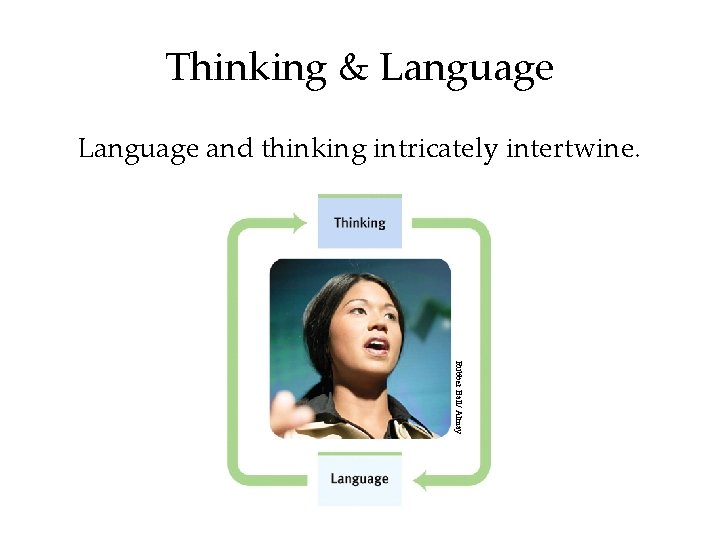
Thinking & Language and thinking intricately intertwine. Rubber Ball/ Almay
Language Influences Thinking Linguistic Determinism: Whorf (1956) suggested that language determines the way we think. For example, he noted that the Hopi people do not have the past tense for verbs. Therefore, the Hopi cannot think readily about the past.
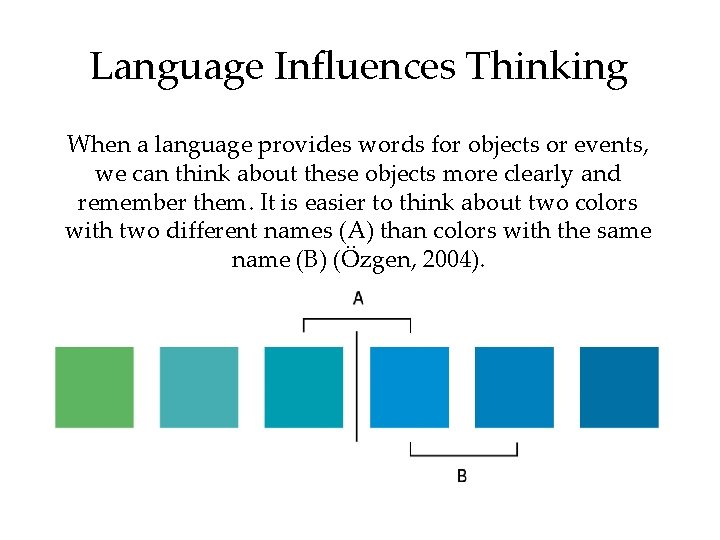
Language Influences Thinking When a language provides words for objects or events, we can think about these objects more clearly and remember them. It is easier to think about two colors with two different names (A) than colors with the same name (B) (Özgen, 2004).
Word Power Increasing word power pays its dividends. It helps explain the bilingual advantage of bilingual children to inhibit one language while using another.
Thinking in Images To a large extent thinking is language-based. When alone, we may talk to ourselves. However, we also think in images. We don’t think in words, when: 1. When we open the hot water tap. 2. When we are riding our bicycle.
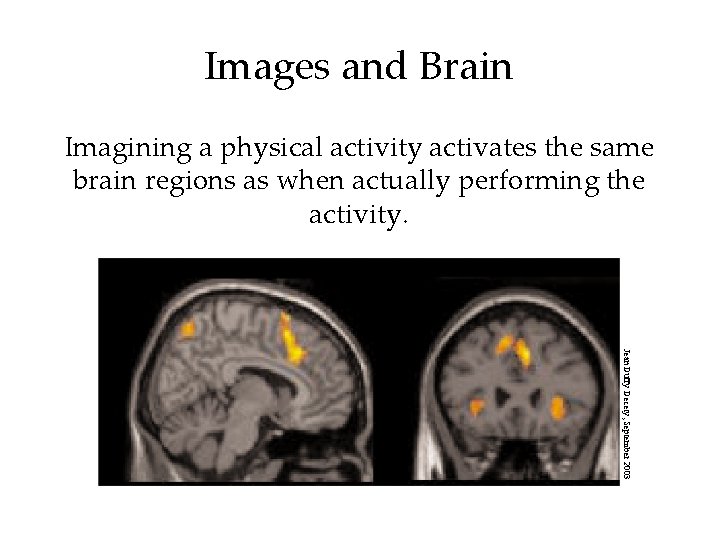
Images and Brain Imagining a physical activity activates the same brain regions as when actually performing the activity. Jean Duffy Decety, September 2003
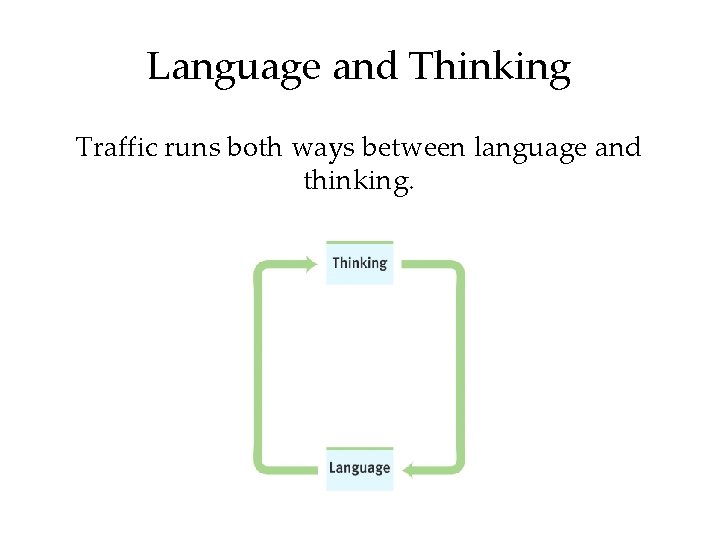
Language and Thinking Traffic runs both ways between language and thinking.
• Crash Course Review
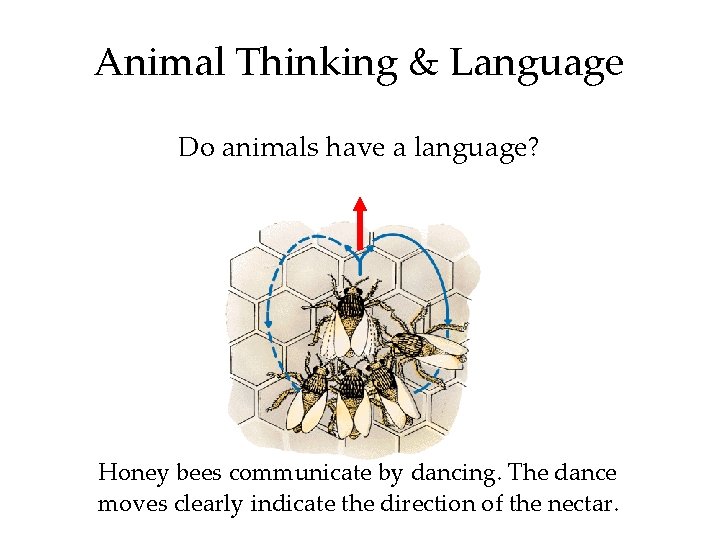
Animal Thinking & Language Do animals have a language? Honey bees communicate by dancing. The dance moves clearly indicate the direction of the nectar.
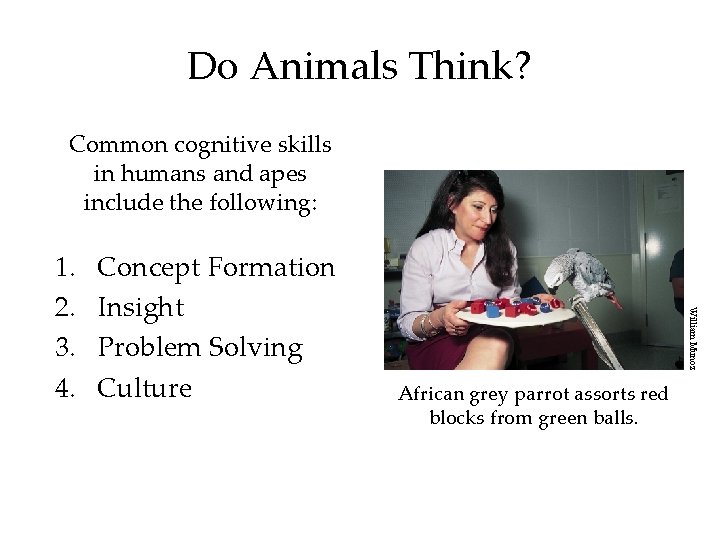
Do Animals Think? Common cognitive skills in humans and apes include the following: Concept Formation Insight Problem Solving Culture William Munoz 1. 2. 3. 4. African grey parrot assorts red blocks from green balls.
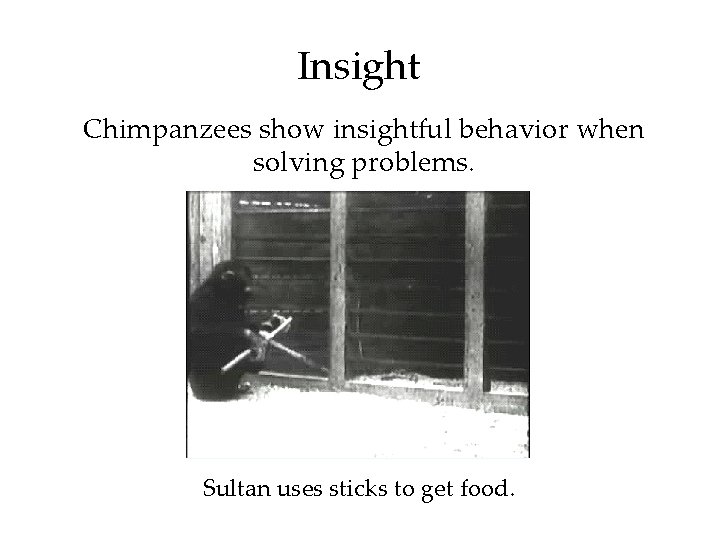
Insight Chimpanzees show insightful behavior when solving problems. Sultan uses sticks to get food.
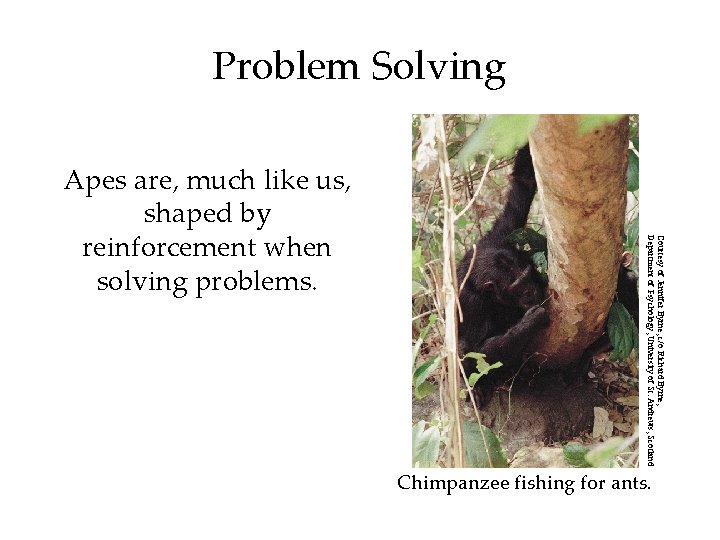
Problem Solving Courtesy of Jennifer Byrne, c/o Richard Byrne, Department of Psychology, University of St. Andrews, Scotland Apes are, much like us, shaped by reinforcement when solving problems. Chimpanzee fishing for ants.
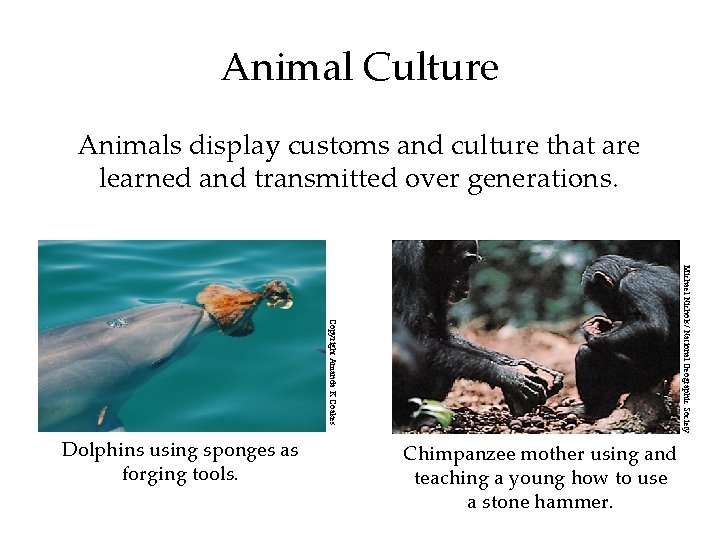
Animal Culture Animals display customs and culture that are learned and transmitted over generations. Michael Nichols/ National Geographic Society Copyright Amanda K Coakes Dolphins using sponges as forging tools. Chimpanzee mother using and teaching a young how to use a stone hammer.
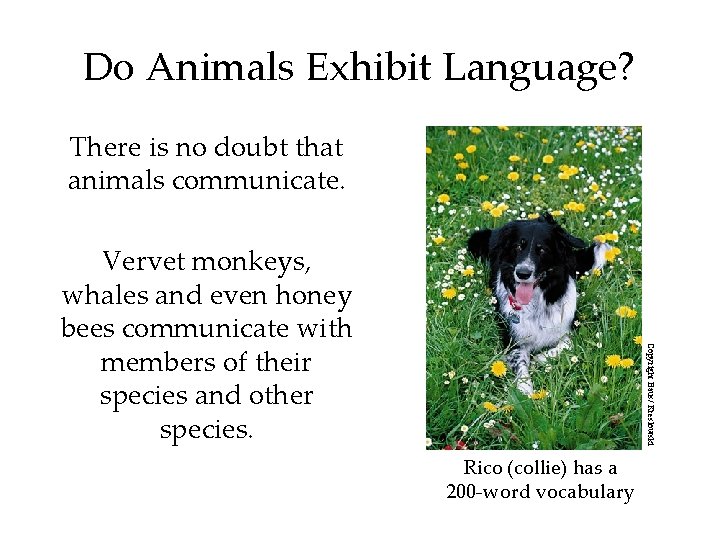
Do Animals Exhibit Language? There is no doubt that animals communicate. Copyright Baus/ Kreslowski Vervet monkeys, whales and even honey bees communicate with members of their species and other species. Rico (collie) has a 200 -word vocabulary
The Case of Apes Gardner and Gardner (1969) used American Sign Language (ASL) to train Washoe, a chimp, who learned 181 signs by the age of 32.
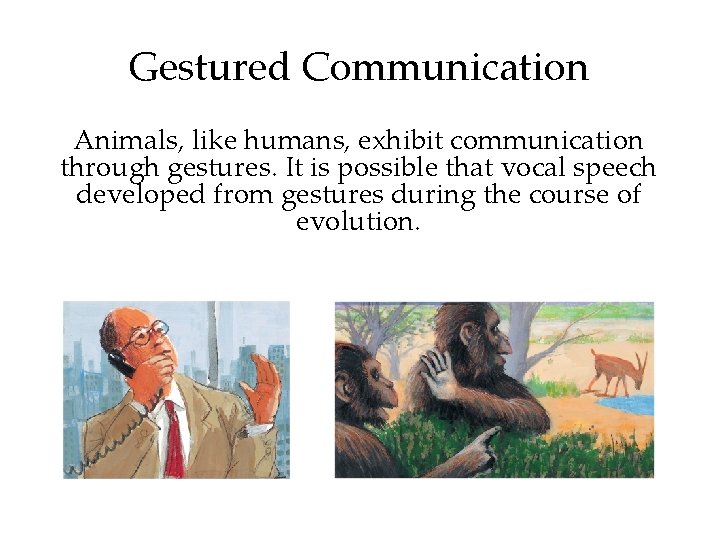
Gestured Communication Animals, like humans, exhibit communication through gestures. It is possible that vocal speech developed from gestures during the course of evolution.
But Can Apes Really Talk? 1. 2. 3. 4. Apes acquire their limited vocabularies with a great deal of difficulty, unlike children who develop vocabularies at amazing rates. Chimpanzees can make signs to receive a reward, just as a pigeon who pecks at the key receives a reward. However, pigeons have not learned a language. Chimpanzees use signs meaningfully but lack human syntax. Presented with ambiguous information, people tend to see what they want to see (perceptual set).
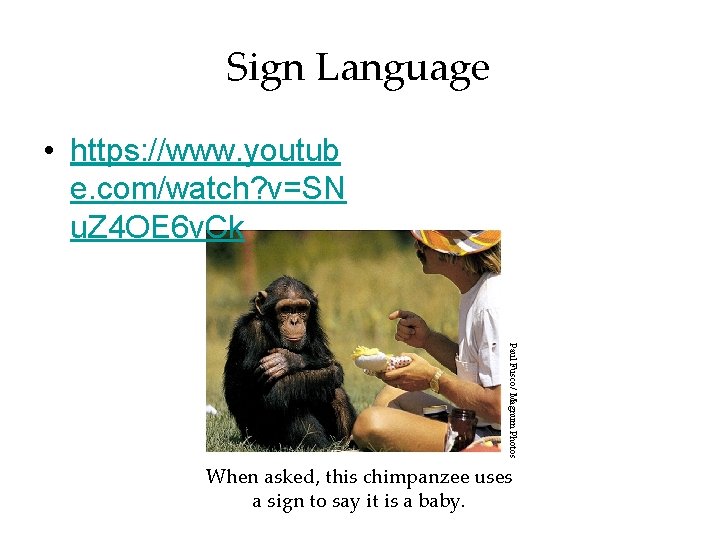
Sign Language • https: //www. youtub e. com/watch? v=SN u. Z 4 OE 6 v. Ck Paul Fusco/ Magnum Photos When asked, this chimpanzee uses a sign to say it is a baby.
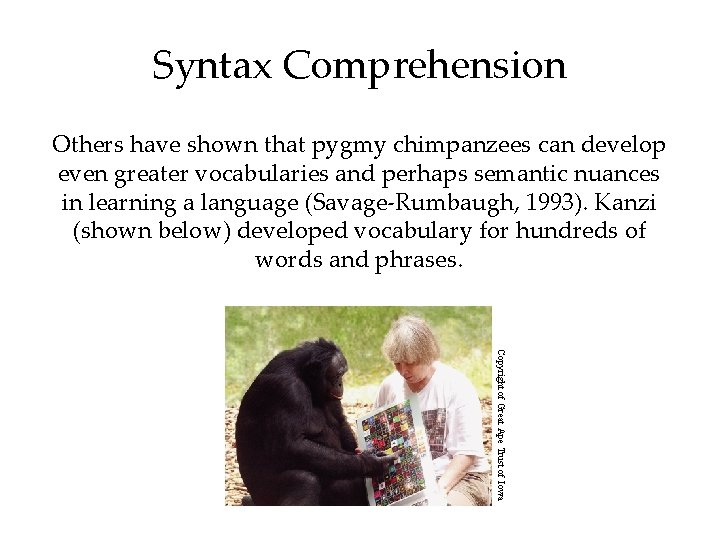
Syntax Comprehension Others have shown that pygmy chimpanzees can develop even greater vocabularies and perhaps semantic nuances in learning a language (Savage-Rumbaugh, 1993). Kanzi (shown below) developed vocabulary for hundreds of words and phrases. Copyright of Great Ape Trust of Iowa
Conclusions If we say that animals can use meaningful sequences of signs to communicate a capability for language, our understanding would be naive… Steven Pinker (1995) concludes, “chimps do not develop language. ”