
Language and social variation Chapter 19 Sociolinguistics n
![Education and occupation n Labov (1966) n Linguistic variable is the pronunciation differences [r]](https://slidetodoc.com/presentation_image_h/273cfece843dc4a832634bc6c180c04e/image-7.jpg "Education and occupation n Labov (1966) n Linguistic variable is the pronunciation differences [r]")
![Education and occupation n Trudgill (1974) in Reading, England n n Linguistic variable [r]](https://slidetodoc.com/presentation_image_h/273cfece843dc4a832634bc6c180c04e/image-8.jpg "Education and occupation n Trudgill (1974) in Reading, England n n Linguistic variable [r]")
![Social markers n The significance of the linguistic variable [r] can be the opposite](https://slidetodoc.com/presentation_image_h/273cfece843dc4a832634bc6c180c04e/image-9.jpg "Social markers n The significance of the linguistic variable [r] can be the opposite")
![Social markers n Another social markers is the final pronunciation of [ŋ] as [n]](https://slidetodoc.com/presentation_image_h/273cfece843dc4a832634bc6c180c04e/image-10.jpg "Social markers n Another social markers is the final pronunciation of [ŋ] as [n]")
- Slides: 19
Language and social variation Chapter 19
Sociolinguistics n n The way one speaks provides clues not only to a person’s regional background but also to his social one, e. g. his/her education and economic status. Speech is a form of social identity. n n Language indicates the membership of different social group- speech community. Speech community n A group of people= share a set of norms, rules, and expectation about language use.
Sociolinguistics n The relationship between language and the society. n Linguistics + anthropology n n Linguistics + sociology n n Language and culture The role language plays in the organization of social groups Linguistics + social psychology n In-group and out-group behaviors
Social dialects n n How the linguistic variables (words- pronunciation) differ between groups separated by certain social variables, e. g. , ethnicity, economic status, gender, level of education, etc. Social class defines a group of people as having something in common n Middle class n n High middle class Lower-middle class Working class Usage varies among social classes, and it is these sociolects that sociolinguistics studies
Social dialects n Accent may indicate social status n In Edinburgh n n n Lower-working class people pronounce ‘home’ as ‘he: m’ Lower-middle class people pronounce it as ‘ho: m” Structure may also indicate social status n Ain’t as ‘I ain’t finishes yet’ is used more by working class people than by middle class
Education and occupation n n Each of us has her own idiolect (personal dialect) but we sound more like those who share similar educational background People who went to college speak different than those who didn’t n n e. g. them boys throwed somethin’ Education is reflected in occupation n n Doctors don’t speak like those who clean windows University professors, bank executives all speak different than those who work in local jobs
Education and occupation n Labov (1966) n Linguistic variable is the pronunciation differences [r] after vowels and the social variables are place of occupation + socio-economic status n n n He looked at three New York department stores, one with upper-middle-class status, and one with middleclass status and another with working-class status. He asked ‘Where are the women’s shoes’? The higher the socio-economic the more [r] is pronounced.
Education and occupation n Trudgill (1974) in Reading, England n n Linguistic variable [r] and social variable is the social class It has an opposite social value than in New York. Upper class pronounce the [r] fewer than lower classes Oh, that’s mahvellous, dahling!
Social markers n The significance of the linguistic variable [r] can be the opposite in terms of social status in two different- it functions as a social marker n Having the feature marks you as a member of a particular group
Social markers n Another social markers is the final pronunciation of [ŋ] as [n] as a marker of less education and lower social status n n e. g. drinkin’ , sittin’ , playin’ The dropping of initial ‘h’ is associated with less education and lower social status n E. g I’m so ‘ungry I could eat an ‘orse
Speech style and style-shifting n n Speech style= a way of speaking that is either formal/careful or informal/casual A change from one to another is called ‘styleshifting’ Middle-class people are more likely to shift styles (Labov, 1966) They sense that the a certain linguistic feature may be ‘better’ in terms of social status
Prestige n A prestige dialect is the dialect spoken by the n Overt prestige- status that is generally n Covert prestige- the status of a feature as having most prestigious people in a speech community recognized as ‘better’ or more positively valued in the community positive but ‘hidden’ value or not valued as such among the larger community
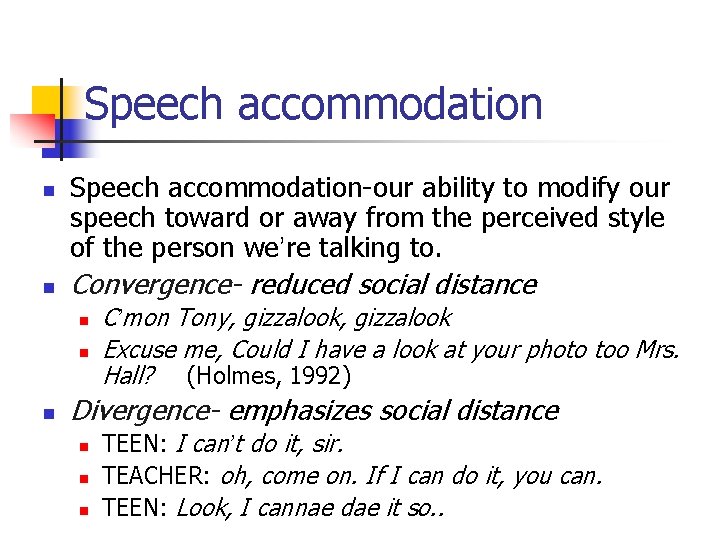
Speech accommodation n n Speech accommodation-our ability to modify our speech toward or away from the perceived style of the person we’re talking to. Convergence- reduced social distance n n n C’mon Tony, gizzalook Excuse me, Could I have a look at your photo too Mrs. Hall? (Holmes, 1992) Divergence- emphasizes social distance n n n TEEN: I can’t do it, sir. TEACHER: oh, come on. If I can do it, you can. TEEN: Look, I cannae dae it so. .
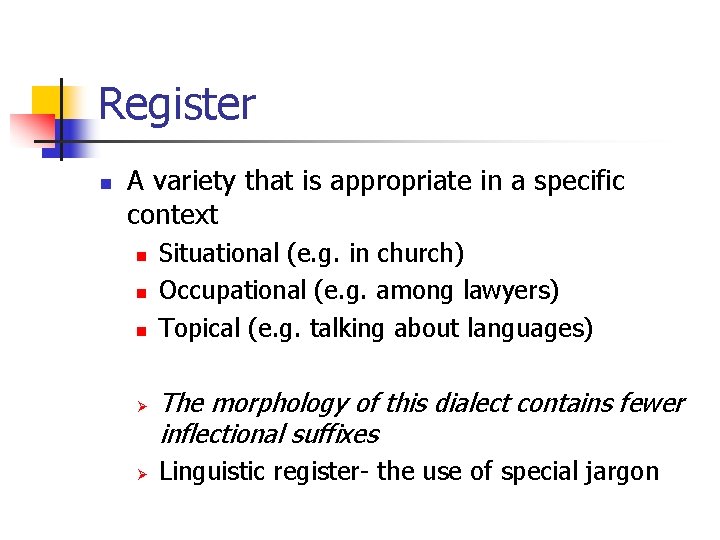
Register n A variety that is appropriate in a specific context n n n Ø Ø Situational (e. g. in church) Occupational (e. g. among lawyers) Topical (e. g. talking about languages) The morphology of this dialect contains fewer inflectional suffixes Linguistic register- the use of special jargon
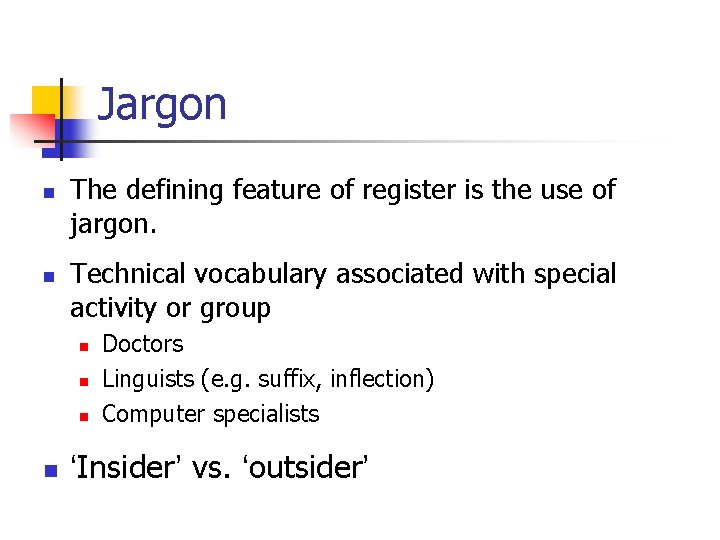
Jargon n n The defining feature of register is the use of jargon. Technical vocabulary associated with special activity or group n n Doctors Linguists (e. g. suffix, inflection) Computer specialists ‘Insider’ vs. ‘outsider’
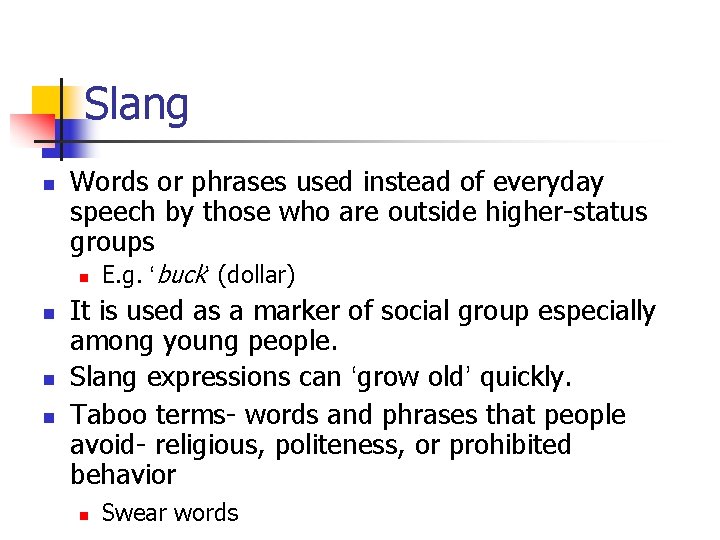
Slang n Words or phrases used instead of everyday speech by those who are outside higher-status groups n n E. g. ‘buck’ (dollar) It is used as a marker of social group especially among young people. Slang expressions can ‘grow old’ quickly. Taboo terms- words and phrases that people avoid- religious, politeness, or prohibited behavior n Swear words
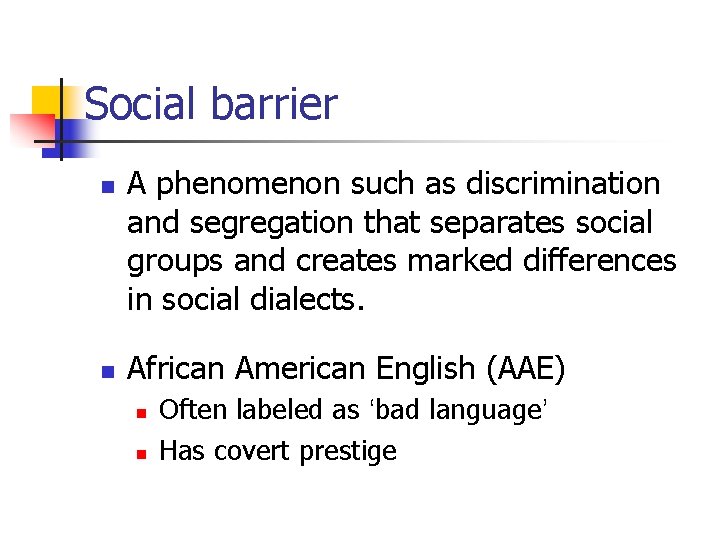
Social barrier n n A phenomenon such as discrimination and segregation that separates social groups and creates marked differences in social dialects. African American English (AAE) n n Often labeled as ‘bad language’ Has covert prestige
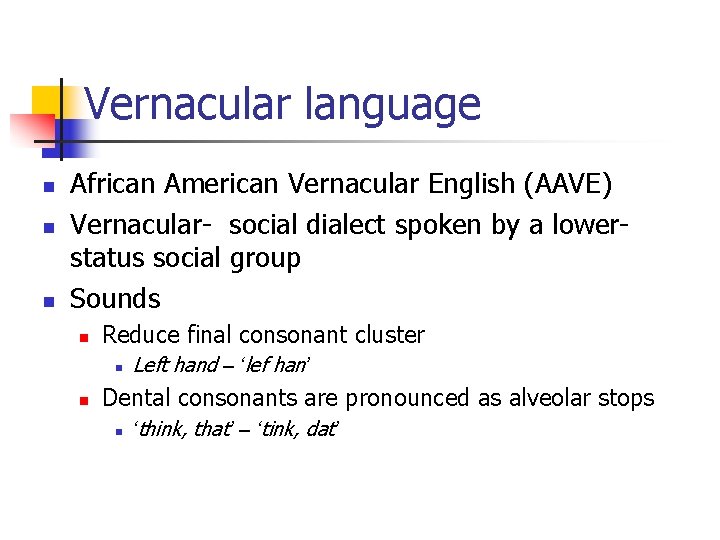
Vernacular language n n n African American Vernacular English (AAVE) Vernacular- social dialect spoken by a lowerstatus social group Sounds n Reduce final consonant cluster n n Left hand – ‘lef han’ Dental consonants are pronounced as alveolar stops n ‘think, that’ – ‘tink, dat’
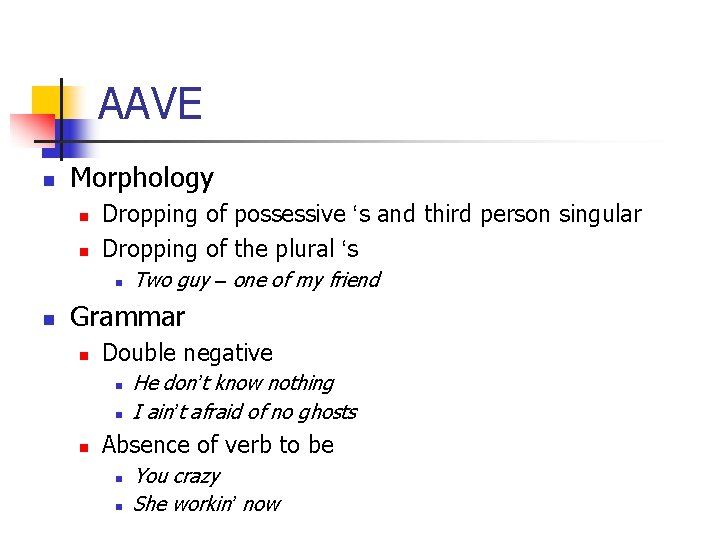
AAVE n Morphology n n Dropping of possessive ‘s and third person singular Dropping of the plural ‘s n n Two guy – one of my friend Grammar n Double negative n n n He don’t know nothing I ain’t afraid of no ghosts Absence of verb to be n n You crazy She workin’ now