
Language and Power How do we identify who
![Grice’s Maxims Grice proposed four basic conversational ‘rules’ [maxims] as criteria for successful conversation:](https://slidetodoc.com/presentation_image_h/13a4f97fbe24ee98626fcc162014d16c/image-7.jpg "Grice’s Maxims Grice proposed four basic conversational ‘rules’ [maxims] as criteria for successful conversation:")
- Slides: 24
Language and Power
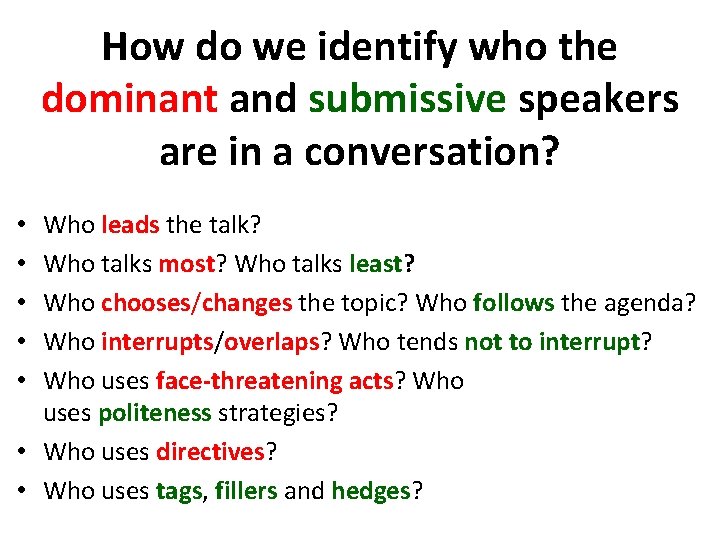
How do we identify who the dominant and submissive speakers are in a conversation? Who leads the talk? Who talks most? Who talks least? Who chooses/changes the topic? Who follows the agenda? Who interrupts/overlaps? Who tends not to interrupt? Who uses face-threatening acts? Who uses politeness strategies? • Who uses directives? • Who uses tags, fillers and hedges? • • •
Firstly let’s look at some THEORIES The following slides contains useful theories; most are reminders of what we’ve already looked at with one or two that we haven’t.
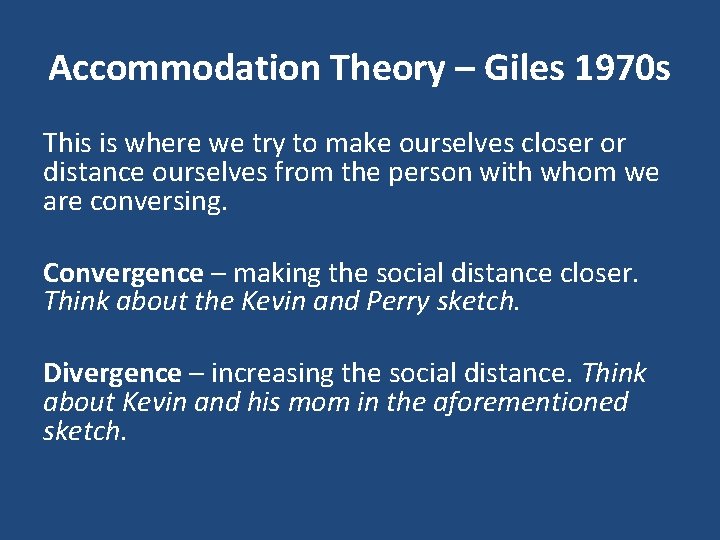
Accommodation Theory – Giles 1970 s This is where we try to make ourselves closer or distance ourselves from the person with whom we are conversing. Convergence – making the social distance closer. Think about the Kevin and Perry sketch. Divergence – increasing the social distance. Think about Kevin and his mom in the aforementioned sketch.
• Upward convergence – make our speech more like Received Pronunciation (RP) and less dialectal. • Downward convergence – making our speech less RP and more informal. Think about the Head in Educating Yorkshire. Coupland (1984) looked at a woman in a Cardiff call centre and noticed how she adapted her accent according to the person on the phone and her attitude towards them.
Audience Design Theory – Bell 1984 We adapt our language according to our audience. Read the Simon Pegg article. This is similar to Synthetic Personalisation (Fairclough – mainly in advertising) which relates to creating a relationship with your audience through direct address, e. g. See you after the break.
Grice’s Maxims Grice proposed four basic conversational ‘rules’ [maxims] as criteria for successful conversation: 1. quantity - don’t say too much or too little 2. relevance - keep to the point 3. manner - speak in a clear, coherent and orderly way 4. quality - be truthful
Politeness: Conversation Theory
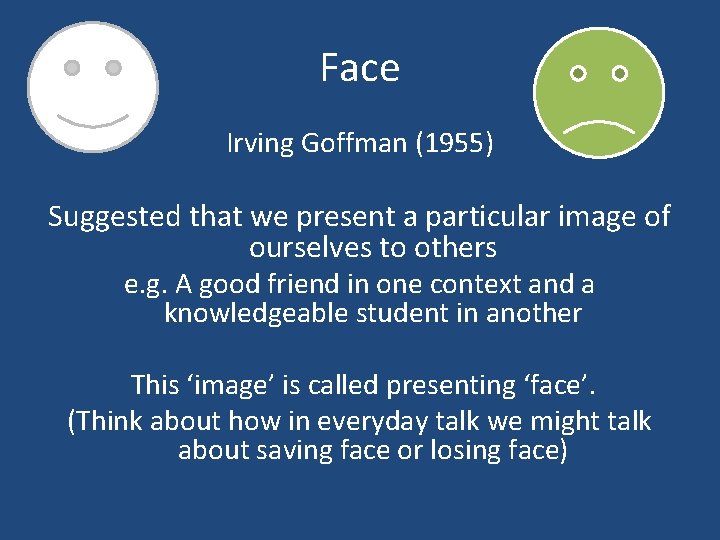
Face Irving Goffman (1955) Suggested that we present a particular image of ourselves to others e. g. A good friend in one context and a knowledgeable student in another This ‘image’ is called presenting ‘face’. (Think about how in everyday talk we might talk about saving face or losing face)
Conversation is co-operative Generally speaking we accept the face that other people present/offer to us. This is all part of co-operating in conversation.
Sometimes we don’t. . . On rare occasions, we might reject the ‘face’ that someone presents to us or we might accuse them of being insincere or mock them for trying to be more knowledgeable than they actually are. If you say something which challenges or rejects someone’s ‘face’ this is called a face threatening act e. g. You don’t know what you’re talking about do you?
Tactful Most of the time we tend to be more tactful and will keep our reservations to ourselves in order to ‘save’ the other person’s ‘face’ because we are being tactful and hope that they would also save our face too.
‘Face work’ - Goffman The purpose of face work is to maintain status (power) either within the conversation or within society. People with lower status tend to be more attentive to the face needs of those who are higher status than vice versa.
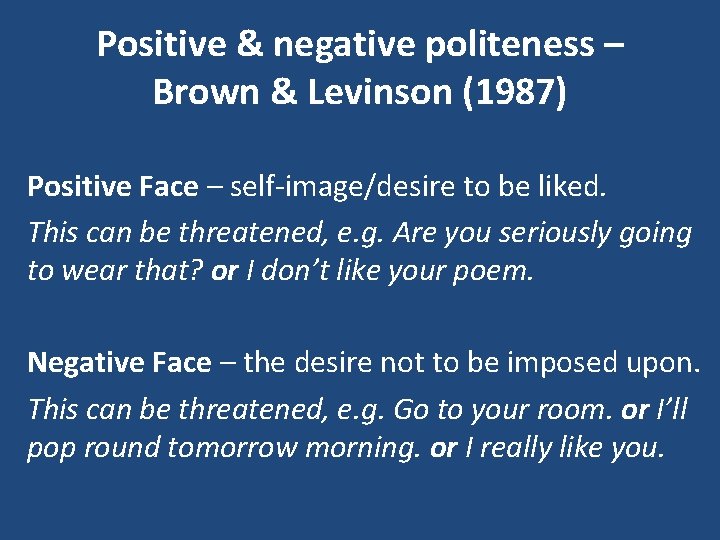
Positive & negative politeness – Brown & Levinson (1987) Positive Face – self-image/desire to be liked. This can be threatened, e. g. Are you seriously going to wear that? or I don’t like your poem. Negative Face – the desire not to be imposed upon. This can be threatened, e. g. Go to your room. or I’ll pop round tomorrow morning. or I really like you.
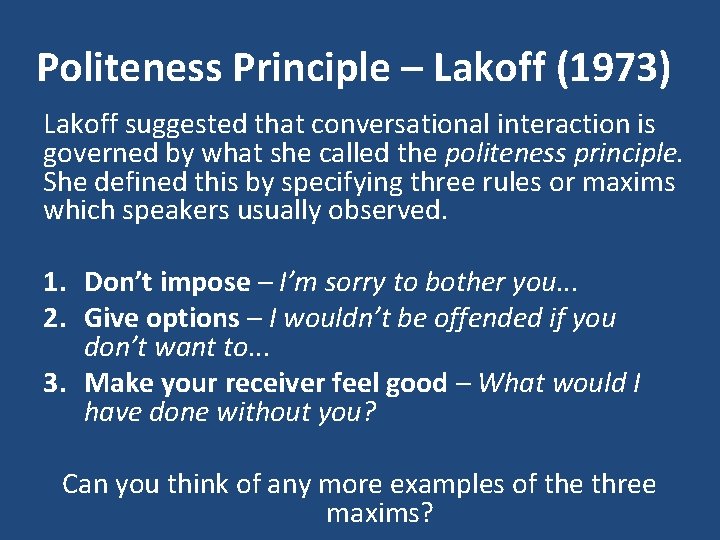
Politeness Principle – Lakoff (1973) Lakoff suggested that conversational interaction is governed by what she called the politeness principle. She defined this by specifying three rules or maxims which speakers usually observed. 1. Don’t impose – I’m sorry to bother you. . . 2. Give options – I wouldn’t be offended if you don’t want to. . . 3. Make your receiver feel good – What would I have done without you? Can you think of any more examples of the three maxims?
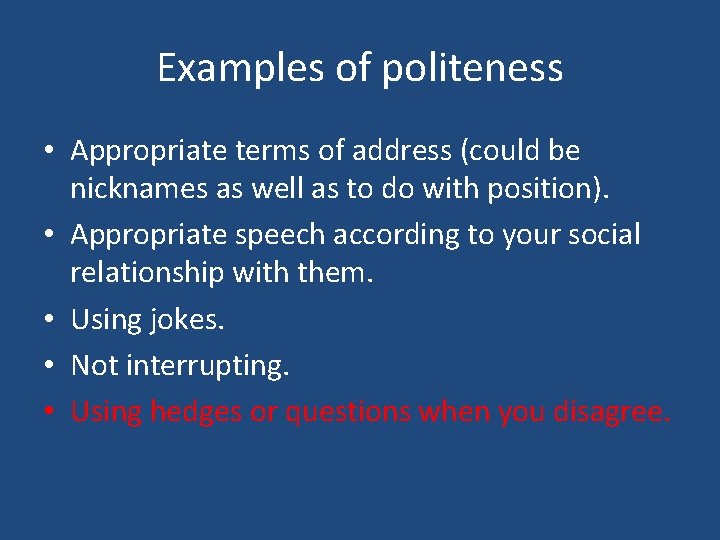
Examples of politeness • Appropriate terms of address (could be nicknames as well as to do with position). • Appropriate speech according to your social relationship with them. • Using jokes. • Not interrupting. • Using hedges or questions when you disagree.
OK, back to LANGUAGE
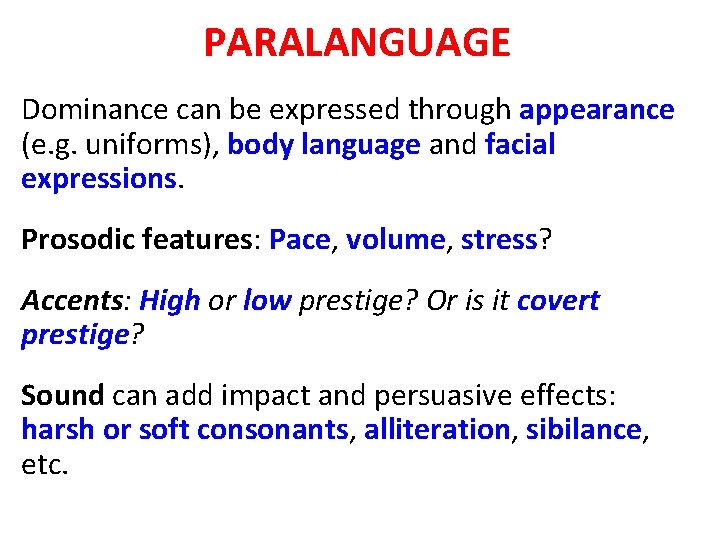
PARALANGUAGE Dominance can be expressed through appearance (e. g. uniforms), body language and facial expressions. Prosodic features: Pace, volume, stress? Accents: High or low prestige? Or is it covert prestige? Sound can add impact and persuasive effects: harsh or soft consonants, alliteration, sibilance, etc.
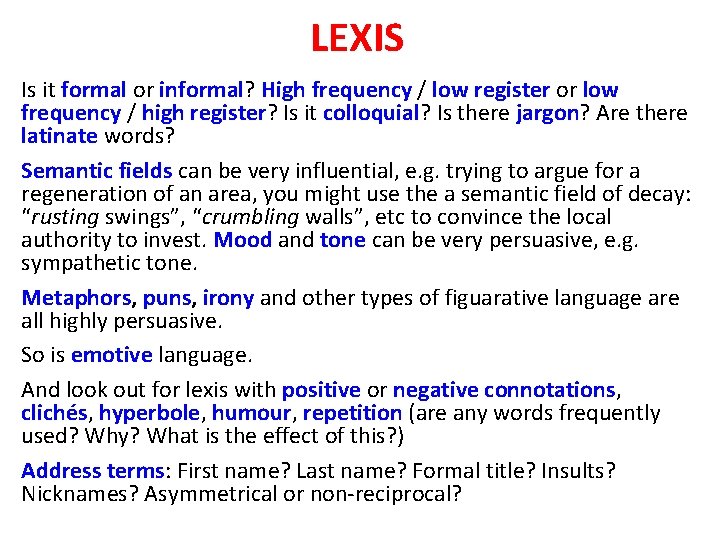
LEXIS Is it formal or informal? High frequency / low register or low frequency / high register? Is it colloquial? Is there jargon? Are there latinate words? Semantic fields can be very influential, e. g. trying to argue for a regeneration of an area, you might use the a semantic field of decay: “rusting swings”, “crumbling walls”, etc to convince the local authority to invest. Mood and tone can be very persuasive, e. g. sympathetic tone. Metaphors, puns, irony and other types of figuarative language are all highly persuasive. So is emotive language. And look out for lexis with positive or negative connotations, clichés, hyperbole, humour, repetition (are any words frequently used? Why? What is the effect of this? ) Address terms: First name? Last name? Formal title? Insults? Nicknames? Asymmetrical or non-reciprocal?
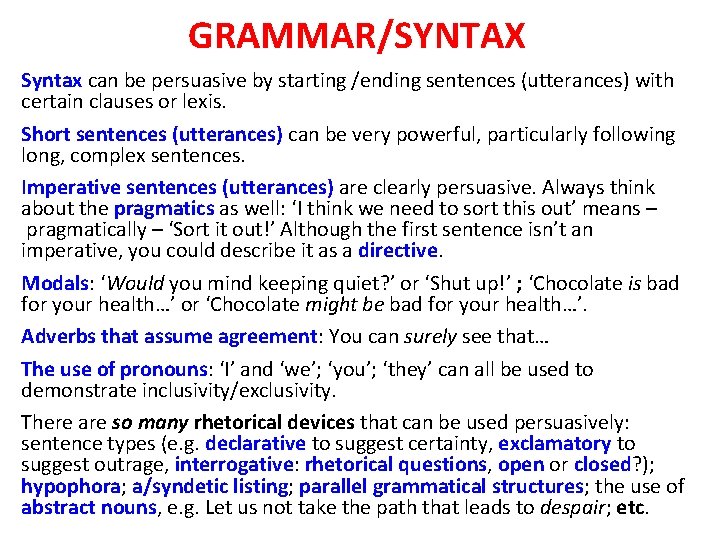
GRAMMAR/SYNTAX Syntax can be persuasive by starting /ending sentences (utterances) with certain clauses or lexis. Short sentences (utterances) can be very powerful, particularly following long, complex sentences. Imperative sentences (utterances) are clearly persuasive. Always think about the pragmatics as well: ‘I think we need to sort this out’ means – pragmatically – ‘Sort it out!’ Although the first sentence isn’t an imperative, you could describe it as a directive. Modals: ‘Would you mind keeping quiet? ’ or ‘Shut up!’ ; ‘Chocolate is bad for your health…’ or ‘Chocolate might be bad for your health…’. Adverbs that assume agreement: You can surely see that… The use of pronouns: ‘I’ and ‘we’; ‘you’; ‘they’ can all be used to demonstrate inclusivity/exclusivity. There are so many rhetorical devices that can be used persuasively: sentence types (e. g. declarative to suggest certainty, exclamatory to suggest outrage, interrogative: rhetorical questions, open or closed? ); hypophora; a/syndetic listing; parallel grammatical structures; the use of abstract nouns, e. g. Let us not take the path that leads to despair; etc.
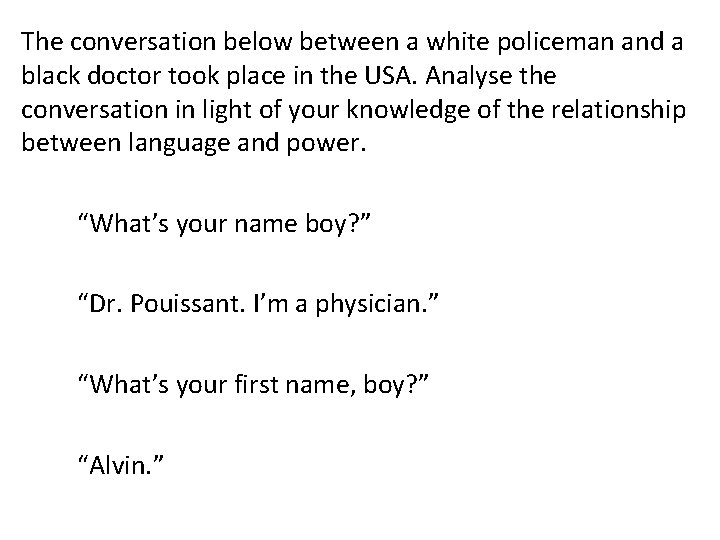
The conversation below between a white policeman and a black doctor took place in the USA. Analyse the conversation in light of your knowledge of the relationship between language and power. “What’s your name boy? ” “Dr. Pouissant. I’m a physician. ” “What’s your first name, boy? ” “Alvin. ”
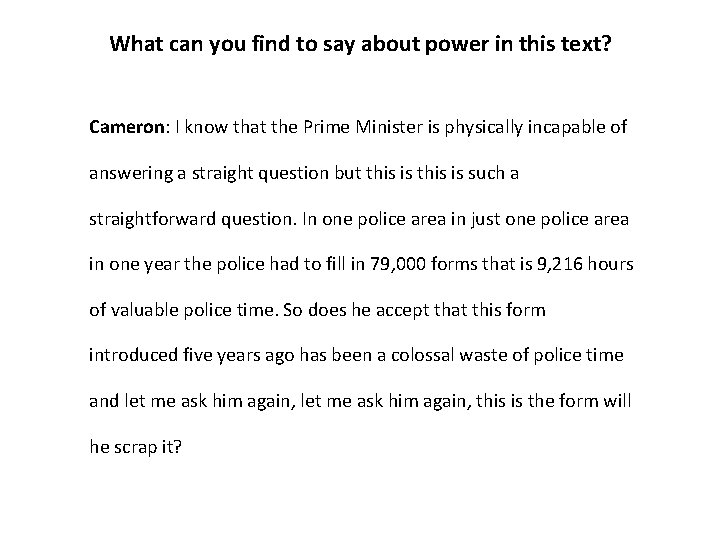
What can you find to say about power in this text? Cameron: I know that the Prime Minister is physically incapable of answering a straight question but this is such a straightforward question. In one police area in just one police area in one year the police had to fill in 79, 000 forms that is 9, 216 hours of valuable police time. So does he accept that this form introduced five years ago has been a colossal waste of police time and let me ask him again, this is the form will he scrap it?
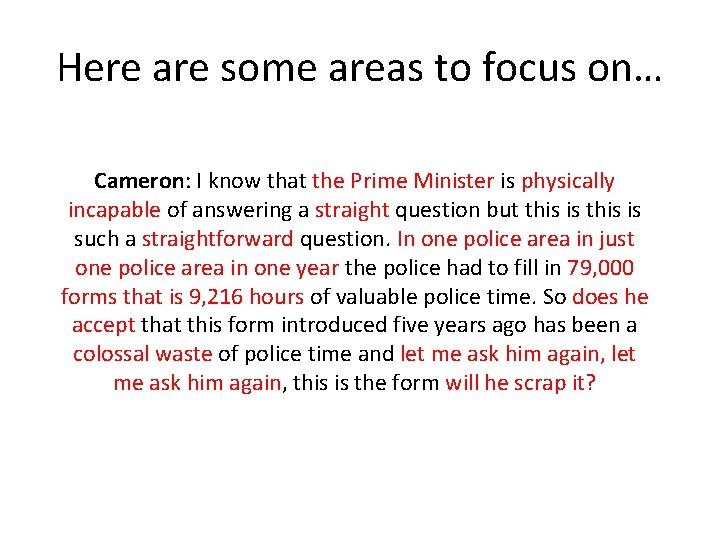
Here are some areas to focus on… Cameron: I know that the Prime Minister is physically incapable of answering a straight question but this is such a straightforward question. In one police area in just one police area in one year the police had to fill in 79, 000 forms that is 9, 216 hours of valuable police time. So does he accept that this form introduced five years ago has been a colossal waste of police time and let me ask him again, this is the form will he scrap it?
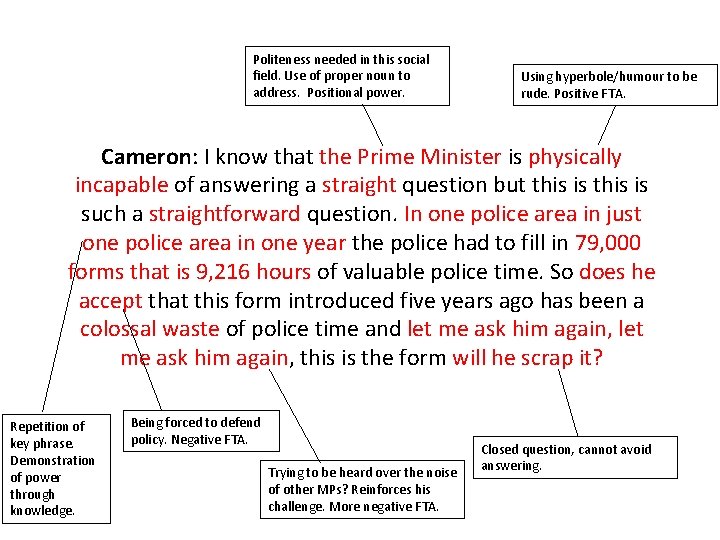
Politeness needed in this social field. Use of proper noun to address. Positional power. Using hyperbole/humour to be rude. Positive FTA. Cameron: I know that the Prime Minister is physically incapable of answering a straight question but this is such a straightforward question. In one police area in just one police area in one year the police had to fill in 79, 000 forms that is 9, 216 hours of valuable police time. So does he accept that this form introduced five years ago has been a colossal waste of police time and let me ask him again, this is the form will he scrap it? Repetition of key phrase. Demonstration of power through knowledge. Being forced to defend policy. Negative FTA. Trying to be heard over the noise of other MPs? Reinforces his challenge. More negative FTA. Closed question, cannot avoid answering.