
Language and Occupation What do we mean by
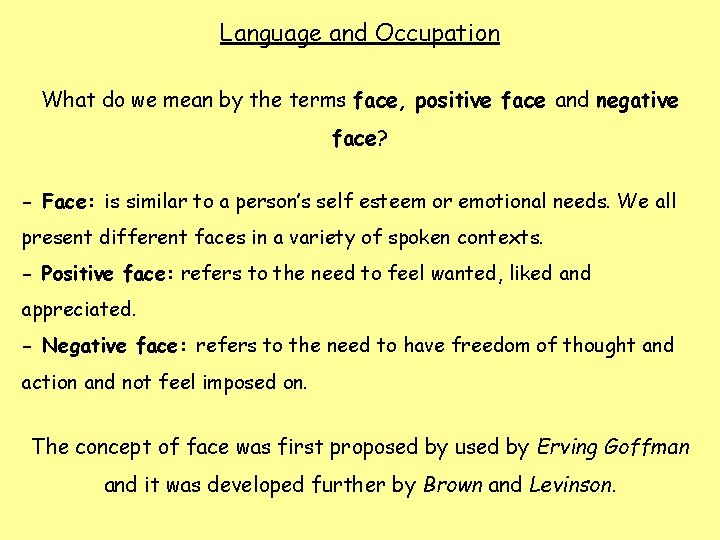
Language and Occupation What do we mean by the terms face, positive face and negative face? - Face: is similar to a person’s self esteem or emotional needs. We all present different faces in a variety of spoken contexts. - Positive face: refers to the need to feel wanted, liked and appreciated. - Negative face: refers to the need to have freedom of thought and action and not feel imposed on. The concept of face was first proposed by used by Erving Goffman and it was developed further by Brown and Levinson.
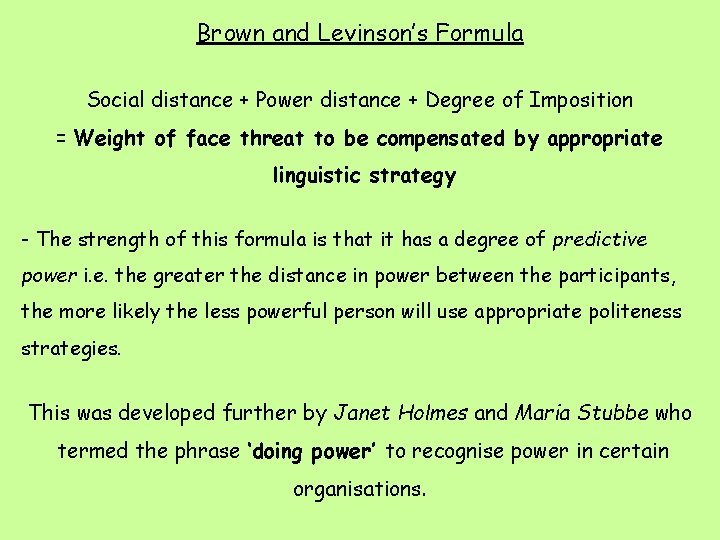
Brown and Levinson’s Formula Social distance + Power distance + Degree of Imposition = Weight of face threat to be compensated by appropriate linguistic strategy - The strength of this formula is that it has a degree of predictive power i. e. the greater the distance in power between the participants, the more likely the less powerful person will use appropriate politeness strategies. This was developed further by Janet Holmes and Maria Stubbe who termed the phrase ‘doing power’ to recognise power in certain organisations.
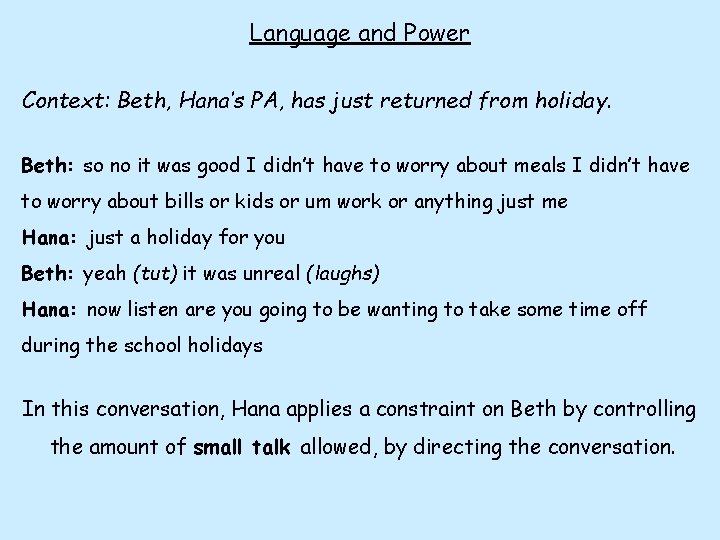
Language and Power Context: Beth, Hana’s PA, has just returned from holiday. Beth: so no it was good I didn’t have to worry about meals I didn’t have to worry about bills or kids or um work or anything just me Hana: just a holiday for you Beth: yeah (tut) it was unreal (laughs) Hana: now listen are you going to be wanting to take some time off during the school holidays In this conversation, Hana applies a constraint on Beth by controlling the amount of small talk allowed, by directing the conversation.

Language and Power - Repressive discourse strategy: a more indirect way of exercising power and control through conversational constraints. - Oppressive discourse strategy: linguistic behaviour that is open in its exercising of power and control. Read through the transcript again and comment on the way you think power is shown in this conversation. - Although the local politician has a degree of political power, in this context, the radio interviewer is very much the more powerful participant. In what context could the power structures be shifted?
- Slides: 4