
Language and Indian Constitution At Independence the official
- Slides: 50
Language and Indian Constitution
• At Independence, the official language of British colonial administration was English, which was spoken by less than 1 per cent of the population. Assembly Debate ?
• 343. (1) The official language of the Union shall be Hindi in Devanagari script. The form of numerals to be used for the official purposes of the Union shall be the international form of Indian numerals. • (2) Notwithstanding anything in clause (1), for a period of fifteen years from the commencement of this Constitution, the English language shall continue to be used for all the official purposes of the Union for which it was being used immediately before such commencement:
(3) Notwithstanding anything in this article, Parliament may by law provide for the use, after the said period of fifteen years, of— • (a) the English language, or • (b) the Devanagari form of numerals, for such purposes as may be specified in the law
Disaggregation.
CHAPTER III. —LANGUAGE OF THE SUPREME COURT, HIGH COURTS, ETC. • 348. (1) Notwithstanding anything in the foregoing provisions of this Part, until Parliament by law otherwise provides— • (a) all proceedings in the Supreme Court and in every High Court, (b) the authoritative texts— (i) of all Bills to be introduced or amendments thereto to be moved in either House of Parliament or in the House or either House of the Legislature of a State,
• (ii) of all Acts passed by Parliament or the Legislature of a State and of all Ordinances promulgated by the President or the Governor of a State, and • (iii) of all orders, rules, regulations and byelaws issued under this Constitution or under any law made by Parliament or the Legislature of a State, shall be in the English language.
ENGLISH STATUS QUO • Article 348(1)(b)(I) - reverse of Article 343(1).
• The Indian Constitution also differentiates between the language of parliamentary deliberations and the language of legislation. Article 120 permits the use of Hindi or English in parliamentary debates, and permits the Speaker of either chamber to permit a member to use his or her mother tongue ((with the right to use English expiring in fifteen years unless extended through legislation, as in the case of Article 343).
Article 348 (2) Notwithstanding anything in sub-clause (a) of clause (1), the Governor of a State may, with the previous consent of the President, authorise the use of the Hindi language, or any other language used for any official purposes of the State, in proceedings in the High Court having its principal seat in that State:
• Provided that nothing in this clause shall apply to any judgment, decree or order passed or made by such High Court • For Supreme Court - No Such Legislative Mechanism ( only through Constitutional Amendments )
Indeed, the Court has declined to permit parties to present arguments before in languages other than English, on the basis of Article 348(1)(a), even though it arguably has the inherent authority to do so.
distinction between the language of deliberations and decision • permitting the former to be multilingual whereas presumptively, or permanently, retaining the unilingual character of the latter.
Why this Particular distinction demand for legal certainty (legal certainty argued in favour of continuing the linguistic status quo) concerns about the redistributive power of official language status explain the retention of English as the language of legislation and judgments.
Further Disaggregation
• it is important to disaggregate the language of public services from the internal working language of government—that is, a distinction between external and internal communication.
• 343. (1) The official language of the Union shall be Hindi in Devanagari scrip Vs • 350. Every person shall be entitled to submit a representation for the redress of any grievance to any officer or authority of the Union or a State in any of the languages used in the Union or in the State, as the case may be
• So , the focus of Article 343 is the internal working language of government. • From a practical standpoint, the State is limited in its ability to function internally in more than one language, because of the difficulties of translation.
Commission and Committee of Parliament on official language • 344. (1) The President shall, at the expiration of five years from the commencement of this Constitution and thereafter at the expiration of ten years from such commencement, by order constitute a Commission which shall consist of a Chairman and such other members representing the different languages specified in the Eighth Schedule as the President may appoint
• (2) It shall be the duty of the Commission to make recommendations to the President as to — • (a) the progressive use of the Hindi language for the official purposes of the Union; • (b) restrictions on the use of the English language for all or any of the official purposes of the Union;
• (c) the language to be used for all or any of the purposes mentioned in article 348; • (d) the form of numerals to be used for any one or more specified purposes of the Union; • (e) any other matter referred to the Commission by the President as regards the official language of the Union and the language for communication between the Union and a State or between one State and another and their use.
Kher Commission’s -1955. • official status solely on Hindi as providing a common language for mass democratic politics. • examinations for the All India Administrative Service (IAS). As the constitutionally set deadline for implementing Article 343 in 1965 approached, the language of the IAS exam emerged as the major flashpoint of controversy.
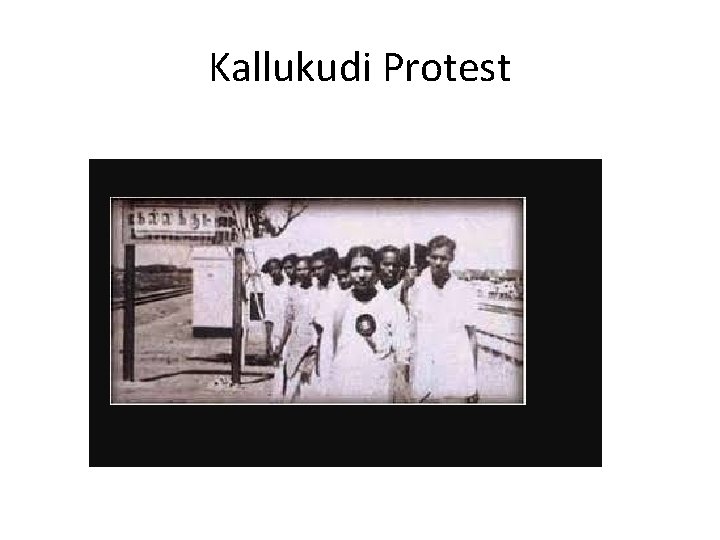
Kallukudi Protest
The status of English was preserved by the Official Languages Act 1967, which grants a statutory veto on the continued use of English to each non-Hindi-speaking State. • notwithstanding the retention of English as the language of the IAS exam, civil servants receive Hindi language training.
VIII Schedule – 344 and 350 • In this context, the Eighth Schedule is striking. • It now lists twenty-two languages, which thereby acquire official status. • However, the inclusion of a language in this schedule has no operative effect with respect to any of the key provisions of Part XVII.
• Since neither the inclusion nor exclusion of a language in the Eighth Schedule has real institutional implications, the politics surrounding the Eighth Schedule is largely symbolic.
Eighth Schedule – 344 and 350 Article 350 - Directive for development of the Hindi language It shall be the duty of the Union to promote the spread of the Hindi language, to develop it so that it may serve as a medium of expression for all the elements of the composite culture of India and to secure its enrichment by assimilating without interfering with its genius, the forms, style and expressions used in Hindustani and in the other languages of India specified in the Eighth Schedule, . and by drawing, wherever necessary or desirable, for its vocabulary, primarily on Sanskrit and secondarily on other languages
• Disaggregation – India’s Contribution • Limits of Disaggregation
Linguistic Reorganisation of States.
• Since 1920, the Congress Party had been committed to linguistic provinces, and indeed, organised itself internally along regionallinguistic lines that did not correspond to the internal administrative divisions of British India.
Wake of Partition
• Modern Citizenship - transcended linguistic and regional divides, The Report of the Linguistic Provinces Commission (the Dar Commission), appointed by the Constituent Assembly to study the issue of linguistic provinces, accordingly rejected the demand for linguistic provinces because it was rooted in ‘a parochial patriotism’.
• The Constituent Assembly rejected linguistic provinces. • But the Constitution contained two provisions that gave political actors the tools to thrust this issue back onto the constitutional agenda.
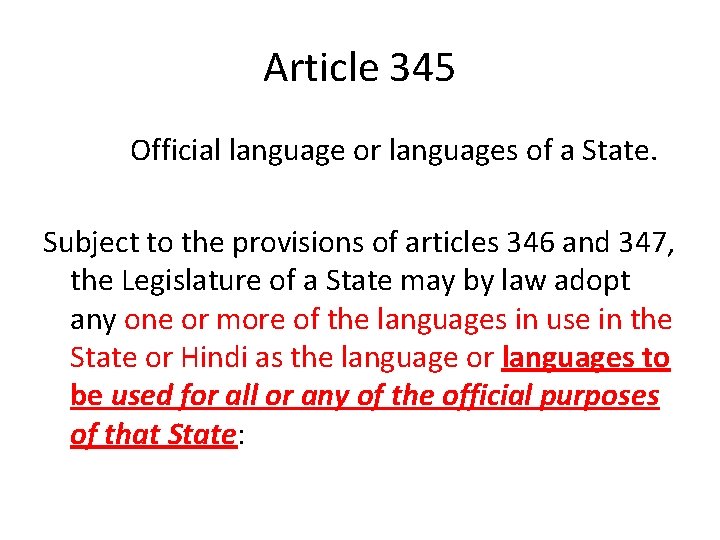
Article 345 Official language or languages of a State. Subject to the provisions of articles 346 and 347, the Legislature of a State may by law adopt any one or more of the languages in use in the State or Hindi as the language or languages to be used for all or any of the official purposes of that State:
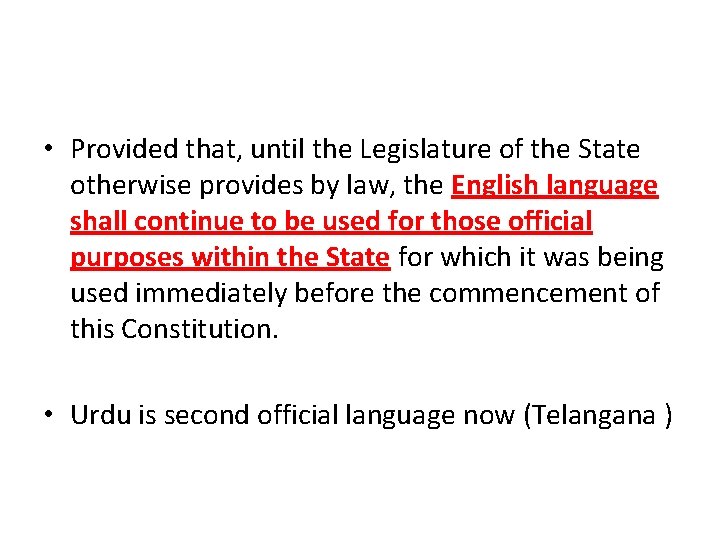
• Provided that, until the Legislature of the State otherwise provides by law, the English language shall continue to be used for those official purposes within the State for which it was being used immediately before the commencement of this Constitution. • Urdu is second official language now (Telangana )
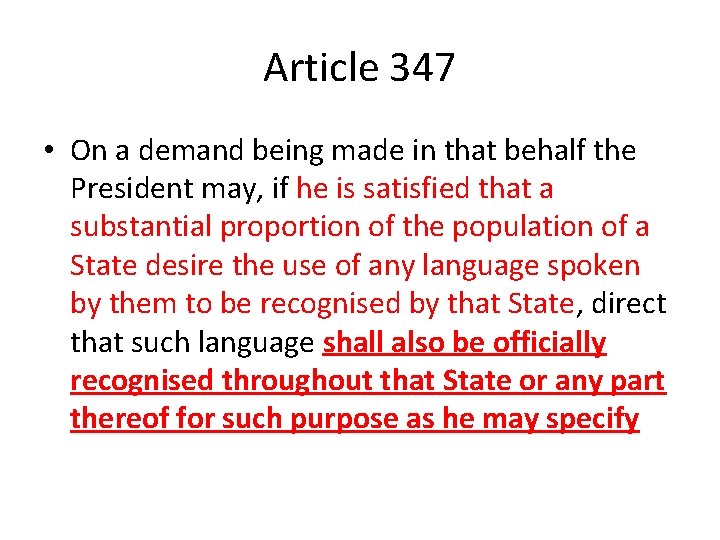
Article 347 • On a demand being made in that behalf the President may, if he is satisfied that a substantial proportion of the population of a State desire the use of any language spoken by them to be recognised by that State, direct that such language shall also be officially recognised throughout that State or any part thereof for such purpose as he may specify
Second Article 3(a) grants authority to Parliament to ‘form a new State by separation of territory from any State or by uniting two or more States or parts of States or by uniting any territory to a part of any State’ through ordinary legislation.
Intreprtation • If the choice of official language could not be resolved within State legislatures, the disagreement could be shifted to Parliament and transformed into a debate over the redrawing of State boundaries, which would be relatively easy to accomplish because of low procedural thresholds.
• Congress Linguistic Provinces Committee, which recommended in 1949 the creation of Andhra State from the Telugu-speaking parts of Madras State, which had a Tamil majority. • Andhra State (later Andhra Pradesh) was created in 1953, which impelled the creation of the States Organisation Commission.
State Reorganization Commission • The Commission was charged with proposing principles for the redrawing of State boundaries and making specific recommendations about State boundaries. • The Commission concluded that language should be a factor in drawing State boundaries, and issued a series of specific recommendations that were largely based on language.
• Based on the Commission’s recommendations, Parliament created Assam, Bihar, Bombay, Jammu and Kashmir, Kerala, Madhya Pradesh, Madras State (later Tamil Nadu), Mysore State (later Karnataka), Orissa, and Punjab in 1956. • Multilingual Bombay State was further divided into Gujarat and Maharashtra in 1960, and Punjab into Haryana and Punjab in 1966.
Minimum Judicial Role • one possible hook was Article 3’s requirement that bills to create new States be referred to the legislatures of the States affected ‘for expressing its views thereon’. • States argued that this requirement of consultation should be interpreted as requiring a State’s consent to any change in State boundaries.
Contrast approach - Article 124(2), where the Court read a requirement to consult the Chief Justice prior to making appointments to the Supreme Court into a need to obtain the Chief Justice’s consent. basic structure challenge to linguistic reorganisation was never made, because the 1956 reorganisation pre-dated Kesavananda Bharati by seventeen years.
345 (Official for all Purpose )vs 348 (1) b Solution Article 348(3) impliedly confirms that such non. English versions of legislation would have legal force, through its requirement that an English translation be ‘published’ of State legislation, and ‘be deemed to be the authoritative text thereof in the English language’,
• in the event of a conflict between the official versions of a statute in English and the regional language, the latter should prevail.
LINGUISTIC FEDERALISM AND LINGUISTIC MINORITIES.
Article 350 A. • It shall be the endeavour of every State and of every local authority within the State to provide adequate facilities for instruction in the mother-tongue at the primary stage of education to children belonging to linguistic minority groups; and the President may issue such directions to any State as he considers necessary or proper for securing the provision of such facilities.
Article 350 B • (1) There shall be a Special Officer for linguistic minorities to be appointed by the President. • (2) It shall be the duty of the Special Officer to investigate all matters relating to the safeguards provided for linguistic minorities under this Constitution and report to the President upon those matters at such intervals as the President may direct, and the President shall cause all such reports to be laid before each House of Parliament, and sent to the Governments of the States concerned. ]
• power of States over education, item 11 in the State List in the Seventh Schedule. • Although the Forty-Second Amendment shifted education to item 25 in the Concurrent List, States still have the power to enact such laws.
Item 25 vs Article 30(1 ) • State of Bombay v Bombay Education Society • Usha Mehta v State of Maharashtra, and • KR Ramaswamy v State.