
Language and Gender Do men and women really

- Slides: 35
Language and Gender Do men and women really speak differently?
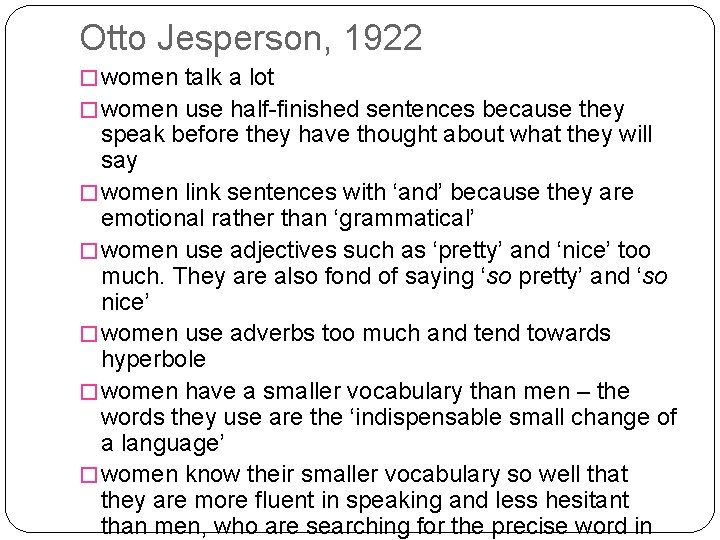
Otto Jesperson, 1922 � women talk a lot � women use half-finished sentences because they speak before they have thought about what they will say � women link sentences with ‘and’ because they are emotional rather than ‘grammatical’ � women use adjectives such as ‘pretty’ and ‘nice’ too much. They are also fond of saying ‘so pretty’ and ‘so nice’ � women use adverbs too much and tend towards hyperbole � women have a smaller vocabulary than men – the words they use are the ‘indispensable small change of a language’ � women know their smaller vocabulary so well that they are more fluent in speaking and less hesitant than men, who are searching for the precise word in
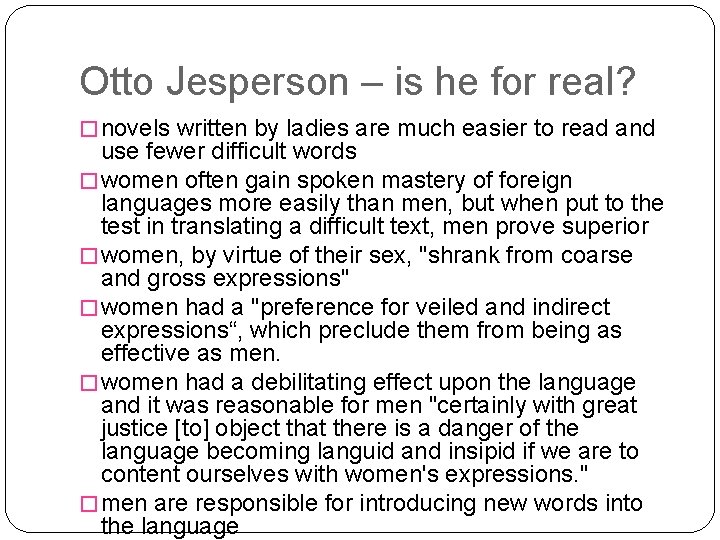
Otto Jesperson – is he for real? � novels written by ladies are much easier to read and use fewer difficult words � women often gain spoken mastery of foreign languages more easily than men, but when put to the test in translating a difficult text, men prove superior � women, by virtue of their sex, "shrank from coarse and gross expressions" � women had a "preference for veiled and indirect expressions“, which preclude them from being as effective as men. � women had a debilitating effect upon the language and it was reasonable for men "certainly with great justice [to] object that there is a danger of the language becoming languid and insipid if we are to content ourselves with women's expressions. " � men are responsible for introducing new words into the language
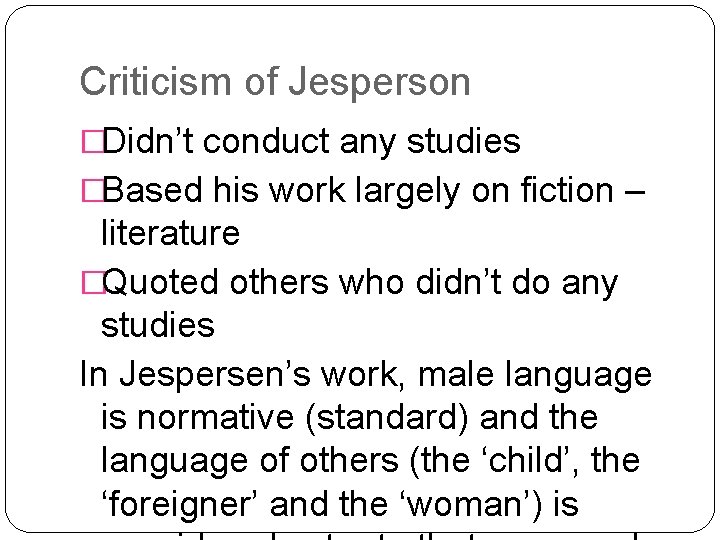
Criticism of Jesperson �Didn’t conduct any studies �Based his work largely on fiction – literature �Quoted others who didn’t do any studies In Jespersen’s work, male language is normative (standard) and the language of others (the ‘child’, the ‘foreigner’ and the ‘woman’) is
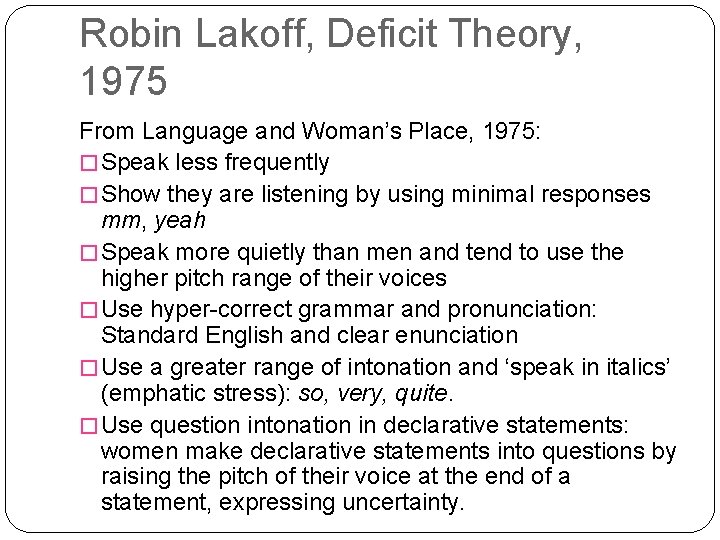
Robin Lakoff, Deficit Theory, 1975 From Language and Woman’s Place, 1975: � Speak less frequently � Show they are listening by using minimal responses mm, yeah � Speak more quietly than men and tend to use the higher pitch range of their voices � Use hyper-correct grammar and pronunciation: Standard English and clear enunciation � Use a greater range of intonation and ‘speak in italics’ (emphatic stress): so, very, quite. � Use question intonation in declarative statements: women make declarative statements into questions by raising the pitch of their voice at the end of a statement, expressing uncertainty.
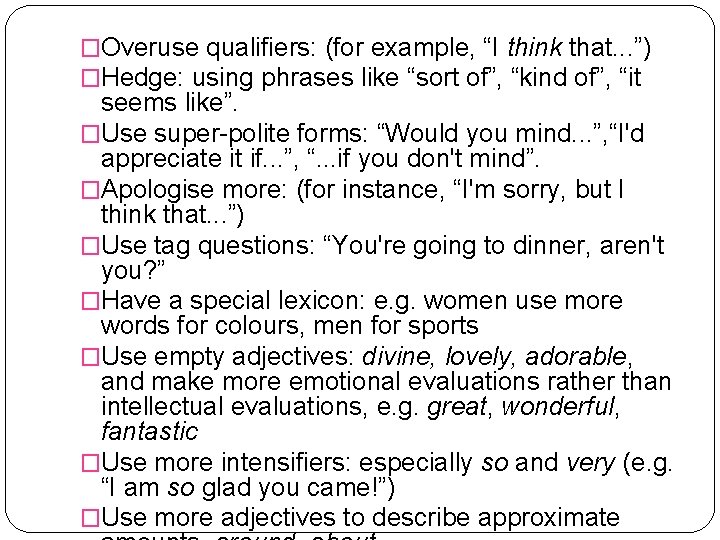
�Overuse qualifiers: (for example, “I think that. . . ”) �Hedge: using phrases like “sort of”, “kind of”, “it seems like”. �Use super-polite forms: “Would you mind. . . ”, “I'd appreciate it if. . . ”, “. . . if you don't mind”. �Apologise more: (for instance, “I'm sorry, but I think that. . . ”) �Use tag questions: “You're going to dinner, aren't you? ” �Have a special lexicon: e. g. women use more words for colours, men for sports �Use empty adjectives: divine, lovely, adorable, and make more emotional evaluations rather than intellectual evaluations, e. g. great, wonderful, fantastic �Use more intensifiers: especially so and very (e. g. “I am so glad you came!”) �Use more adjectives to describe approximate
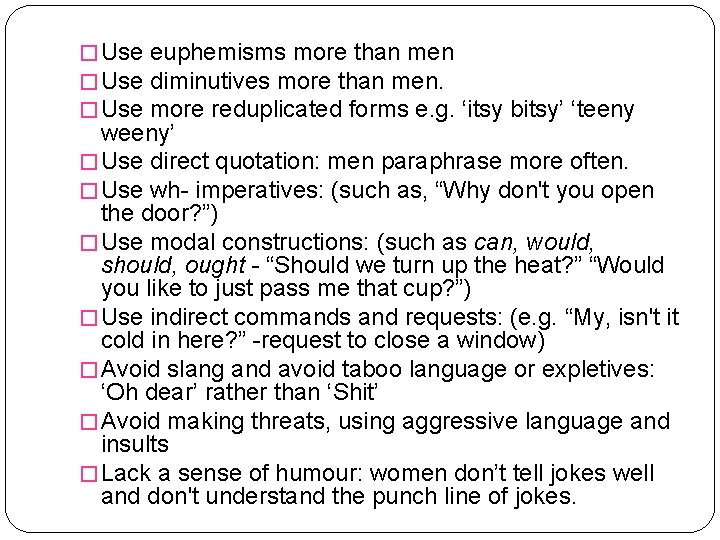
� Use euphemisms more than men � Use diminutives more than men. � Use more reduplicated forms e. g. ‘itsy bitsy’ ‘teeny weeny’ � Use direct quotation: men paraphrase more often. � Use wh- imperatives: (such as, “Why don't you open the door? ”) � Use modal constructions: (such as can, would, should, ought - “Should we turn up the heat? ” “Would you like to just pass me that cup? ”) � Use indirect commands and requests: (e. g. “My, isn't it cold in here? ” -request to close a window) � Avoid slang and avoid taboo language or expletives: ‘Oh dear’ rather than ‘Shit’ � Avoid making threats, using aggressive language and insults � Lack a sense of humour: women don’t tell jokes well and don't understand the punch line of jokes.
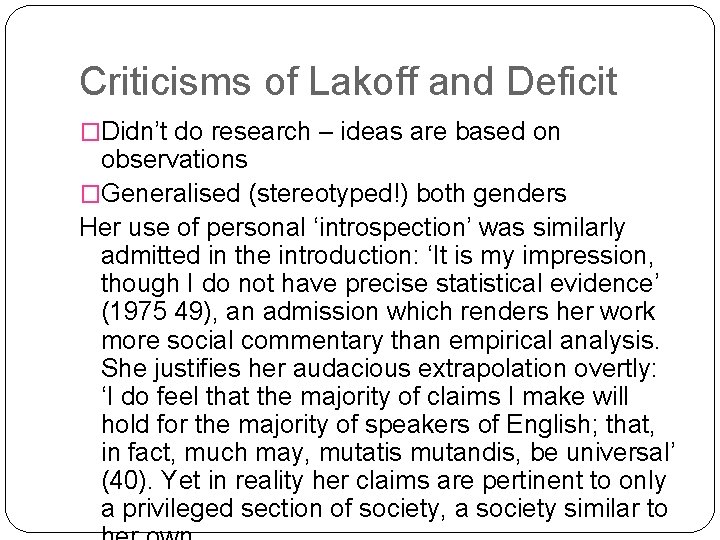
Criticisms of Lakoff and Deficit �Didn’t do research – ideas are based on observations �Generalised (stereotyped!) both genders Her use of personal ‘introspection’ was similarly admitted in the introduction: ‘It is my impression, though I do not have precise statistical evidence’ (1975 49), an admission which renders her work more social commentary than empirical analysis. She justifies her audacious extrapolation overtly: ‘I do feel that the majority of claims I make will hold for the majority of speakers of English; that, in fact, much may, mutatis mutandis, be universal’ (40). Yet in reality her claims are pertinent to only a privileged section of society, a society similar to
Dominance Theory, Dale Spender 1980 �Idea is that men dominate women in language, reflecting a patriarchal society "The crux of our difficulties lies in being able to identify and transform the rules which govern our behaviour and which bring patriarchal order into existence. Yet the tools we have for doing this are part of that patriarchal order. While we can modify, we must none the less use the only language, the only classification scheme which is at our disposal. We must use it in a way that is acceptable and meaningful. But that very language and the conditions for its use in turn structure a patriarchal order. "
Zimmerman and West, dominance �Spender built on Don Zimmerman and Candace West’s 1975 study on interruptions (competitive overlaps). �A small sample of conversations, recorded by Don Zimmerman and Candace West at the Santa Barbara campus of the University of California in 1975. The subjects of the recording were white, middle class and under 35. Zimmerman and West produce in evidence 31 segments of conversation. They report that in 11 conversations between men and women, men used 46 interruptions, but women only two. From their small sample Zimmerman and West conclude that, since men interrupt more often, then they are dominating or attempting to do so.
Problems with Z&W Study �Very small study -- few people and few conversations �Didn’t count interruptions within same gender conversations �Subjects were all white middle class – little variety This study has been criticised a lot, including Geoff Beattie’s 1982 criticism (only seven years later)
Geoff Beattie contradicts Z&W �"The problem with this is that you might simply have one very voluble man in the study which has a disproportionate effect on the total. " Beattie also questions the meaning of interruptions: : "Why do interruptions necessarily reflect dominance? Can interruptions not arise from other sources? Do some interruptions not reflect interest and involvement? ”
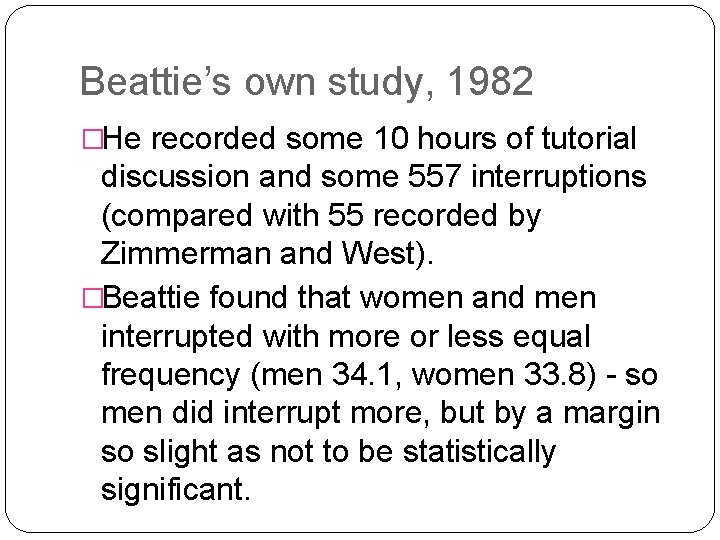
Beattie’s own study, 1982 �He recorded some 10 hours of tutorial discussion and some 557 interruptions (compared with 55 recorded by Zimmerman and West). �Beattie found that women and men interrupted with more or less equal frequency (men 34. 1, women 33. 8) - so men did interrupt more, but by a margin so slight as not to be statistically significant.
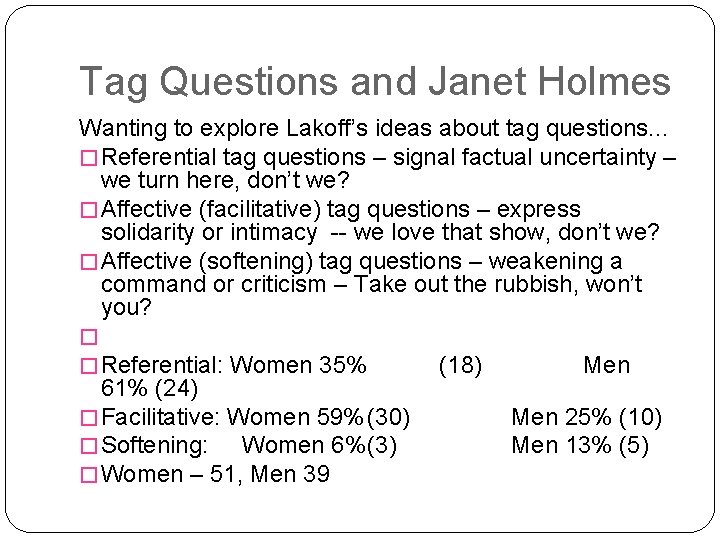
Tag Questions and Janet Holmes Wanting to explore Lakoff’s ideas about tag questions. . . � Referential tag questions – signal factual uncertainty – we turn here, don’t we? � Affective (facilitative) tag questions – express solidarity or intimacy -- we love that show, don’t we? � Affective (softening) tag questions – weakening a command or criticism – Take out the rubbish, won’t you? � � Referential: Women 35% 61% (24) � Facilitative: Women 59% (30) � Softening: Women 6%(3) � Women – 51, Men 39 (18) Men 25% (10) Men 13% (5)
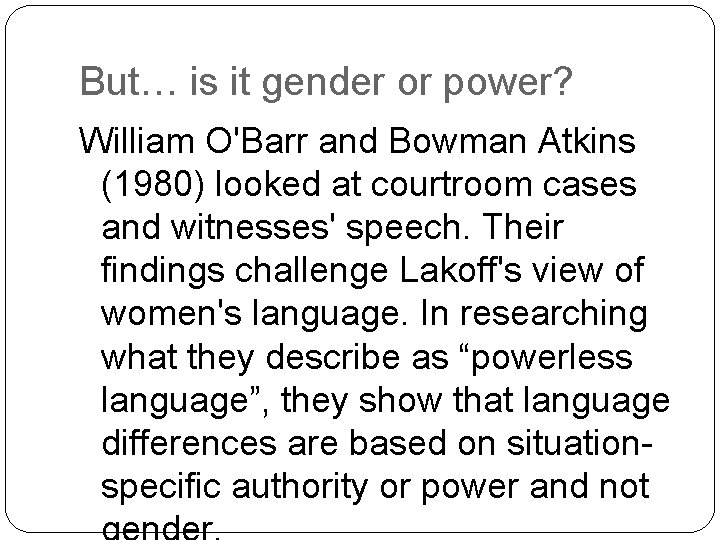
But… is it gender or power? William O'Barr and Bowman Atkins (1980) looked at courtroom cases and witnesses' speech. Their findings challenge Lakoff's view of women's language. In researching what they describe as “powerless language”, they show that language differences are based on situationspecific authority or power and not
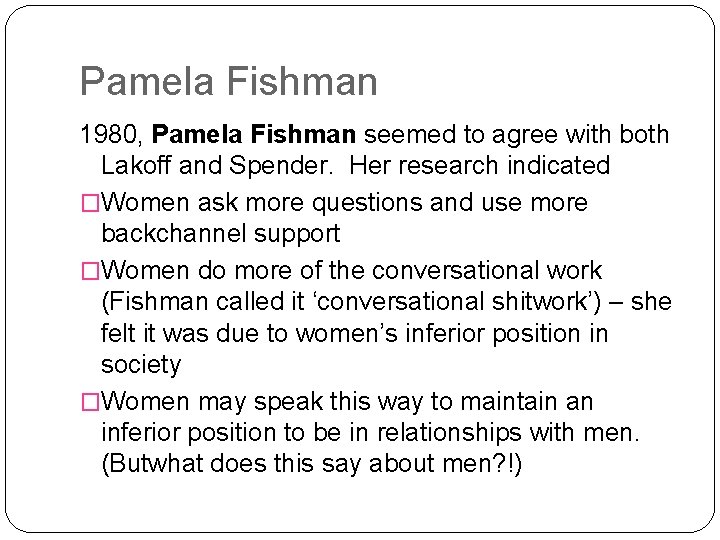
Pamela Fishman 1980, Pamela Fishman seemed to agree with both Lakoff and Spender. Her research indicated �Women ask more questions and use more backchannel support �Women do more of the conversational work (Fishman called it ‘conversational shitwork’) – she felt it was due to women’s inferior position in society �Women may speak this way to maintain an inferior position to be in relationships with men. (Butwhat does this say about men? !)
Pamela Fishman, 1990 s work �Her continuing research, through the 1990 s, showed Women Men questions Asked three times the number of questions Asked one-third of the number of questions Minimal responses Used supportive minimal noises to show interest Delayed giving or didn’t give minimal responses Attention-getters Used phrases like “you know Made little or no use of what? ” to get attention-getters Topic initiation Topics initiated by women Topics initiated by men were not always taken up in were always successful – the conversation and were supported by the women
Deborah Tannen (1990) and Difference � Deborah Tannen (1990 s) – uses the term speech style rather than women’s language � Idea that socialisation starts when we are children – how to be a boy or girl Tannen suggested that � Women’s language style is based on the rehearsed role of manyt woment o build relationships – societal expectations � Men are set up for monologues – idea of rapport (women) versus report(men) � Speech styles are a series of contrasts: � Status vs support, independence vs intimacy, advice vs understanding, information vs feeling, orders vs proposals, conflict vs compromise � (Described by Mary Talbot as sympathy vs problem- solving, rapport vs report, listening vs lecturing, private vs public, connection vs status, supportive vs oppositional, intimacy vs independence) � Men and women are more comfortable with these gender roles
Status versus Support Men grow up in a world in which conversation is competitive - they seek to achieve the upper hand or to prevent others from dominating them. For women, however, talking is often a way to gain confirmation and support for their ideas. Men see the world as a place where people try to gain status and keep it. Women see the world as “a network of connections seeking support and consensus”.
Independence vs. Intimacy Women often think in terms of closeness and support, and struggle to preserve intimacy. Men, concerned with status, tend to focus more on independence. These traits can lead women and men to starkly different views of the same situation. Professor Tannen gives the example of a woman who would check with her husband before inviting a guest to stay - because she likes telling friends that she has to check with him. The man, meanwhile, invites a friend without asking his wife first, because to tell the friend he must check amounts to a loss of status. (Often, of course, the relationship is such that an annoyed
Advice versus Understanding Deborah Tannen claims that, to many men a complaint is a challenge to find a solution: �“When my mother tells my father she doesn't feel well, he invariably offers to take her to the doctor. Invariably, she is disappointed with his reaction. Like many men, he is focused on what he can do,
Information vs Feelings � A young man makes a brief phone call. His mother overhears it as a series of grunts. Later she asks him about it - it emerges that he has arranged to go to a specific place, where he will play football with various people and he has to take the ball. A young woman makes a phone call - it lasts half an hour or more. The mother asks about it - it emerges that she has been talking “you know” “about stuff”. The conversation has been mostly grooming-talk and comment on feelings. � Historically, men's concerns were seen as more important than those of women, but today this situation may be reversed so that the giving of information and brevity of speech are considered of less value than sharing of emotions and elaboration. From the viewpoint of the language student, no value judgement is made regarding purposes and topics in speech.
Orders versus Proposals �Women often suggest that people do things in indirect ways - “let's”, “why don't we? ” or “wouldn't it be good, if we. . . ? ” Men may use, and prefer to hear, a direct imperative.
Conflict versus Compromise �“In trying to prevent fights, ” writes Professor Tannen, “some women refuse to oppose the will of others openly. But sometimes it's far more effective for a woman to assert herself, even at the risk of conflict. ” �This situation is easily observed in work-situations where a management decision seems unattractive - men will often resist it vocally, while women may appear to accede, but complain subsequently. Of course, this is a broad generalization - and for every one of Deborah Tannen's oppositions, we will know of men and women who are exceptions to the norm.
Dangers with Difference �According to Victoria Bergvall, – discussing these so-called differences supports the view that such differences exist. �Deborah Cameron feels that they can lead to job discrimination – a woman couldn’t be a police officer or run a company. A man couldn’t be a nurse or a counsellor. �Leads to stereotypes, such as “Men are from Mars, Women are from Venus”, leading to the idea that men and women have conflicts simply due to speaking different languages.
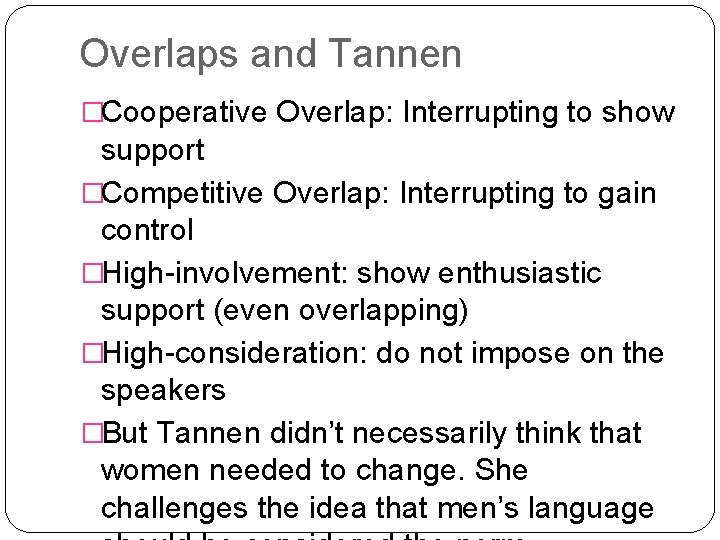
Overlaps and Tannen �Cooperative Overlap: Interrupting to show support �Competitive Overlap: Interrupting to gain control �High-involvement: show enthusiastic support (even overlapping) �High-consideration: do not impose on the speakers �But Tannen didn’t necessarily think that women needed to change. She challenges the idea that men’s language
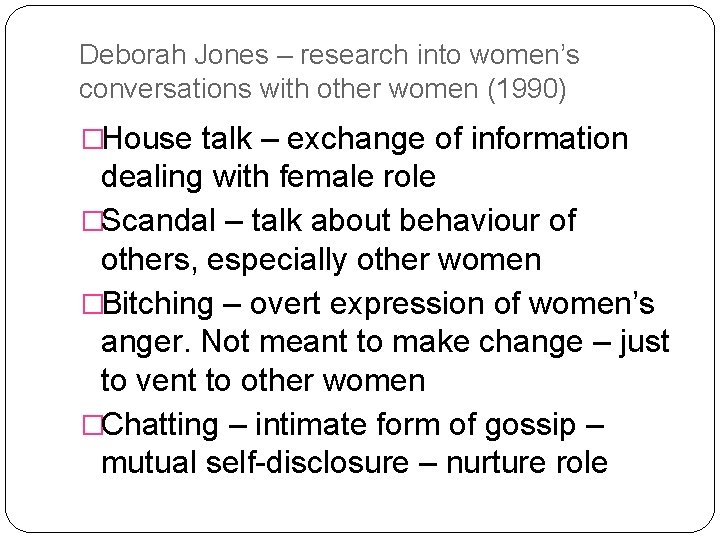
Deborah Jones – research into women’s conversations with other women (1990) �House talk – exchange of information dealing with female role �Scandal – talk about behaviour of others, especially other women �Bitching – overt expression of women’s anger. Not meant to make change – just to vent to other women �Chatting – intimate form of gossip – mutual self-disclosure – nurture role
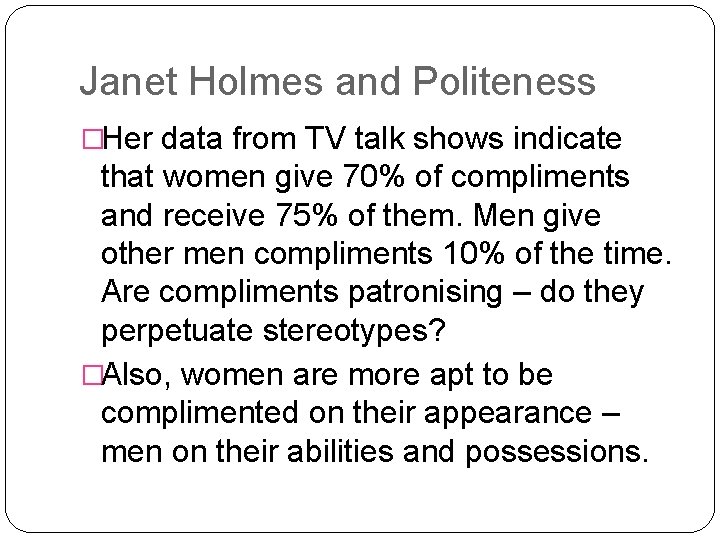
Janet Holmes and Politeness �Her data from TV talk shows indicate that women give 70% of compliments and receive 75% of them. Men give other men compliments 10% of the time. Are compliments patronising – do they perpetuate stereotypes? �Also, women are more apt to be complimented on their appearance – men on their abilities and possessions.
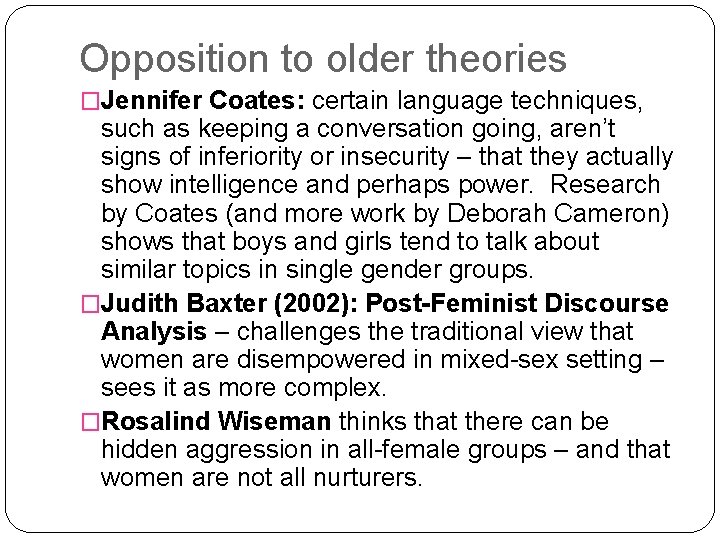
Opposition to older theories �Jennifer Coates: certain language techniques, such as keeping a conversation going, aren’t signs of inferiority or insecurity – that they actually show intelligence and perhaps power. Research by Coates (and more work by Deborah Cameron) shows that boys and girls tend to talk about similar topics in single gender groups. �Judith Baxter (2002): Post-Feminist Discourse Analysis – challenges the traditional view that women are disempowered in mixed-sex setting – sees it as more complex. �Rosalind Wiseman thinks that there can be hidden aggression in all-female groups – and that women are not all nurturers.
Susan Githens: Susan Githens comments on Professor Tannen's views, as follows: �“If we believe that women and men have different styles and that the male is the standard, we are hurting both women and men. The women are treated based on the norms for men, and men with good intentions speak to women as they would other men and are perplexed when their words spark anger and resentment. Finally, apart from her objection to women having to do all the changing, Tannen states that women changing will not work either. As Dale Spender theorized, women who talk like men are judged differently -and harshly. A woman invading the man's realm of speech is often considered unfeminine, rude or
Deborah Cameron �Any differences are due to societal expectations of each gender. The way men and women think they are meant to speak is “verbal hygiene” – how we use language to impose order in society. �She’s backed up by Janet Hyde’s research (2005) – there are only very minor (statistically insignificant) differences.
Louann Brizendine versus James Pennebaker �In 2006, Louann Brizendine, founder and director of the University of California, San Francisco's Women's Mood and Hormone Clinic, published The Female Brain. One of the most cited gems within its pages was a claim that women are chatterboxes, speaking an average of 20, 000 words per day, nearly three times the mere 7, 000 spoken by men. �It seemed to make sense, given the rep of women as purveyors of gossip, not to mention creatures incapable of keeping their traps shut. Right? Wrong.
Pennebaker’s study, 2007 �His device, called EAR (for electronically activated recorder), is a digital recorder that subjects can store in a sheath similar to a case for glasses in their purses or pockets. The EAR samples 30 seconds of ambient noise (including conversations) every 12. 5 minutes; carriers cannot tamper with recordings. �Researchers used this device to collect data on the chatter patterns of 396 university students (210 women and 186 men) at universities in Texas, Arizona and Mexico. They estimated the total number of words that each volunteer spoke daily, assuming they were awake 17 of 24 hours.
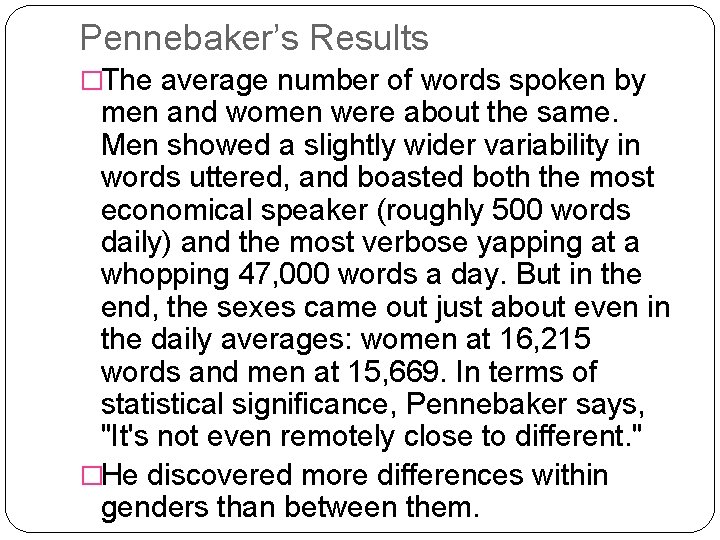
Pennebaker’s Results �The average number of words spoken by men and women were about the same. Men showed a slightly wider variability in words uttered, and boasted both the most economical speaker (roughly 500 words daily) and the most verbose yapping at a whopping 47, 000 words a day. But in the end, the sexes came out just about even in the daily averages: women at 16, 215 words and men at 15, 669. In terms of statistical significance, Pennebaker says, "It's not even remotely close to different. " �He discovered more differences within genders than between them.
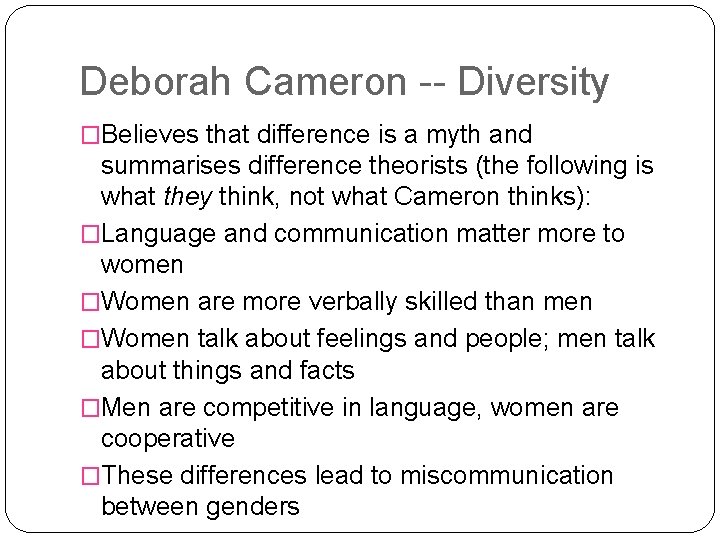
Deborah Cameron -- Diversity �Believes that difference is a myth and summarises difference theorists (the following is what they think, not what Cameron thinks): �Language and communication matter more to women �Women are more verbally skilled than men �Women talk about feelings and people; men talk about things and facts �Men are competitive in language, women are cooperative �These differences lead to miscommunication between genders