
Language and Disadvantage before the Law Language and
Language and Disadvantage before the Law
Language and disadvantage before the law Communicating what one wishes to say – not always straightforward Reasons: parallel linguistic world of the law and the ideology of language in the legal context Belief that language is objective and that meaning ccan be ascertained – important for the law because otherwise decision making would be even more difficult But: both linguists and lawyers know that communication is not straightforward: this is especially true if several languages are present in the legal context
Communication problems in the courtroom 1) conceptual content 2) coercion 3) trauma
Language and disadvantage before the law Law has the potential to be a mechanism for oppression rather than a means of achieving justice Providing the same treatment does not equate with providing just treatment (e. g. treating a second language speaker in the same way as native speakers) Just treatment – not the same treatment, but rather recognizing difference, and developing measures to cope with these differences
Children Reliability of children’s testimony – similar to that of adults if they are questioned in a way that helps them produce their own version of events) Children may be more suggestible The problem of interpersonal power and coercion; children may be frightened into silence (e. g. sexual abuse cases) Yes-no questions, tag questions – coercive Extreme syntactic complexity – a lack of understanding
Read the following questions addressed to children in court and rephrase them to make them less confusing A) So, you told us that you don’t remember, do you remember saying that a moment ago? (to 10 year old) B) How far was the trampoline from you when you were first helped on the bike by Mr Brown? (to 7 year old) C) Well I know, I understand what you say you have been talking to her today, but you see what I am asking you is this, that stzatement suggests that you said those things which you now say are wrong to the police. Did you say it to the police, or did you not? (to 9 year old) D) Now you had a bruise, did you not, near one of your breasts, do you remember this? (to 11 year old) E) But do you recall going to the hospital and will you tell us why you went to the hospital? (to child aged between 4 and 6)
Discussion Some people think that children should not have t answer questions in court. What do you think? Consider the situation in which a serious crime has been committed and the only witness is a child. How would an ideal justice system approach the child’s evidence in this case?
Indigenous minorities: Aborigines – different attitude to knowledge; secret knowledge is not shared; questioning in Aboriginal societies – done with great caution; direct questioning – rude and intrusive; answering is not obligatory; the clash with police questioning and courtroom cross-examination Aboriginal culture – no measurement expressions, esp. regarding time; e. g. a date is referred to by a significant event, not by a calender date Sequences of narrative – different; Aborigines do not organize their information in conformity with western ‘logic’ and are viewed as incoherent Aborigines – prone to saying ‘yes’ to everything to avoid pressure and questioning
Activity: Is the witness credible? DC= Defence Council; W=Witness DC: and you knew when you spoke to these six police officers in the Valley that you didn’t have to go anywhere with them if you didn’t want to, didn’t you? W: No. DC: You knew that, Mr Coley I’d suggest to you, please do not lie, you knew that you didn’t have to go anywhere if you didn’t want to, didn’t you? Didn’t you, Mr Coley. W: yea.
Activity DC: WHY DID YOU JUST LIE TO ME? WHY DID YOU JUST SAY NO MR COLEY? YOU WANT ME TO SUGGEST A REASON MR COLEY? THE REASON WAS THIS, THAT YOU WANTED THE COURT TO BELIEVE THAT YOU THOUGHT YOU HAD TO GO WITH POLICE, ISN’T THAT SO? W: Yeah. DC: AND YOU LIED TO THE COURT, TRYING TO PUT ONE OVER ON THE COURT, DIDN’T YOU? W: No.
Activity DC: THAT WAS YOUR REASON, MR COLEY WASN’T IT? WASN’T IT, MR COLEY? W: Yep DC: YES, BECAUSE YOU WANTED THE COURT TO THINK THAT YOU DIDN’T KNOW THAT YOU COULD TELL THESE POLICE YOU WEREN’T GOING ANYWHERE WITH THEM. THAT WAS THE REASON WASN’T IT? W: Yes DC: Yes.
Background Witness: L 1 speaker of Australian Aboriginal English; only 15 years old Sociolinguistic competence – how to do things with language, over and above the basic structure of a language Interactional norms in AAE that are important to this extract relate to silence and question forms In AAE – silence after a question is normal and is valued; it indicates that the person is taking the question seriously; common in formal and semi-formal situations
Australian Aboriginal English In AAE – gratuitous concurrence – speakers are much more likely to answer ‘yes’ to some questions, regardless of what the ‘true answer is This is much more likely to happen when questions are asked forcefully, either through increased volume and emphasis, by repetition or because the questioner has power over the addressee
Australian Aboriginal culture In Western culture, people are expected to share what they know In Aborigianl culture, information is precious; there are some pieces of knowledge that cannot be generally shared What a person can be told depends on the relationship between the speaker and the hearer Information seeking – done indirectly as part of interaction in ongoing reciprocal relationships
Summary Sociolinguistic competence is about knowing how to do things with language The rules of sociolinguistic competence vary between languages and language varieties To understand power in the courtroom, looking at individual features of talk is not enough
Silence and silencing Silencing may contribute to the high number of indigenous Australians in prison or in police custody An idividual’s ethnicity – not determinative of their language variety Some Aborigines do not have AAE as their mother tongue, others are bilingual Individuals who are fluent in Standard Australian English may not experience the same kind of discrimination and silencing that AAE speakers do
Activity: The following is an extract of examination-in-chief during a sentencing hearing The witness assaulted one of the Smiths Identify instances of silence in the following:
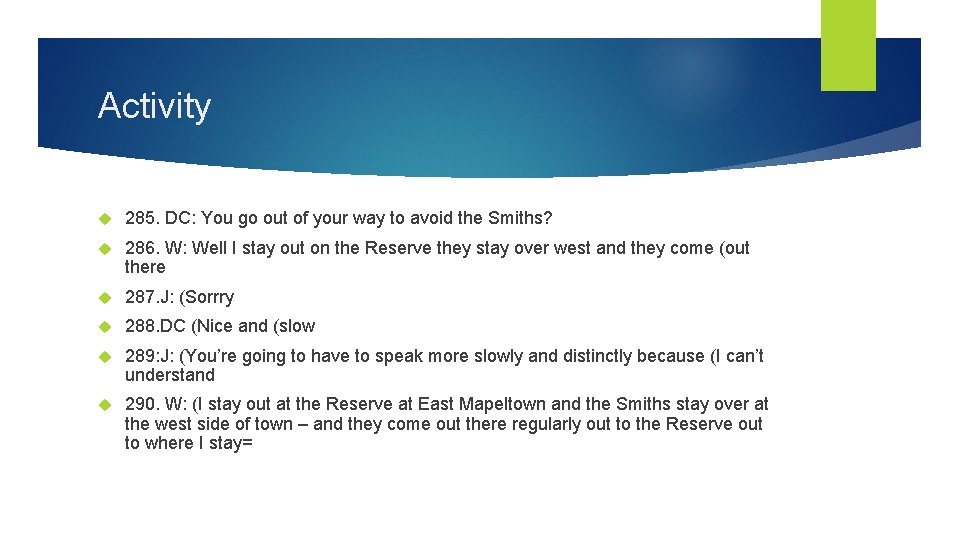
Activity 285. DC: You go out of your way to avoid the Smiths? 286. W: Well I stay out on the Reserve they stay over west and they come (out there 287. J: (Sorrry 288. DC (Nice and (slow 289: J: (You’re going to have to speak more slowly and distinctly because (I can’t understand 290. W: (I stay out at the Reserve at East Mapeltown and the Smiths stay over at the west side of town – and they come out there regularly out to the Reserve out to where I stay=
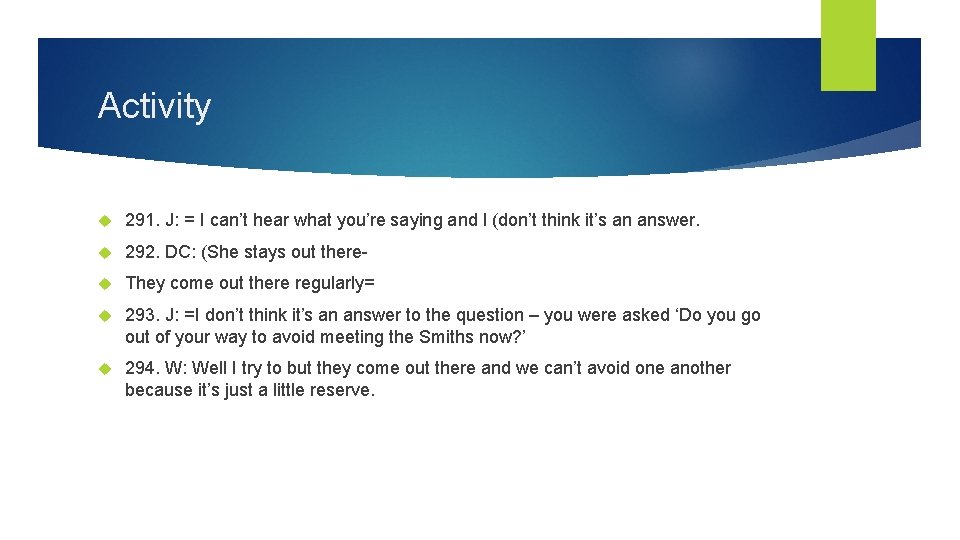
Activity 291. J: = I can’t hear what you’re saying and I (don’t think it’s an answer. 292. DC: (She stays out there- They come out there regularly= 293. J: =I don’t think it’s an answer to the question – you were asked ‘Do you go out of your way to avoid meeting the Smiths now? ’ 294. W: Well I try to but they come out there and we can’t avoid one another because it’s just a little reserve.
Comment Interruptions – a common way of silencing someone in a conversation The preferred answer: ‘yes’ The witness – trying to answer the question and obey relevant Gricean maximes
AAE speakers A declarative with a rising intonation is a good, non-coercive question The lawyer offering a string of declaratives and the witness agreeing: ‘evidentiary harmony’ Due to their different sociolinguistic competence, AAE speakers are at a real disadvantage in the courtroom Rules of interaction in the courtroom clash with the rules of interaction in thier culture The fact that AAE is a variety of English makes this disadvantage even more acute as the other participants may not be aware that Aborigenes are second language speakers
Summary When rules of interaction clash, discrimination and injustice are likely to occur This is more likely with ‘non-standard’ varieties of English or varieties demanding different sociolinguistic competence
Legal interpreting and translation International and national legislation on the right to translation and interpretaton Interpreters needed not only for people with no command of a language, but also those with a limited command Courts, police stations, prisons Reluctance to use interpreters and translators
Moving between languages Access to the law and justice depends on access to the language of the law The availability of interpreting in the legal context – an important right In the courtroom, the fairness of a trial may depend on good interpretation
Court interpreting The use of professional interpreters – not universal; Sometimes interpreters are community members, public officers or even children Interpreting: during arrest, detention and questioning by the police; in the courtroom
Translation and interpreting Translation – written texts Interpreting - oral
translation translating a text from the source language into a target language Translators often work under time pressure, but they can consult dictionaries, translation tools and other sources Translators can revise and redraft their text Able to see the whole text
Interpreting 1) consecutive 2) simultaneous
Simultaneous interpreting Two people are speaking at the same time The interpreter is doing two things at once: listenig to a speaker in L 1 and producing speech in L 2 – extremely demanding
Consecutive interpreting Also demanding, but at least one person speaks at a time The first speaker has to provide enough speech for the interpreter to be able to make sense of the message, without it being too long to hold in working memory Both modes: very challenging, especially in the courtroom
Activity Think about rules of interaction in the courtroom Consider the ideologies that the law holds about language What effect might these factors have on court interpreter? What other kind of practical issues might the interpreter have to deal with?
Comment Linguistic ideology operating in the law: that language is objective and transparent As a result: interpreters seen as „translation machines” that simply have to translate everything that is being said: the conduit model of communication Conduit model seed communication as a simple transmission of information from A to B – hardly accurate when dealing with one language, when dealing with more languages, even less convincing
Court interpreting Interpreting requires knowing the legal language of both codes, as well as the language used by the police, lawyers and judges Legal language- closely related to legal structure, and not all places have the same legal system Terms which exist in everyday language may have a special meaning in legal English
Court interpreter Might be perceived as an expert witness and treated with suspicion The interpreter is probably the only person n the courtroom who can understand both languages; other participants simply have to trust that what is being communicated is actually what the witness said The interpreter may not have been given any inormation about the case, the charge or the witness’s testimony They have no context for what they are hearing; not able to ask for clarification
Court interpreting: practical problems The interpreter may not even be in the courtroom Whether co-present or not, speakers should speak clearly, pausing regularly to allow the interpretation to take place The interpreter needs to be situated in a place where she can hear what is being said She should be allowed to ask for clarification, take notes, to have breaks and to have sth to drink Often this is not provided
Court interpreting An interpreter will be talking more than anyone else in the courtroom, as they have to repeat everything that anyone says – exhausting activity Interpreters should be highly trained professionals who should have adequate working conditions and be paid professional rates that are commensurate with the difficulty of the task
Summary Differences between the structure and semantics of languages are difficult to manage Interpreters face practical difficulties because of the rules and routines of the court
Court interpreting In moving from one language to another, interpreters will usually leave some elements out and add some elements: additions and deletions necessary for moving from one language to another Hedges, fillers, discourse markers
Hedges, fillers, discourse markers Reduce the certainty or force of a statement In the court – the level of commitment can be very important Fillers may have the effect of hedging; they can also indicate the presence of a sensitive or embarassing topic Discourse markers structure utterances and arguments; provide particular kinds of information and emphasis
Example Witness: Se me extravio. No se en realidad (I lost it. I don’t really know) Interpreter: I lost it.
Comment Uncertainty – removed The witness may be held to this unqualified answer If the witness says anything which is at odds with the certainty of ‘I lost it’, he may start to look unreliable
Example Answer: No, no se hablo de eso. (No, that wasn’t discussed. ) Interpreter: I don’t think so…I don’t think so.
Comment An answer which was unequivocal is made less certain by the interpreter
Findings In interpreting from Spanish to English, the number of hedges, fillers and discourse markers went down and the number of hesitations went up Interpreters tend to use a formal register of English, regardless of the style of the original
Problems 1) availability of interpreters/translators (lesser-used languages) 2) quality (training, pay, career structure)
Recommendations Communication would be improved, and justice may be better served, if judges, lawyers and juries were fully aware of difficulties that interpreters face Allowing interpreters to take their time, to take notes or to have some access to witness statements would make interpreters’ work slightly less impossible
Which language? Which language is appropriate is not always clear People may be spoken to in a language they are not fluent in This may be because an appropriate interpreter is unavailable or because the interviewee seems to be able to understand communicate in the language being used Evidence gathered in this way, or testimony elicited from such a speaker may be unreliable because of his language difficulties
Second language speakers Communication problems – remedy: legal translation and interpreting Evidence of communication problems: responding with an apology, a clarification request, absence of response, inappropriate response
Activity: Consider the following P: Right. Now I want to ask you some questions about the trouble out there but I want you to understand that you don’t have to answer any questions at all. Do you understand that? W: Yes. P: Do you have to tell me the story? W: Yes. P: Do you have to though? W: Yes. P: Do you, am I making you tell me the story? W: Yes. P: Or are you telling me because you want to? W: Yes.
Comment Gratuitous concurrence Also: exchange with a non-native speaker of English If the police officer had stopped with the first question, and not gone on to check the witness’s comprehension, the witness’s difficulty may not have come to light Without understanding gratuitous concurrence, a questioner may conclude that the witess is being uncooperative
Example P: Which man, which man had this shining thing? W: Who wear white thing. Police: The white thing? W: White, white shirt. P: Is he the man you stabbed in the backside? W: Yeah. P: Yeah? W: Yeah.
Cont. P: And how long was this shining thing? W: Fifteen second it’s. P: How, how? W: five seconds. How long? Ah yeah, I can’t remember. P: You can’t remember? W: I see something shining but I can’t remember
Comment A witness struggling with the English language
Example P: My friend, my friend, this interview we’ve spoke now for an hour and a half. W: Yeah. P: And you’ve spoken perfect English W: Yeah.
Comment Detainees should understand the language which is used to interview them However: the detainee’s language proficiency may never be examined
Summary Interpreters may add or remove parts of a witness’s utterance This can have an effect on the witness’s meaning and style Interpreting is not always well understood by legal professionals It may be necessary to fully assess an individual’s linguistic proficiency
The deaf There is no signed legal system Characteristics of legal language cause severe communication problems A signer who is handcuffed cannot communicate
Social class Lower level of command of High Register Social stereotyping contributes to unequal treatment
Asylum seekers Claims about origin based on language In many parts of the world – languages are not confined to well-marked national borders Asylum seekers often come from regions characterised by complex multilingualism, creolisation or diglossia Very little may be known about the link between a region and its language
Asylum seekers do not always move quickly and directly from point A to point B The journey may well last for many years, involving periods in refugee camps and in other countries; all this may leave linguistic traces
Measures to reduce communication problems 1) Information (training of lawyers) 2) Mediation (by people who understand both sides e. g. the Aboriginal Legal Services, child councellors, mediators in cases of sexual assault) 3) Modifying legal procedures (e. g. guidelines on formulating questions and ensuring comprehension; admission of video-taped interviews with young children)
Summary Linguists are involved in determining individuals’ geographical origin Understanding multilingual contexts and the journeys of asylum seekers is important in making these determinations
- Slides: 62