
Language and Compiler Support for Mixin Programming Richard
![Previous Approaches l Ad-hoc naming conventions l l Configuration repositories [Czarnecki 00] l l](https://slidetodoc.com/presentation_image_h2/bfca50d1e688e2a0c4242826b3f70155/image-19.jpg "Previous Approaches l Ad-hoc naming conventions l l Configuration repositories [Czarnecki 00] l l")
![Related Work l CLOS mixin classes use multiple inheritance [Moon, 1986; Keene, 1989] l](https://slidetodoc.com/presentation_image_h2/bfca50d1e688e2a0c4242826b3f70155/image-38.jpg "Related Work l CLOS mixin classes use multiple inheritance [Moon, 1986; Keene, 1989] l")
![Conclusion l Designed/Implemented novel support for mixin programming [Cardone & Lin, ICSE 2001], [Cardone,](https://slidetodoc.com/presentation_image_h2/bfca50d1e688e2a0c4242826b3f70155/image-39.jpg "Conclusion l Designed/Implemented novel support for mixin programming [Cardone & Lin, ICSE 2001], [Cardone,")
- Slides: 50
Language and Compiler Support for Mixin Programming Richard Cardone Calvin Lin, Advisor Department of Computer Sciences University of Texas at Austin April 22, 2002 4/22/02 Cardone Defense
The Problem l Large applications are difficult and expensive to build! l Variation over time l Variation in execution environments 4/22/02 Cardone Defense 2
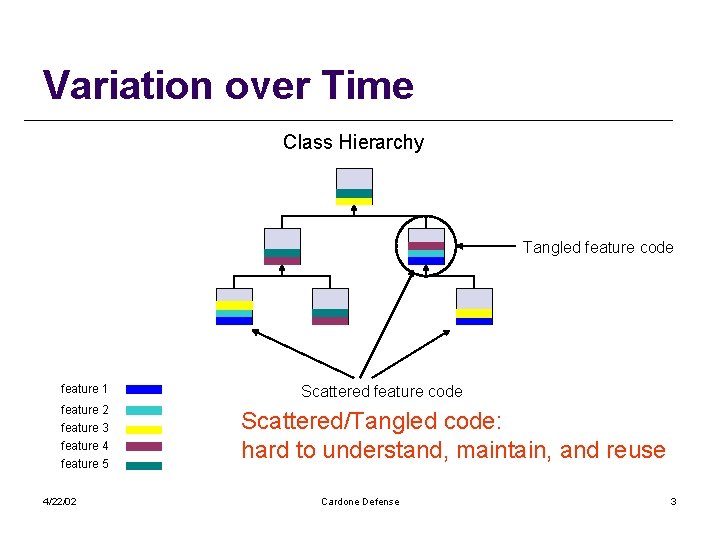
Variation over Time Class Hierarchy Tangled feature code feature 1 feature 2 feature 3 feature 4 feature 5 4/22/02 Scattered feature code Scattered/Tangled code: hard to understand, maintain, and reuse Cardone Defense 3
Variation in Execution Environments l Need multiple versions of an application l Different users l Different market segments l Different computer architectures Support for multiple versions requires effective reuse 4/22/02 Cardone Defense 4
Our Solution: Java Layers (JL) l Address problems of variation over time and environments l l Extend Java with mixins l l Build software from reusable components Mixins: an object-oriented reuse technology Provide novel language and compiler support for mixin programming 4/22/02 Cardone Defense 5
Presentation Overview l Mixin Background l Contributions l Support for Mixin Programming l l 4/22/02 l Addressing complexity l Increasing expressiveness Evaluating Mixin Programming l Fidget: Building flexible widgets l ACE: Comparing OO frameworks Conclusion & Future Work Cardone Defense 6
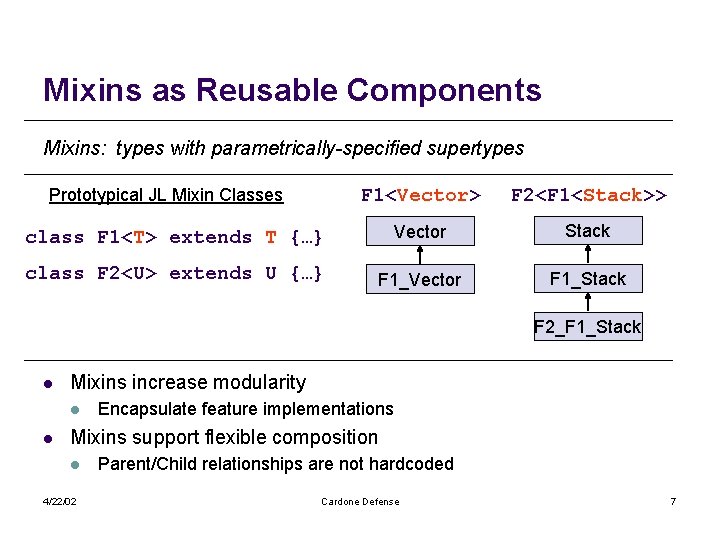
Mixins as Reusable Components Mixins: types with parametrically-specified supertypes F 1<Vector> F 2<F 1<Stack>> class F 1<T> extends T {…} Vector Stack class F 2<U> extends U {…} F 1_Vector F 1_Stack Prototypical JL Mixin Classes F 2_F 1_Stack l Mixins increase modularity l l Encapsulate feature implementations Mixins support flexible composition l 4/22/02 Parent/Child relationships are not hardcoded Cardone Defense 7
Mixins Increase Complexity l Increased flexibility can lead to increased complexity! l Can arbitrarily compose mixins Easy to make undesirable compositions l Supertypes are not known at definition time Initialization is tricky l Existing OO languages don’t support useful mixin idioms 4/22/02 Cardone Defense 8
Why Java Layers? Make mixins a practical way to program l l Start with Java l Widespread use l Embodies good software engineering characteristics Address complexity of mixin programming l 4/22/02 Design and implement specialized mixin support Cardone Defense 9
Contributions 1. Design new language and compiler support for mixin programming l Enhance effectiveness of mixins 2. Integrate mixin support into an OO language l Implement Java Layers as an extension of Java 3. Demonstrate effectiveness of mixin programming using Java Layers 4/22/02 l Cardone Defense Show that mixin programming improves application development 10
Overview l Mixin Background l Contributions l Support for Mixin Programming l l 4/22/02 l Addressing complexity l Increasing expressiveness Evaluating Mixin Programming l Fidget: Building flexible widgets l ACE: Comparing OO frameworks Conclusion & Future Work Cardone Defense 11
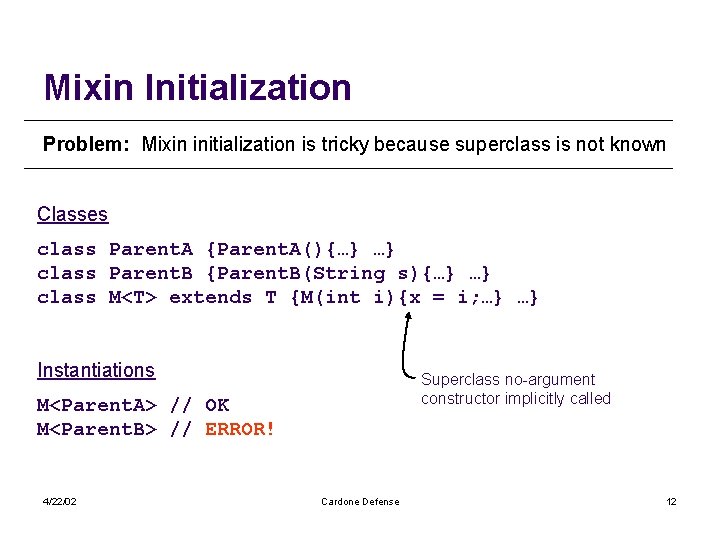
Mixin Initialization Problem: Mixin initialization is tricky because superclass is not known Classes class Parent. A {Parent. A(){…} …} class Parent. B {Parent. B(String s){…} …} class M<T> extends T {M(int i){x = i; …} …} Instantiations Superclass no-argument constructor implicitly called M<Parent. A> // OK M<Parent. B> // ERROR! 4/22/02 Cardone Defense 12
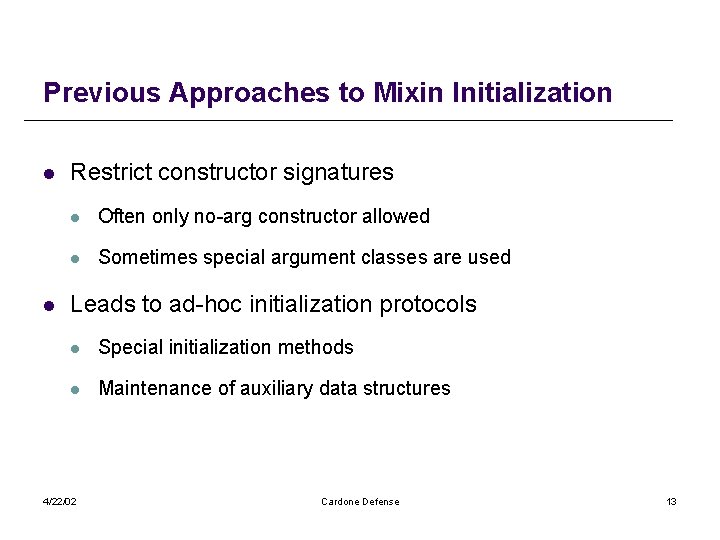
Previous Approaches to Mixin Initialization l l Restrict constructor signatures l Often only no-arg constructor allowed l Sometimes special argument classes are used Leads to ad-hoc initialization protocols l Special initialization methods l Maintenance of auxiliary data structures 4/22/02 Cardone Defense 13
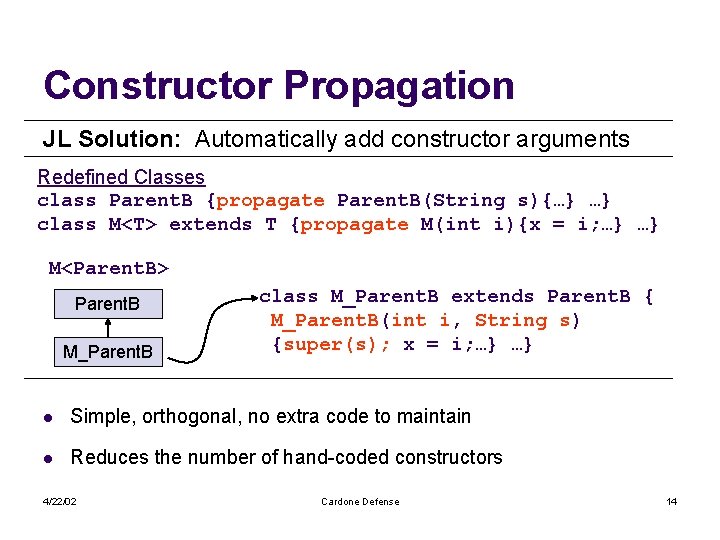
Constructor Propagation JL Solution: Automatically add constructor arguments Redefined Classes class Parent. B {propagate Parent. B(String s){…} …} class M<T> extends T {propagate M(int i){x = i; …} …} M<Parent. B> Parent. B M_Parent. B class M_Parent. B extends Parent. B { M_Parent. B(int i, String s) {super(s); x = i; …} …} l Simple, orthogonal, no extra code to maintain l Reduces the number of hand-coded constructors 4/22/02 Cardone Defense 14
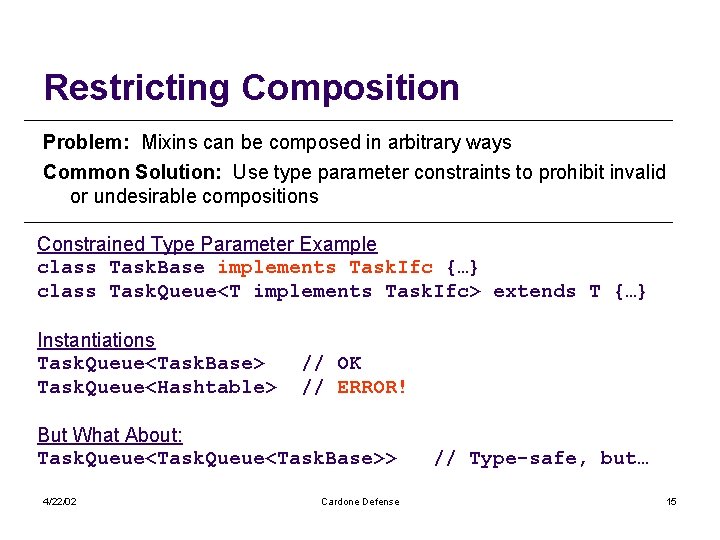
Restricting Composition Problem: Mixins can be composed in arbitrary ways Common Solution: Use type parameter constraints to prohibit invalid or undesirable compositions Constrained Type Parameter Example class Task. Base implements Task. Ifc {…} class Task. Queue<T implements Task. Ifc> extends T {…} Instantiations Task. Queue<Task. Base> Task. Queue<Hashtable> // OK // ERROR! But What About: Task. Queue<Task. Base>> 4/22/02 Cardone Defense // Type-safe, but… 15
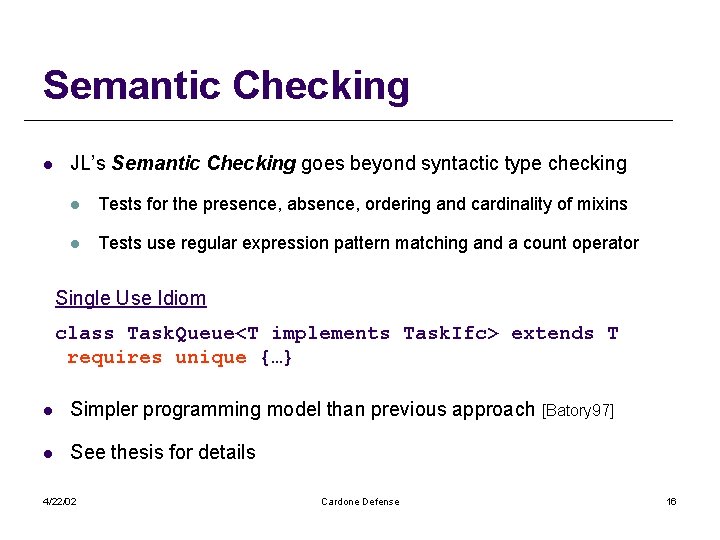
Semantic Checking l JL’s Semantic Checking goes beyond syntactic type checking l Tests for the presence, absence, ordering and cardinality of mixins l Tests use regular expression pattern matching and a count operator Single Use Idiom class Task. Queue<T implements Task. Ifc> extends T requires unique {…} l Simpler programming model than previous approach [Batory 97] l See thesis for details 4/22/02 Cardone Defense 16
Overview l Mixin Background l Contributions l Support for Mixin Programming l l 4/22/02 l Addressing complexity l Increasing expressiveness Evaluating Mixin Programming l Fidget: Building flexible widgets l ACE: Comparing OO frameworks Conclusion & Future Work Cardone Defense 17
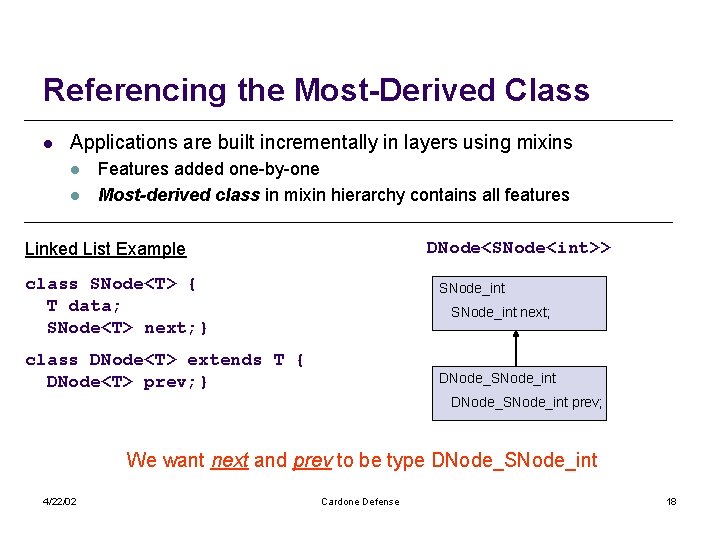
Referencing the Most-Derived Class l Applications are built incrementally in layers using mixins l l Features added one-by-one Most-derived class in mixin hierarchy contains all features DNode<SNode<int>> Linked List Example class SNode<T> { T data; SNode<T> next; } SNode_int next; class DNode<T> extends T { DNode<T> prev; } DNode_SNode_int prev; We want next and prev to be type DNode_SNode_int 4/22/02 Cardone Defense 18
Previous Approaches l Ad-hoc naming conventions l l Configuration repositories [Czarnecki 00] l l Fixed leaf class name Maintain auxiliary data New type systems [Thorup 97, Bruce 97 -98] l 4/22/02 Powerful, but change Java semantics and implementation Cardone Defense 19
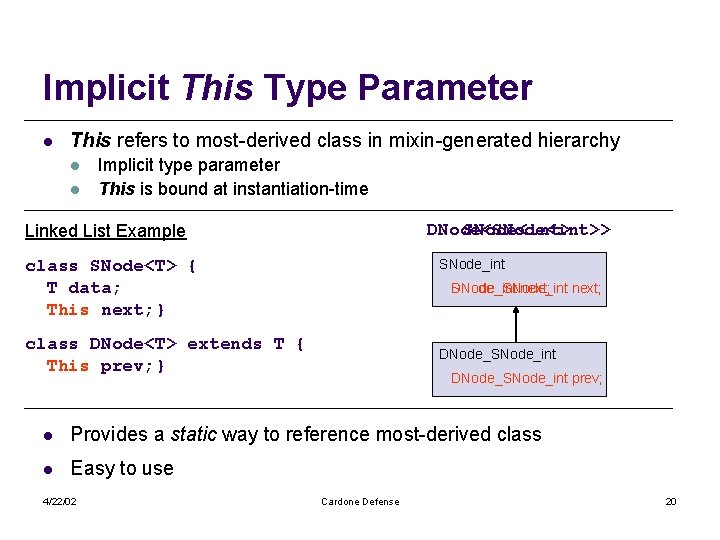
Implicit This Type Parameter l This refers to most-derived class in mixin-generated hierarchy l l Implicit type parameter This is bound at instantiation-time DNode<SNode<int>> SNode<int> Linked List Example class SNode<T> { T data; This next; } SNode_int next; DNode_SNode_int next; class DNode<T> extends T { This prev; } DNode_SNode_int prev; l Provides a static way to reference most-derived class l Easy to use 4/22/02 Cardone Defense 20
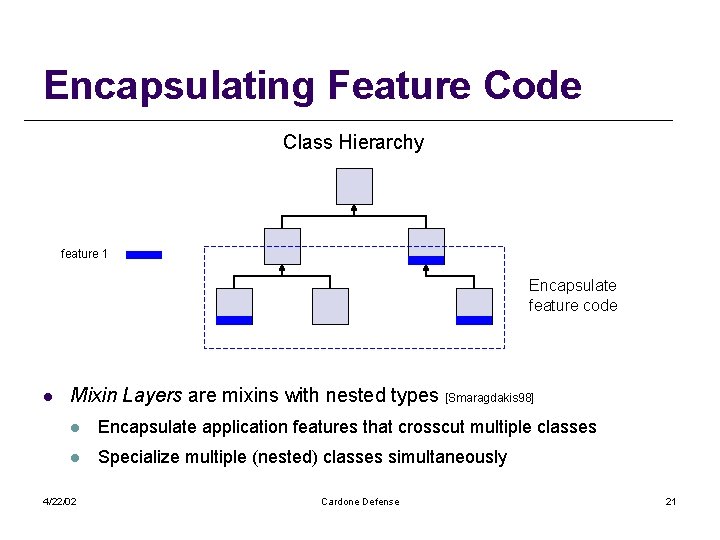
Encapsulating Feature Code Class Hierarchy feature 1 Encapsulate feature code l Mixin Layers are mixins with nested types [Smaragdakis 98] l Encapsulate application features that crosscut multiple classes l Specialize multiple (nested) classes simultaneously 4/22/02 Cardone Defense 21
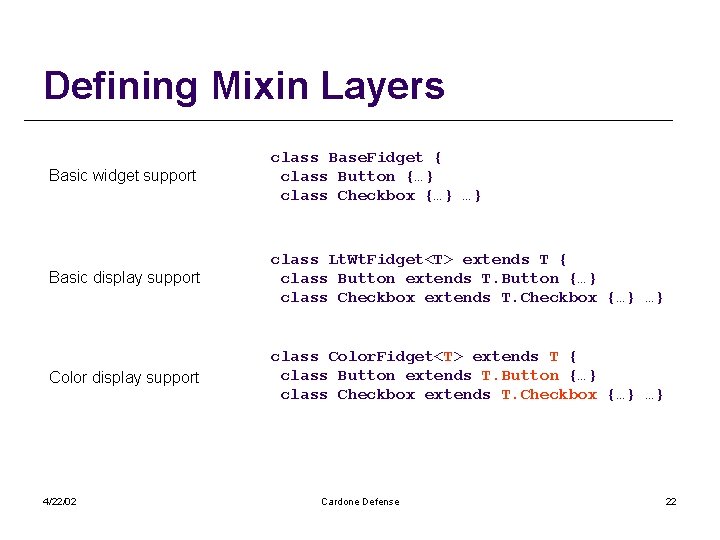
Defining Mixin Layers Basic widget support class Base. Fidget { class Button {…} class Checkbox {…} …} Basic display support class Lt. Wt. Fidget<T> extends T { class Button extends T. Button {…} class Checkbox extends T. Checkbox {…} …} Color display support class Color. Fidget<T> extends T { class Button extends T. Button {…} class Checkbox extends T. Checkbox {…} …} 4/22/02 Cardone Defense 22
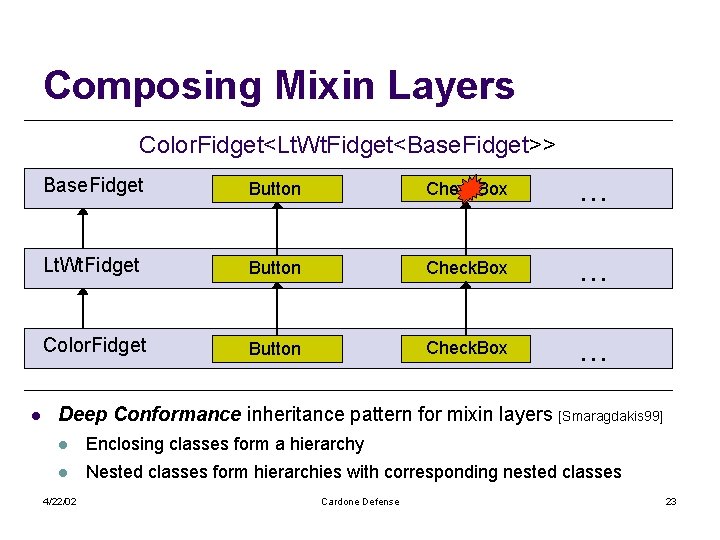
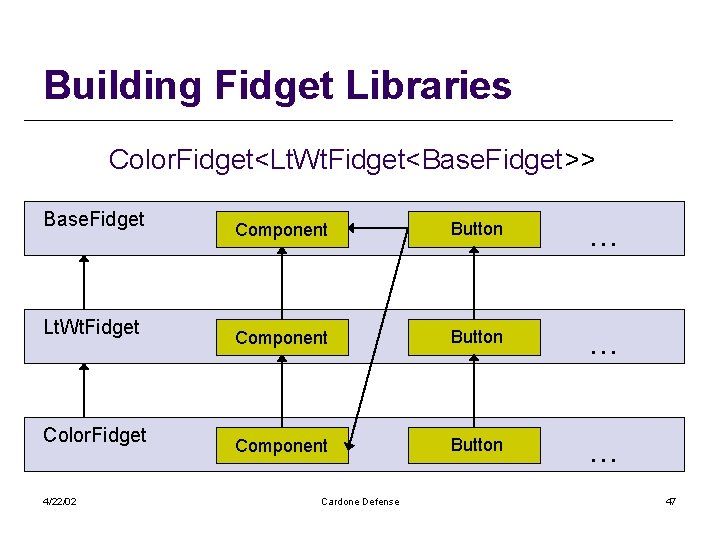
Composing Mixin Layers Color. Fidget<Lt. Wt. Fidget<Base. Fidget>> l Base. Fidget Button Check. Box . . . Lt. Wt. Fidget Button Check. Box . . . Color. Fidget Button Check. Box . . . Deep Conformance inheritance pattern for mixin layers [Smaragdakis 99] l Enclosing classes form a hierarchy l Nested classes form hierarchies with corresponding nested classes 4/22/02 Cardone Defense 23
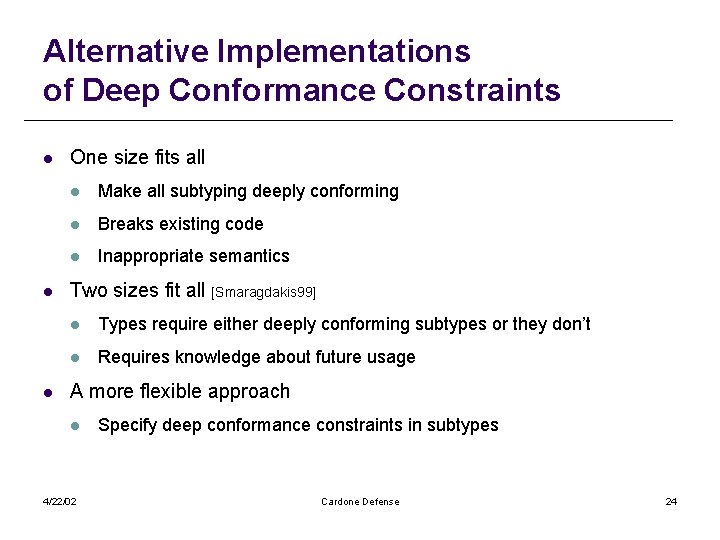
Alternative Implementations of Deep Conformance Constraints l l l One size fits all l Make all subtyping deeply conforming l Breaks existing code l Inappropriate semantics Two sizes fit all [Smaragdakis 99] l Types require either deeply conforming subtypes or they don’t l Requires knowledge about future usage A more flexible approach l 4/22/02 Specify deep conformance constraints in subtypes Cardone Defense 24
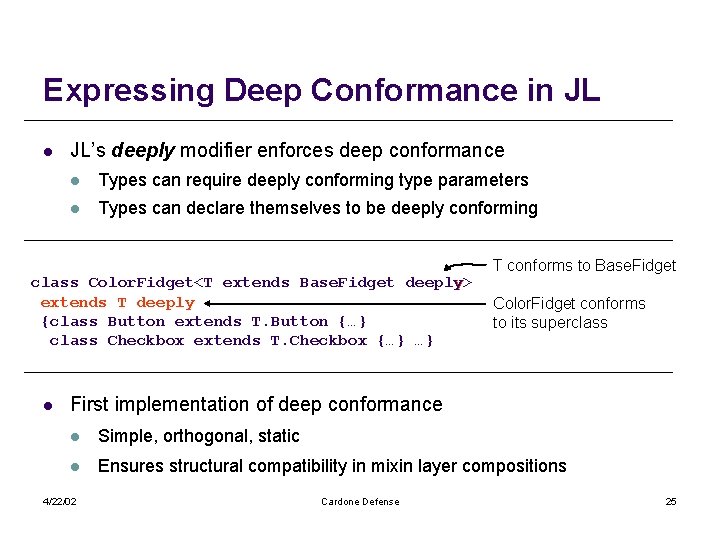
Expressing Deep Conformance in JL l JL’s deeply modifier enforces deep conformance l Types can require deeply conforming type parameters l Types can declare themselves to be deeply conforming class Color. Fidget<T extends Base. Fidget deeply> extends T deeply {class Button extends T. Button {…} class Checkbox extends T. Checkbox {…} …} l T conforms to Base. Fidget Color. Fidget conforms to its superclass First implementation of deep conformance l Simple, orthogonal, static l Ensures structural compatibility in mixin layer compositions 4/22/02 Cardone Defense 25
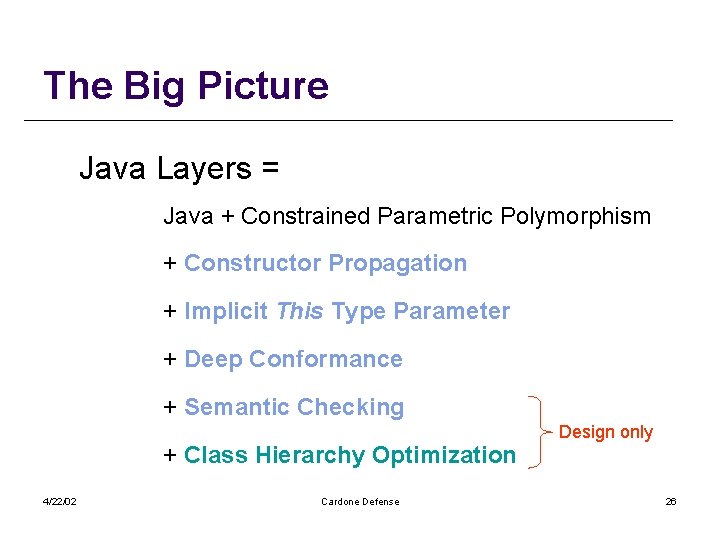
The Big Picture Java Layers = Java + Constrained Parametric Polymorphism + Constructor Propagation + Implicit This Type Parameter + Deep Conformance + Semantic Checking + Class Hierarchy Optimization 4/22/02 Cardone Defense Design only 26
Overview l Mixin Background l Contributions l Support for Mixin Programming l l 4/22/02 l Addressing complexity l Increasing expressiveness Evaluating Mixin Programming l Fidget: Building flexible widgets l ACE: Comparing OO frameworks Conclusion & Future Work Cardone Defense 27
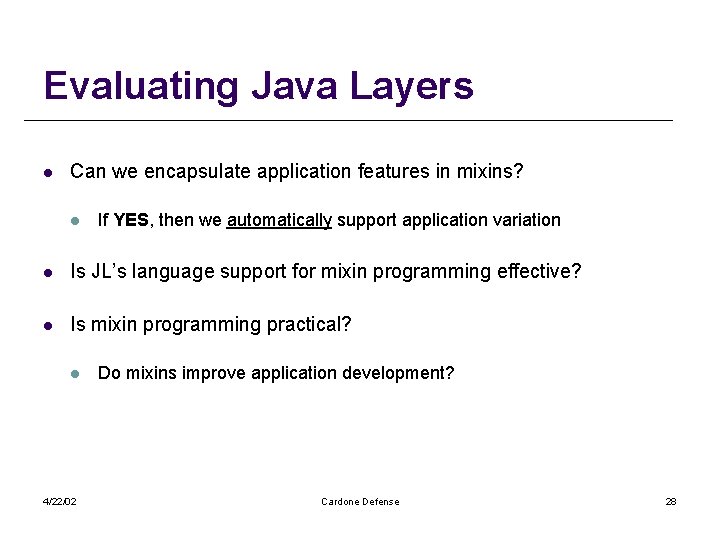
Evaluating Java Layers l Can we encapsulate application features in mixins? l If YES, then we automatically support application variation l Is JL’s language support for mixin programming effective? l Is mixin programming practical? l 4/22/02 Do mixins improve application development? Cardone Defense 28
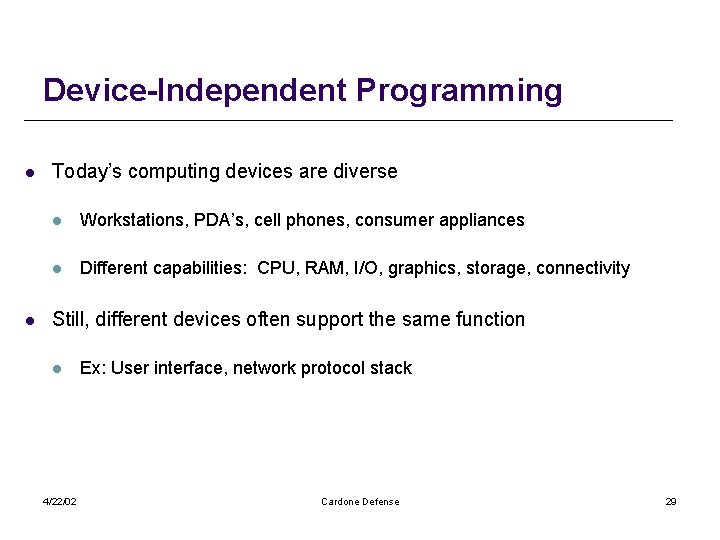
Device-Independent Programming l l Today’s computing devices are diverse l Workstations, PDA’s, cell phones, consumer appliances l Different capabilities: CPU, RAM, I/O, graphics, storage, connectivity Still, different devices often support the same function l 4/22/02 Ex: User interface, network protocol stack Cardone Defense 29
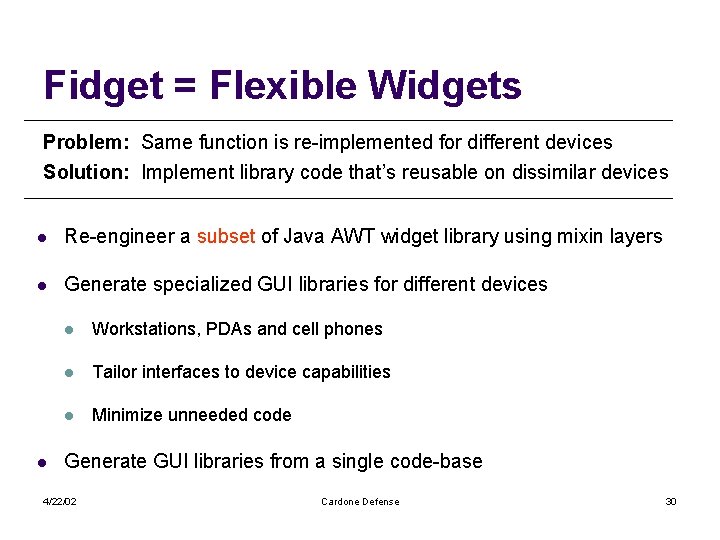
Fidget = Flexible Widgets Problem: Same function is re-implemented for different devices Solution: Implement library code that’s reusable on dissimilar devices l Re-engineer a subset of Java AWT widget library using mixin layers l Generate specialized GUI libraries for different devices l l Workstations, PDAs and cell phones l Tailor interfaces to device capabilities l Minimize unneeded code Generate GUI libraries from a single code-base 4/22/02 Cardone Defense 30
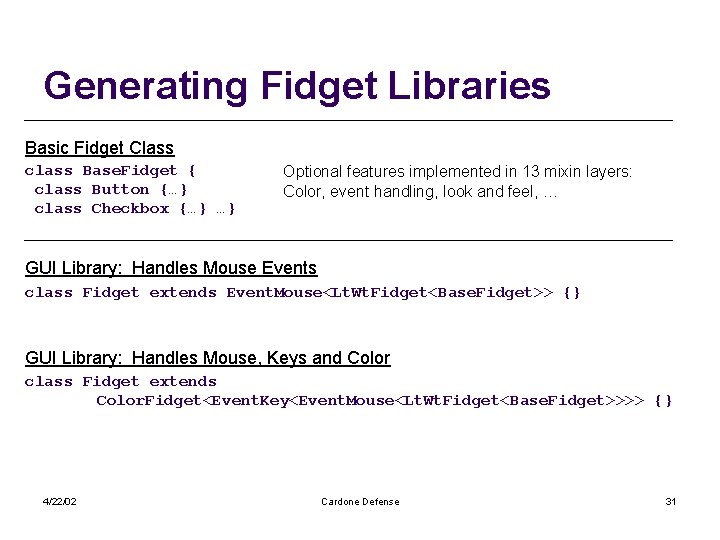
Generating Fidget Libraries Basic Fidget Class class Base. Fidget { class Button {…} class Checkbox {…} …} Optional features implemented in 13 mixin layers: Color, event handling, look and feel, … GUI Library: Handles Mouse Events class Fidget extends Event. Mouse<Lt. Wt. Fidget<Base. Fidget>> {} GUI Library: Handles Mouse, Keys and Color class Fidget extends Color. Fidget<Event. Key<Event. Mouse<Lt. Wt. Fidget<Base. Fidget>>>> {} 4/22/02 Cardone Defense 31
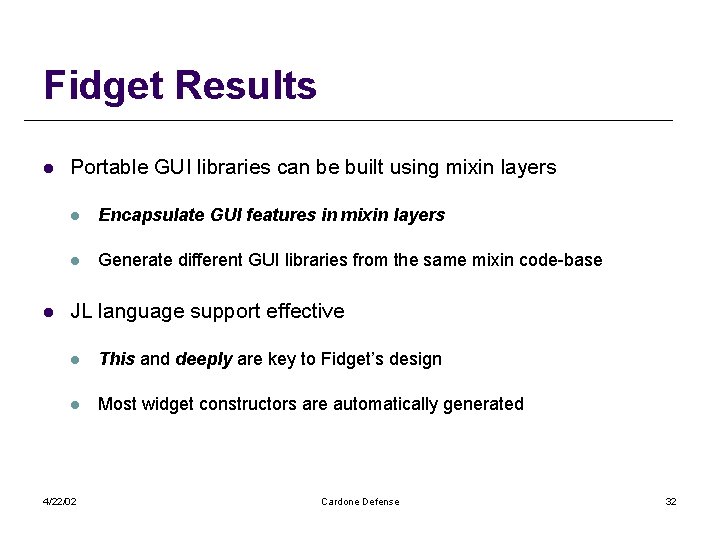
Fidget Results l l Portable GUI libraries can be built using mixin layers l Encapsulate GUI features in mixin layers l Generate different GUI libraries from the same mixin code-base JL language support effective l This and deeply are key to Fidget’s design l Most widget constructors are automatically generated 4/22/02 Cardone Defense 32
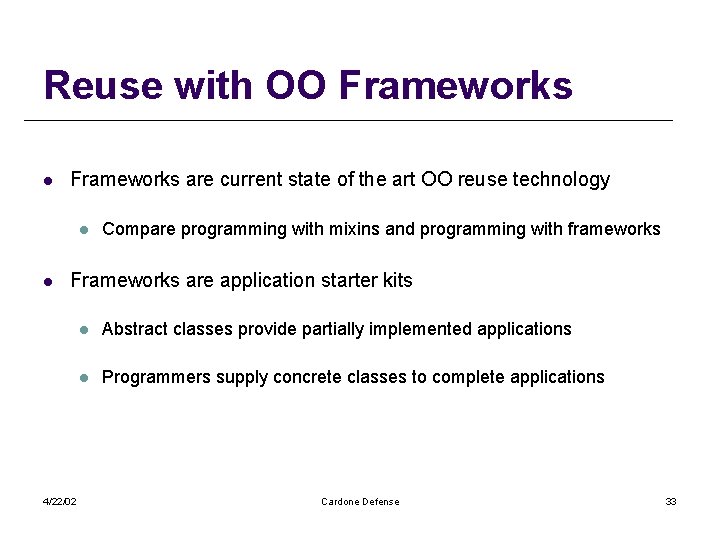
Reuse with OO Frameworks l Frameworks are current state of the art OO reuse technology l l Compare programming with mixins and programming with frameworks Frameworks are application starter kits 4/22/02 l Abstract classes provide partially implemented applications l Programmers supply concrete classes to complete applications Cardone Defense 33
The ACE Framework l Schmidt’s Adaptive Communication Environment (ACE) l C++ client/server application framework l Proven, mature OO framework technology l 4/22/02 More than 60 commercial and academic applications Cardone Defense 34
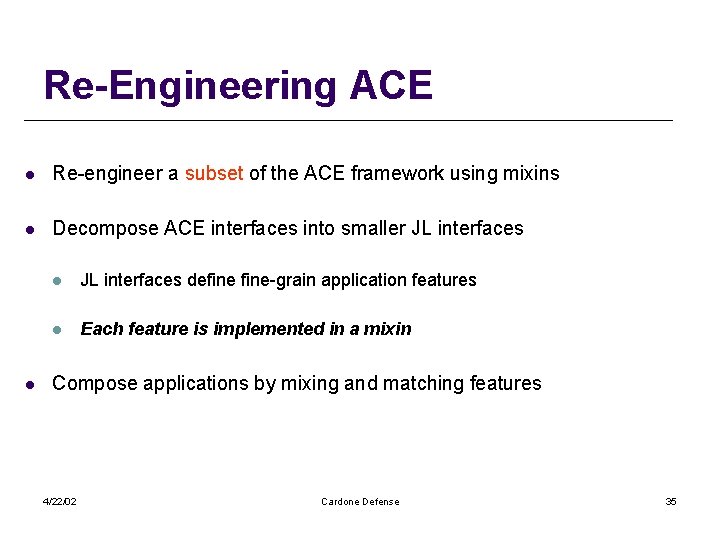
Re-Engineering ACE l Re-engineer a subset of the ACE framework using mixins l Decompose ACE interfaces into smaller JL interfaces l l JL interfaces define-grain application features l Each feature is implemented in a mixin Compose applications by mixing and matching features 4/22/02 Cardone Defense 35
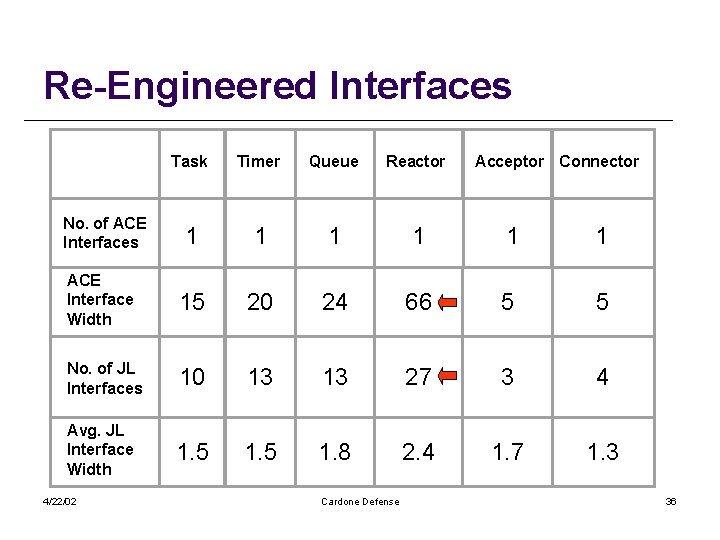
Re-Engineered Interfaces Task Timer Queue Reactor No. of ACE Interfaces 1 1 1 ACE Interface Width 15 20 24 66 5 5 No. of JL Interfaces 10 13 13 27 3 4 Avg. JL Interface Width 1. 5 1. 8 2. 4 1. 7 1. 3 4/22/02 Cardone Defense Acceptor Connector 36
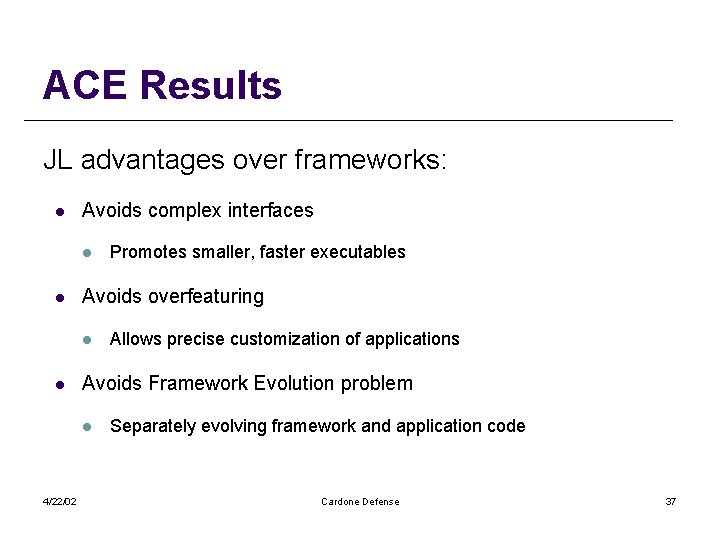
ACE Results JL advantages over frameworks: l Avoids complex interfaces l l Avoids overfeaturing l l Allows precise customization of applications Avoids Framework Evolution problem l 4/22/02 Promotes smaller, faster executables Separately evolving framework and application code Cardone Defense 37
Related Work l CLOS mixin classes use multiple inheritance [Moon, 1986; Keene, 1989] l Mixins defined as abstract subclasses [Bracha & Cook, 1990] l Useful in single inheritance languages l Mixins are reusable software components [Van. Hilst & Notkin, 1996] l Mixin Layers simplify mixin composition [Smaragdakis & Batory, 1998] l 4/22/02 Encapsulate features that crosscut multiple classes Cardone Defense 38
Conclusion l Designed/Implemented novel support for mixin programming [Cardone & Lin, ICSE 2001], [Cardone, Brown, Mc. Dirmid & Lin, AOSD 2002] l Integrated mixin support into a conventional OO language l l Implementation lessons described in thesis Demonstrated benefits of mixin programming over current techniques [Batory, Cardone & Smaragdakis, SPLC 2000] Specialized language and compiler support make mixins a practical reuse technology 4/22/02 Cardone Defense 39
Future Work l Build real-world applications using mixins l Implement a JL-to-bytecode compiler l l Implement Semantic Checking and Class Hierarchy Optimization l Explore different Java bytecode representations for mixins Explore generative programming l 4/22/02 What compile-time code transformations should be supported? Cardone Defense 40
The End www. cs. utexas. edu/users/richcar/Java. Layers. html 4/22/02 Cardone Defense 41
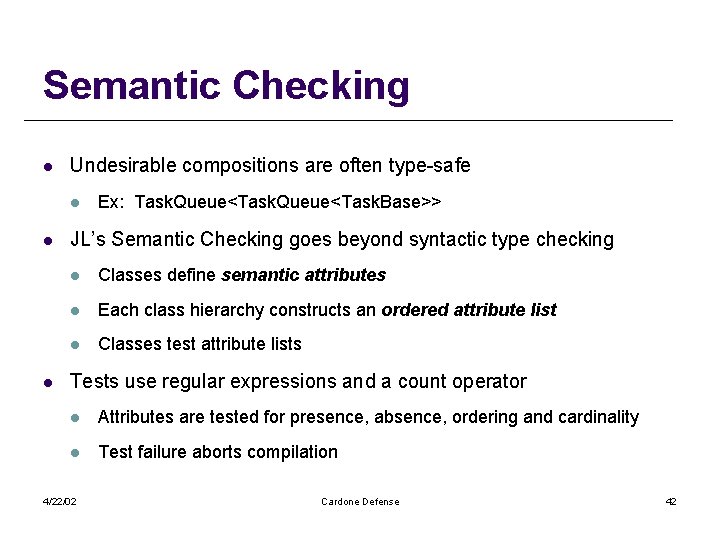
Semantic Checking l Undesirable compositions are often type-safe l l l Ex: Task. Queue<Task. Base>> JL’s Semantic Checking goes beyond syntactic type checking l Classes define semantic attributes l Each class hierarchy constructs an ordered attribute list l Classes test attribute lists Tests use regular expressions and a count operator l Attributes are tested for presence, absence, ordering and cardinality l Test failure aborts compilation 4/22/02 Cardone Defense 42
Semantic Checking Contributions l JL’s Semantic Checking is: l Simple l Static l Orthogonal l Expressive (so far) [Batory 97] l Designed, but not implemented 4/22/02 Cardone Defense 43
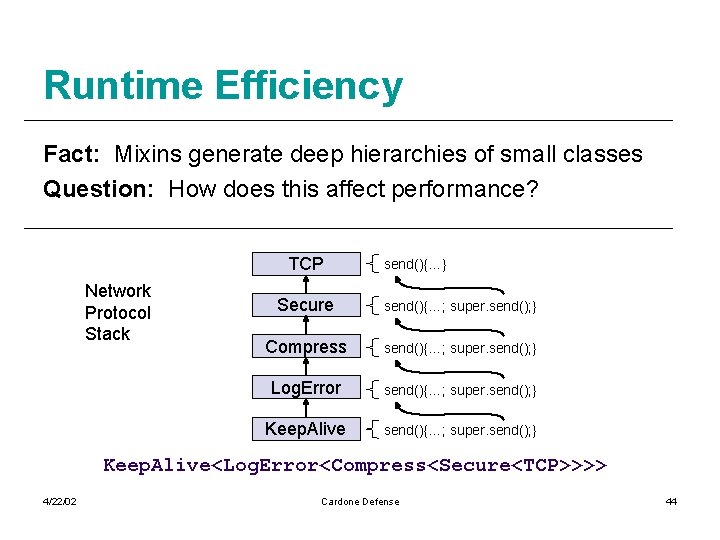
Runtime Efficiency Fact: Mixins generate deep hierarchies of small classes Question: How does this affect performance? TCP Network Protocol Stack send(){…} Secure send(){…; super. send(); } Compress send(){…; super. send(); } Log. Error send(){…; super. send(); } Keep. Alive<Log. Error<Compress<Secure<TCP>>>> 4/22/02 Cardone Defense 44
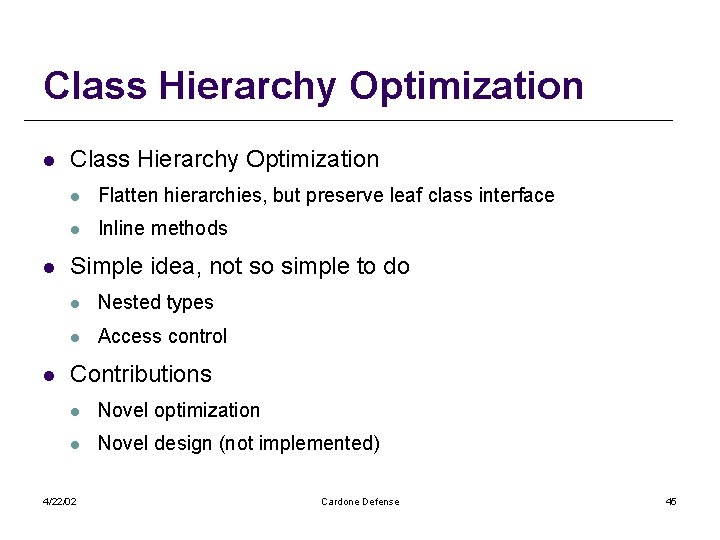
Class Hierarchy Optimization l l l Class Hierarchy Optimization l Flatten hierarchies, but preserve leaf class interface l Inline methods Simple idea, not so simple to do l Nested types l Access control Contributions l Novel optimization l Novel design (not implemented) 4/22/02 Cardone Defense 45
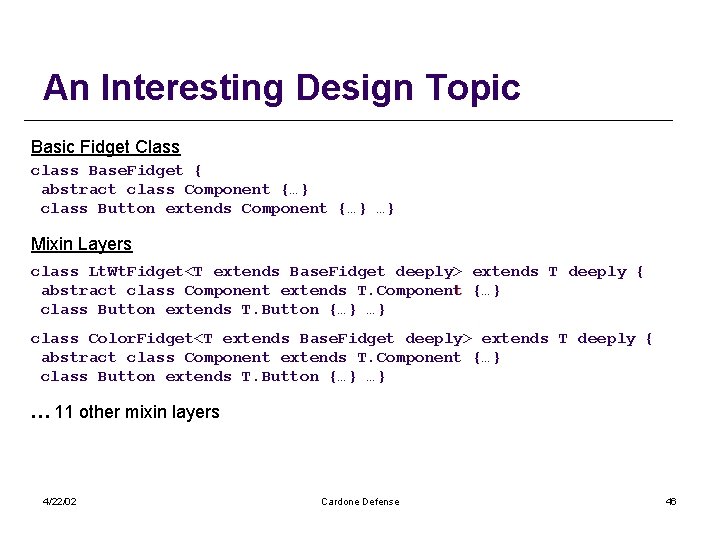
An Interesting Design Topic Basic Fidget Class class Base. Fidget { abstract class Component {…} class Button extends Component {…} …} Mixin Layers class Lt. Wt. Fidget<T extends Base. Fidget deeply> extends T deeply { abstract class Component extends T. Component {…} class Button extends T. Button {…} …} class Color. Fidget<T extends Base. Fidget deeply> extends T deeply { abstract class Component extends T. Component {…} class Button extends T. Button {…} …} … 11 other mixin layers 4/22/02 Cardone Defense 46
Building Fidget Libraries Color. Fidget<Lt. Wt. Fidget<Base. Fidget>> Base. Fidget Lt. Wt. Fidget Color. Fidget 4/22/02 Component Button . . . Cardone Defense 47
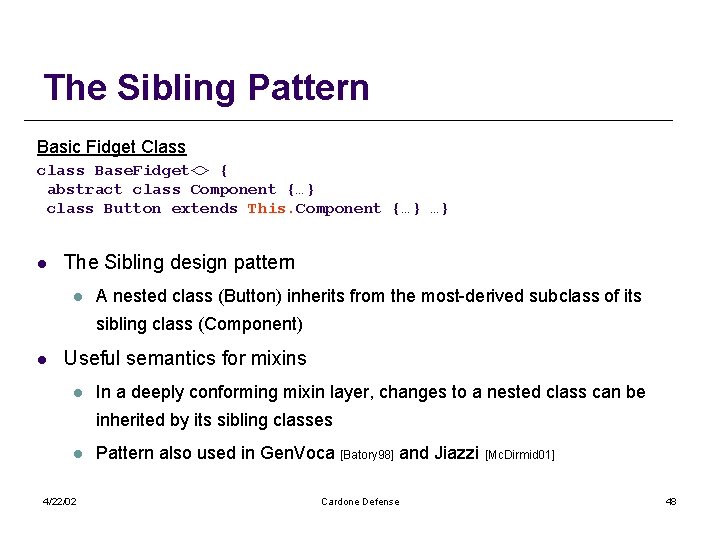
The Sibling Pattern Basic Fidget Class class Base. Fidget<> { abstract class Component {…} class Button extends This. Component {…} …} l The Sibling design pattern l A nested class (Button) inherits from the most-derived subclass of its sibling class (Component) l Useful semantics for mixins l In a deeply conforming mixin layer, changes to a nested class can be inherited by its sibling classes l 4/22/02 Pattern also used in Gen. Voca [Batory 98] and Jiazzi [Mc. Dirmid 01] Cardone Defense 48
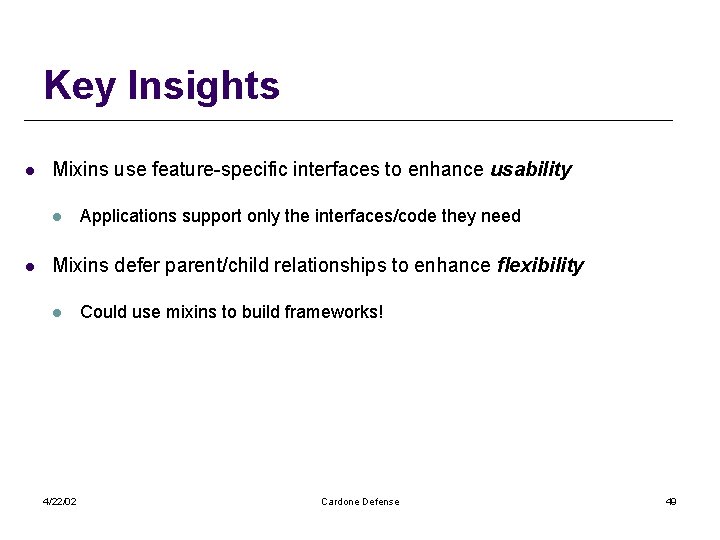
Key Insights l Mixins use feature-specific interfaces to enhance usability l l Applications support only the interfaces/code they need Mixins defer parent/child relationships to enhance flexibility l 4/22/02 Could use mixins to build frameworks! Cardone Defense 49
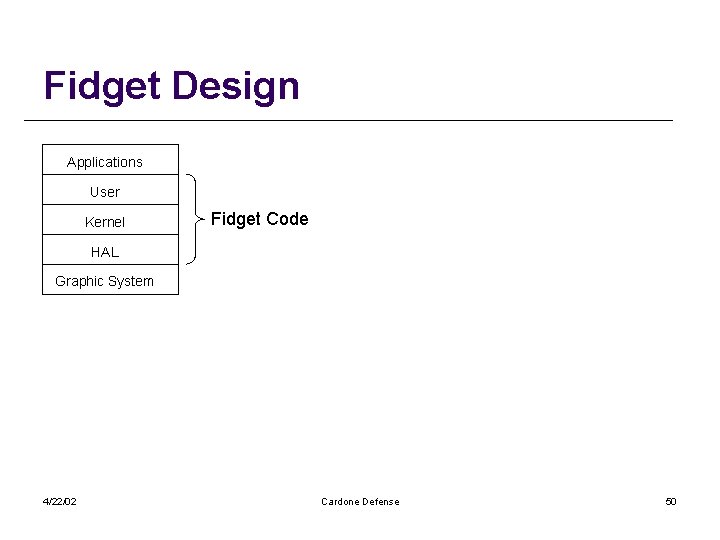
Fidget Design Applications User Kernel Fidget Code HAL Graphic System 4/22/02 Cardone Defense 50