
Language and Cognitive Science By Holly Cummings Elizabeth
Language and Cognitive Science By: Holly Cummings, Elizabeth Ray, and Lindsay Hines
What is Language? • Function – thought expression – means of communication • Properties – – – communicative arbitrary (except for onomatopoeia) self-referent (metalanguage) dynamic human trait only (oral speech) • Sources: http: //peace. saumag. edu/faculty/kardas/Courses/Learning/language. html
Language and the Brain • Where is Language Processed? – Broca’s Area and Wernicke’s Area • right-handed- 97% chance processed in left hemisphere • left-handed- 68% chance processed in left hemisphere, 19% chance processed in right hemisphere, 13% chance processed in both • Sources: http: //www. ccunix. ccu. edu. tw/~lngmyers/Lx_Brain. txt
Composition of Language I • What is language composed of? – phones- a speech sound considered without reference to its status as a phoneme or an allophone in a language – phonemes- the smallest phonetic unit in a language that is capable of conveying a distinction in meaning – phonemonics- the study of the sound system of a given language and the analysis and classification of its phonemes • Sources: http: //peace. saumag. edu/faculty/kardas/Courses/Learning/language. html http: //www. dictionary. com
Composition of Language II • What is language composed of ? – morphemes- a meaningful linguistic unit consisting of a word, or a word element, that cannot be divided into smaller meaningful parts – lexicon- the morphemes of a language considered as a group – vocabulary- the sum of words used by, understood by, or at the command of a particular person or group • Sources: http: //peace. saumag. edu/faculty/kardas/Courses/Learning/language. html http: //www. dictionary. com
Composition of Language III • What is language composed of? – syntax- the study of the rules whereby words or other elements of a sentence structure are combined to form grammatical sentences (predicate, prepositional phrase. . etc) • ex) “Mary is going to Bob’s house for Thanksgiving dinner. ” • Sources: http: //peace. saumag. edu/faculty/kardas/Courses/Learning/language. html http: //www. dictionary. com
Language Acquisition • Prenatal – response to human voices • Postnatal – – – cooing babbling one-word utterances (around 1 st birthday) ex) “mama” two-word utterances (18 mos. ) ex) “Big truck” fluent sentences (late twos and mid threes) • Sources: http: //peace. saumag. edu/faculty/kardas/Courses/Learning/language. html http: //www. cogsci. soton. ac. uk/~harnad/Papers/Py 104/Pinker. langacq. html
How does Language Acquisition Occur? • Learnability Theory- defines learning language as a scenario involving four parts (Gold, 1967; Osherson, Stob & Weinstein, ) – – a class of languages an environment a learning strategy a success criterion • Sources: http: //peace. saumag. edu/faculty/kardas/Courses/Learning/language. html http: //www. cogsci. soton. ac. uk/~harnad/Papers/Py 104/Pinker. langacq. html

Language and Its Meaning • Semantics- the study of the relationships between signs and symbols and what they represent. The meaning or the interpretation of a word, sentence or other language form. • Theories of Meaning – Definitional Theory – Prototype Theory • Sources: http: //peace. saumag. edu/faculty/kardas/Courses/Learning/language. html http: //www. dictionary. com
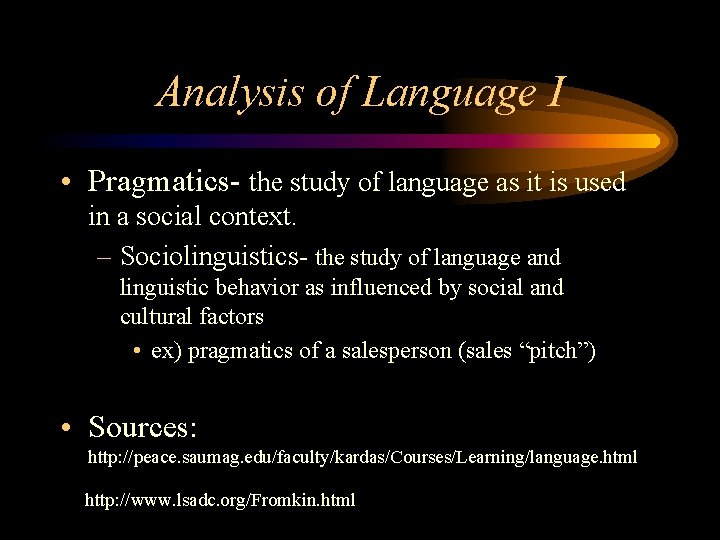
Analysis of Language I • Pragmatics- the study of language as it is used in a social context. – Sociolinguistics- the study of language and linguistic behavior as influenced by social and cultural factors • ex) pragmatics of a salesperson (sales “pitch”) • Sources: http: //peace. saumag. edu/faculty/kardas/Courses/Learning/language. html http: //www. lsadc. org/Fromkin. html
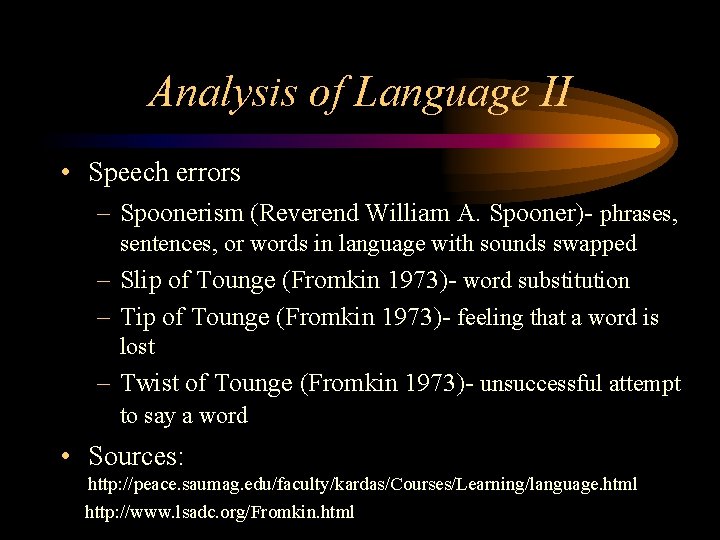
Analysis of Language II • Speech errors – Spoonerism (Reverend William A. Spooner)- phrases, sentences, or words in language with sounds swapped – Slip of Tounge (Fromkin 1973)- word substitution – Tip of Tounge (Fromkin 1973)- feeling that a word is lost – Twist of Tounge (Fromkin 1973)- unsuccessful attempt to say a word • Sources: http: //peace. saumag. edu/faculty/kardas/Courses/Learning/language. html http: //www. lsadc. org/Fromkin. html
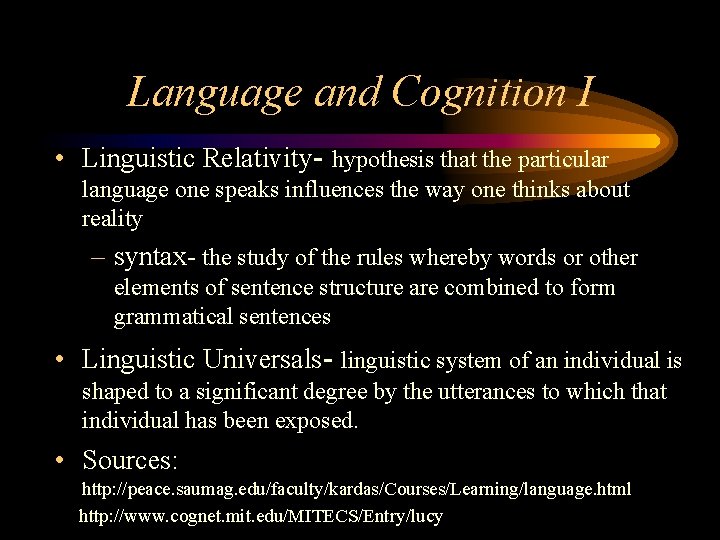
Language and Cognition I • Linguistic Relativity- hypothesis that the particular language one speaks influences the way one thinks about reality – syntax- the study of the rules whereby words or other elements of sentence structure are combined to form grammatical sentences • Linguistic Universals- linguistic system of an individual is shaped to a significant degree by the utterances to which that individual has been exposed. • Sources: http: //peace. saumag. edu/faculty/kardas/Courses/Learning/language. html http: //www. cognet. mit. edu/MITECS/Entry/lucy
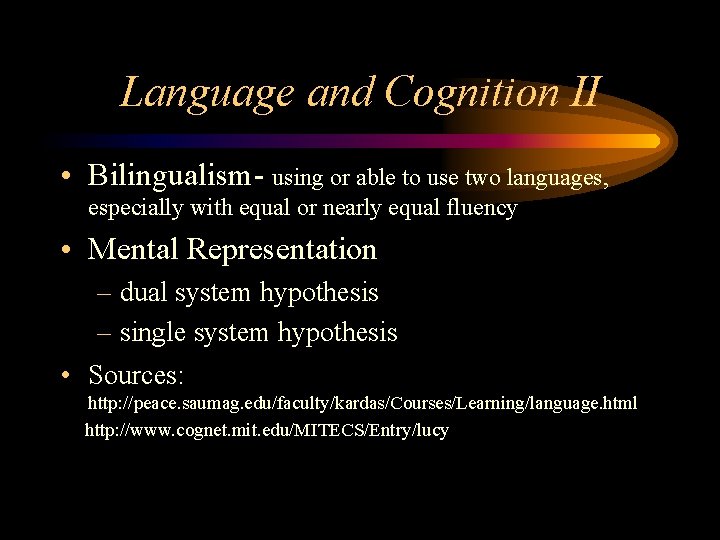
Language and Cognition II • Bilingualism- using or able to use two languages, especially with equal or nearly equal fluency • Mental Representation – dual system hypothesis – single system hypothesis • Sources: http: //peace. saumag. edu/faculty/kardas/Courses/Learning/language. html http: //www. cognet. mit. edu/MITECS/Entry/lucy
Language Pathologies I • Aphasia- denotes a class of acquired language disorders – Broca’s aphasia – Wernicke’s aphasia • Sources: http: //www. hfac. uh. edu/COGSCI/lang/pathologies. html
Language Pathologies II • Disfluency- stammering, stuttering, and cluttering; excessive speed of delivery of speech • Agnosia- ability to perceive sounds is intact while the ability to recognize them is impaired • Aphonia- involves a complete loss of voice and may be organic or functional • Sources: http: //www. hfac. uh. edu/COGSCI/lang/pathologies. html

Thank you for listening to our presentation! Do you have any questions?
- Slides: 16