
Language and brain Contents Language and the brain
Language and brain
Contents • Language and the brain • Aphasia
Language and the brain
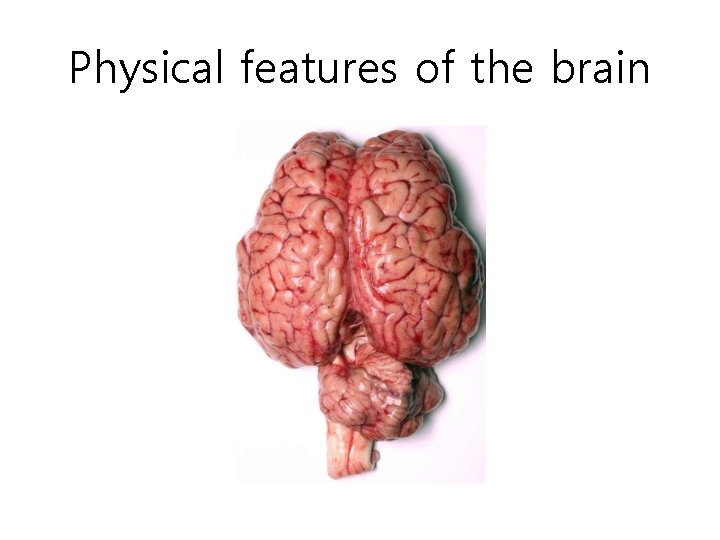
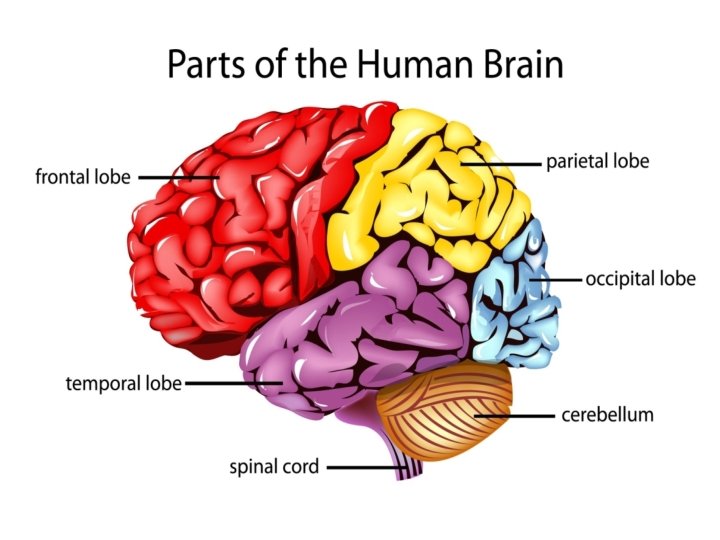
Physical features of the brain
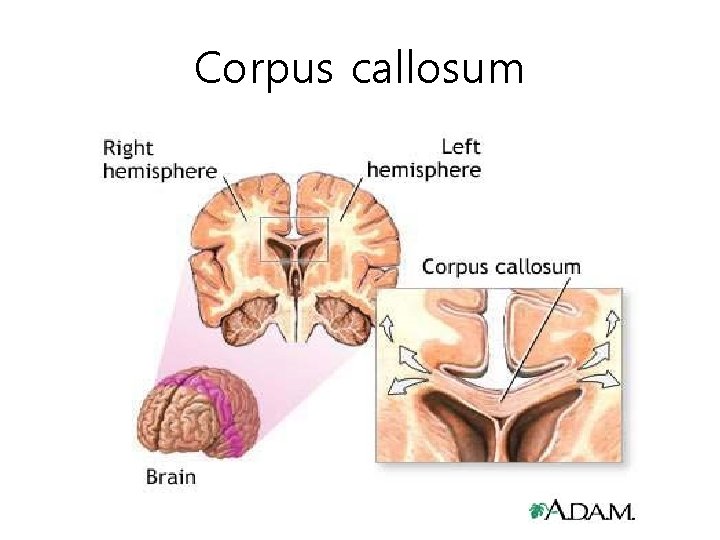
Corpus callosum
Cortex • The brain is covered by a one-quarterinch think membrane called the cortex. • It makes human beings capable of higher cognitive functions (e. g. math, language) • Its development was one of the primary evolutionary changes that separated us from other animals.
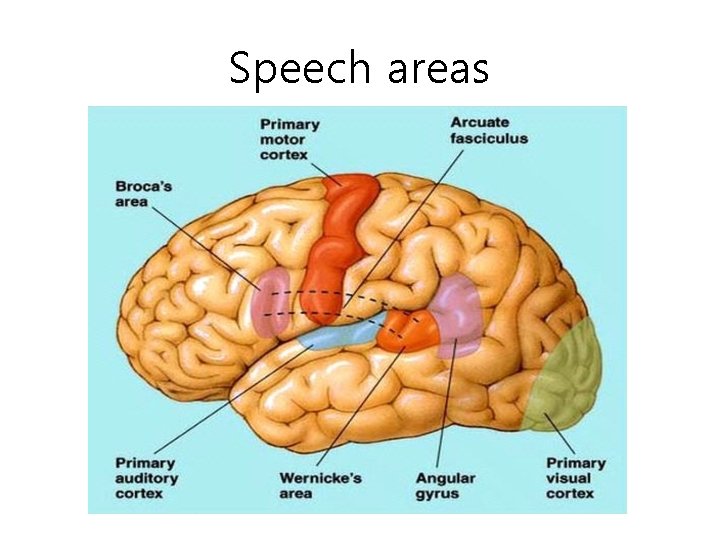
Speech areas
Language centers • Only in one hemisphere in most cases • Broca’s area – Organize the articulatory patterns of language and direct the motor cortex when we want to talk – Mainly responsible for language production • Wernicke’s area – Comprehension of words and sentences and the selection of words from the mental lexicon when producing sentences – Largely responsible for language perception and comprehension • Arcuate fasciculus – A bundle of nerve fibers connecting the two areas above to share information • Angular gyrus – Converts visual stimuli into auditory stimuli (and vice versa)
The flow of linguistic information • When producing a spoken word – Wernicke’s area • Activated when accessing the lexicon; interprets lexical entry – Arcuate fasciculus • Phonetic information sent from Wernicke’s area to Broca’s area – Broca’s area • Interprets information received from arcuate fasciculus; transmits articulatory information to motor cortex – Motor cortex • Directs movement of muscles for articulation
The flow of linguistic information • When hearing a word – Auditory cortex • Processes information perceived by ears – Wernicke’s area • Interprets auditory stimulus and matches information to a lexical entry
The flow of linguistic information • When reading a word – Visual cortex • Processes information perceived by eyes – Angular gyrus • Associates written form of word with lexical entry – Wernicke’s area • Activated during lexical access; makes available the meaning and pronunciation of word
Lateralization • The feature of the brain that each hemisphere is responsible for different cognitive functions • Left hemisphere – Analytic reasoning, temporal ordering, arithmetic, language processing, etc. • Right hemisphere – Processing music, perceiving nonlinguistic sounds, performing tasks that require visual and spatial skills or pattern recognition
Contralateralization • The connections between the brain and the body are almost completely contralateral, which means that the right side of the body is controlled by the left hemisphere, while the left side of the body is controlled by the right hemisphere.
Aphasia
What is aphasia? • An inability to perceive, process, or produce language because of physical damage to the brain
Broca’s aphasia http: //www. youtube. com/watch? v=f 2 Ii. MEb. Mn. PM • Incapable of planning the motor sequences used in speech or sign • Example Examiner: Tell me, what did you do before you retired? Aphasic: Uh, uh, pub, partender, no. Examiner: Carpenter? Aphasic: [nodding] Carpenter, tuh, tenty year.
Wernicke’s aphasia http: //www. youtube. com/watch? v=a. Vh. YN 7 NTIKU • Unable to interpret what others say and respond properly • Tends to produce semantically incoherent speech • Example Examiner: Do you like it here in Kansas City? Aphasic: Yes, I am. Examiner: I’d like to have you tell me something about your problem. Aphasic: Yes, I, ugh, can’t hill all of my way. I can’t talk all of the things I do, and part of the part I can go all right, but I can’t tell from the other people. I usually most of my things. I know what can I talk and know what they are, but I can’t always come back even though I know they should be in, and I know should something eely I should know what I’m doing …
Conduction aphasia • Damage to the arcuate fasciculus • Conduction aphasics sound something like a Wernicke’s aphasic (fluent but meaningless speech) but shows signs of being able to comprehend the speech of others.
But!! • “There is little evidence … for a simplistic association of production problems (only) with Broca’s area, and comprehension problems (only) with Wernicke’s area. Although there are obvious links of Broca’s are with speech production, and of Wernicke’s area with reception and perception, grammar clearly does not ‘live’ in one of these regions and vocabulary in another. ” (Mc. Mahon & Mc. Mahon 2012: 129)

Any questions or comments?
- Slides: 21