
LANGUAGE ACQUISITION LI 2023 NATHALIE F MARTIN References






- Slides: 59
LANGUAGE ACQUISITION LI 2023 NATHALIE F. MARTIN
References References: Language files (7 th ed). Cipollone, Keiser & Vasishth Contemporary Linguistic Analysis (5 th ed) O’Grady & Archibald http: //www. ling. upenn. edu/courses/ ling 001/acquisition. html
Introduction Language acquisition is the process by which the language capability _____ in a human. First language acquisition concerns the development of language in _____ , while second language acquisition focuses on language development in _____ as well
Introduction Opinion According to you, what does a child need to learn in order to “know” his or her language?
Three general theories of language acquisition: 1. 2. 3. 4. Innateness Theory Imitation Theory Reinforcement Theory Interactionist Theory (or Constructivism)
Introduction Opinion According to you, how does a child learn a language?
Theories of language acquisition INNATENESS THEORY Children have the _____ to differentiate phonemes, extract words from the stream of language, and process grammar. Rowe & Levine (2012). A Concise Introduction to Linguistics, p. 237.
Theories of language acquisition IMITATION THEORY Children learn grammar by _____ the words and sentences of their language Problems with this theory: Children produce many things that are not found in _________ Children make consistent ______that cannot be attributed to mispronunciation and which still are not ever heard in the adult grammar. Children can produce and understand _____
Theories of language acquisition REINFORCEMENT THEORY Children learn to speak like adults because they are taught to do so: Through _____ and _____ when speaking “correctly”. Through _____ when making “mistakes” Problems with this theory: Adults don't seem to correct children's grammar as much as we might think, neither do they praise them for using proper adult grammatical constructions. There is little evidence that reinforcement has any great effect on the language development of the child
Theories of language acquisition INTERACTIONIST THEORY Children "invent" the rules of grammar for themselves Though it is based on the _________ Innate ability to _________ Only approach that explains how children Produce _________ Ex: Past tense - goed* or hitted* Generate ______that they have never heard Seem almost impervious to correction from adults
Theories of language acquisition INTERACTIONIST THEORY Irregular verbs acquisition - Past tense: Children acquire some irregular past tense forms quite early through memorization Then the child starts to notice a general “rule” for past tense formation This results in _______(ex: goed*) Finally the child realizes that “went” is an _____
Aspects of Language Acquisition Phonetic development Phonological development Morphological development Syntactic development Semantic development
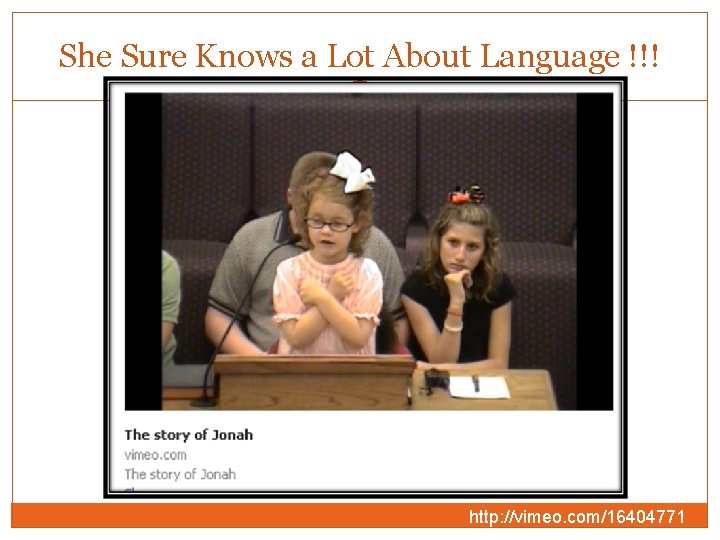
She Sure Knows a Lot About Language !!! http: //vimeo. com/16404771
Introduction Questions What does one need to learn in order to learn a language? When do you think an individual begins learning language?
Acquisition: PHONETICS
Aspects of Language Acquisition Phonetic Acquisition Beginning to learn language involves: Learning how to _____ the necessary speech sounds Learning to _____ make sense of the speech sounds Ex: Figuring out what are the phones & _____ of one's language
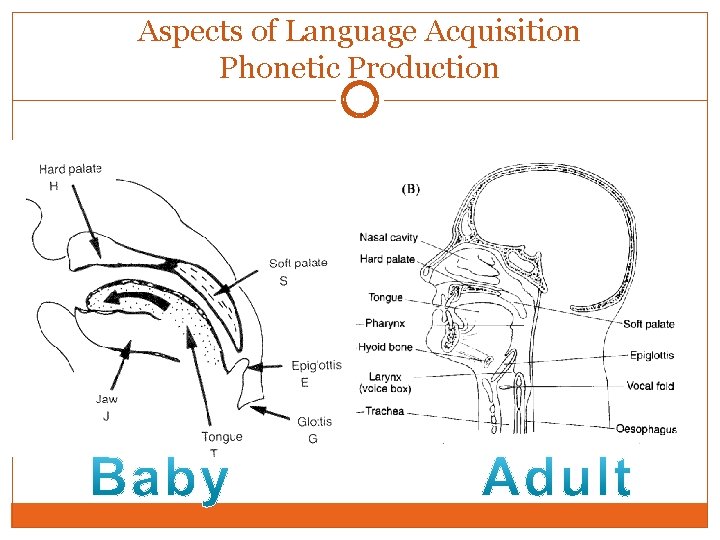
Aspects of Language Acquisition Phonetic Production
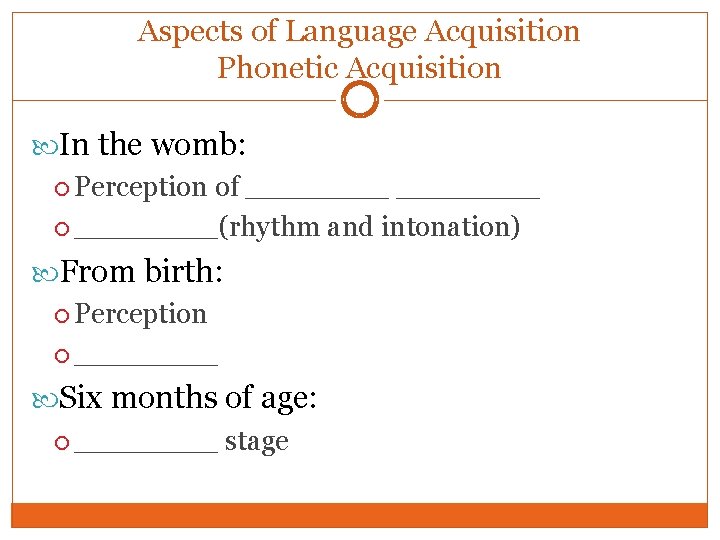
Aspects of Language Acquisition Phonetic Acquisition In the womb: Perception of ________ ____(rhythm and intonation) From birth: Perception ____ Six months of age: ____ stage
Vocalization (Cooing) For an example of a baby vocalization/cooing: http: //www. youtube. com/watch? v=b. Ku_r. Us. IPHM &feature=related
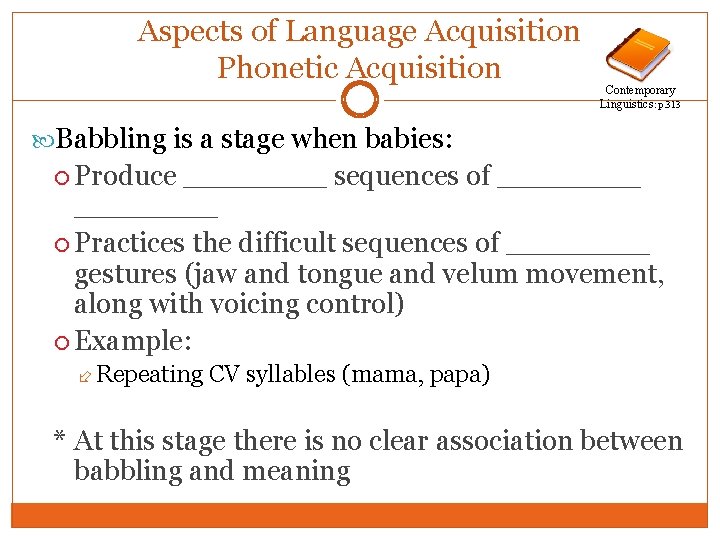
Aspects of Language Acquisition Phonetic Acquisition Contemporary Linguistics: p. 313 Babbling is a stage when babies: Produce ____ sequences of ________ Practices the difficult sequences of ____ gestures (jaw and tongue and velum movement, along with voicing control) Example: Repeating CV syllables (mama, papa) * At this stage there is no clear association between babbling and meaning
Babbling For an example of babbling: Vowels: http: //www. youtube. com/watch? v=0 DDZb. Q_ OJWw Syllables: http: //www. youtube. com/watch? v=7 Rq. UTJAf y 48&feature=related http: //www. youtube. com/watch? v=NZw 2 Nsqk FBo&feature=related
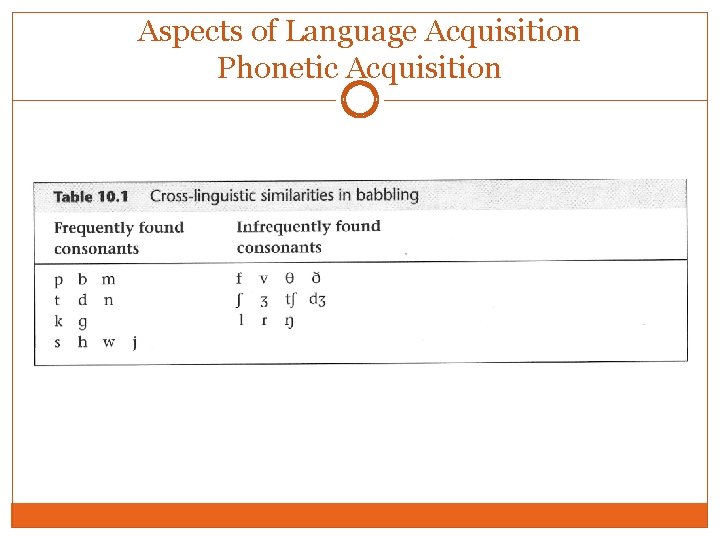
Aspects of Language Acquisition Phonetic Acquisition
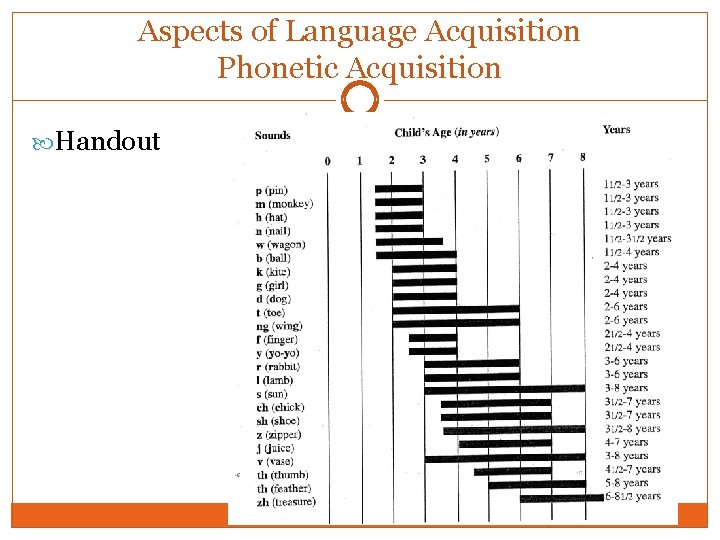
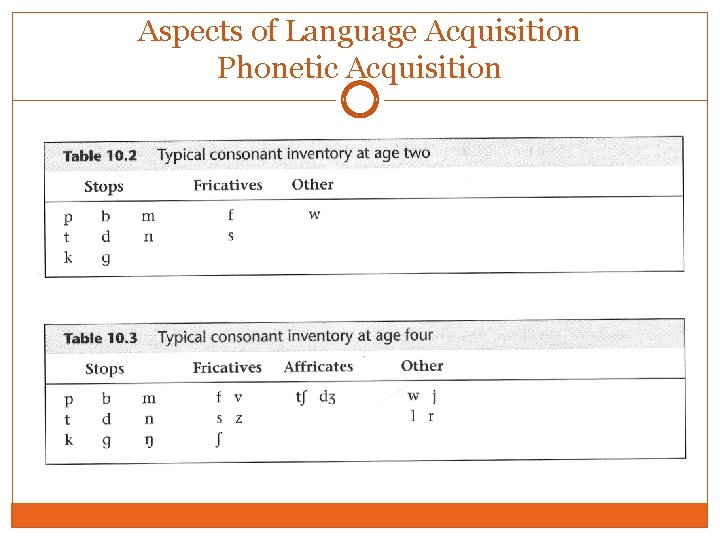
Difficult sounds Analysis Why do you think certain sounds are easier to produce for children? What makes a sound hard to pronounce? What about allophones?
Aspects of Language Acquisition Phonetic Acquisition Handout
Aspects of Language Acquisition Phonetic Acquisition
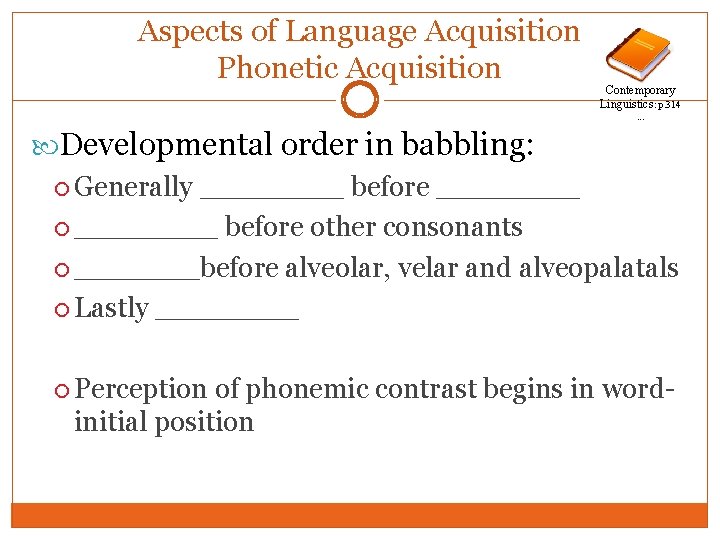
Aspects of Language Acquisition Phonetic Acquisition Contemporary Linguistics: p. 314. . . Developmental order in babbling: Generally ____ before ________ before other consonants _______before alveolar, velar and alveopalatals Lastly ____ Perception of phonemic contrast begins in word- initial position
Acquisition: PHONOLOGY
Experiments on Babies Research on how infants acquire language in a video featuring Toby Mintz, associate professor of psychology and linguistics at the USC College of Letters, Arts & Sciences, and USC College undergraduate Ashlee Welday. http: //www. youtube. com/watch? v=m. ZAu. Z--Yeqo
Aspects of Language Acquisition Phonological Acquisition 18 months: Link between sound and _____ Memorizes single words as chunks and not pay much attention to _____ differences Ex: doesn’t necessarily understand that /b/ and /d/ are different phonemes in English
Aspects of Language Acquisition Phonological Acquisition Later phonological acquisition: Perception of phonemic _____ Perception of CV & _______ structure Understanding of _____ Babies naturally delete unstressed syllables in words. For example: “nana” [n. Any] for “banana” [ben. Any]
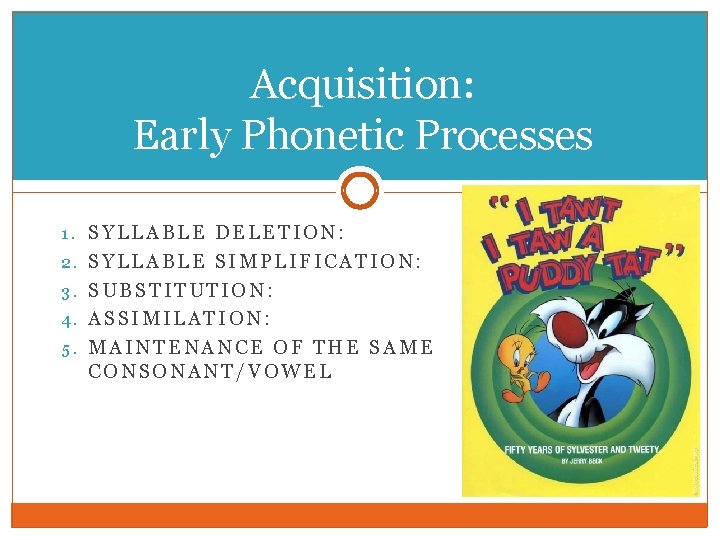
Acquisition: Early Phonetic Processes 1. SYLLABLE DELETION: 2. SYLLABLE SIMPLIFICATION: 3. SUBSTITUTION: 4. ASSIMILATION: 5. MAINTENANCE OF THE SAME CONSONANT/VOWEL
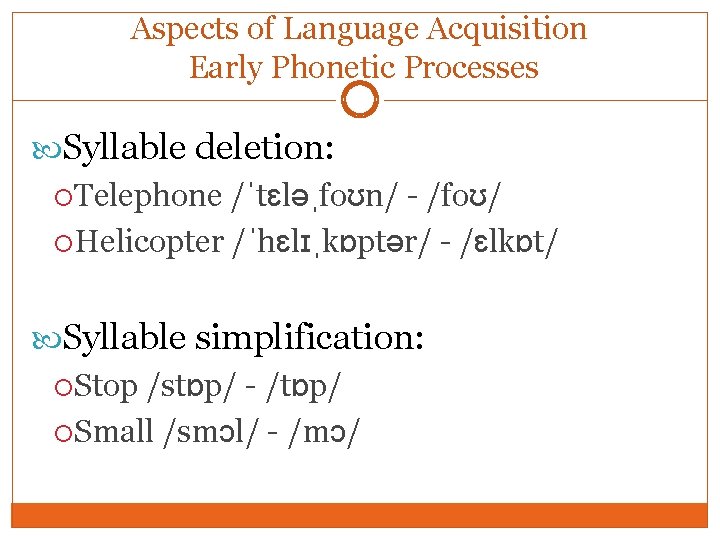
Aspects of Language Acquisition Early Phonetic Processes Syllable deletion: Telephone /ˈtɛləˌfoʊn/ - /foʊ/ Helicopter /ˈhɛlɪˌkɒptər/ - /ɛlkɒt/ Syllable simplification: Stop /stɒp/ - /tɒp/ Small /smɔl/ - /mɔ/
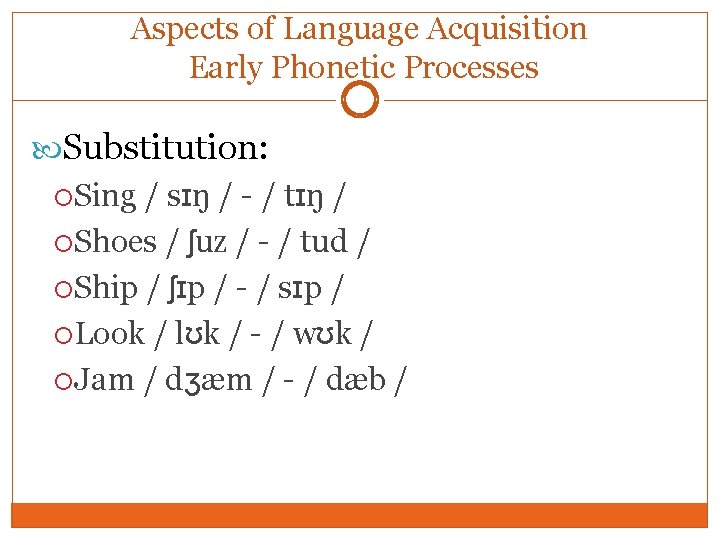
Aspects of Language Acquisition Early Phonetic Processes Substitution: Sing / sɪŋ / - / tɪŋ / Shoes / ʃuz / - / tud / Ship / ʃɪp / - / sɪp / Look / lʊk / - / wʊk / Jam / dʒæm / - / dæb /
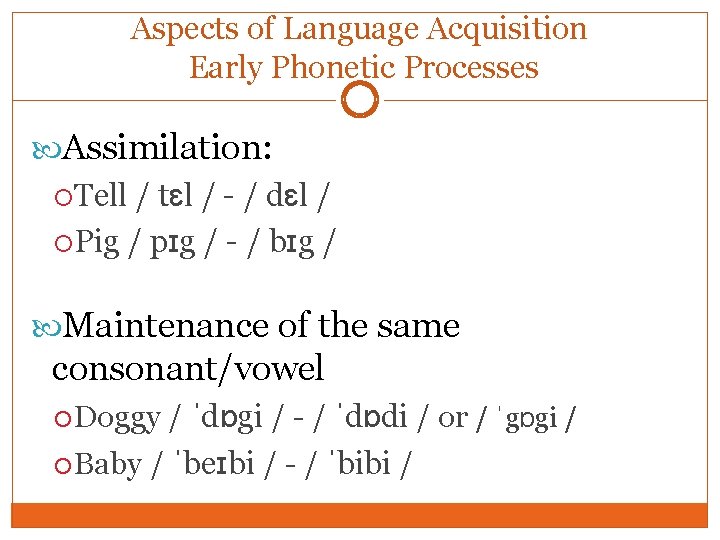
Aspects of Language Acquisition Early Phonetic Processes Assimilation: Tell / tɛl / - / dɛl / Pig / pɪg / - / bɪg / Maintenance of the same consonant/vowel Doggy / ˈdɒgi / - / ˈdɒdi / or / ˈgɒgi / Baby / ˈbeɪbi / - / ˈbibi /
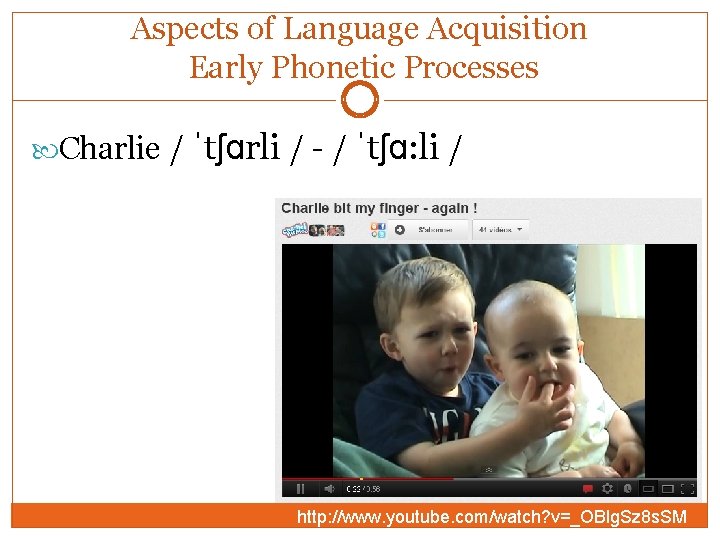
Aspects of Language Acquisition Early Phonetic Processes Charlie / ˈtʃɑrli / - / ˈtʃɑ: li / http: //www. youtube. com/watch? v=_OBlg. Sz 8 s. SM
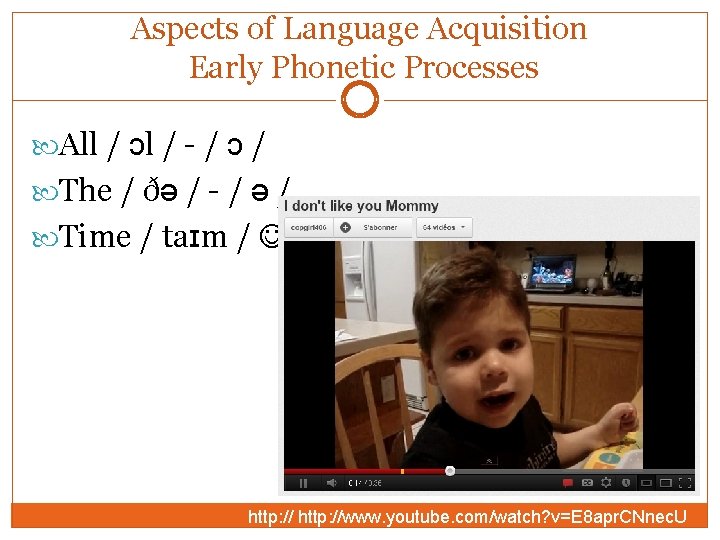
Aspects of Language Acquisition Early Phonetic Processes All / ɔl / - / ɔ / The / ðə / - / ə / Time / taɪm / http: //www. youtube. com/watch? v=E 8 apr. CNnec. U
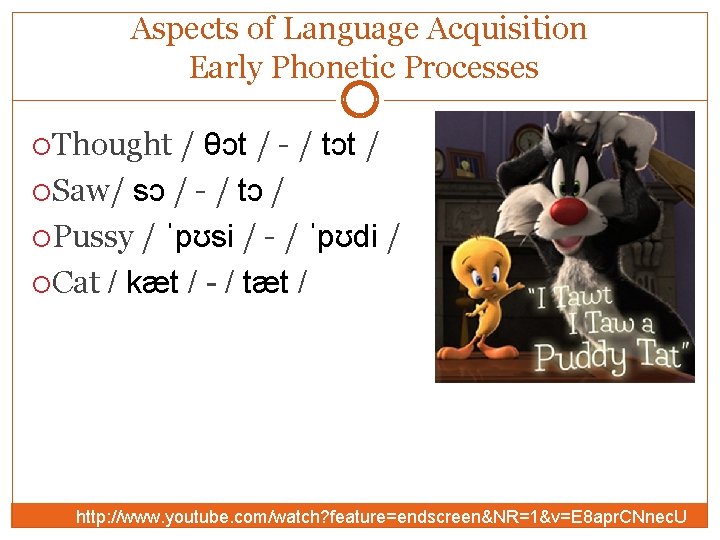
Aspects of Language Acquisition Early Phonetic Processes Thought / θɔt / - / tɔt / Saw/ sɔ / - / tɔ / Pussy / ˈpʊsi / - / ˈpʊdi / Cat / kæt / - / tæt / http: //www. youtube. com/watch? feature=endscreen&NR=1&v=E 8 apr. CNnec. U
Acquisition: VOCABULARY & SEMANTICS
Aspects of Language Acquisition Semantic acquisition is how children acquire _____ & _____ Children need to learn: Nouns (Concrete vs. abstract) Verbs Adjectives Pronouns Articles Etc. Contemporary Linguistics: p. 317. . .
Aspects of Language Acquisition Semantic Acquisition To learn word meaning children basically have to make guesses about what words mean Example …
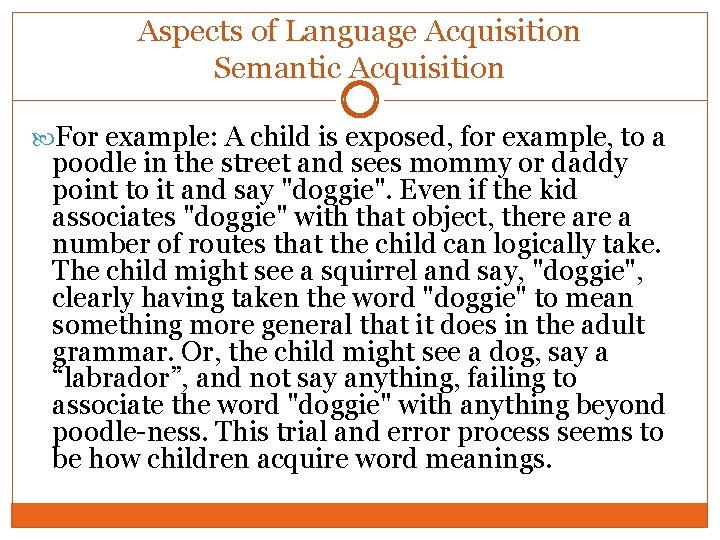
Aspects of Language Acquisition Semantic Acquisition For example: A child is exposed, for example, to a poodle in the street and sees mommy or daddy point to it and say "doggie". Even if the kid associates "doggie" with that object, there a number of routes that the child can logically take. The child might see a squirrel and say, "doggie", clearly having taken the word "doggie" to mean something more general that it does in the adult grammar. Or, the child might see a dog, say a “labrador”, and not say anything, failing to associate the word "doggie" with anything beyond poodle-ness. This trial and error process seems to be how children acquire word meanings.
Aspects of Language Acquisition Semantic Acquisition Contemporary Linguistics: p. 320 Overgeneralizations (or overextensions): Overgeneralizations are cases in which a child gives a word a ____________ that it has in the adult grammar E. g. Using the word "fly" to include specks of dirt, dust, small insects, and bread crumbs
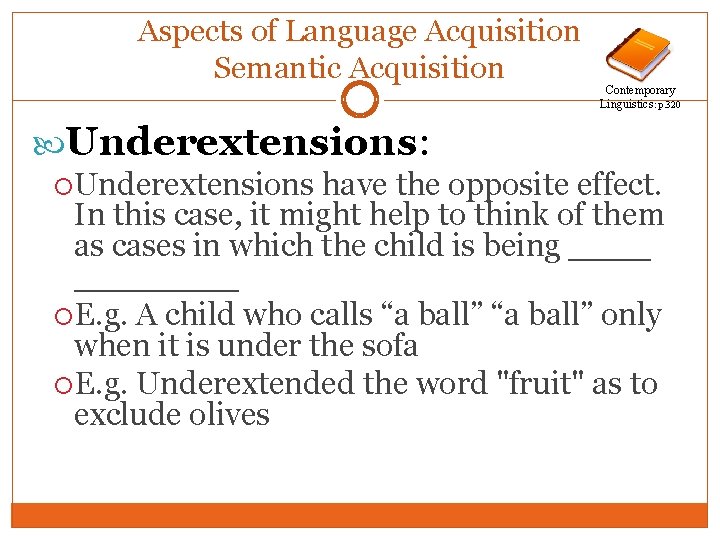
Aspects of Language Acquisition Semantic Acquisition Contemporary Linguistics: p. 320 Underextensions: Underextensions have the opposite effect. In this case, it might help to think of them as cases in which the child is being ________ E. g. A child who calls “a ball” only when it is under the sofa E. g. Underextended the word "fruit" as to exclude olives
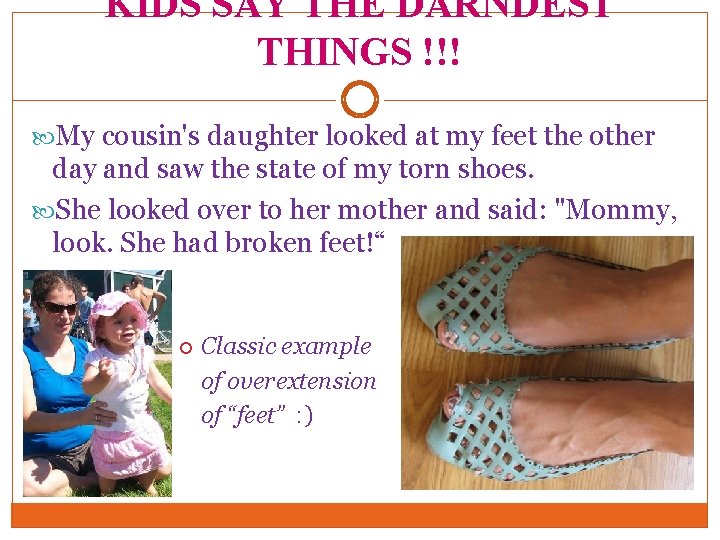
KIDS SAY THE DARNDEST THINGS !!! My cousin's daughter looked at my feet the other day and saw the state of my torn shoes. She looked over to her mother and said: "Mommy, look. She had broken feet!“ Classic example of overextension of “feet” : )
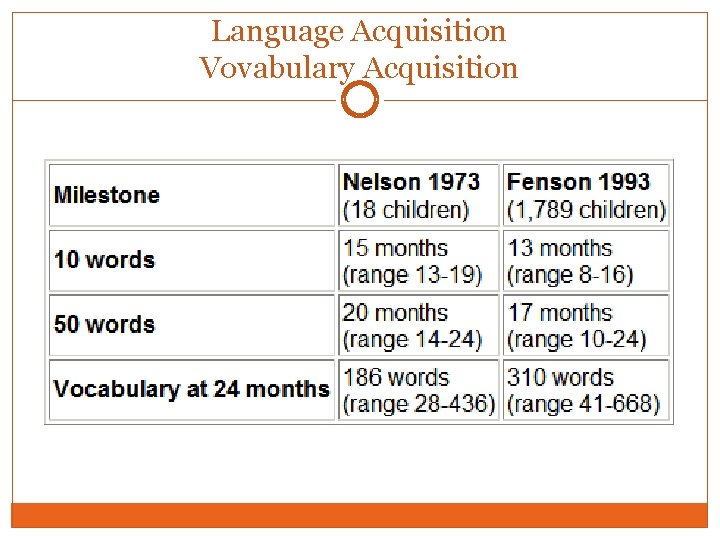
Language Acquisition Vovabulary Acquisition
Acquisition: MORPHOLOGY
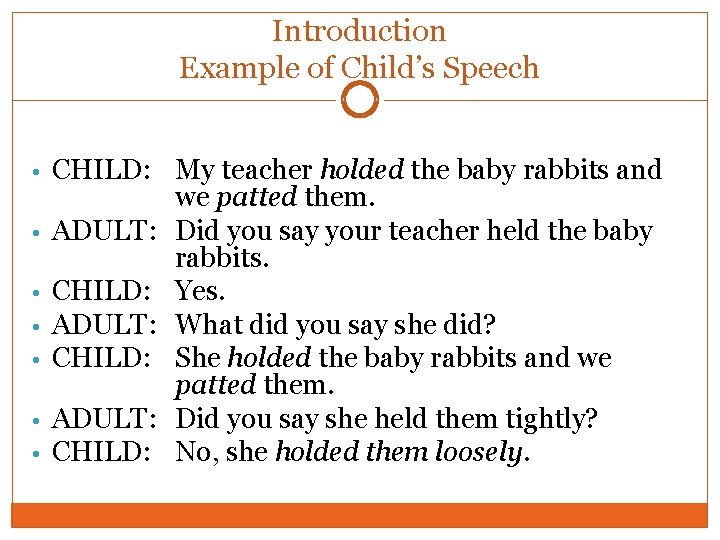
Introduction Example of Child’s Speech • CHILD: My teacher holded the baby rabbits and • ADULT: • CHILD: we patted them. Did you say your teacher held the baby rabbits. Yes. What did you say she did? She holded the baby rabbits and we patted them. Did you say she held them tightly? No, she holded them loosely.
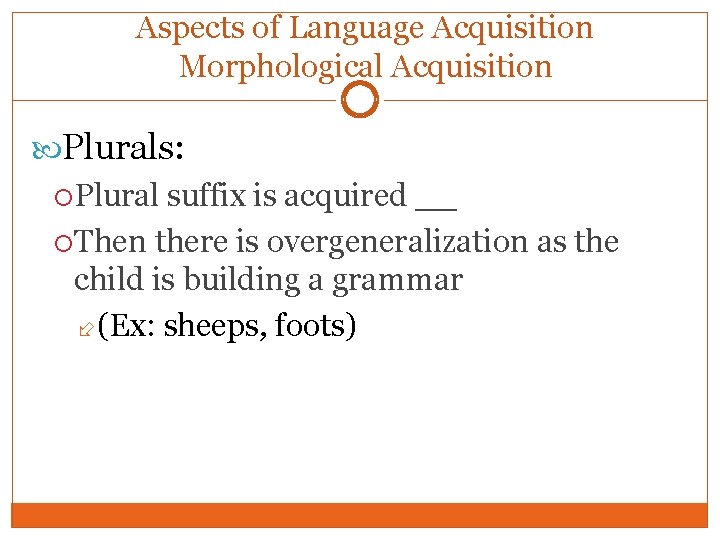
Aspects of Language Acquisition Morphological Acquisition Plurals: Plural suffix is acquired __ Then there is overgeneralization as the child is building a grammar (Ex: sheeps, foots)
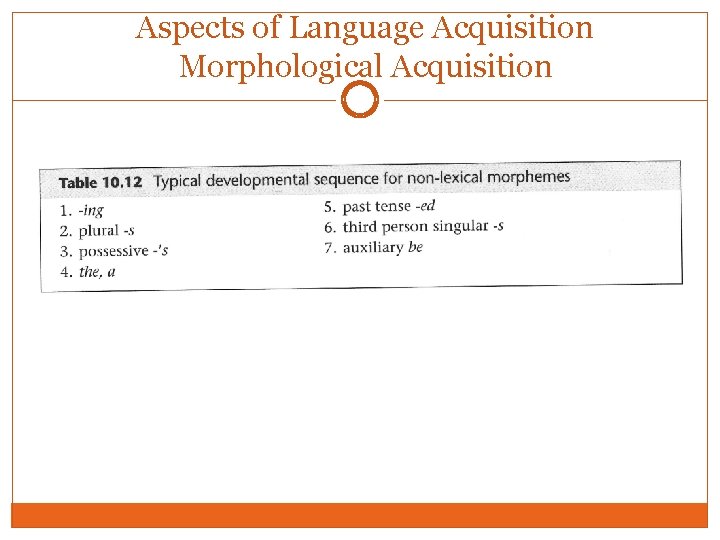
Aspects of Language Acquisition Morphological Acquisition
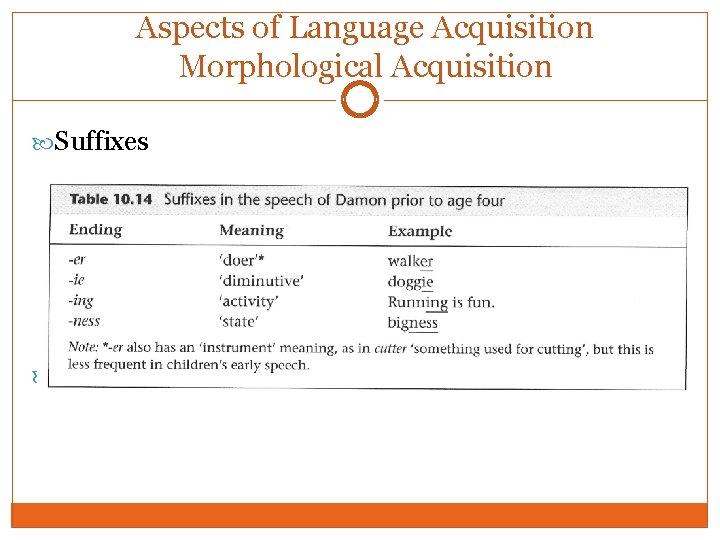
Aspects of Language Acquisition Morphological Acquisition Suffixes Example: Church kids
Acquisition: SYNTAX
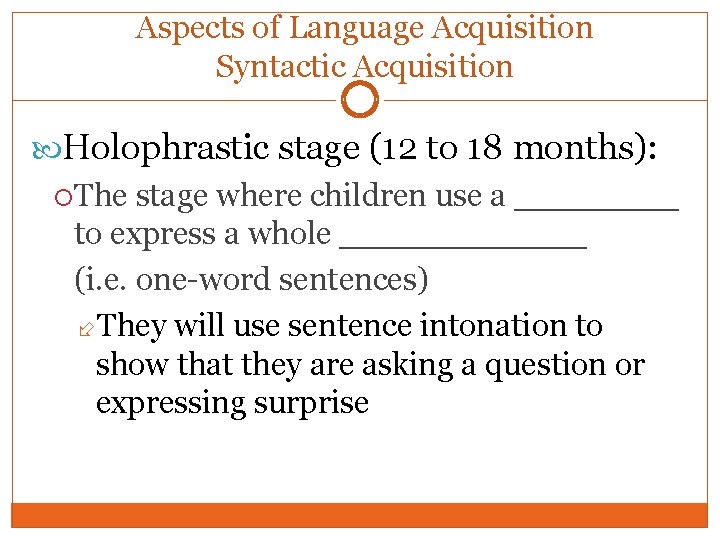
Aspects of Language Acquisition Syntactic Acquisition Holophrastic stage (12 to 18 months): The stage where children use a ____ to express a whole ______ (i. e. one-word sentences) They will use sentence intonation to show that they are asking a question or expressing surprise
Aspects of Language Acquisition Syntactic Acquisition Two-word stage (18 -24 months): This stage tends to combine important words with crucial semantic relationships Examples: agent + action = baby sleep action + agent = kick ball action + locative = sit chair (locative means something that locates an action or entity) entity + locative = teddy bed possessor + possession = Mommy book entity + attribute = block red demonstrative + entity = this shoe
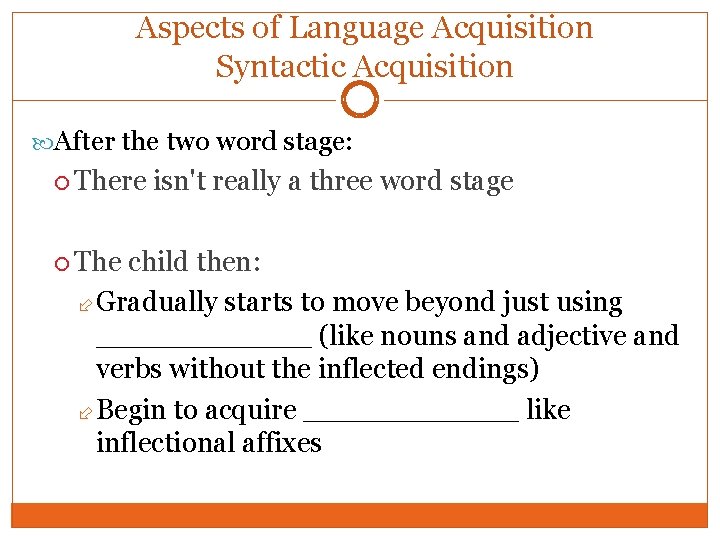
Aspects of Language Acquisition Syntactic Acquisition After the two word stage: There isn't really a three word stage The child then: Gradually starts to move beyond just using ______ (like nouns and adjective and verbs without the inflected endings) Begin to acquire ______ like inflectional affixes
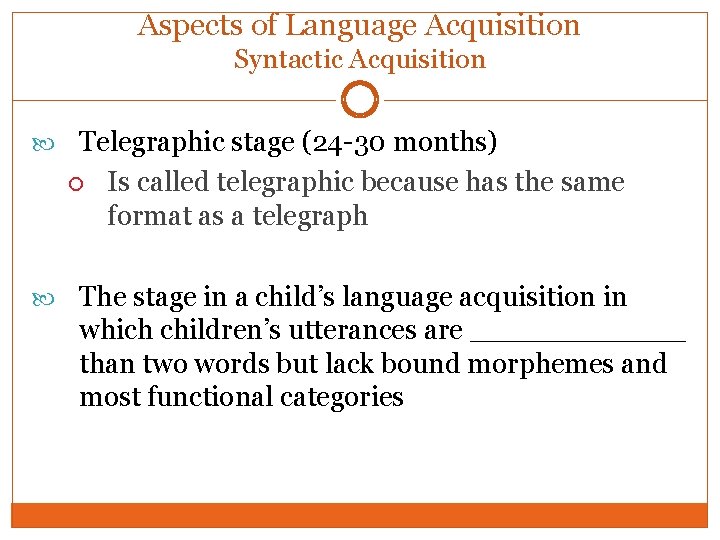
Aspects of Language Acquisition Syntactic Acquisition Telegraphic stage (24 -30 months) Is called telegraphic because has the same format as a telegraph The stage in a child’s language acquisition in which children’s utterances are ______ than two words but lack bound morphemes and most functional categories
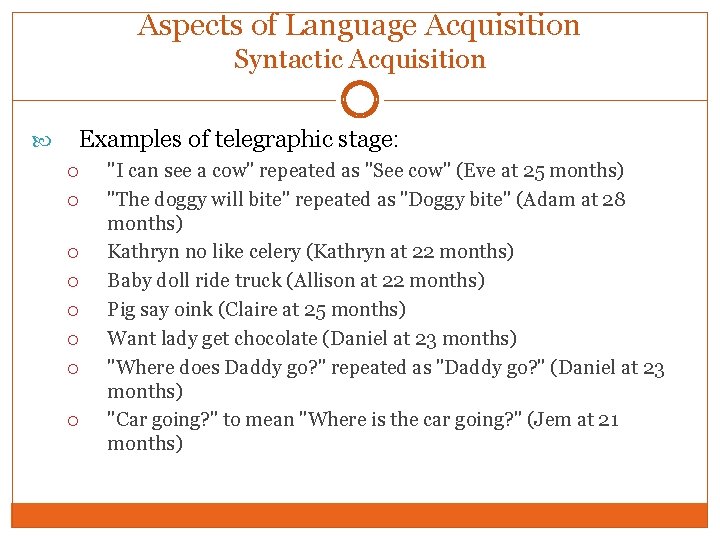
Aspects of Language Acquisition Syntactic Acquisition Examples of telegraphic stage: "I can see a cow" repeated as "See cow" (Eve at 25 months) "The doggy will bite" repeated as "Doggy bite" (Adam at 28 months) Kathryn no like celery (Kathryn at 22 months) Baby doll ride truck (Allison at 22 months) Pig say oink (Claire at 25 months) Want lady get chocolate (Daniel at 23 months) "Where does Daddy go? " repeated as "Daddy go? " (Daniel at 23 months) "Car going? " to mean "Where is the car going? " (Jem at 21 months)
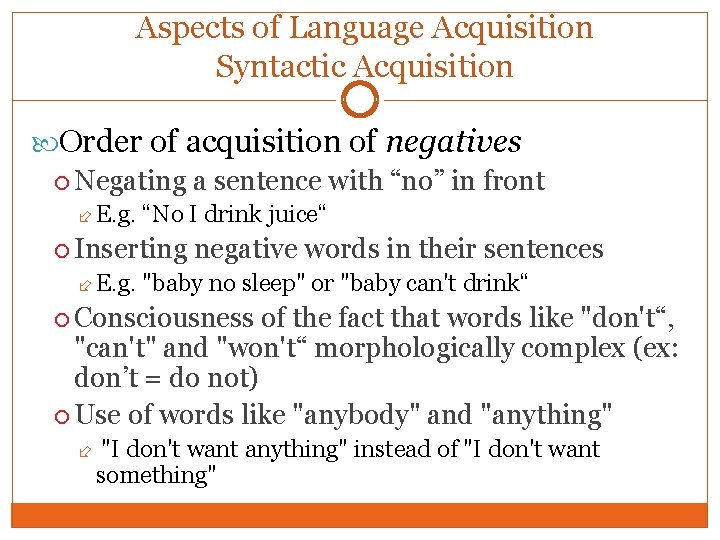
Aspects of Language Acquisition Syntactic Acquisition Order of acquisition of negatives Negating a sentence with “no” in front E. g. “No I drink juice“ Inserting negative words in their sentences E. g. "baby no sleep" or "baby can't drink“ Consciousness of the fact that words like "don't“, "can't" and "won't“ morphologically complex (ex: don’t = do not) Use of words like "anybody" and "anything" "I don't want anything" instead of "I don't want something"
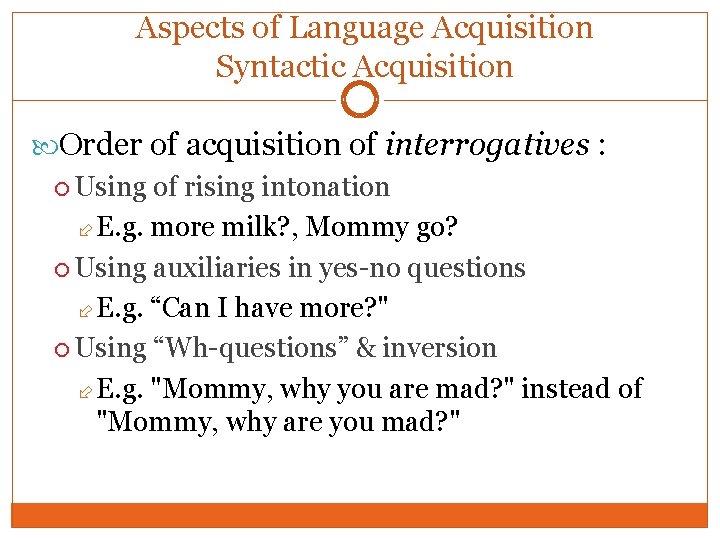
Aspects of Language Acquisition Syntactic Acquisition Order of acquisition of interrogatives : Using of rising intonation E. g. more milk? , Mommy go? Using auxiliaries in yes-no questions E. g. “Can I have more? " Using “Wh-questions” & inversion E. g. "Mommy, why you are mad? " instead of "Mommy, why are you mad? "
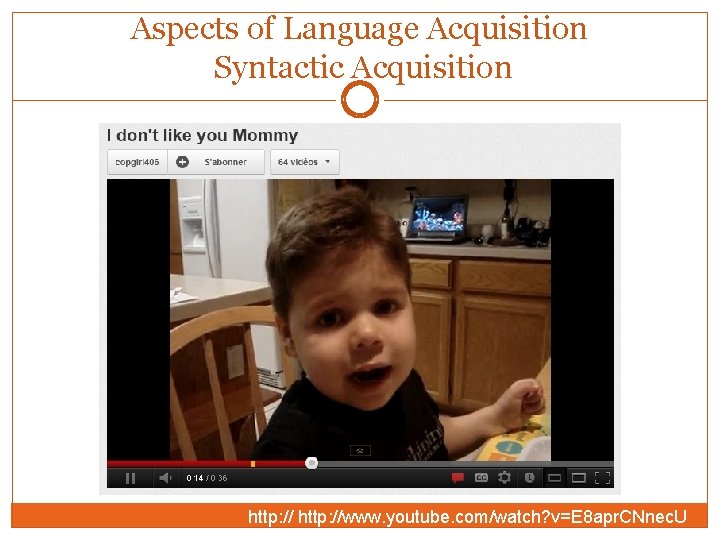
Aspects of Language Acquisition Syntactic Acquisition http: //www. youtube. com/watch? v=E 8 apr. CNnec. U