
LANGUAGE ACQUISITION IN MULTILINGUAL CATALONIA THEORIES AND FOUNDATIONS







- Slides: 25
LANGUAGE ACQUISITION IN MULTILINGUAL CATALONIA THEORIES AND FOUNDATIONS OF SECOND LANGUAGE ACQUISITION MÀSTER DE FORMACIÓ DE PROFESSORAT DE SECUNDÀRIA BATXILLERATS I EOIs Helena Roquet Pugès Departament de Traducció i Ciències del Llenguatge Universitat Pompeu Fabra, Oct 2013 Grup d’Adquisició de Llengües de la Catalunya Multilingüe (ALLENCAM) 1
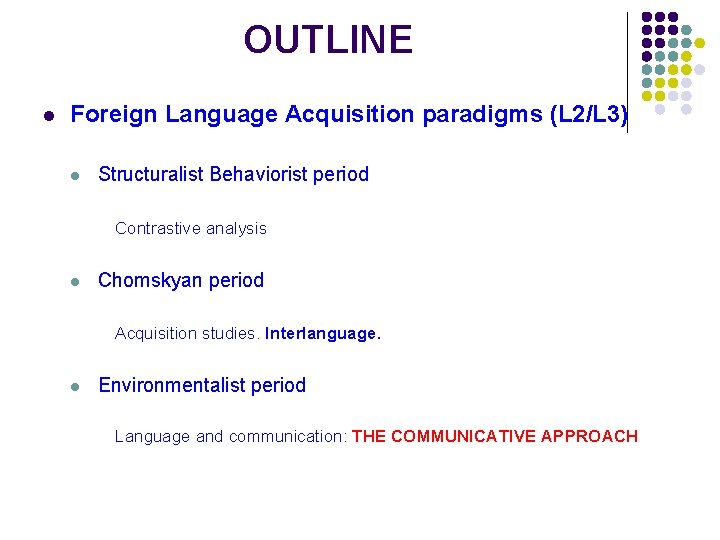
OUTLINE l Foreign Language Acquisition paradigms (L 2/L 3) l Structuralist Behaviorist period Contrastive analysis l Chomskyan period Acquisition studies. Interlanguage. l Environmentalist period Language and communication: THE COMMUNICATIVE APPROACH
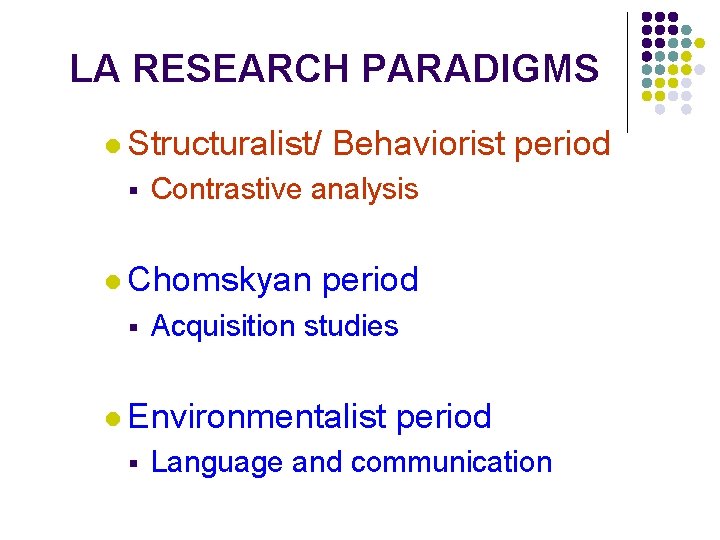
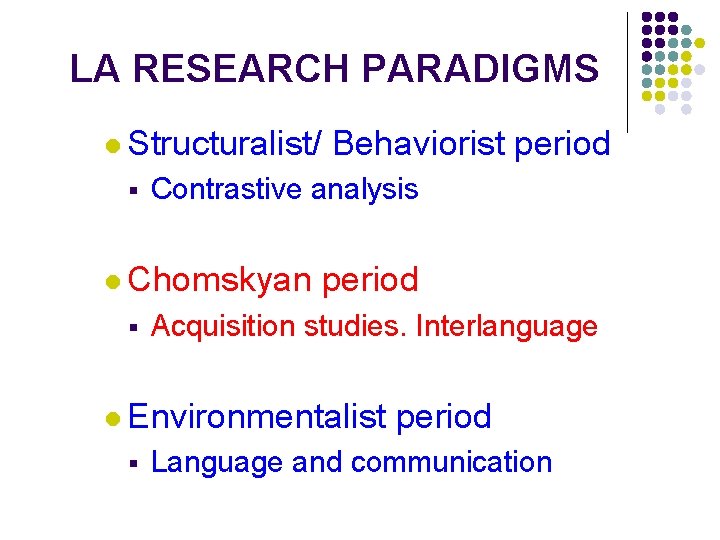
LA RESEARCH PARADIGMS l Structuralist/ § Contrastive analysis l Chomskyan § Behaviorist period Acquisition studies l Environmentalist § period Language and communication
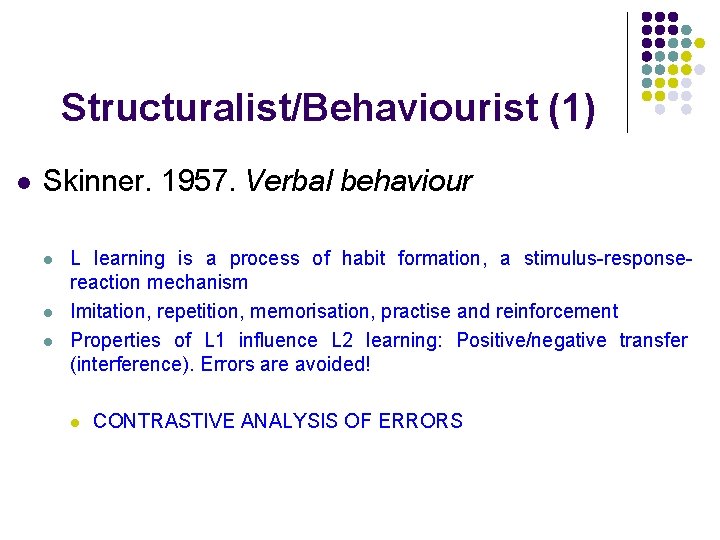
Structuralist/Behaviourist (1) l Skinner. 1957. Verbal behaviour l l l L learning is a process of habit formation, a stimulus-responsereaction mechanism Imitation, repetition, memorisation, practise and reinforcement Properties of L 1 influence L 2 learning: Positive/negative transfer (interference). Errors are avoided! l CONTRASTIVE ANALYSIS OF ERRORS
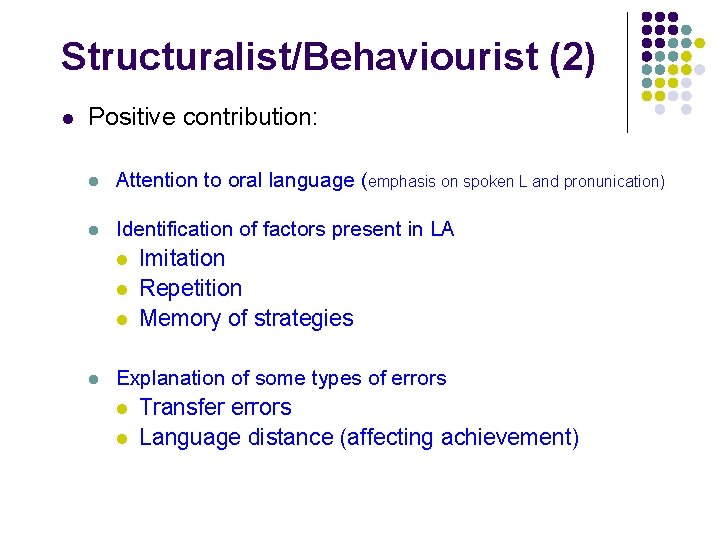
Structuralist/Behaviourist (2) l Positive contribution: l Attention to oral language (emphasis on spoken L and pronunication) l Identification of factors present in LA l l Imitation Repetition Memory of strategies Explanation of some types of errors l l Transfer errors Language distance (affecting achievement)
Structuralist/Behaviourist (3) Negative contribution: l Attention to form and not to meaning l Learner is a passive recipient l Learning proceeds by analogy l Creativity is not allowed
LA RESEARCH PARADIGMS l Structuralist/ § Contrastive analysis l Chomskyan § Behaviorist period Acquisition studies. Interlanguage l Environmentalist § period Language and communication
The Chomskyan period (1) N. Chomsky. 1957. Syntactic Structures. 1959 Review of Verbal Behaviour l Acquisition: Rule-governed behaviour l l Learning by analysis and not by analogy Creativity in L: “Generate an infinite number of sentences from a finite number of rules”
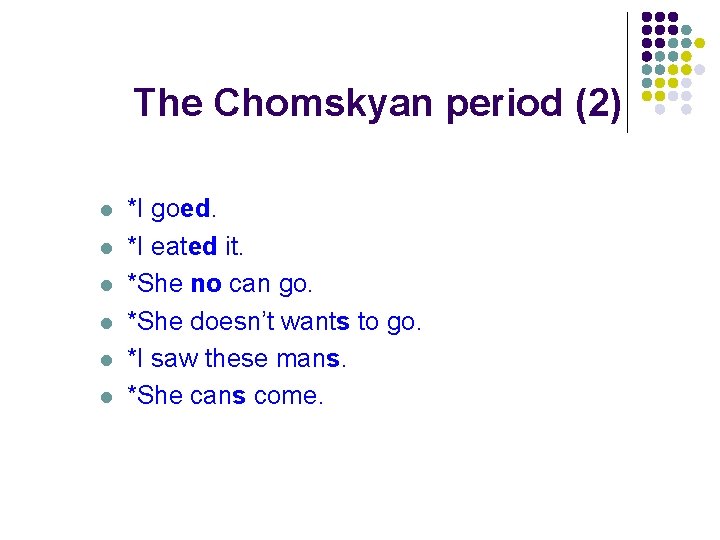
The Chomskyan period (2) l l l *I goed. *I eated it. *She no can go. *She doesn’t wants to go. *I saw these mans. *She cans come.
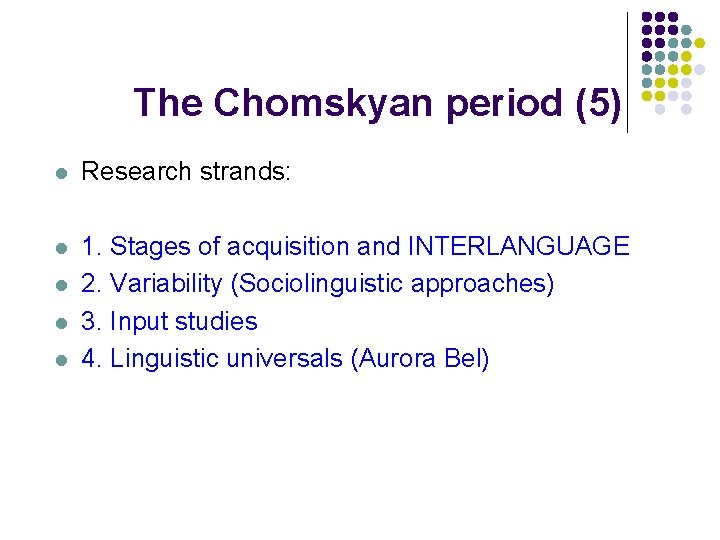
The Chomskyan period (5) l Research strands: l 1. Stages of acquisition and INTERLANGUAGE 2. Variability (Sociolinguistic approaches) 3. Input studies 4. Linguistic universals (Aurora Bel) l l l
INTERLANGUAGE (1) l Each of the stages the learner goes through on his/her way towards mastery of the target language. Each stage is a linguistic system in its own right, with specific features which characterize it, known as interlanguage.
INTERLANGUAGE (2) l l l It is different from the target language. It has its own internal structure. Errors are systematic. It is permeable to input. At each given moment a particular stage of acquisition is apparent. Each stage includes forms typical of a previous stage and forms anticipating the next one (Variability).
Past morpheme interlanguage development l John eat a banana yesterday. l l She went. She broke. She jump. She walked. l l (sporadic use) She goed. She eated. John breaked. l l (ref. past no morf. ) (overegularitzation) She went. She walked l (correct use)
Legacy of the period l l Several models among which Krashen (1983. The Natural Approach) Monitor model. § Based on 5 principles: § Comprehension precedes production § Production emerges in stages (students are not forced to speak before they are ready) § Communicative goals (classroom activities organised by topics, not by grammatical structures) § The instructor must create a good atmosphere
The Natural Approach (1983, Krashen) 5 hypothesis: 1. The Acquisition/Learning hypothesis 2. The Monitor hypothesis 3. The Natural Order hypothesis 4. The Input hypothesis (emphasis on what the L learners here before they try to produce L) 5. The Affective Filter hypothesis
LA RESEARCH PARADIGMS l Structuralist/ § Contrastive analysis l Chomskyan § Behaviorist period Acquisition studies. Interlanguage l Environmentalist § period Language and communication
Environmentalist period (1) l Language acquisition: l Complex interaction between the linguistic environment (input) and the learner's internal mechanisms, with neither viewed as primary. Verbal interaction is of crucial importance
Sociolinguistics (2) l Hymes (1971): Different levels competence involved in language: l l l of Structural Discourse Communicative Strategic ALL USED IN ‘CONTEXT’: Situation where discourse arises
Discourse Analysis (3) l l Austin (1975): Speech act theory How language is used to do things l YOU CAN SAY ONE SAME MEANING WITH A VARIETY OF FORMS, AND ONE SAME FORM CAN HAVE A VARIETY OF MEANINGS
l LANGUAGE IN USE IS COMMUNICATIVE l Real communication is based on interaction. It gives information which the person engaged in conversation with the speaker does not have. l Real communication is always with a purpose. l Real communication contains an element of unpredictability of choices of words. Only in very restricted formulaic expressions language is predictable.
The Communicative Approach l Language is seen as a tool for communicating l Real language practice in the classroom l To develop communicative competence in real communicative context l To develop communicative strategies through interaction l Language is communicative as well as linguistic: grammar + pronunciation + social rules l Focus on functions, not on structures l View that students acquire a language when focusing on meaning, not only in form
The role of grammar in the CA l COMMUNICATIVE TEACHING l l l + Focus on meaning + Group work interaction + Genuine questions + Opportunities to use lang. creatively + Opportunities to participate in task negotiations of topics
ENVIRONMENTALISM l Interaction l Negotiation of meaning l ‘Noticing’ new forms in the input
Instructional Implications? Use of authentic materials and tasks Communicative activities such as games and role plays Group and pair work Small number of students interacting Emphasis on functions and meaning, not forms Tolerate errors of form …
CONCLUSION l Learning a second/foreign language it is not completely different from learning a first language, yet it is not entirely the same…. .