
Language A system of rules for using symbols
Language A system of rules for using symbols to share meaning
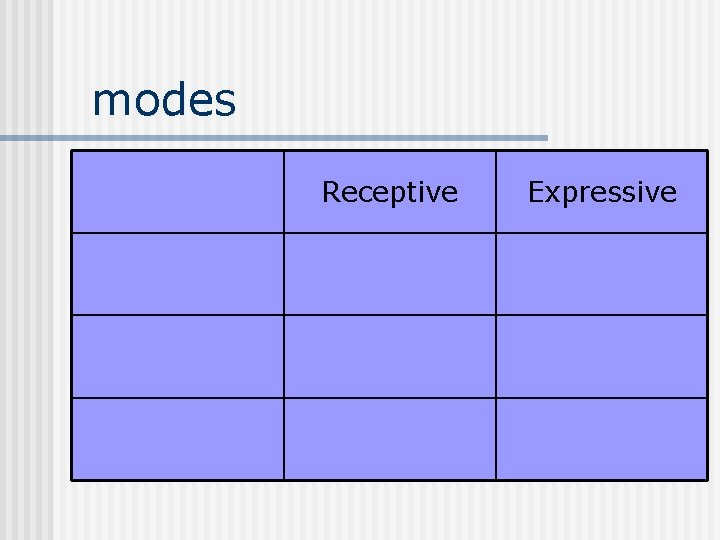
modes Receptive Expressive
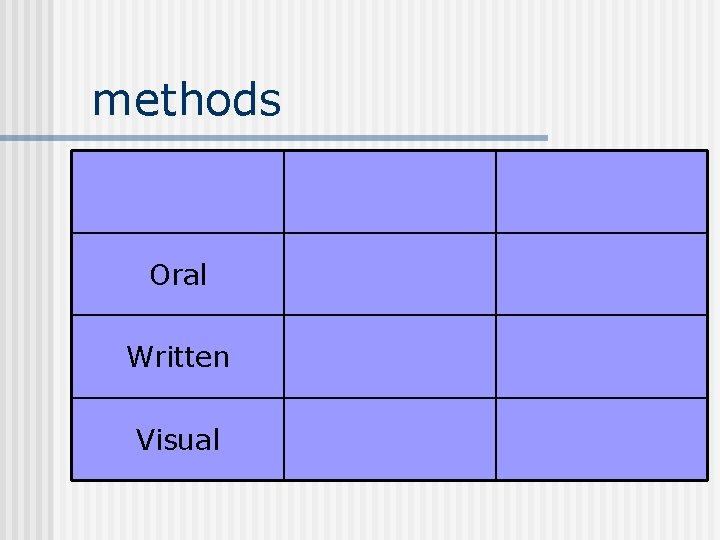
methods Oral Written Visual
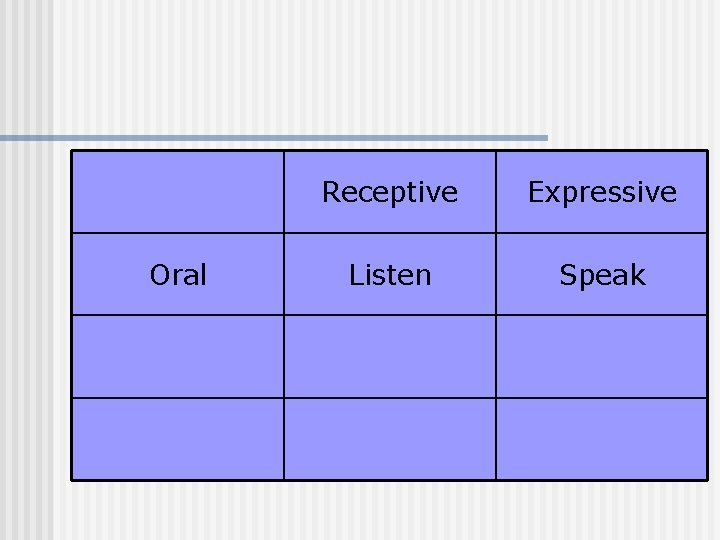
Oral Receptive Expressive Listen Speak
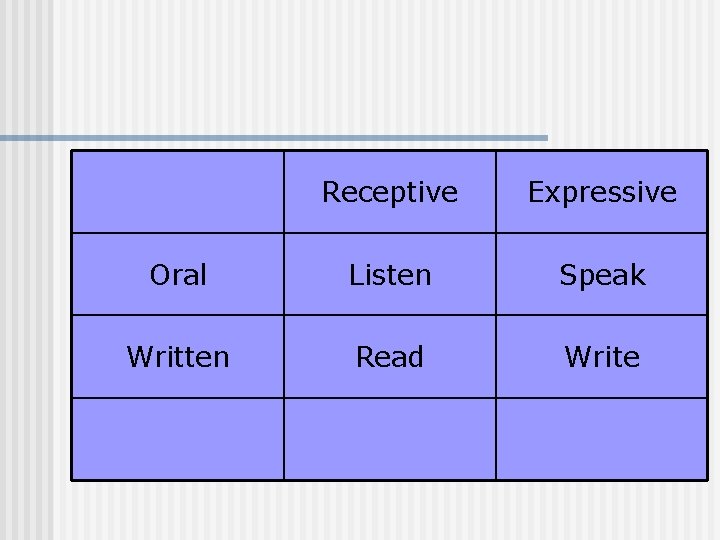
Receptive Expressive Oral Listen Speak Written Read Write
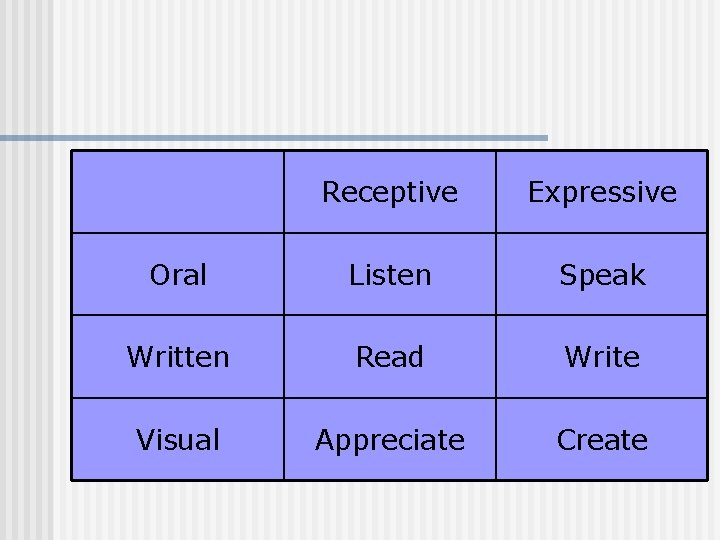
Receptive Expressive Oral Listen Speak Written Read Write Visual Appreciate Create
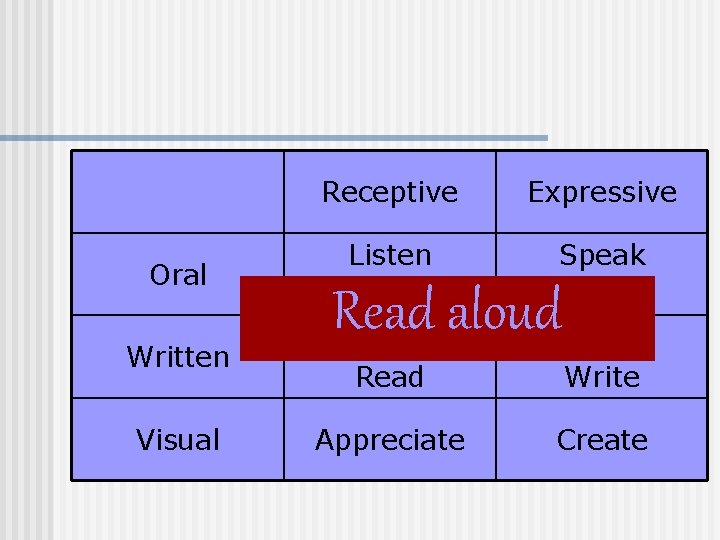
Oral Written Visual Receptive Expressive Listen Speak Read aloud Read Write Appreciate Create

Language Rule Systems n Phonology (sounds) n Semantics (meaning) n Syntax (structure) n Pragmatics (function)
Language Rule Systems n Gunning (2008, p. 4) adds two more: Morphology – word formation (a part of syntax) n Prosody – intonation and rhythm of speech (a part of pragmatics) n
Phonology ~ 77 Phonemes n ~ 45 in English n Int’l. Phonetic Alphabet (IPA) n Articulatory Phonetics n Voice anatomy n
Semantics n Meaningful cries: n n n Vocabulary Fast mapping n n 12 months = 1 word, 18=20, 24=270 Hart and Risley n n n hunger, anger, pain Professional / Middle / Poor families 11 / 6 / 3 million words by age 3 Over- and underextension

Syntax Grammatical structure n S-V-O, S-O-V n Morphemes n Overregularization n Nouns, verbs, adjectives, articles n Conjunctions, embedded sentences, tag questions, ido-do, passive n
Pragmatics Communicative competence Knowing when to speak, when not to, what to talk about and with whom, when, where, and in what manner to interact Burst feeding
Pragmatics, continued n Infants must Focus attention n Recognize gaze and gesture n Associate sounds and voices with certain events and people n Develop reciprocity n Use language to communicate n
Pragmatics, continued n Cultural context n n Dialect, hierarchy, space Language functions Halliday, Tough n Baron: Affection, Control, Information, Pedagogy, Social exchange n n Discourse - Tele-talk, greetings, lecture, caregiver speech
Language Acquisition Theories Virtually every child, without special training, exposed to surface structures of language in many interaction contexts, builds for himself – in a short period of time and at an early stage in his cognitive development – a deep-level, abstract, and highly complex system of linguistic structure and use. (Lindfors 1987)
Nurture = Behaviorism Attention n Repetition n Approval (reinforcement) n
Nature = Nativist n Language Acquisition Device Chomsky: Colorless green ideas sleep furiously n Pinker: Language Instinct (1995) n
Biological Influences n Brain’s role • • • Hemispheric specialization Broca’s area – structure Wernicke’s area – comprehension
Biological prewiring Chomsky’s view: Language Acquisition Device n Critical Period for Language n Case of Genie n Critical period not certain n
Social interaction Responsive interaction n Siegel: “human connections shape the neural connections from which the mind emerges” n Bruner’s Language Acquisition Support System (LASS) n Caregiver speech n
Social interaction n Piaget: Thought and Language Egocentric n Addressed to no one n n Vygotsky: Language and Thought Private speech n Inner speech n Communication with the self n
Social interaction Whole Language approach n Emergent Literacy n
Language Development Milestones COOING n 4 weeks – precursors to vowels n 8 weeks – real vowels n 12 weeks – discovers own voice BABBLING n 6 months – Echolalia • m, p, b, k, g with vowels n 8 months – Vocables
Milestones FIRST WORDS n 12 months – Holophrases n Overgeneralized speech n
Milestones TELEGRAPHIC SPEECH • • • Identificaton – “See doggie” Location – “Book there” Repetition – “More milk” Nonexistence – “Allgone thing” Negation – “Not wolf” Possession – “My candy” Attribution – “Big car” Agent-action – “ Mama walk” Action-direct object – “Hit you” Action-indirect object – “Give Papa” Action-instrument – “Cut knife” Question – “Where ball?
Bilingualism n Simultaneous n Successive
Bilingualism n True Bilingual education • Teach immigrant children in native language • Add English gradually n Bilingualism does not interfere with language development.
Bilingualism n English as a Second Language n Content curriculum in English n Assistance in ESL n Intervention
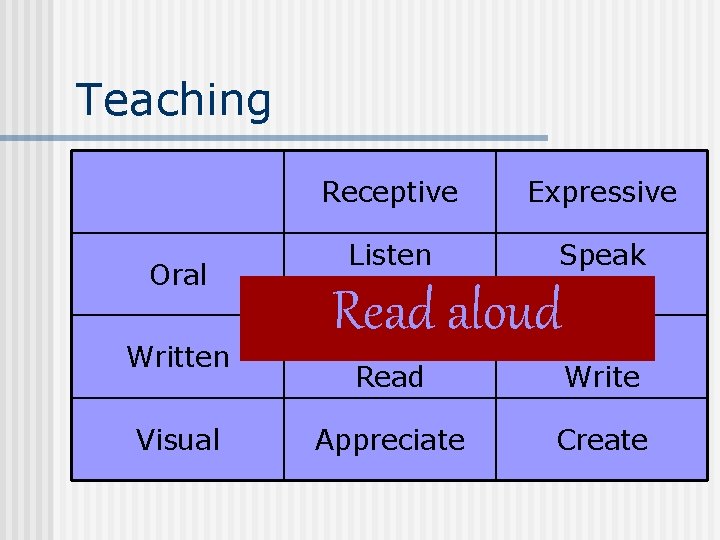
Teaching Oral Written Visual Receptive Expressive Listen Speak Read aloud Read Write Appreciate Create
Learning about speech n Prenatal auditory experiences influence neonatal auditory preferences (De. Casper & Spence 1986) n Caregiver speech n Extensions, expansions, recasts Dramatic play n Metalinguistic awareness n
Learning about Print n Environmental Print n Book Print
Learning about writing Letter like forms n Constancy of position in space n Reversals n Dyslexia n Spacing n Spelling: public and private (invented) n
Learning about reading Five Big Ideas in Early Literacy n Phonemic awareness n Phonics n Vocabulary n Comprehension n Fluency (National Reading Panel, 1999)
Learning about reading n n n Alphabetic principle Sight words Part-to-whole instruction Whole-to-part instruction Genres n n Baby board books Predictable books Fairy tales and Mother Goose Poems and Songs
Reading aloud is the single most important activity for building the understandings and skills that are essential for later reading success NAEYC (1998) Learning to Read & Write.

Language Development n Infancy • • • Vocalization: Begins with babbling Early communications are pragmatic One-word (holophrase) stage: 10 to 13 months Two word (telegraphic) stage: 18 to 24 months Roger Brown: Mean Length of Utterance (MLU) Five stages of MLU index language maturity
Language Development n Early childhood: Advances in • • • n Phonology Morphology Syntax Semantics Pragmatics Sequences of development • • • Words/vocabulary emerge (12 months) Transition to combining words/phrases into sentences (24 months) Transition to complex sentences (age 2 to 3 through elementary years)
Middle and Late Childhood: Reading n Chall’s model describes the development of reading in five stages with the first ranging from birth to first grade and the final stage in the high school years.
Debate n There is debate about the whole language approach vs. the basic skills-&-phonics approach.
Whole language approach n stresses that the learning to read should parallel the child’s natural learning of language. The premise is that reading should be integrated with other skills.
Basic skills-&-phonics approach n emphasizes teaching phonetics and its rules for translating written symbols into sounds.
n A combination of the two approaches is probably best.

- Slides: 45