
LANE 622 APPLIED LINGUISTICS Prepared by Dr Abdullah
LANE 622 APPLIED LINGUISTICS Prepared by Dr. Abdullah S. Al-Shehri asalshehri@hotmail. com 1
LECTURE II FIRST LANGUAGE ACQUISTION 2
First Language Acquisition why? A coherent grasp of the nature of F 1 acquisition helps to construct a theory of L 2 acquisition. 3
Theories of First Language Acquisition n The Behavioristic Approach. n The Nativist Approach. n The Functional Approach. 4
The Behavioristic Approach Verbal Behavior, B. F. Skinner (1957; 1968) n Skinner’s theory of Verbal Behavior is an extension of his general theory of learning by operant conditioning (stimulus : response). n Organism (human) emits an operant (an utterance). n If reinforced, utterance is maintained and strengthened. n If not reinforced, linguistic behavior is weakened and eventually extinguished. n Language is a set of habits acquired by a process of conditioning. n This approach assumes a ‘tabula rasa’ (no innate predisposition for language in the human brain). 5
Criticism of the Behavioristic (Verbal Behavior) Approach n This approach is criticized for failing to adequately account for the n n n n Capacity to acquire language. Fast development of language. Generativity of language. Creativity of language. Abstract nature of language. Nature of ‘meaning’. Relationship between meaning and utterance. 6
The Nativist Approach Chomsky (1965) and Lenneberg (1967) n Language acquisition is biologically and innately determined. n Existence of a genetic capacity/predisposition to perceive language systematically. n Systematic perception of language results in the construction of a creative language system. n Language acquisition is therefore systematic and rule-governed. n Innate capacity is embodied in a ‘language acquisition device’ (LAD). n LAD is expanded into a system of ‘universal linguistic rules’ or ‘Universal Grammar’ (UG). n Discovery of an early grammar of child language: pivotal grammar. n Parallel distributed processing (PDP): Sentences are the result of the simultaneous interconnection of a multitude of brain cells, and not a serial process of rule application. 7
LAD’s Innate Linguistic Properties As described by Mc. Neill (1966) n The ability to distinguish speech sounds from other sounds in the environment. n The ability to organize linguistic data into various classes. n Knowledge that only a certain kind of linguistic system is possible. n The ability to constantly evaluate the developing linguistic system. 8
Universal Grammar Theory (UG) n Innate principles of grammar shared by all languages. n Attempts to explain language acquisition in general. n Proposes a set of rules intended to explain language development in children. n Attempts have been made to apply the idea to the area of second language acquisition (SLA). 9
How does the system of child language work? According to the Nativist Theories: n Child language is a legitimate system in its own right. n Child language development is not a process of developing fewer and fewer mistakes. n All stages of child language are systematic. n A child is constantly forming linguistic hypotheses on the basis of the input and testing these hypotheses in speech. n Hypotheses are continually revised, reshaped or abandoned, as child’s language develops. n A child does not learn language as a series of separate discrete items, but as an integrated system within which there is an active application of grammatical rules. 10
The Nativist (Generative) Framework n Hypothetical descriptive grammars were constructed. n Complex language of five to ten-year-olds were found. n Early grammars of child language discovered: pivot grammars. n Research data yielded a multitude of pivotal grammatical rules. n Some of these rules were described as UG rules. 11
Contributions of the Nativist Approach to F 1 Acquisition n Freedom from the restrictions of the ‘scientific method’ to explore the unobservable, abstract linguistic structures being developed in the child. n Systematic description of the child’s linguistic repertoire as a rule-governed system. n The construction of a number of potential properties of UG. 12
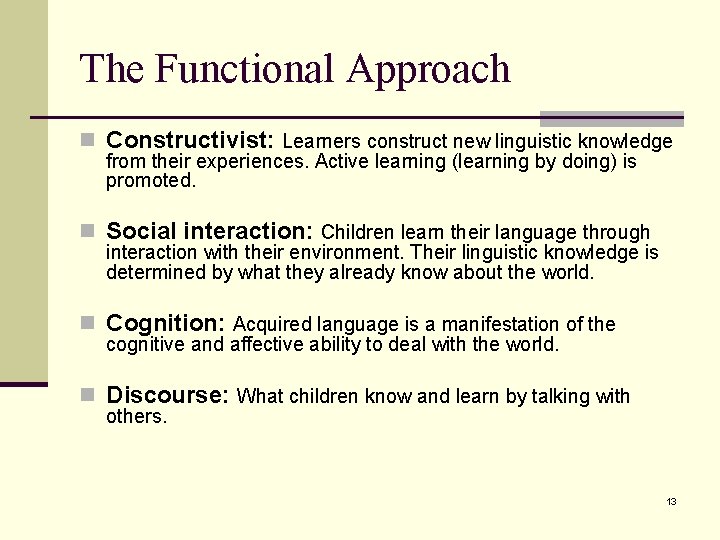
The Functional Approach n Constructivist: Learners construct new linguistic knowledge from their experiences. Active learning (learning by doing) is promoted. n Social interaction: Children learn their language through interaction with their environment. Their linguistic knowledge is determined by what they already know about the world. n Cognition: Acquired language is a manifestation of the cognitive and affective ability to deal with the world. n Discourse: What children know and learn by talking with others. 13
Issues in First Language Acquisition 14
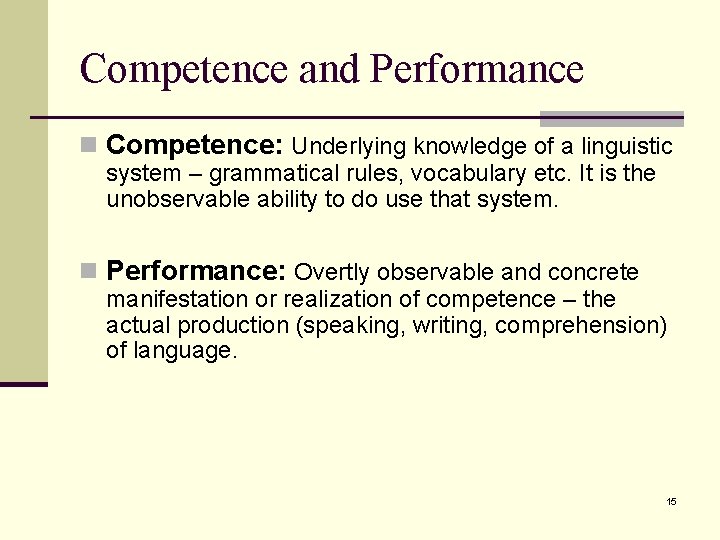
Competence and Performance n Competence: Underlying knowledge of a linguistic system – grammatical rules, vocabulary etc. It is the unobservable ability to do use that system. n Performance: Overtly observable and concrete manifestation or realization of competence – the actual production (speaking, writing, comprehension) of language. 15
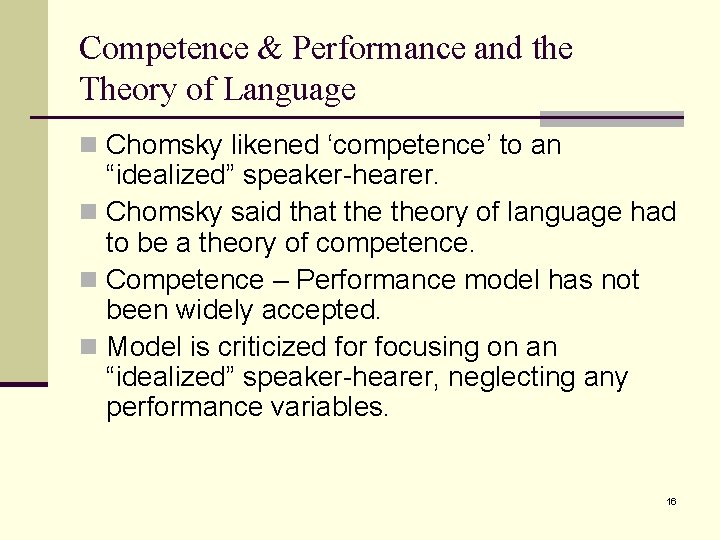
Competence & Performance and the Theory of Language n Chomsky likened ‘competence’ to an “idealized” speaker-hearer. n Chomsky said that theory of language had to be a theory of competence. n Competence – Performance model has not been widely accepted. n Model is criticized for focusing on an “idealized” speaker-hearer, neglecting any performance variables. 16
Comprehension & Production n Not to be equated with competence and performance. n Comprehension and production are aspects of both competence and performance. n In child language, comprehension is superior to production. 17
Nature & Nurture n Nature n n Innate property LAD / UG Genetic transmission of language Biological timetable n Nurture n n Environmental exposure Teaching Child’s construction of his/her linguistic reality Interaction with others 18
Universals n Language is universally acquired in the same way n Common deep structure n Pivot grammar universals: n Word order, agreement, noun & verb classes, predication, negation, question formation etc. n Structural dependency: Language is organized in such a way that it crucially depends on the structural relationships between elements in a sentence. 19
Systematicity & Variability n Language acquisition is systematic: n Children exhibit a remarkable ability to infer the phonological, structural, lexical, and semantic system of language. n Variability still exists in the process of learning: n For example, children who have not learned the past-tense morpheme tend to learn past tense forms as separate items before they know the difference between regular and irregular verbs. Later, they begin to perceive a system. 20
Language & Thought n Cognitive development is central to human. n Language depends upon, and springs from, cognitive development. n Language influences cognitive development. n Social interaction, through language, is a prerequisite to cognitive development. n Sapir-Whorf hypothesis of linguistic reality: § Language influences thought. § Thought influences language. § Each language imposes on its speaker a particular “world view”. n Cognitive and linguistic development are inextricably intertwined. 21
Imitation n Children are good imitators. n ‘Imitation’ is an important language acquisition strategy. n ‘Imitation’ is in agreement with behavioristic principles of language acquisition. n Children engage in surface structure as well as deep structure imitation. 22
Practice n Children practice language, especially in the early stages of language acquisition. n Practice is key to language acquisition. n Practice, as a language acquisition strategy, covers both speaking and comprehension. 23
Input n Role of ‘input’ in child language acquisition is crucial. n Child’s language is shaped by adults’ input. n Nurture and environment are extremely important as sources of linguistic inputs. 24
Discourse n Exposure alone to language is not enough for successful language acquisition. n ‘Interaction’, rather than exposure, is required. n Children do not learn language from overhearing conversations alone. n Children acquire language by being spoken to. 25
- Slides: 25