
Landscaping What is Landscaping Landscaping is a profession




- Slides: 34
Landscaping
What is Landscaping? Landscaping is a profession that includes designing, installing, and maintaining the outdoor human environment. l There are 3 branches of the landscaping industry l l Landscape Architecture l Landscape Contractors l Landscape Maintenance
Landscape Architects Licensed professions Landscape designers usually do actual drawings for residential landscapes.
Landscape Contractors Carry out the installation or actual construction of the landscape plan l Often use subcontractors to do special work such as pools, electrical work, stonework, etc. l
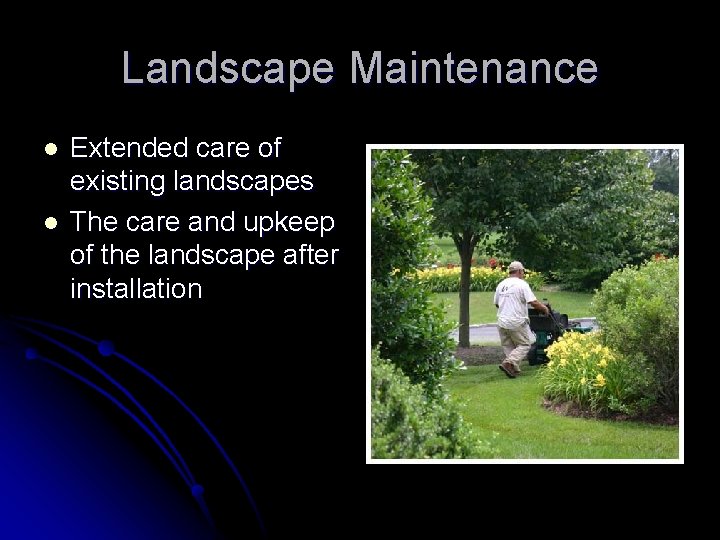
Landscape Maintenance l l Extended care of existing landscapes The care and upkeep of the landscape after installation
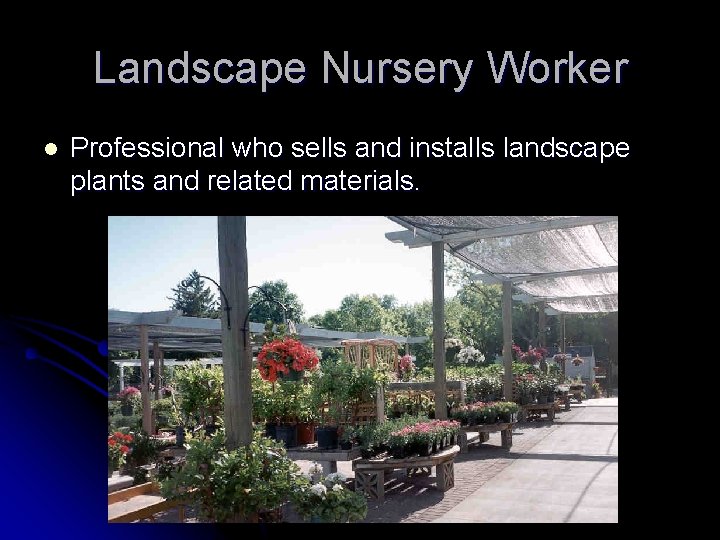
Landscape Nursery Worker l Professional who sells and installs landscape plants and related materials.
Types of Landscape Plans
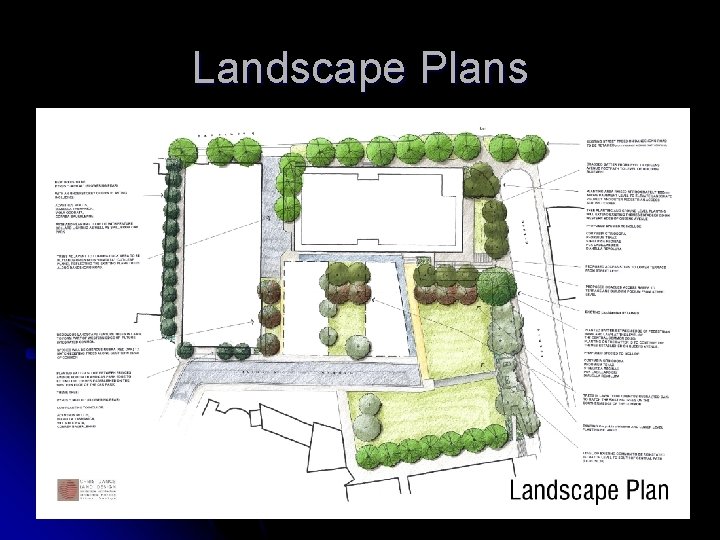
Landscape Plans
Landscape Principles and Procedures
Principles of Design Balance l Focalization of Interest l Simplicity l Rhythm and Line l Proportion l Unity l
Balance l l Materials are distributed evenly on opposite sides of a central axis Three types of balance: l l l Symmetric Asymmetric Proximal/distal Macro-range-the viewer sees the landscape from the most distant vantage point Closer range-the views from other locations not as distant
Symmetric Balance l l One side is a reflective mirror image of the opposite side Most formal type of balance
Asymmetric Balance Each side has as much interest as the other l Not a duplicate of the other side l
Proximal/Distal Balances right and left as well as near and far
Focalization of Interest Selects and positions visually strong items in the landscape composition to create focal points l Draws the eye of the viewer to one major feature in each use area l l Example: corner planting
Simplicity Seeks to make viewers comfortable within the landscape l Excludes any unnecessary changes in shape, color, direction, etc. l
Rhythm and Line Repeating something at a standard interval or pattern creates rhythm l Lines establish the shape and form of the landscape l Replicating strong existing lines such as the lines of a house or a pool l Functions of line plantings include foundation plantings, block a view, frame a view, and provide privacy. l
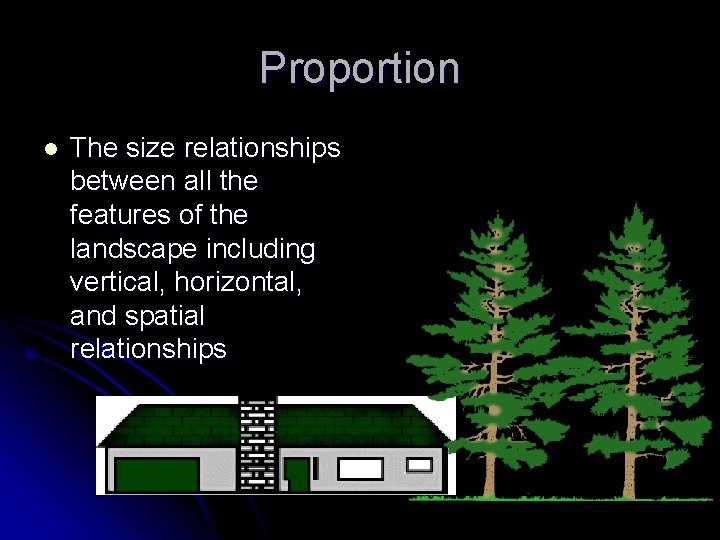
Proportion l The size relationships between all the features of the landscape including vertical, horizontal, and spatial relationships
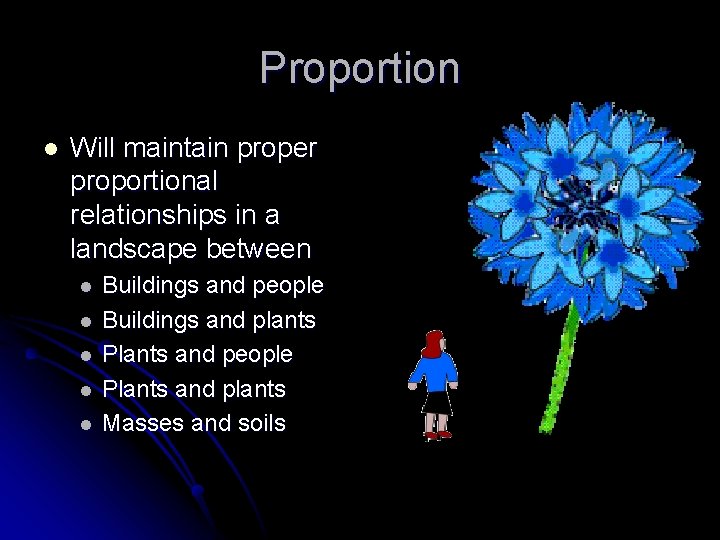
Proportion l Will maintain proper proportional relationships in a landscape between l l l Buildings and people Buildings and plants Plants and people Plants and plants Masses and soils
Unity All the separate parts contribute to the creation of the total design l Ties together individual parts of each area by: l l Repeating prominent colors l Repeating construction materials l Continuing interior design themes to outdoor rooms l Repeat plant species l Raise patios, decks, and porches to door level
Landscape Processes Process is a sequence of steps to reach a goal l There are three parts to the landscape process l l Project development l Project maintenance l Design
Project Development Process Includes determining need or objective l Design process l Accepting the design l Contracting and subcontracting l Landscaping l Acceptance l Billing and payment l
Project Maintenance Process Determining need or desire l Selecting landscape maintenance company which assesses the needs and presents a proposal l If the proposal is accepted, the company schedules and does the work l Customer is billed l
Design Process l Site analysis and program analysis
Interior Landscaping
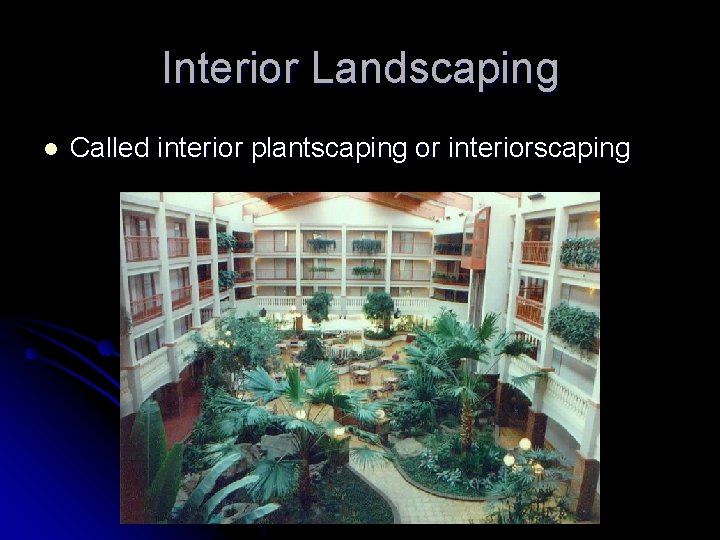
Interior Landscaping l Called interior plantscaping or interiorscaping
Purposes of Interior Landscaping l l l l Add color Add textures Add softness Add life Increase employee productivity Decrease employee absenteeism Add oxygen l l Provide herbs for cooking, medicine, or fragrance Add beauty and comfort by combining all of the previously mentioned purposes
Benefits of Interior Landscaping Adds color, texture, softness, life and oxygen to interior plantscape l Increases employee productivity l Decreases employee absences from work l Provides herbs for cooking, fragrance, or medicine l
Disadvantages of Interior Landscaping Reduced light l Reduced root system l Dependant upon people for watering l Build-up of soluble salts from fertilizer l Plugging stomata from dust on leaves l Damage from heating, air conditioning, and cleaning chemicals l
Disadvantages of Interior Landscaping Growing medium l Only plants that will grow inside can be used l Picking or breaking leaves by people using the interior building area l
Benefits of Exterior Landscaping l l l l l Adds color, texture, and life Adds aesthetic value (beauty) Adds economic value to property Adds comfort (shade) Adds privacy—borders, fences, etc. Helps prevent erosion Can use larger exterior plants Rain natural soil provide most of required water Gets natural light
Disadvantages of Exterior Landscaping May get too much rain and drown l Natural soils may have diseases, insects, improper p. H, etc. l Natural soils may be shallow or rocky l Natural outdoor soils may be subject to erosion l Weed and insect control is more difficult l Large areas of landscaping costs more l More labor is required to establish outdoor landscape l
Methods of Planting Ornamental Plants
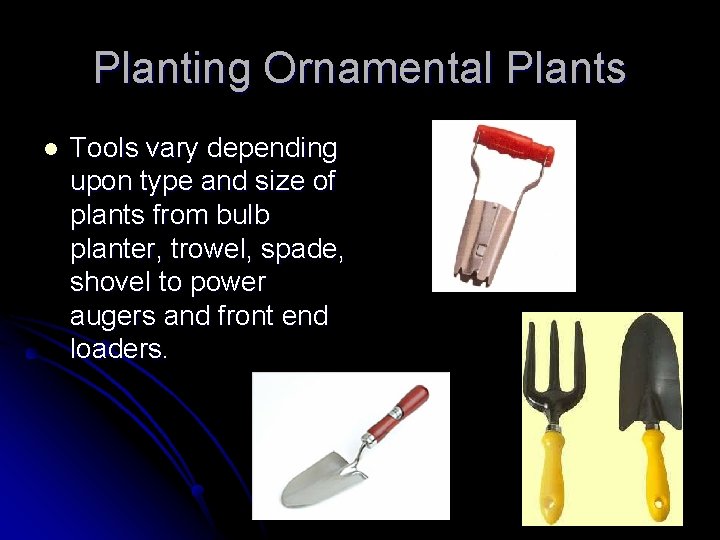
Planting Ornamental Plants l Tools vary depending upon type and size of plants from bulb planter, trowel, spade, shovel to power augers and front end loaders.