
Landscape vs Geobiocoenology http user mendelu czkusbach Antonn
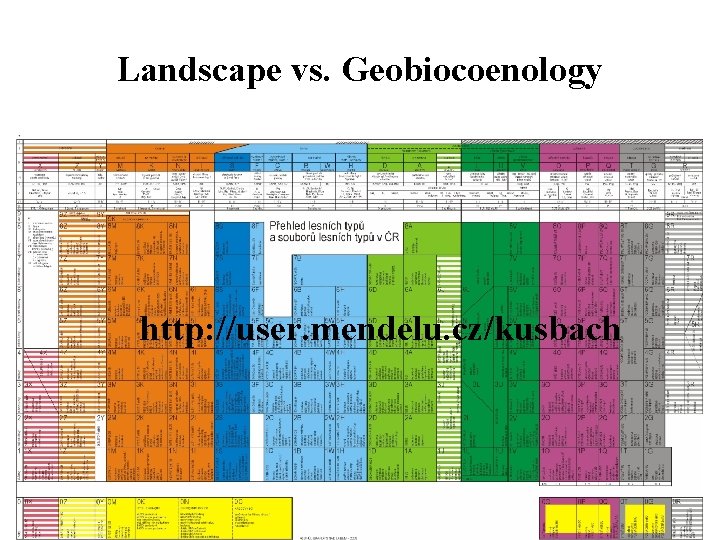
Landscape vs. Geobiocoenology http: //user. mendelu. cz/kusbach
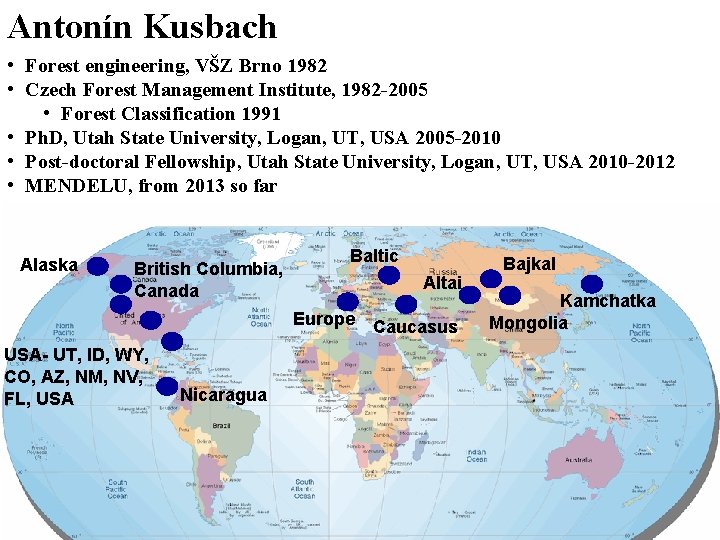
Antonín Kusbach • Forest engineering, VŠZ Brno 1982 • Czech Forest Management Institute, 1982 -2005 • Forest Classification 1991 • Ph. D, Utah State University, Logan, UT, USA 2005 -2010 • Post-doctoral Fellowship, Utah State University, Logan, UT, USA 2010 -2012 • MENDELU, from 2013 so far Alaska British Columbia, Canada Baltic Altai Europe USA- UT, ID, WY, CO, AZ, NM, NV, FL, USA Nicaragua Caucasus Bajkal Kamchatka Mongolia
80 -86386 -10 -4 Complementary Study Materials and Sources Forest Manag. Institute: http: //www. uhul. cz/nase-cinnost/lesnicka-typologie/uvod Plíva, K. Typologický klasifikační systém ÚHÚL. 1987: http: //www. uhul. cz/images/typologie/Typologicky_klasifikacni_system_UHUL_Pli va_1987. pdf Forest Management Series. Available at: http: //www. uhul. cz/images/typologie/SLT_CHS_MZD_ceny_pozemku. pdf Soil taxonomical system: http: //klasifikace. pedologie. cz http: //www. uhul. cz/images/typologie/taxonomicky_klasifikacni_system_pud_v_cr. pdf Plíva, K. : Funkčně integrované lesní hospodářství. 1. Přírodní podmínky v lesním plánování. Brandýs nad Labem: Ústav pro hospodářskou úpravu lesů. 1991. Průša, E. : Pěstování lesů na typologických základech. Lesnická práce Kostelec n. Č. l. 2001. ISBN 80 -86386 -10 -4. Power Point: http: //user. mendelu. cz/kusbach/
Landscape ecology introduction Aims of landscape ecology intro: 1) Short introduction to landscape ecology (definitions, basic terms, etc. ) 2) Principles of landscape differentiation and landscape typology (geobiocoenology)
Fundamentals of landscape ecology • Landscape structure • Landscape fragmentation • Island theory • Ecological networks • Biogeographical landscape differentiation in geobiocoenological conception • Landscape (biotope) mapping • Landscape character
What is it the landscape? Landscape = heterogeneous part of earth surface, composed by a set of ecosystems (both, natural and created by man) influencing each other, that can repeat in similar forms (according to Forman, Godron)
What is it the landscape? Landscape = part of earth surface, that creates the unit differing from surroundings. Landscape has geographical position, boundaries and physiognomy depending on bedrock, local climate, soils, relief (=abiotic factors), biotic factors and man activity
Landscape perception l l l Landscape perceived by man Landscape perceived by animals Landscape perceived by plants Any human intervention to landscape is necessary to evaluate not only from narrow perspective of man, but we have to know, that the landscape is differently perceived and used by other kinds of organisms – animals and plants.
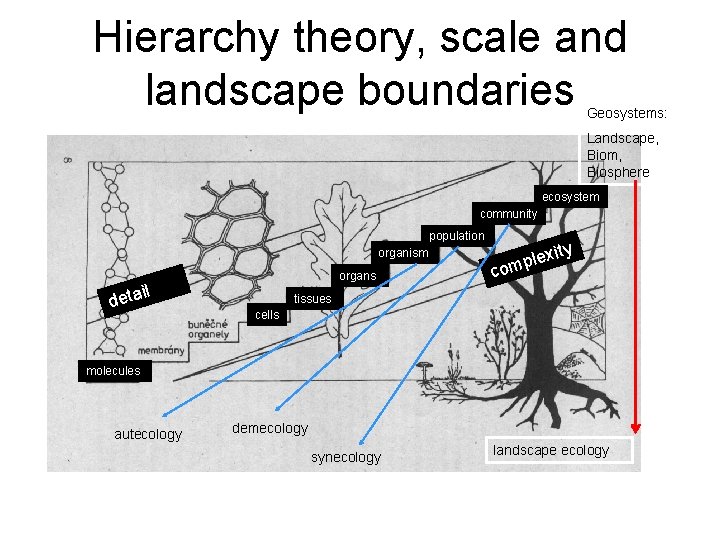
Hierarchy theory, scale and landscape boundaries Geosystems: Landscape, Biom, Biosphere ecosystem community population organism deta organs il ity x e l mp co tissues cells molecules autecology demecology synecology landscape ecology
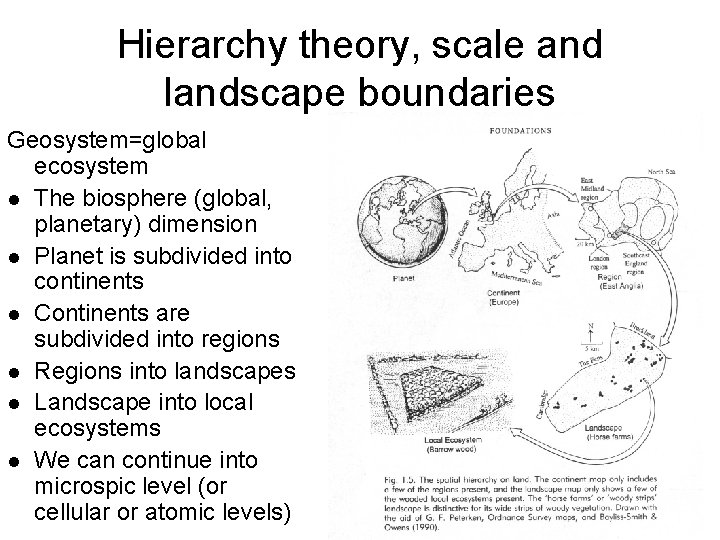
Hierarchy theory, scale and landscape boundaries Geosystem=global ecosystem l The biosphere (global, planetary) dimension l Planet is subdivided into continents l Continents are subdivided into regions l Regions into landscapes l Landscape into local ecosystems l We can continue into microspic level (or cellular or atomic levels)
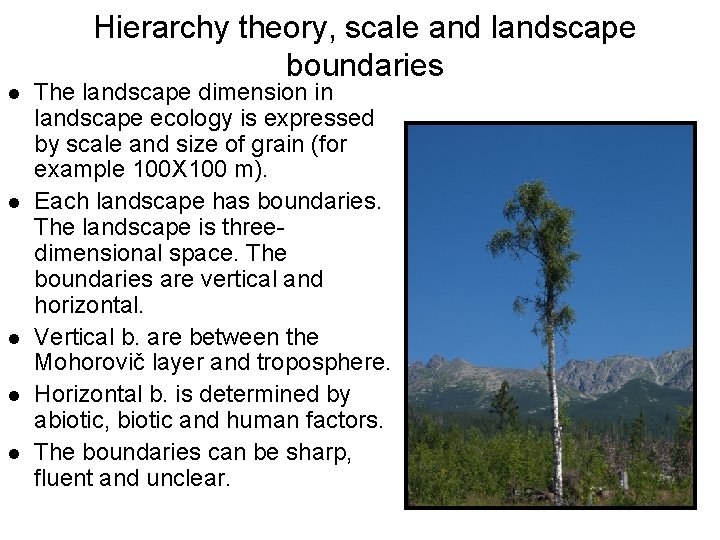
Hierarchy theory, scale and landscape boundaries l l l The landscape dimension in landscape ecology is expressed by scale and size of grain (for example 100 X 100 m). Each landscape has boundaries. The landscape is threedimensional space. The boundaries are vertical and horizontal. Vertical b. are between the Mohorovič layer and troposphere. Horizontal b. is determined by abiotic, biotic and human factors. The boundaries can be sharp, fluent and unclear.
Hierarchy theory, scale and landscape boundaries l l l The fourth landscape dimension is the time We are talking about spatiotemporal scale of landscape The landscape is changing during the time due to natural processes (succession) and antropic influences (human development).
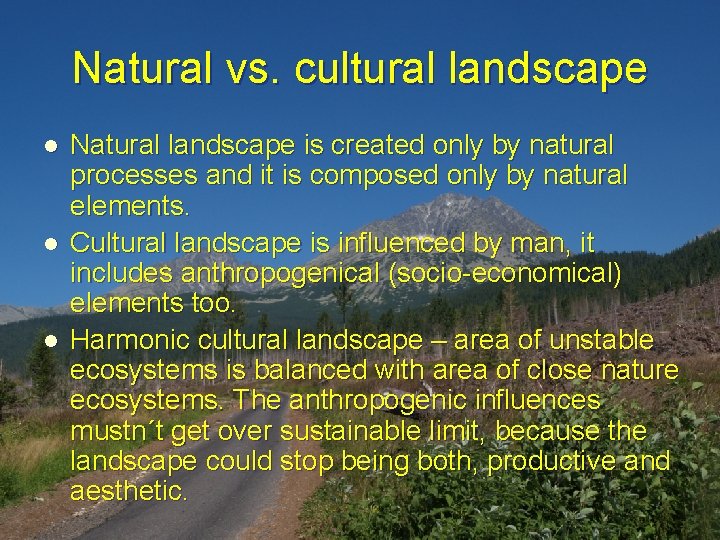
Natural vs. cultural landscape l l l Natural landscape is created only by natural processes and it is composed only by natural elements. Cultural landscape is influenced by man, it includes anthropogenical (socio-economical) elements too. Harmonic cultural landscape – area of unstable ecosystems is balanced with area of close nature ecosystems. The anthropogenic influences mustn´t get over sustainable limit, because the landscape could stop being both, productive and aesthetic.
The main landscape types l l Urban landscape (industrial) – high proportion of built-up and industrial areas, brown fields etc. Proportion of green vegetation is minor. Agricultural landscape – majority of fields, arable lands, forests up to 10% Forest landscape – with large complex of closed forests Agricultural-forest landscape – with mosaic of fields, meadows, forests, pastures, orchards and villages, it is close to harmonic cultural landscape.
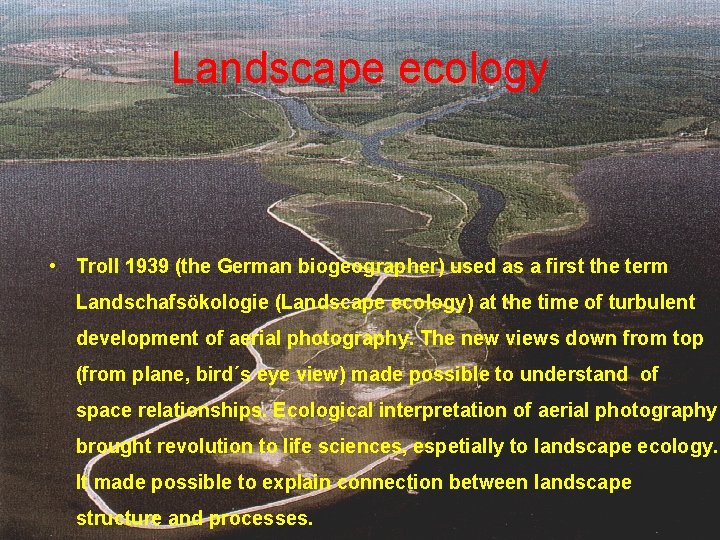
Landscape ecology • Troll 1939 (the German biogeographer) used as a first the term Landschafsökologie (Landscape ecology) at the time of turbulent development of aerial photography. The new views down from top (from plane, bird´s eye view) made possible to understand of space relationships. Ecological interpretation of aerial photography brought revolution to life sciences, espetially to landscape ecology. It made possible to explain connection between landscape structure and processes.
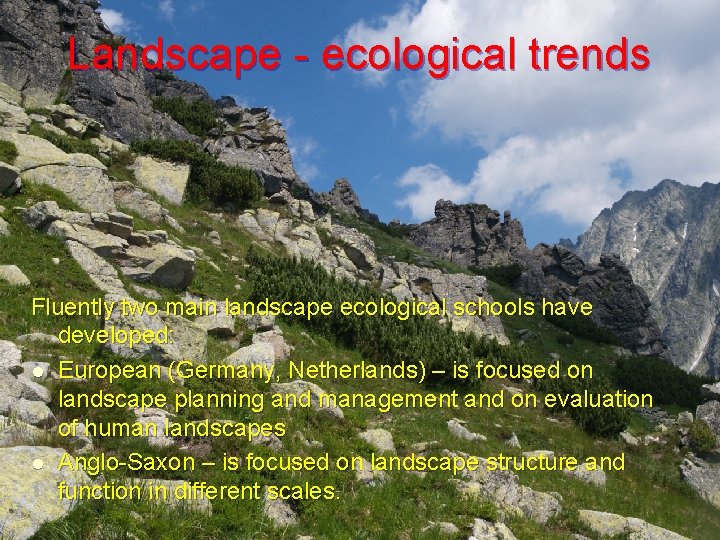
Landscape - ecological trends Fluently two main landscape ecological schools have developed: l European (Germany, Netherlands) – is focused on landscape planning and management and on evaluation of human landscapes l Anglo-Saxon – is focused on landscape structure and function in different scales.
The role of landscape ecology in science system l LE is transdisciplinary science (Zonnenveld) – it integrates different sciences (Geology, Geomorphology, Soil science, Hydrology, Botany, Zoology, Geography, Climatology, etc. ) and uses different approaches (GIS, GPS, aerial photography, remote sensing by satelites, …)
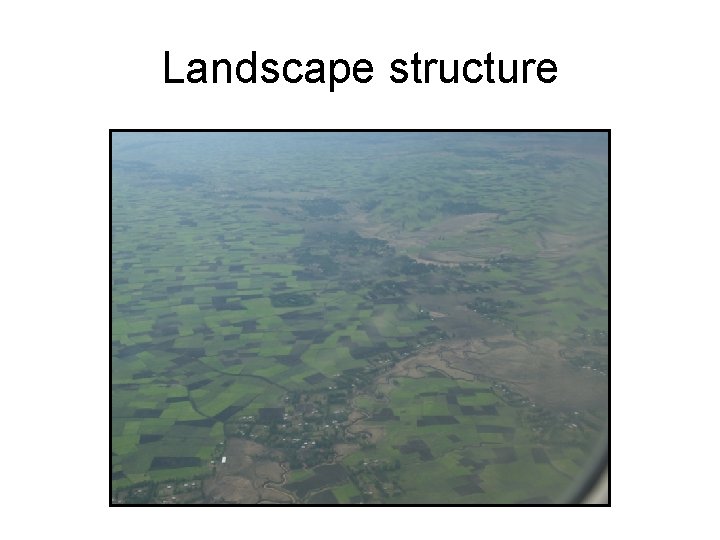
Landscape structure
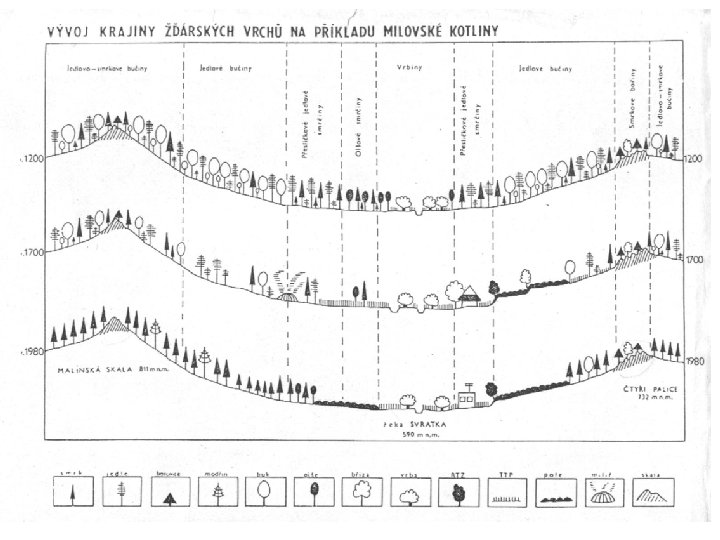
Theory of geobiocoene type This theory make possible to create model of natural state of landscape. It means such state, which should be in landscape without man influence.
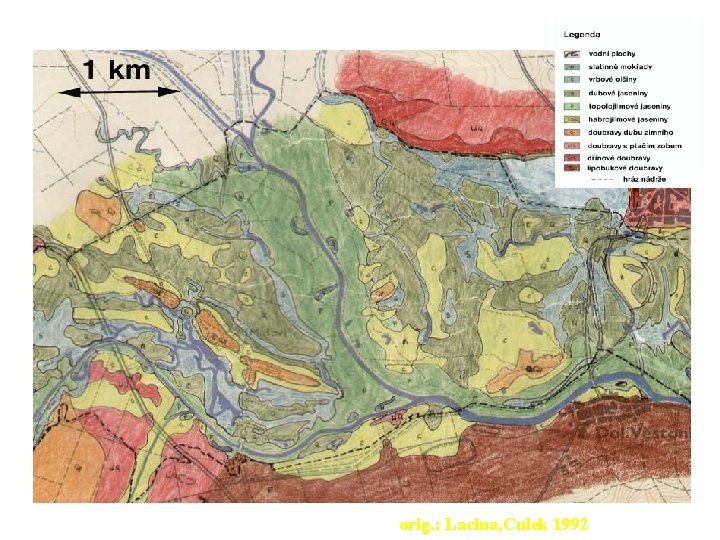
orig. : Lacina, Culek 1992
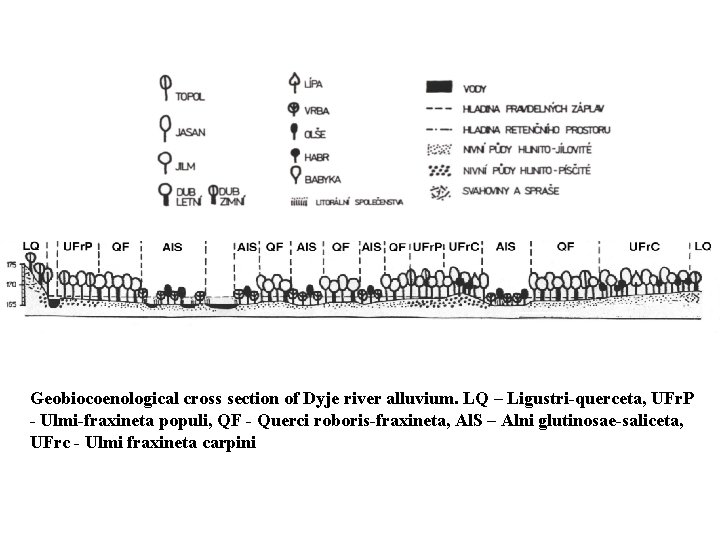
Pleistocénní a holocénní fluviální štěrky a štěrkopísky Geobiocoenological cross section of Dyje river alluvium. LQ – Ligustri-querceta, UFr. P - Ulmi-fraxineta populi, QF - Querci roboris-fraxineta, Al. S – Alni glutinosae-saliceta, UFrc - Ulmi fraxineta carpini
Principles of geobiocoenological landscape typification l l l Biogeocoenosis was considered as a part of the Earth surface on which the biocoenosis and to it corresponding parts of atmosphere, lithosphere, hydrosphere and pedosphere as well as their mutual relations remain homogeneous, thus constituting a uniform and internally conditioned complex (SUKACHEV 1949). The original Sukachev’s term was altered by ZLATNÍK (1975) to geobiocoenosis, the reason being an improper division of the central notion of biocoenosis. Geobiocoenology is defined by ZLATNÍK (1973) as a coenological discipline dealing with the unity of biocoenosis and ecotope, i. e. with geobiocoenosis. In this concept, geobiocoenology belongs in the sphere of natural sciences with its focal point dwelling in biology, and forms a necessary base of landscape ecology (ZLATNÍK 1975). In the Central-European landscape, the natural (potential) geobiocoenoses are mainly forest geobiocoenoses which would have -without the impact of commercial human activities - normally exhibited alternation of individual stages of the developmental cycle of forest biocoenoses (regeneration, growth, maturity, disintegration) in dependence on diverse permanent ecological conditions, given by the properties of bedrock, relief, climate and soils.
- Slides: 23