
Landscape Unit Planning Guide Training 1 Agenda for
- Slides: 22
Landscape Unit Planning Guide Training 1
Agenda for the day 8: 30 AM - 4: 30 PM - opening remarks - introduction - wildlife tree retention - review principles of OGMA delineation - case studies 2
Purpose of training • To learn how to use the LUPG to maximize the benefits to biodiversity within the timber supply impact cap – to understand the technical procedures for delineating OGMAs – to review changes to wildlife tree retention calculations and implementation 3
Who is involved in LU planning? • lead the process: government (MOF & MELP) • contribute information: agencies, industry, ENGOs, others • compile information, delineate OGMAs & prepare draft LU objectives: MELP & MOF district planners • review & comment: public, tenure-holders, interest groups, First Nations • establish objectives: DM & DEO (the SDMs) • implement: licensees, Small Business Program 4
Why are we managing for biodiversity? • To maintain the diversity of plants, animals and other living organisms in all their forms and levels of organization • Maintain ecosystem integrity and function • Essential to achieve sustainability of forest resource - significant conservation provisions in the FPC • Signatory to the Biodiversity Convention 5
Key principles of biodiversity conservation • Maintain biodiversity at a variety of levels that are linked (prov, regional, landscape, stand) • Maintain habitat diversity as a surrogate to maintain biodiversity • The more managed forests resemble forests created by natural disturbances the higher the likelihood of maintaining native species and ecological processes 6
Why is old growth retention a priority? • Old growth ecosystems are becoming scarcer - thus old growth species and ecosystems are most at risk of loss • Old growth is the most difficult seral stage to recreate or manage 7
Why is old growth retention a priority? (practical benefits) • Certainty regarding operating areas • Improve standing timber inventory through elimination of interim measures once OGMAs in place 8
Why is wildlife tree retention a priority? • Retention of stand structure is fundamental to maintaining biodiversity • Need to have consistent and appropriate landscape unit objectives to ensure a sound legal basis • Landscape objectives for WTR reduce stand level only requirements 9
Principles Governing the Development of LUPG • Must be focused on elements that are most at risk • Must be operationally feasible • Must provide the best biological management within the policy limits set by government 10
Approach to maintaining biodiversity in the LUPG • To maintain viable, representative old growth forest ecosystems well distributed across their natural range through old growth objectives • To maintain important stand structure through WTR objectives 11
12
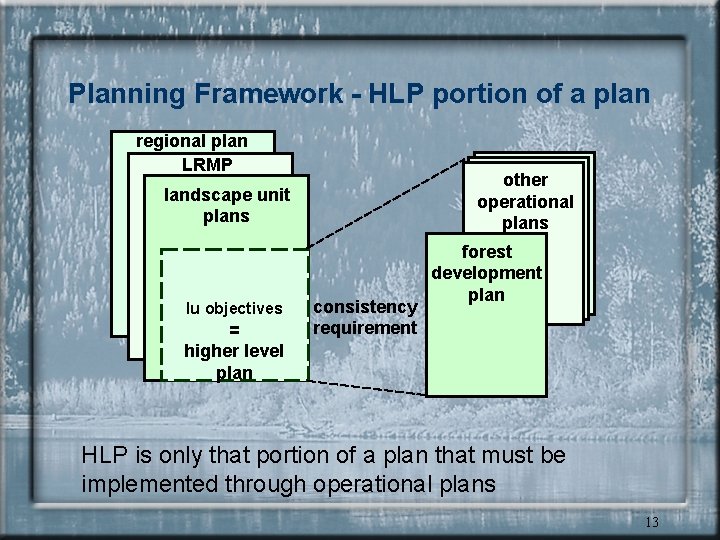
Planning Framework - HLP portion of a plan regional plan LRMP other operational plans landscape unit plans lu objectives = higher level plan consistency requirement forest development plan HLP is only that portion of a plan that must be implemented through operational plans 13
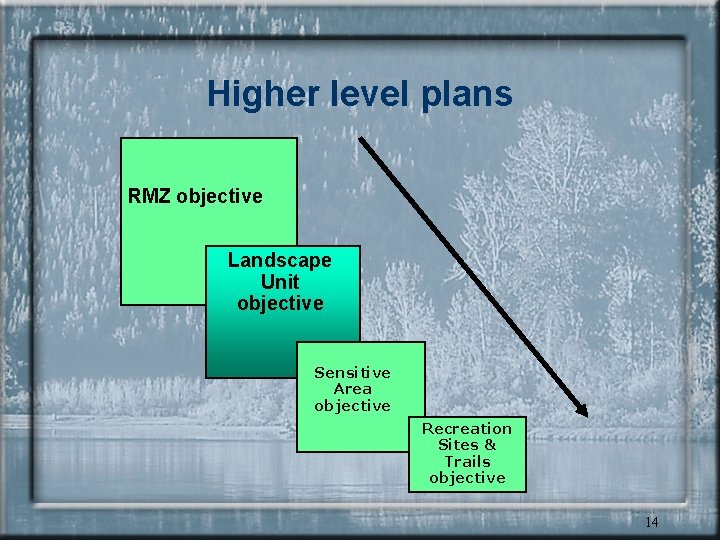
Higher level plans RMZ objective Landscape Unit objective Sensitive Area objective Recreation Sites & Trails objective 14
Function and context of the LUPG • Goal of the LUPG is to deliver maximum biodiversity conservation within the Code framework by: – following Chief Forester direction in accordance with legislation – staying within FPC timber supply impact cap (February 1996) – complying with government policy 15
Function and context of the LUPG (cont’d) • LUPG consolidates previous direction and is used along with ch 5 HLP: P&P • focusing on two priority biodiversity objectives • layout management controls 16
Management controls process controls • RLUPS & RLUPS review • Completion of LU training prior to legal establishment • The requirement to comply with the Guide • District, Regional and Headquarters working groups • Timber Supply review and associated sensitivity analysis 17
Management controls: priority biodiversity • Priority biodiversity elements - Must do • Old growth retention (OGMAs) Wildlife tree retention (WTR) (see detail in OG & WT Retention sections) • Non priority biodiversity and other forest resources - May do – where RMZ HLP directs or through draft objectives 18
Management controls: Managing Timber Supply Impacts • Timber supply impacts capped • “Rules” based approach • Table 2. 8 - checks district use of THLB • Decision made: 2 priority biodiversity elements “get” the impact budget • Other values/attributes can be accommodated in OGMAs but no additional impact budget unless RMZ HLP 19
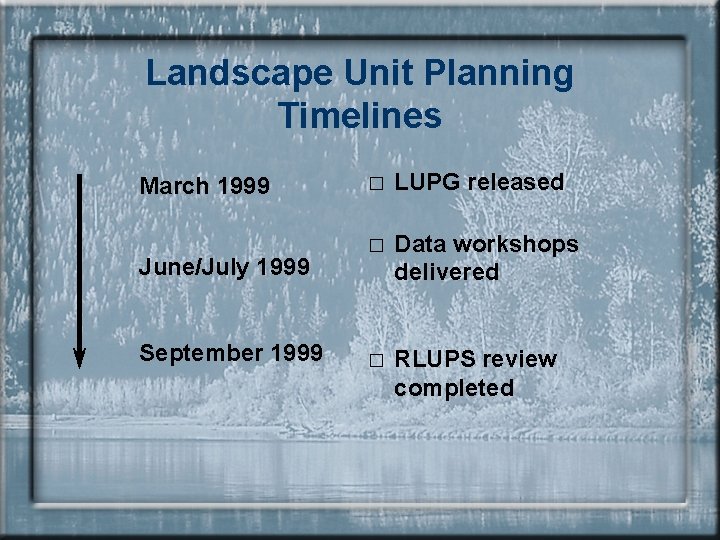
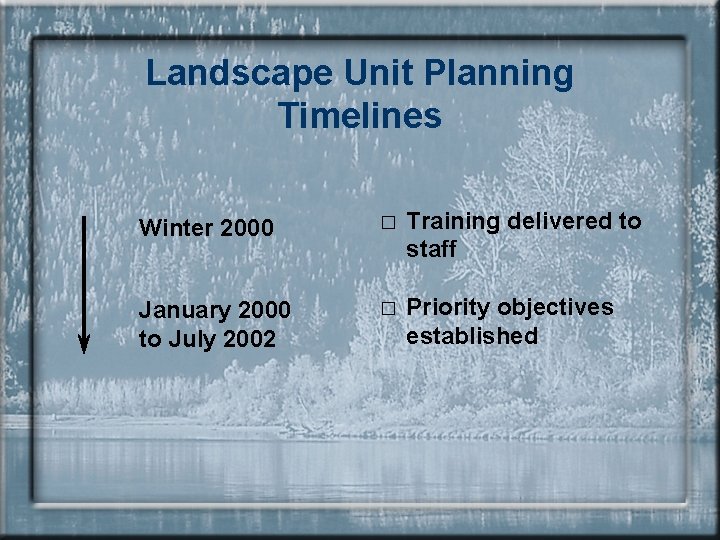
Landscape Unit Planning Timelines March 1999 June/July 1999 September 1999 � LUPG released � Data workshops delivered � RLUPS review completed
Landscape Unit Planning Timelines Winter 2000 � Training delivered to staff January 2000 to July 2002 � Priority objectives established
Successful Implementation Depends On • Clear understanding of the LUPG – balancing biological considerations within policy framework • Partnership and commitment among government, industry and environmental community • Willingness to work within management controls 22