
Landos working method Matthias E Storme Full professor
- Slides: 10
Lando’s working method Matthias E. Storme Full professor KU Leuven, Institute for commercial and insolvency law Copenhage Business School, 25 October 2019
Topics I. Purposes II. People III. Balancing IV. Instrument V. Method VI. Afterlife
I. Purposes: an imperfect code a) Alternative for conflict of law rules But also model contract code for Europe b) Need for codification c) Characteristics of a perfect code: certainty, accessability, margin of interpretation > Detailed rules + vaguer general clauses
II. People Requires sufficient common ground Ø independent, comparative The common values - In the field of ethics, economics, legal technique - Christian ethics, corrected market economy, …
III. Balancing • Common values, different opinions as to their balancing • > More, or less, freedom of contract (’liberal/social’) • Political differences rather than cultural ones • Is there still sufficient common ground today ?
IV. Instrument Restatement: rules, comments, examples, sources Structure: “life-cycle” Accessible language (Huber) Generalisation or redundant repetition ?
V. Method Practica Best rule as a result of functional comparative analysis - Comparative law: collective reason - Cases/problems > similar solutions Did it work ? E. g. specific performance, agency Operative rules, no definitions Terminology fit to be common How much in the blackletter rules? Question of acceptability in national legal order Translatability !
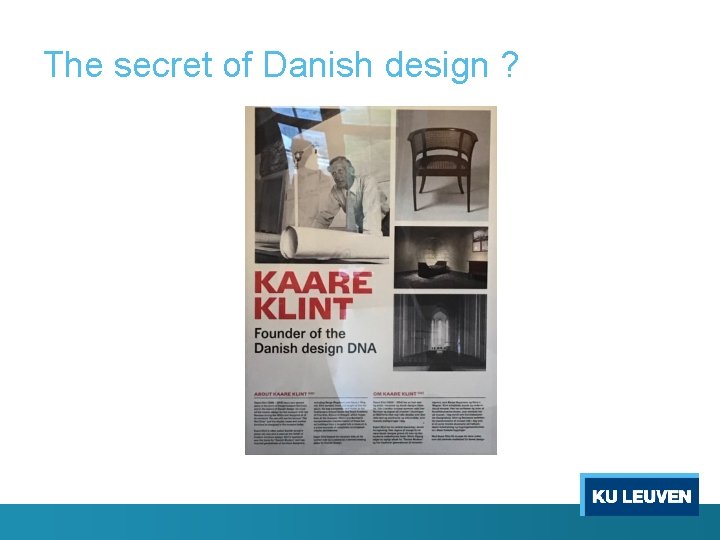
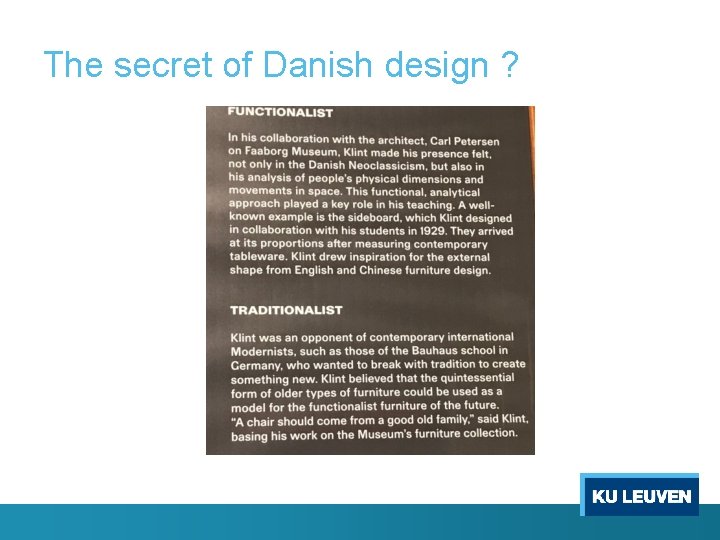
The secret of Danish design ?
The secret of Danish design ?
Topics VI. Afterlife General contract law without specific contracts ? Did the balance shift in the DCFR ?