
Landing the Raven Positioning the Knowledge Discovery System
- Slides: 25
Landing the Raven: Positioning the Knowledge Discovery System in the Enterprise Wendi Pohs, Iris Associates wendi_pohs@iris. com
n. What Contents is the Knowledge Discovery System? n. Knowledge Management Architectures n. Content stores: Spiders n. Information warehouse: The K-map n. Classification: K-map Builder n. Retrieval: K-map Indexer n. Presentation: K-station n. Association: Metrics n. Tales from the trenches
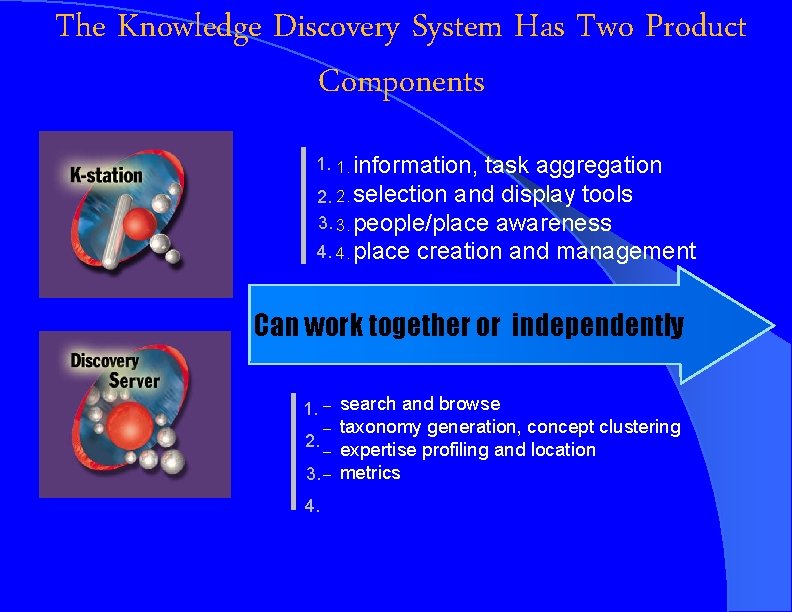
The Knowledge Discovery System Has Two Product Components 1. 1. information, task aggregation 2. 2. selection and display tools 3. 3. people/place awareness 4. 4. place creation and management Can work together or independently 1. – search and browse taxonomy generation, concept clustering – expertise profiling and location 3. – metrics 2. 4. –
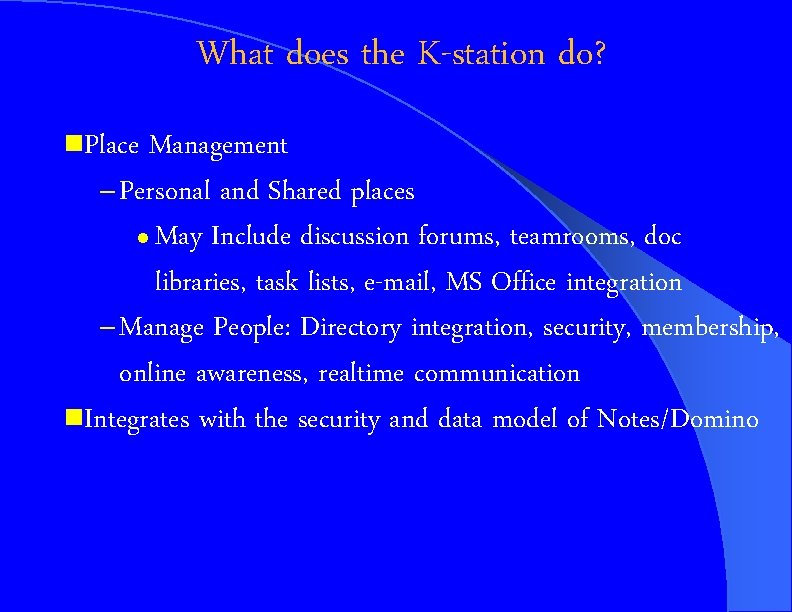
What does the K-station do? n. Place Management – Personal and Shared places l May Include discussion forums, teamrooms, doc libraries, task lists, e-mail, MS Office integration – Manage People: Directory integration, security, membership, online awareness, realtime communication n. Integrates with the security and data model of Notes/Domino
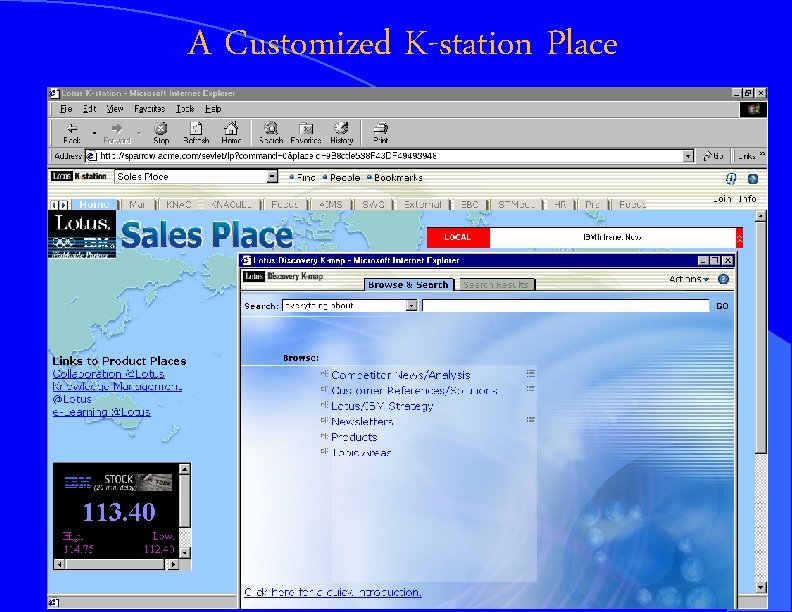
A Customized K-station Place
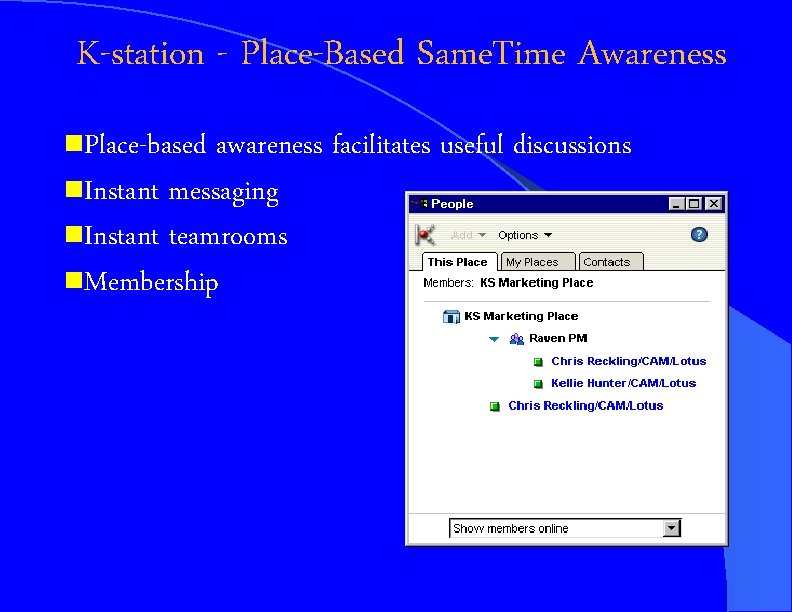
K-station - Place-Based Same. Time Awareness n. Place-based awareness facilitates useful discussions n. Instant messaging n. Instant teamrooms n. Membership
The Knowledge Discovery Server n. Connects people with the right info at the right time – Integrates People, Places, Things into a Knowledge Map – Discovers relationships between People, Content and Categories to add context to information n. Supports KM practices within organizations – Respects user privacy – Enforces system security
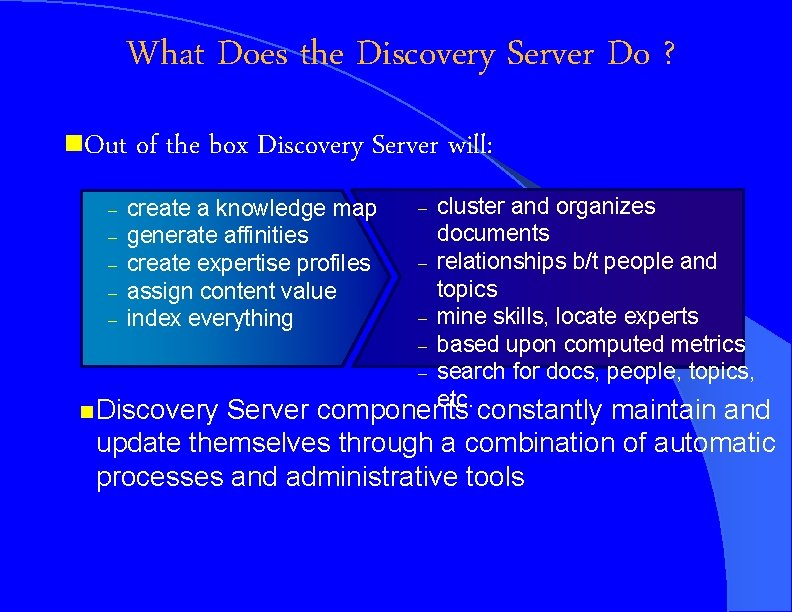
What Does the Discovery Server Do ? n. Out – – – of the box Discovery Server will: create a knowledge map generate affinities create expertise profiles assign content value index everything – – – n Discovery cluster and organizes documents relationships b/t people and topics mine skills, locate experts based upon computed metrics search for docs, people, topics, etc. Server components constantly maintain and update themselves through a combination of automatic processes and administrative tools
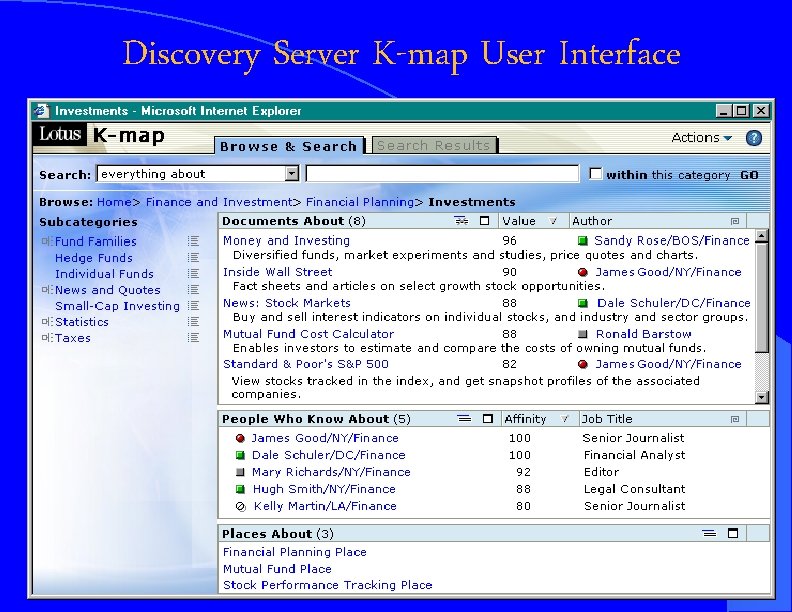
Discovery Server K-map User Interface
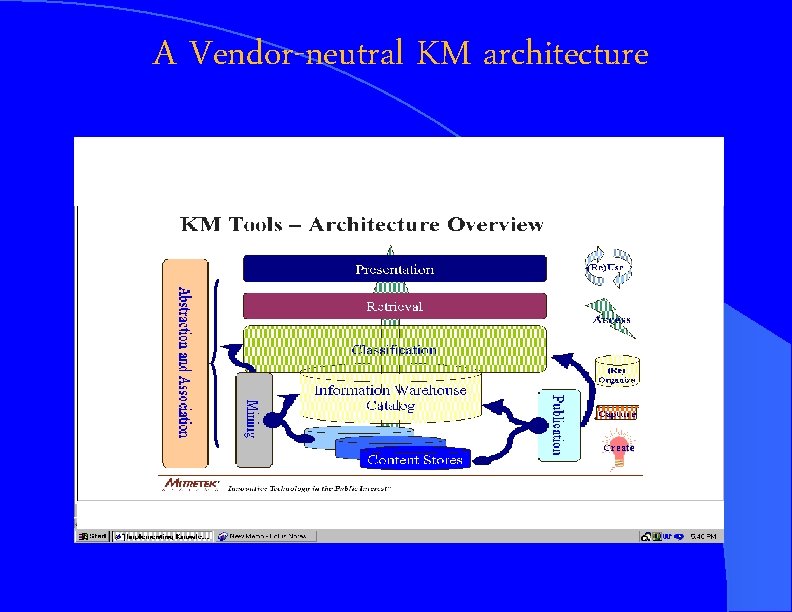
A Vendor-neutral KM architecture
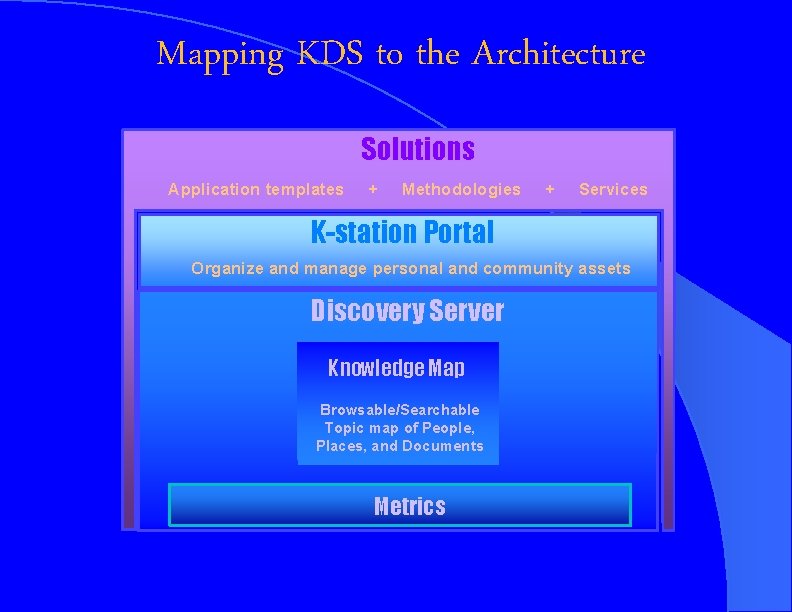
Mapping KDS to the Architecture Solutions Application templates + Methodologies + Services K-station Portal Organize and manage personal and community assets Discovery Server Knowledge Map Browsable/Searchable Topic map of People, Places, and Documents Metrics
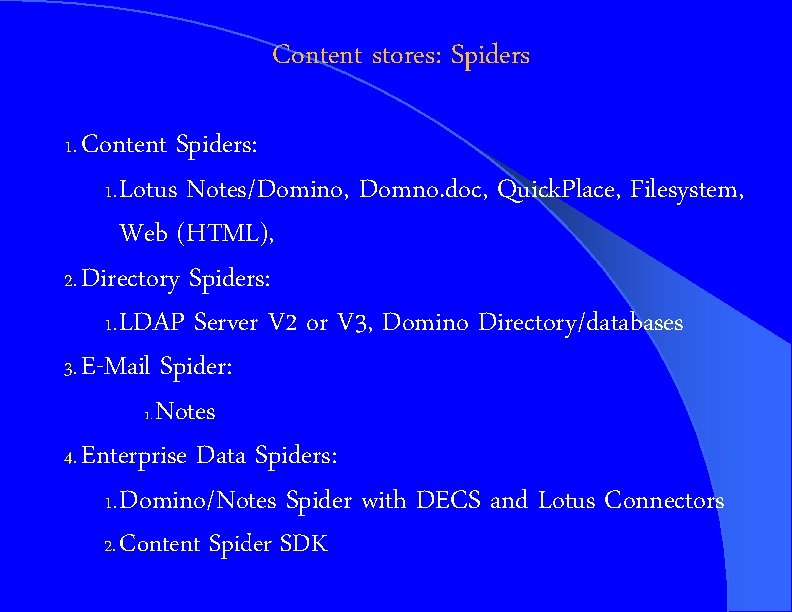
Content stores: Spiders 1. Content Spiders: 1. Lotus Notes/Domino, Domno. doc, Quick. Place, Filesystem, Web (HTML), 2. Directory Spiders: 1. LDAP Server V 2 or V 3, Domino Directory/databases 3. E-Mail Spider: 1. Notes 4. Enterprise Data Spiders: 1. Domino/Notes Spider with DECS and Lotus Connectors 2. Content Spider SDK
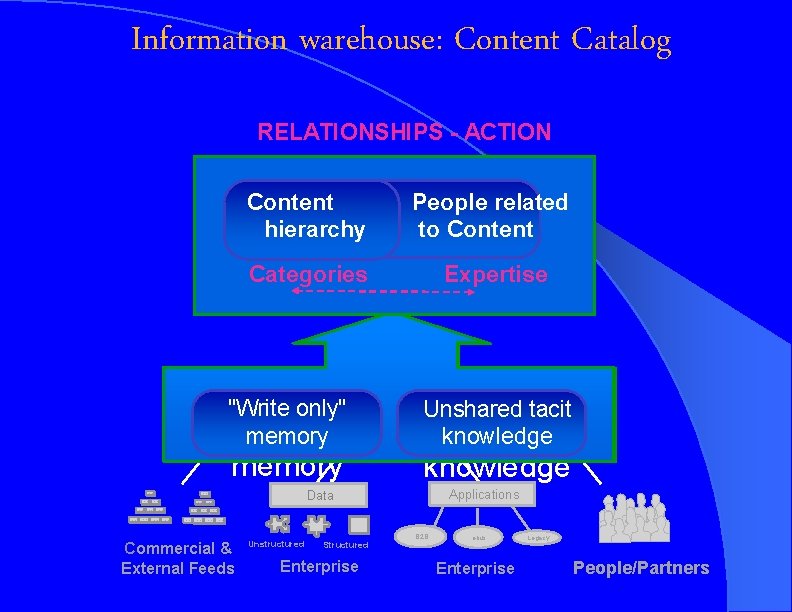
Information warehouse: Content Catalog RELATIONSHIPS - ACTION Content hierarchy People related to Content Categories Expertise TRADITIONAL ENTERPRISE "Write Unshared "Write only" Unshared tacit only" tacit memory knowledge Type text Type text Type text Type text Applications Data Type text Type text Commercial & External Feeds Unstructured Structured Enterprise B 2 B ebus Enterprise Legacy People/Partners
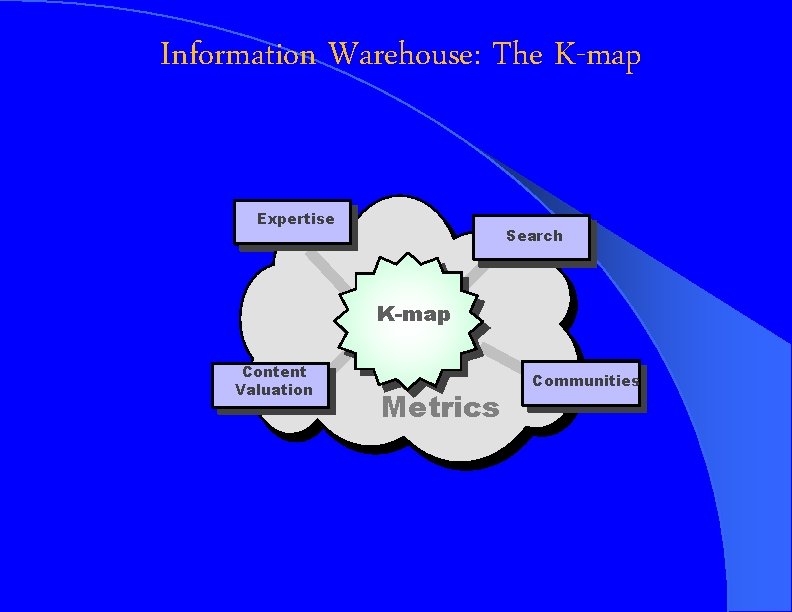
Information Warehouse: The K-map Search Expertise Search Catalog K-map Content Search Valuation Metrics Search Hot Lists Communities
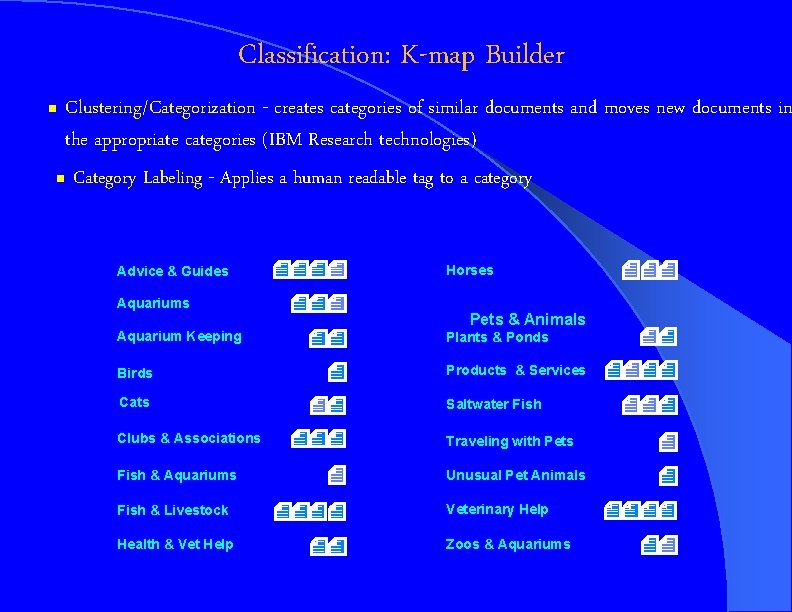
Classification: K-map Builder Clustering/Categorization - creates categories of similar documents and moves new documents in the appropriate categories (IBM Research technologies) n Category Labeling - Applies a human readable tag to a category n Advice & Guides Aquariums Horses Pets & Animals Aquarium Keeping Plants & Ponds Birds Products & Services Cats Saltwater Fish Clubs & Associations Traveling with Pets Fish & Aquariums Unusual Pet Animals Fish & Livestock Veterinary Help Health & Vet Help Zoos & Aquariums
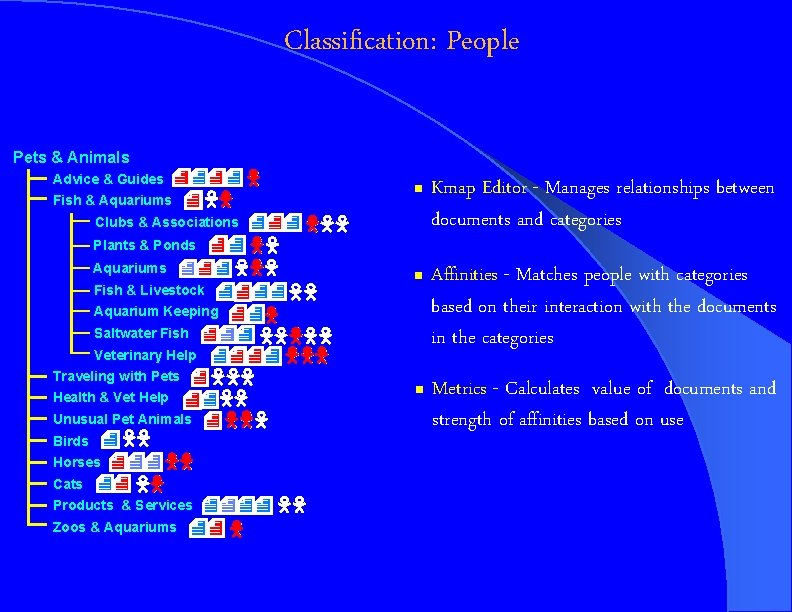
Classification: People Pets & Animals Advice & Guides Fish & Aquariums n Clubs & Associations Plants & Ponds Aquariums Fish & Livestock n Aquarium Keeping Saltwater Fish Veterinary Help Traveling with Pets Health & Vet Help Unusual Pet Animals Birds Horses Cats Products & Services Zoos & Aquariums n Kmap Editor - Manages relationships between documents and categories Affinities - Matches people with categories based on their interaction with the documents in the categories Metrics - Calculates value of documents and strength of affinities based on use
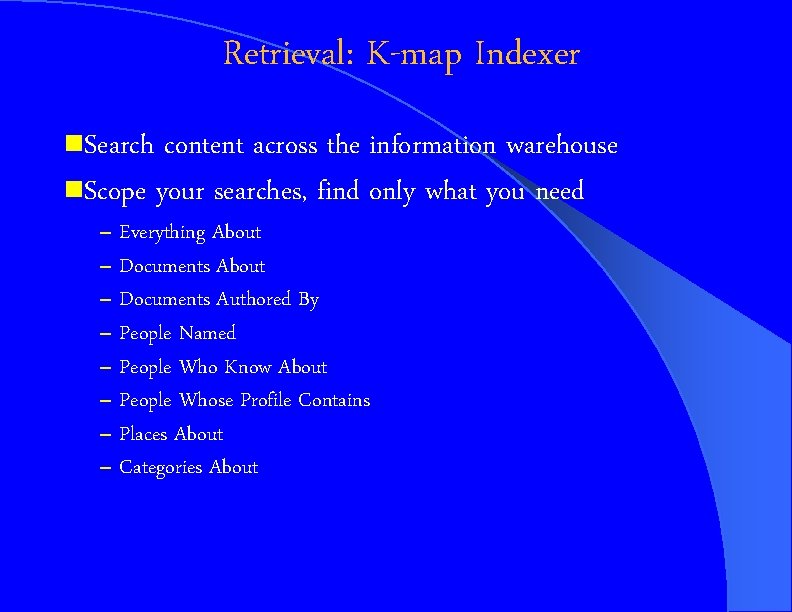
Retrieval: K-map Indexer n. Search content across the information warehouse n. Scope your searches, find only what you need Everything About – Documents Authored By – People Named – People Who Know About – People Whose Profile Contains – Places About – Categories About –
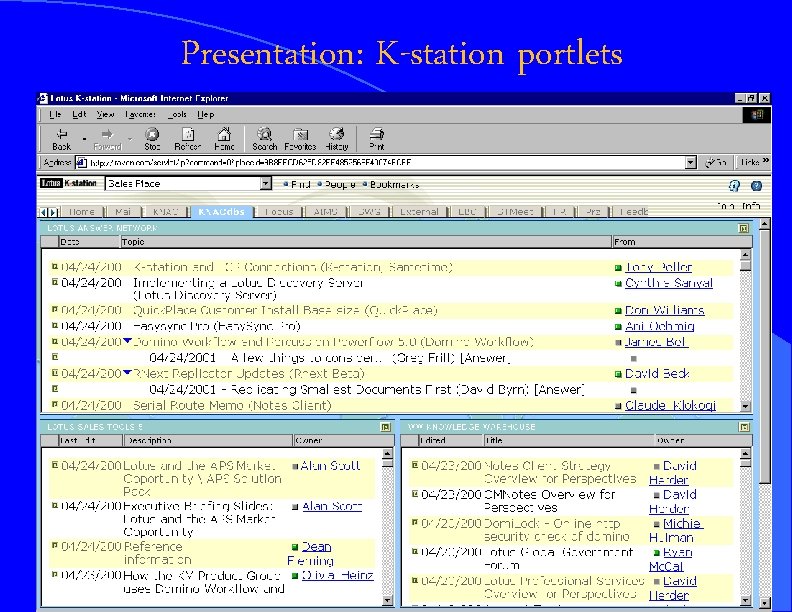
Presentation: K-station n. Portal with common structure n. Create shared places from templates n. Put information in context n. Reuse places as templates
Presentation: K-station portlets
Association: Metrics n. Metrics – Collects "Digital Breadcrumbs" l Statistics about information flow – No additional burden on users – Leverages document meta data – Analyses trends, relationships, and patterns
Association: Basic Metrics 1. Authorship - documents created by person 2. Linkage - number of links to/from a document 3. Messages - number of messages between two people, number of links forwarded 4. Activity of document or database - frequency of change, volume of change 5. Activity of person - frequency of system use
Association: Advanced Metrics n. Advanced Metrics are calculated using basic metrics and relationships between entities n. Person to Topic Affinity - based on documents in the topic and the people who authored, contributed, distributed, and read n. Value of Document - based on activity of document, linkage n. Value of Topic - sum of Value of Documents in Topic
Association: Metrics Reports 1. Most Content and Usage Activity: Active K-map Categories 2. Highest Document Values 3. Most Active Authors 4. Most Active/Linked To/From Documents 5. Most Active/Read Documents 2. Monitors Activity Trends over Time
Tales from the trenches n. Set appropriate expectations – Map to a known business process – Determine access to content stores in advance – Anticipate some effort to create and maintain the taxonomy – Look at existing meta-data n. If creating user profiles and affinities, consider privacy issues
Lotus KM Product Information www. lotus. com/km 1. www. lotus. com/k-station 2. www. lotus. com/discoveryserver 2. www. notes. net - KM Discussion 1.