
Landforms of Erosion Aim To understand different types
- Slides: 7
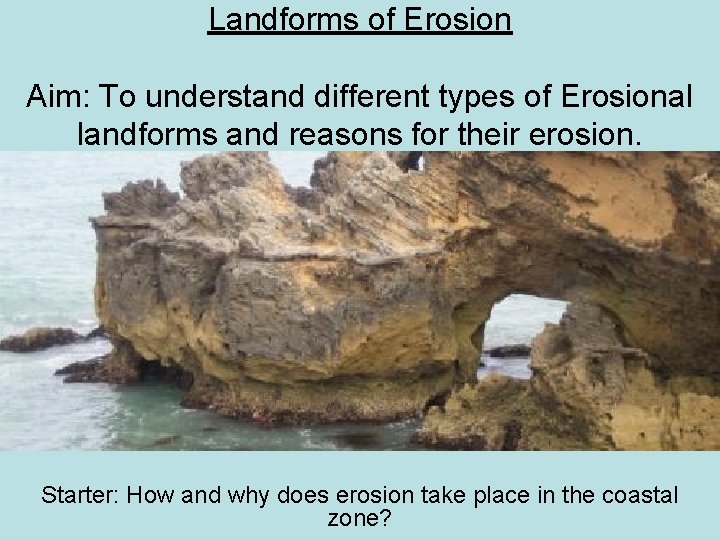
Landforms of Erosion Aim: To understand different types of Erosional landforms and reasons for their erosion. Starter: How and why does erosion take place in the coastal zone?
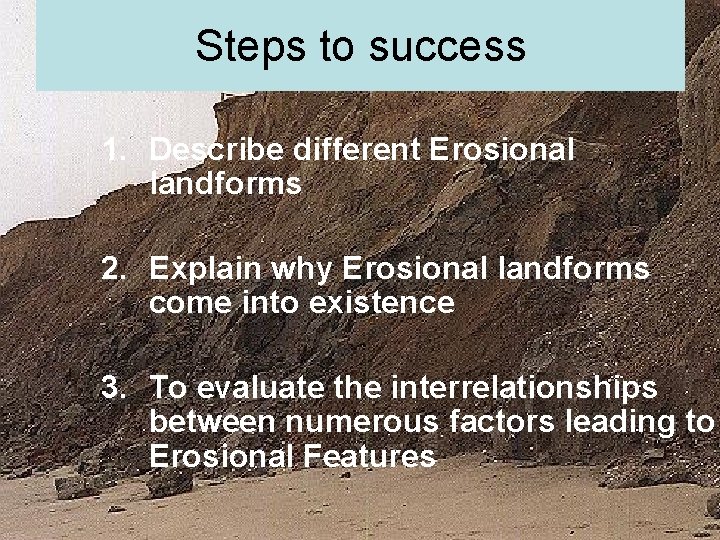
Steps to success 1. Describe different Erosional landforms 2. Explain why Erosional landforms come into existence 3. To evaluate the interrelationships between numerous factors leading to Erosional Features
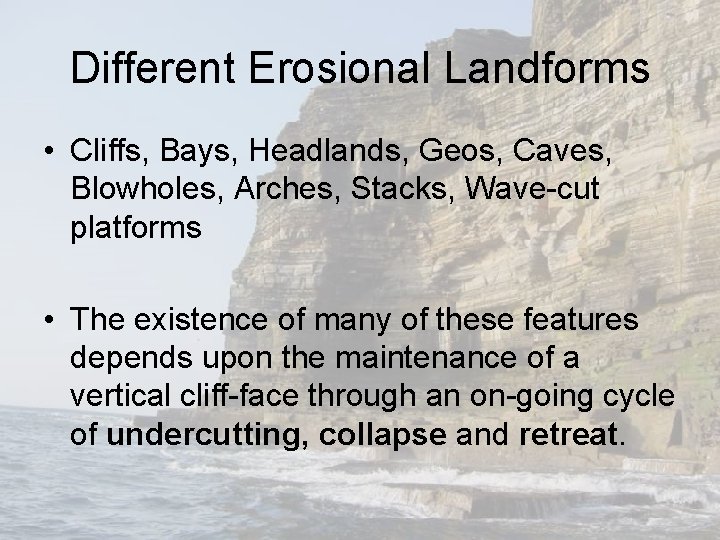
Different Erosional Landforms • Cliffs, Bays, Headlands, Geos, Caves, Blowholes, Arches, Stacks, Wave-cut platforms • The existence of many of these features depends upon the maintenance of a vertical cliff-face through an on-going cycle of undercutting, collapse and retreat.
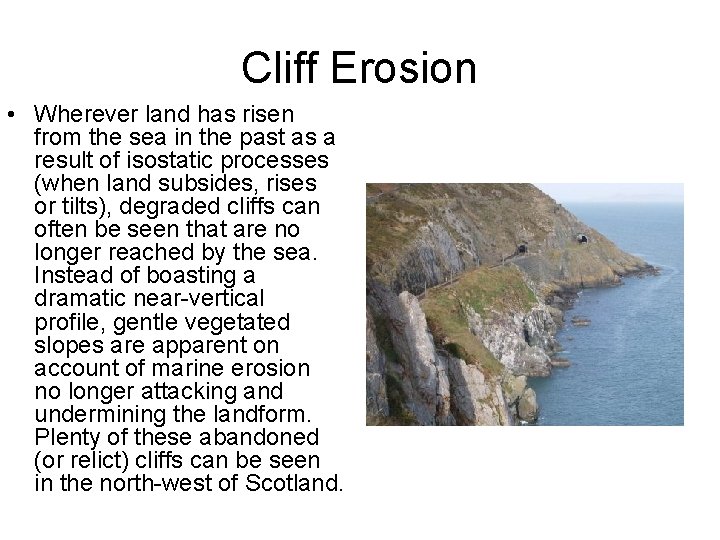
Cliff Erosion • Wherever land has risen from the sea in the past as a result of isostatic processes (when land subsides, rises or tilts), degraded cliffs can often be seen that are no longer reached by the sea. Instead of boasting a dramatic near-vertical profile, gentle vegetated slopes are apparent on account of marine erosion no longer attacking and undermining the landform. Plenty of these abandoned (or relict) cliffs can be seen in the north-west of Scotland.
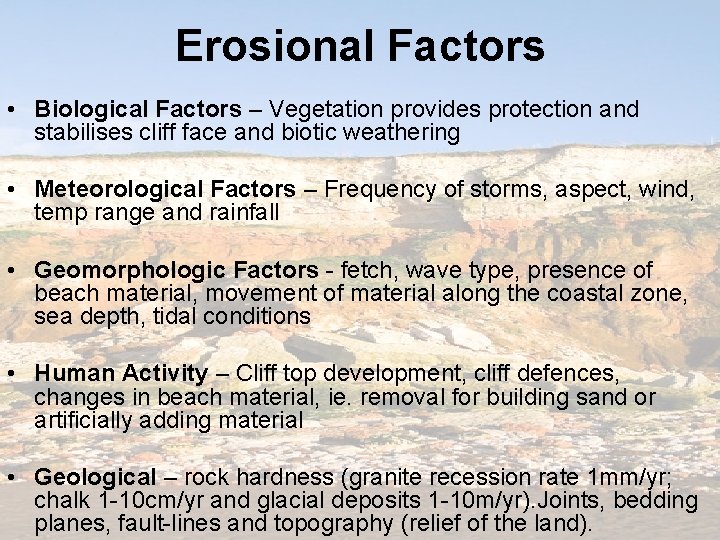
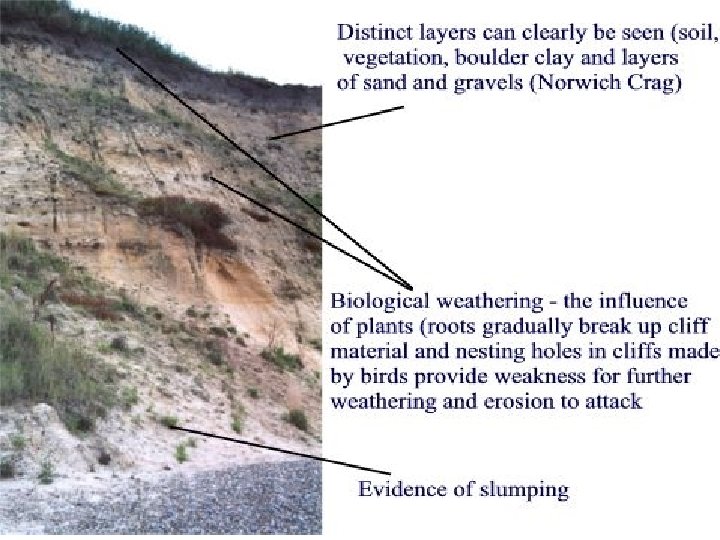
Erosional Factors • Biological Factors – Vegetation provides protection and stabilises cliff face and biotic weathering • Meteorological Factors – Frequency of storms, aspect, wind, temp range and rainfall • Geomorphologic Factors - fetch, wave type, presence of beach material, movement of material along the coastal zone, sea depth, tidal conditions • Human Activity – Cliff top development, cliff defences, changes in beach material, ie. removal for building sand or artificially adding material • Geological – rock hardness (granite recession rate 1 mm/yr; chalk 1 -10 cm/yr and glacial deposits 1 -10 m/yr). Joints, bedding planes, fault-lines and topography (relief of the land).
Define your terms!! • Coastal Zone: The coastal waters (including the lands therein and thereunder) and the adjacent shorelands (including the waters therein and thereunder), strongly influenced by each and in proximity to the shorelines of the several coastal states, and includes islands, transitional and intertidal areas, salt marshes, wetlands, and beaches.