
LANDFILL Landfill Type aerobic landfill anaerobic sanitary landfill
LANDFILL
Ø Landfill Type Ø aerobic landfill Ø anaerobic sanitary landfill with daily cover Ø improve anaerobic sanitary landfill with buried leachate collection facilities Ø landfill with forced aeration
Ø Only the anaerobic and semi-aerobic landfill are desirable when leachate and gas quality to be considered
Advantages
Disadvantages Ø Open dumping Ø Ø Ø Ø potential source of disease fires are uncontrolled air pollution smell pollute nearby waterways & ground water ugly scavenging
Sanitary landfill destruction of habitats - (wetland) Ø cause of urban land shortage Ø hence transportation cost – (distant) Ø lost of resources – cannot be replace Ø leachate leakage - (groundwater contamination) Ø maintenance after completion require 10 to 15 years Ø Non-available of suitable cover material Ø
Ø Level of Sanitary Landfill Ø Level 1: control tipping Ø Level 2: sanitary landfill with bound and daily soil cover Ø Level 3: sanitary landfill with leachate recirculation Ø Level 4: sanitary landfill with leachate treatment facilities.
Ø Landfill Technology Ø The most common landfill technologies are Ø area method Ø trench method Ø ramp method Ø sandwich method
Area method/Depression Ø terrain is unsuitable for the excavation of trenches Ø Solid waste cells constructed in a large area Ø layers of cells are created until the permitted height reached Ø Each cell represents the waste received and compacted in place and covered each day.
Ø Can accommodate very large volume operation Ø Earth dyke with height of one lift (2 -3 m) is first constructed to gate the support for compacting. Ø The wastes are unloaded at the top of the earth dyke and spread and compacted on the slope of the dyke. Ø The layers dept is from 30 – 60 cm.
Ø Depression method best for area where natural depression exist. Ø The installation liners and leachate collection system is relative easy. Ø The earth cover of this system is usually obtain from borrow-pit or brought from elsewhere.
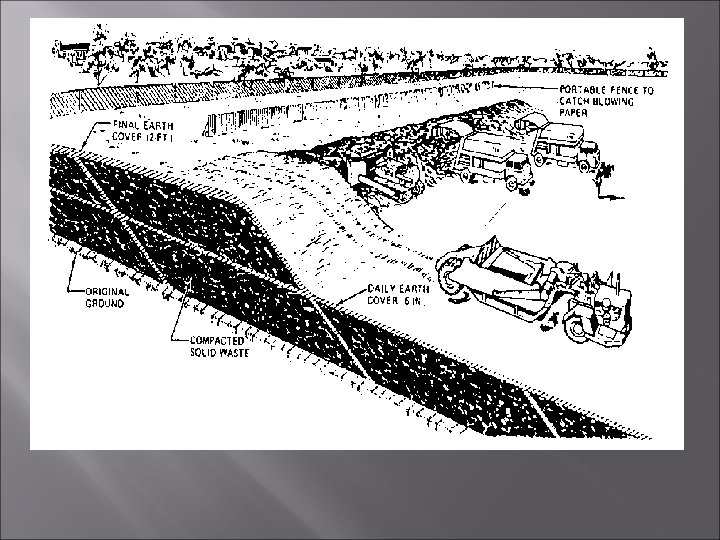
• Area method
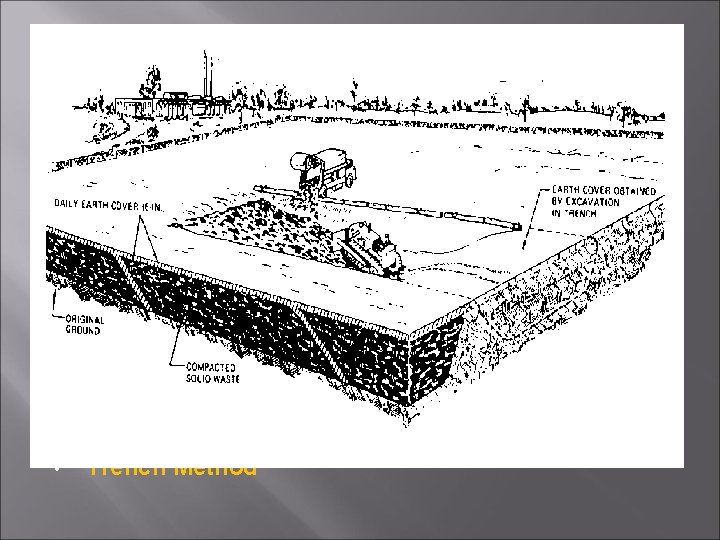
Ø Trench Method Waste is spread and compacted in an excavated trench Ø The excavator tailings are used as cover material Ø Best for flat land where the excavation of trenches can be carryout easily. Ø The ground water level should be sufficiently low Ø
Ø The trench size varies in length and width: Ø dept: 1 – 2 metre Ø width: 2 – 5 metre Ø length: 30 – 120 metre Ø Wastes are spread into thin layers from 30 60 cm and compacted before soil cover in introduced.
• Trench Method

Ø Ramp method also call progressive slope. Ø A combination of area method and trench method Ø Solid waste is spread and compacted on a slope Ø cover material is obtained directly from the front of the working face. Ø The excavation of cover material provides a depression for the next day waste. Ø
Ø Ramp is about 15 metre wide and 30 metre length and suitable height. Ø Trucks come on the top of the ramp and discharge their contents inside the trench.
Ø Sandwich method Used when the solid waste is deposited horizontally into narrow valleys. Ø Cover soil layer is added over each layer of solid waste Ø

THANK YOU
- Slides: 19