
Landfill in Boise Idaho Chapter 16 Waste Generation
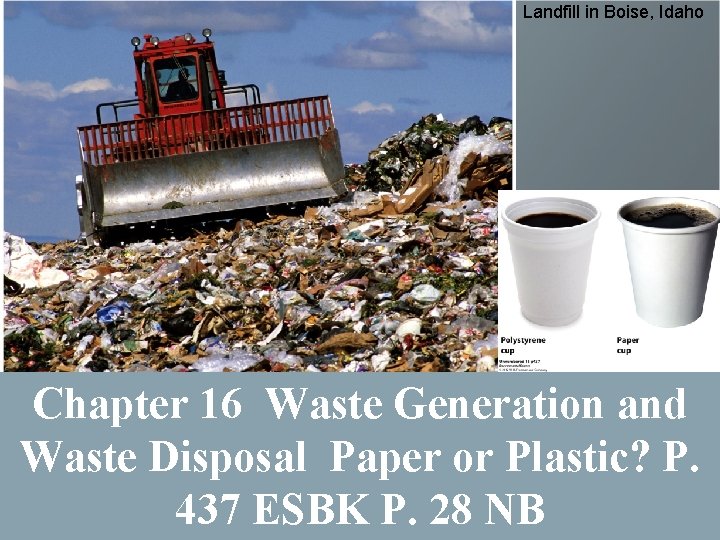
Landfill in Boise, Idaho Chapter 16 Waste Generation and Waste Disposal Paper or Plastic? P. 437 ESBK P. 28 NB
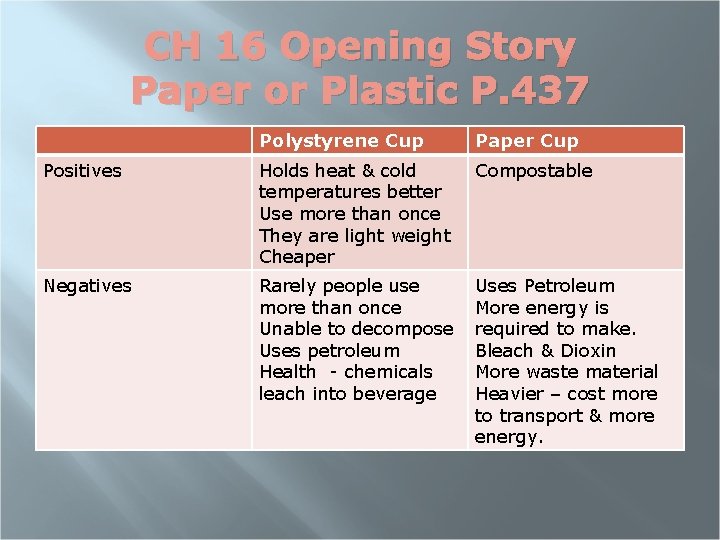
CH 16 Opening Story Paper or Plastic P. 437 Polystyrene Cup Paper Cup Positives Holds heat & cold temperatures better Use more than once They are light weight Cheaper Compostable Negatives Rarely people use more than once Unable to decompose Uses petroleum Health - chemicals leach into beverage Uses Petroleum More energy is required to make. Bleach & Dioxin More waste material Heavier – cost more to transport & more energy.
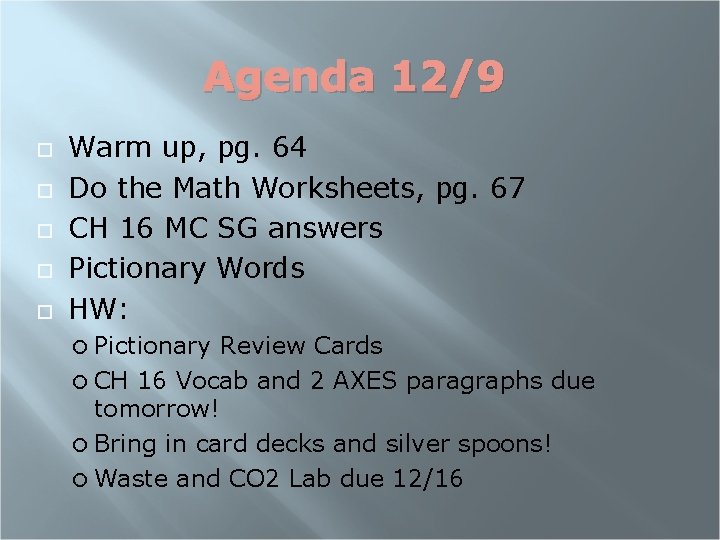
Agenda 12/9 Warm up, pg. 64 Do the Math Worksheets, pg. 67 CH 16 MC SG answers Pictionary Words HW: Pictionary Review Cards CH 16 Vocab and 2 AXES paragraphs due tomorrow! Bring in card decks and silver spoons! Waste and CO 2 Lab due 12/16
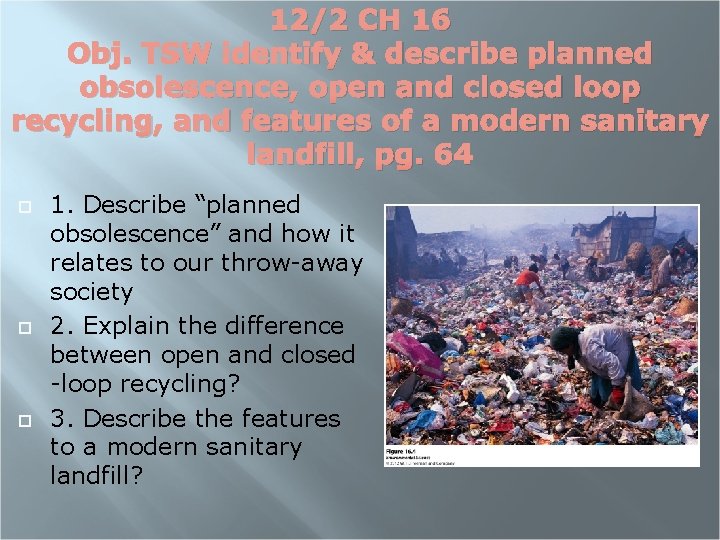
12/2 CH 16 Obj. TSW identify & describe planned obsolescence, open and closed loop recycling, and features of a modern sanitary landfill, pg. 64 1. Describe “planned obsolescence” and how it relates to our throw-away society 2. Explain the difference between open and closed -loop recycling? 3. Describe the features to a modern sanitary landfill?
Planned obsolescence Until a society becomes wealth= generates little waste Every object that no longer has value for its original purpose becomes useful 1900: Almost everything recycled Ex: ? After WWII: Able to purchase things that could be used and thrown away The design of a produce so it will need to be replaced within a few years Ex: ? Leader of “Throw Away Society”
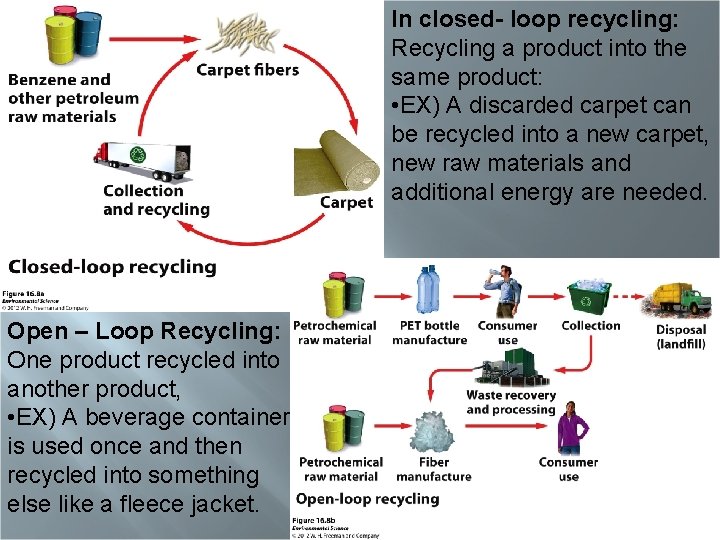
In closed- loop recycling: Recycling a product into the same product: • EX) A discarded carpet can be recycled into a new carpet, new raw materials and additional energy are needed. Open – Loop Recycling: One product recycled into another product, • EX) A beverage container is used once and then recycled into something else like a fleece jacket.
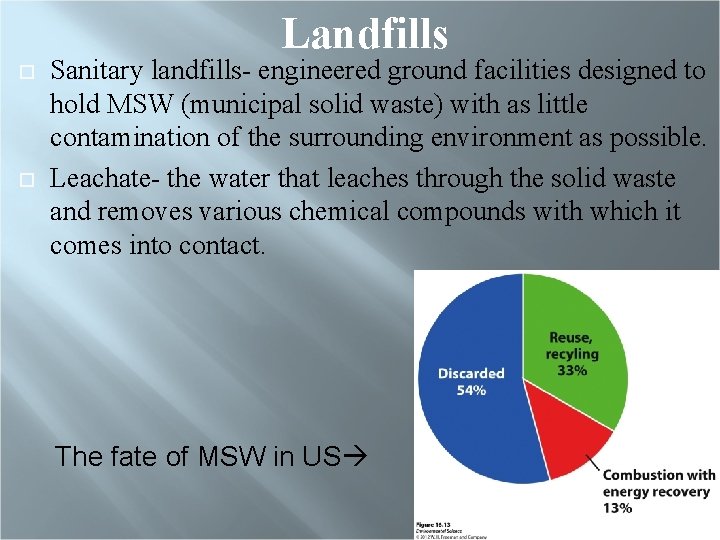
Landfills Sanitary landfills- engineered ground facilities designed to hold MSW (municipal solid waste) with as little contamination of the surrounding environment as possible. Leachate- the water that leaches through the solid waste and removes various chemical compounds with which it comes into contact. The fate of MSW in US
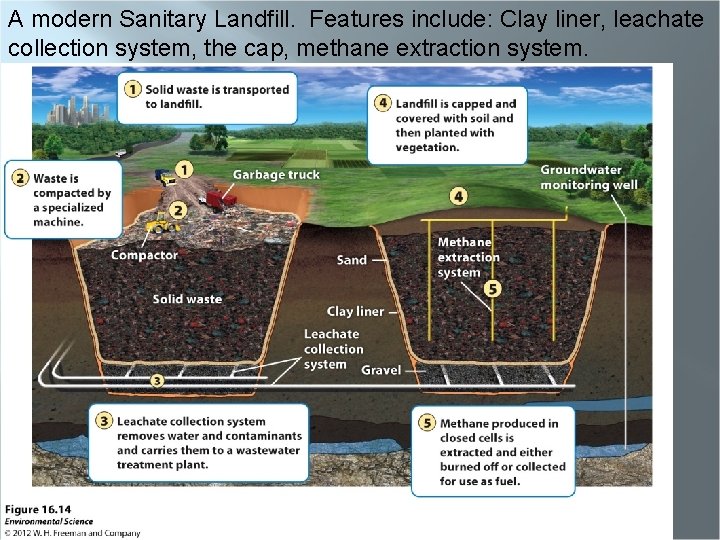
A modern Sanitary Landfill. Features include: Clay liner, leachate collection system, the cap, methane extraction system.
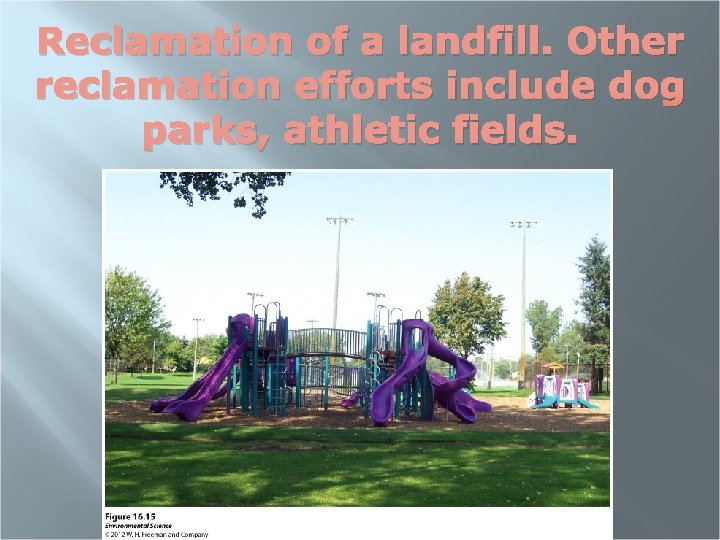
Reclamation of a landfill. Other reclamation efforts include dog parks, athletic fields.
Agenda 12/10 Warm up, pg. 66 Stamp CH 16 Vocab/2 AXES, pg. 63 Do the Math, pg. 67 Current Events: Ayat, Luis, Priashna, Lovpret Pictionary Review for CH 16 “In the News. . . ” HW: Notebook Check pg. 61 -67 Study for CH 14, 15, 16 Quiz

12/10 Waste Generation Obj. TSW identify and explain the three Rs, hazardous waste, & why it is hard to dispose of it 1. Describe three Rs? 2. What is hazardous waste, and why it is hard to dispose of? 3. Pick a vocab word/concept for Pictionary Review, come to me with word!
Pictionary Review Reduce, reuse, recycle Lifecycle analysis Modern sanitary landfill Incineration Planned obsolesce Integrated waste management brown field point source E waste VOCs Manure lagoon Leachate Waste stream Septic system Input and output Primary and secondary pollution Asbestos Particulate matter Thermal pollution MSW Photochemical smog Compost Thermal inversion Closed loop recycling Sick building syndrome
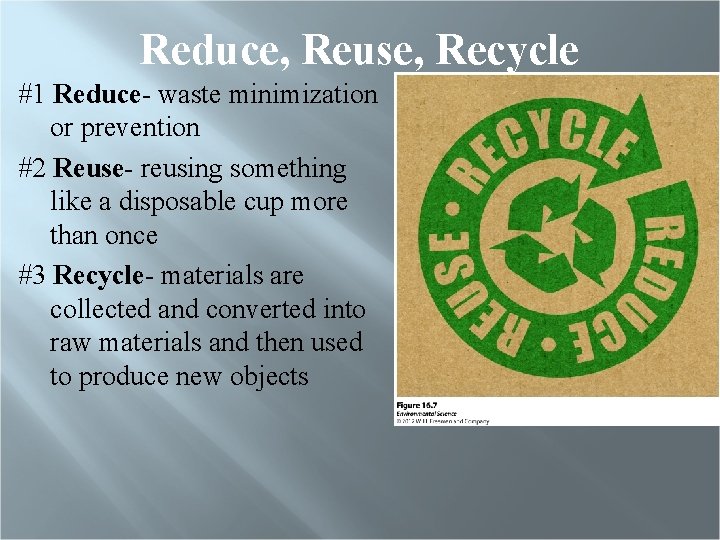
Reduce, Reuse, Recycle #1 Reduce- waste minimization or prevention #2 Reuse- reusing something like a disposable cup more than once #3 Recycle- materials are collected and converted into raw materials and then used to produce new objects
Hazardous Waste Liquid, solid, gaseous, or sludge waste material that is harmful to humans or ecosystems. By-product of industrial processes such as textile production, cleaning of machinery, and manufacturing of computer equipment Also generated by small businesses: Dry cleaners, automobile service stations, small farms Also generated by individual households
Disposal of Hazardous Waste More expensive and more difficult to dispose of than MSW Collection sites for hazardous waste must be staffed with specially trained personnel. Hazardous waste must be treated before disposal Must make it less environmentally harmful, must usually be altered through a series of chemical procedures
Laws Resource Conservation and Recovery Act (RCRA)Main goal is to protect human health and environmental integrity by reducing source hazardous waste Designed to reduce or eliminate hazardous waste. Also know as “cradle-to-grave” tracking. RCRA ensures that hazardous waste is tracked and properly disposed of.
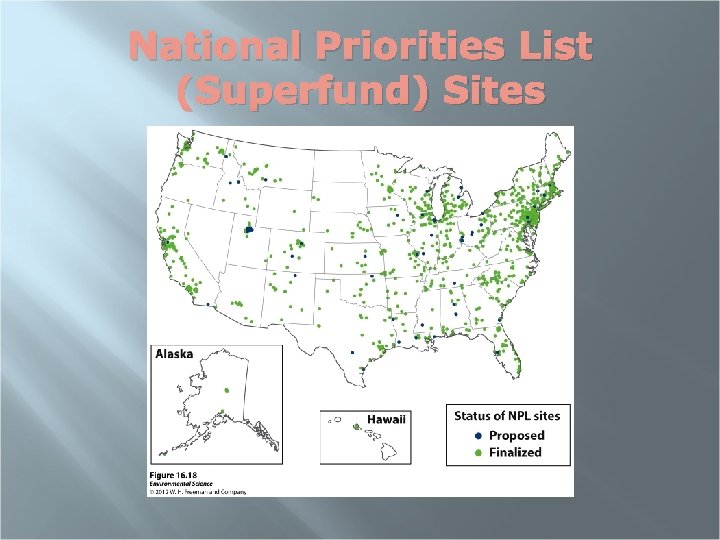
National Priorities List (Superfund) Sites
Laws Comprehensive Environmental Response, Compensation, and Liability Act (CERCLA)- also know as “Superfund”. Puts a tax on the chemical and petroleum industries. This revenue is used to cleanup abandoned and nonoperating hazardous waste sites where a responsible party cannot be found. Requires the federal government to respond directly to the release of substance that may pose a threat to human health or the environment
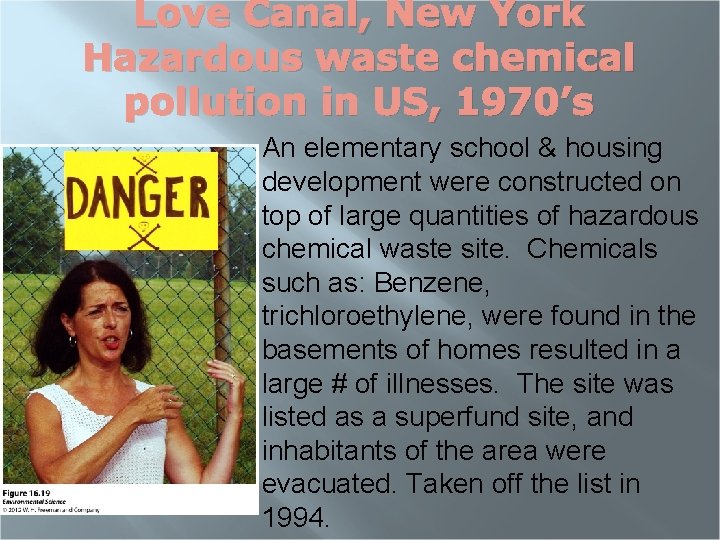
Love Canal, New York Hazardous waste chemical pollution in US, 1970’s An elementary school & housing development were constructed on top of large quantities of hazardous chemical waste site. Chemicals such as: Benzene, trichloroethylene, were found in the basements of homes resulted in a large # of illnesses. The site was listed as a superfund site, and inhabitants of the area were evacuated. Taken off the list in 1994.
Brownfields Contaminated industrial or commercial sites that may require environmental cleanup before they can be redeveloped or expanded. Old factories, industrial areas and waterfronts, dry cleaners, gas stations, landfills, and rail yards are some examples.
Do the Math #1 The Draper family is looking at ways to reduce its solid waste footprint. Each of the four members of the family produces 3 lbs. of solid waste per day. If the Draper Family decides to compost all organic materials (food scraps, yard waste, etc. ) they would reduce their solid waste footprint by 20%. (a) Calculate the amount of waste the Draper Family produces in one year. (b) Calculate the total solid waste after implementing composting.
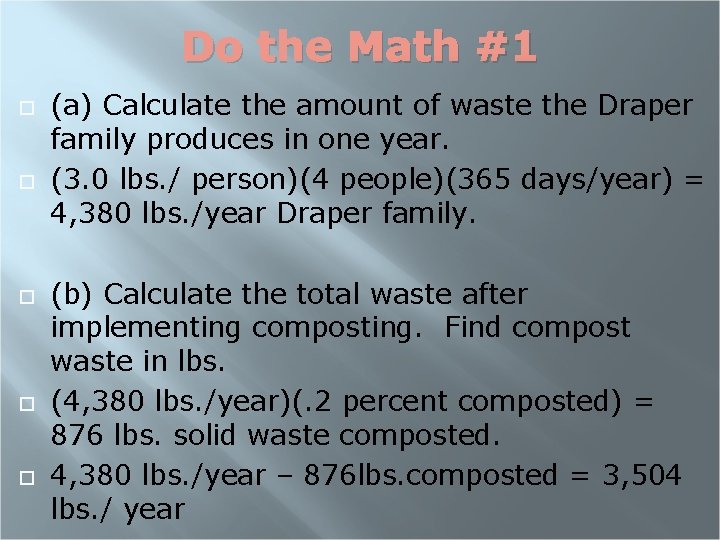
Do the Math #1 (a) Calculate the amount of waste the Draper family produces in one year. (3. 0 lbs. / person)(4 people)(365 days/year) = 4, 380 lbs. /year Draper family. (b) Calculate the total waste after implementing composting. Find compost waste in lbs. (4, 380 lbs. /year)(. 2 percent composted) = 876 lbs. solid waste composted. 4, 380 lbs. /year – 876 lbs. composted = 3, 504 lbs. / year
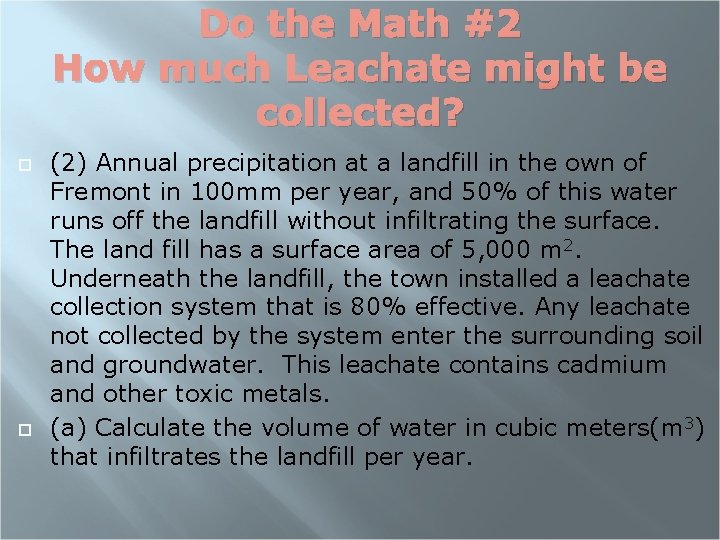
Do the Math #2 How much Leachate might be collected? (2) Annual precipitation at a landfill in the own of Fremont in 100 mm per year, and 50% of this water runs off the landfill without infiltrating the surface. The land fill has a surface area of 5, 000 m 2. Underneath the landfill, the town installed a leachate collection system that is 80% effective. Any leachate not collected by the system enter the surrounding soil and groundwater. This leachate contains cadmium and other toxic metals. (a) Calculate the volume of water in cubic meters(m 3) that infiltrates the landfill per year.
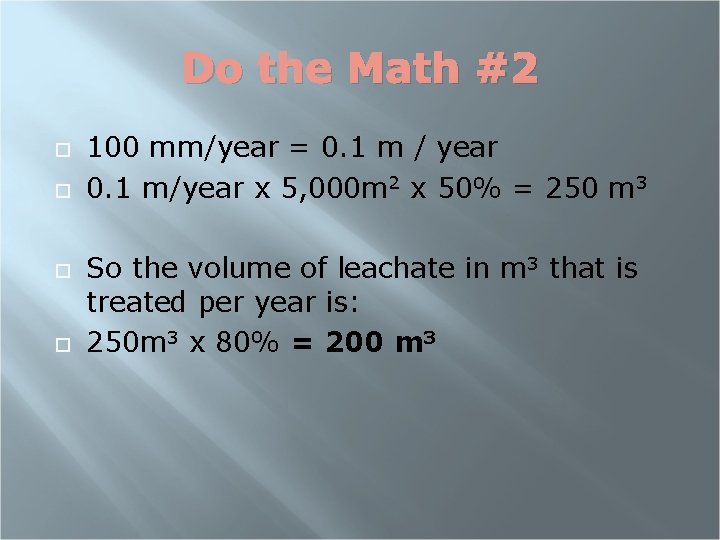
Do the Math #2 100 mm/year = 0. 1 m / year 0. 1 m/year x 5, 000 m 2 x 50% = 250 m 3 So the volume of leachate in m 3 that is treated per year is: 250 m 3 x 80% = 200 m 3
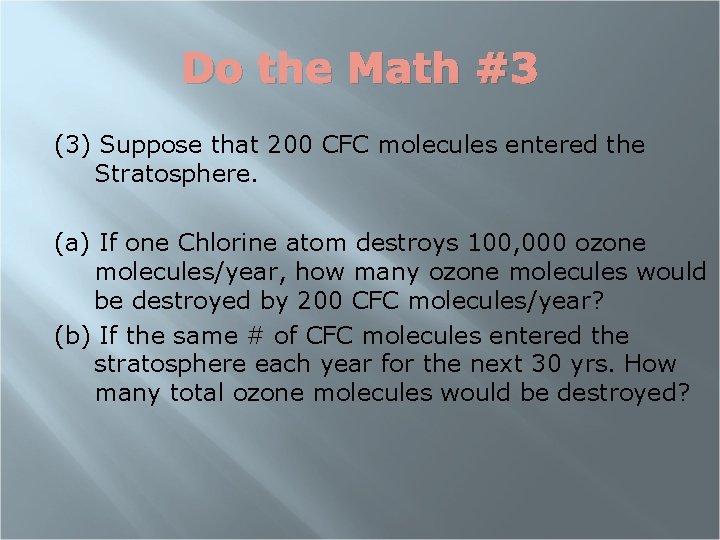
Do the Math #3 (3) Suppose that 200 CFC molecules entered the Stratosphere. (a) If one Chlorine atom destroys 100, 000 ozone molecules/year, how many ozone molecules would be destroyed by 200 CFC molecules/year? (b) If the same # of CFC molecules entered the stratosphere each year for the next 30 yrs. How many total ozone molecules would be destroyed?
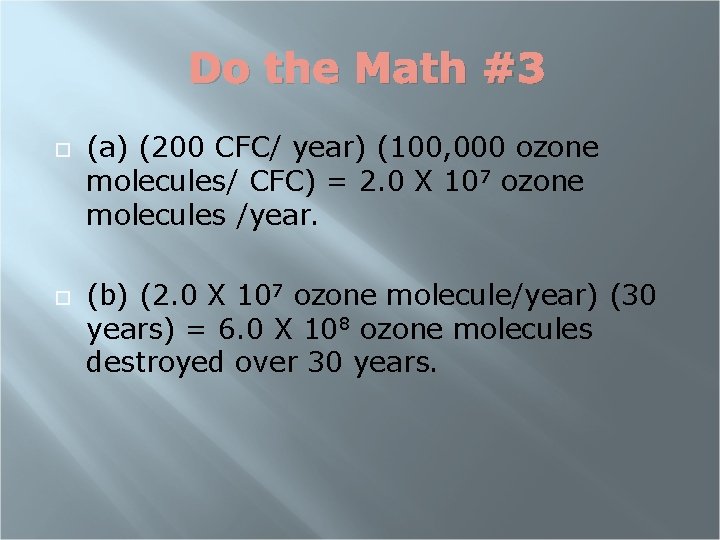
Do the Math #3 (a) (200 CFC/ year) (100, 000 ozone molecules/ CFC) = 2. 0 X 107 ozone molecules /year. (b) (2. 0 X 107 ozone molecule/year) (30 years) = 6. 0 X 108 ozone molecules destroyed over 30 years.
In the News. . .
Agenda 12/11 Notebook Time (5 minutes) Quiz CH 14, 15, 16 After Quiz: Pick up CH 17 MC SG & Vocabulary Warm up, pg. 68 Article/Discussion: Recycling: You May be Doing it Wrong. . .

Warm up

12/12 Rally Day! Warm up, pg. 70 In Class FRQ Article/discussion: Recycling: You May Be Doing it Wrong…
Warm up pg. 70
Free Response Question You have 22 minutes to complete the free response question We will go over it together Don’t leave any blanks. . . TRY YOUR BEST!
Answers
POLLUTION & RECYCLING
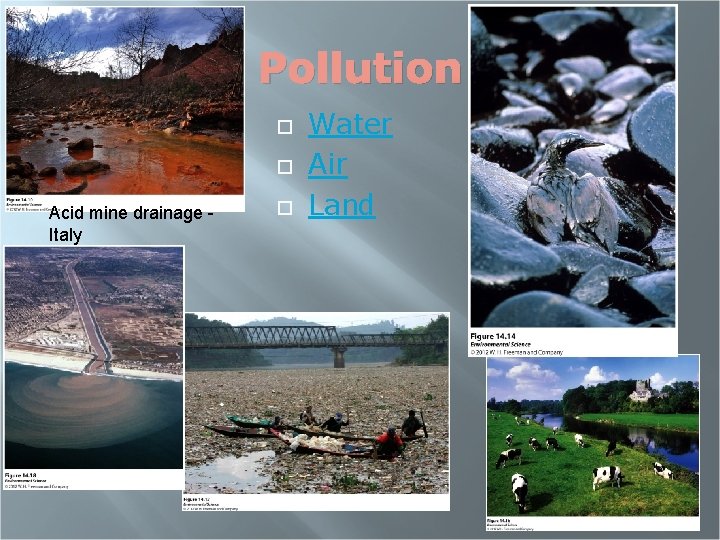
Pollution Acid mine drainage Italy Water Air Land
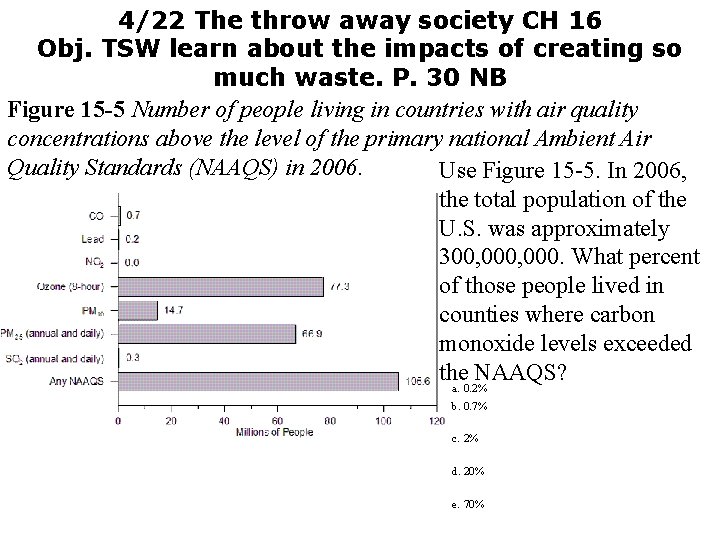
4/22 The throw away society CH 16 Obj. TSW learn about the impacts of creating so much waste. P. 30 NB Figure 15 -5 Number of people living in countries with air quality concentrations above the level of the primary national Ambient Air Quality Standards (NAAQS) in 2006. Use Figure 15 -5. In 2006, the total population of the U. S. was approximately 300, 000. What percent of those people lived in counties where carbon monoxide levels exceeded the NAAQS? a. 0. 2% b. 0. 7% c. 2% d. 20% e. 70%
http: //www. zerowasteamerica. org/Landfill s. htm p. NB Modern Marvels: Trash What are some components to landfills? How are new landfills designed better? What are some concerns about landfills? Research Superfund Sites – What, where, Why? Brownfields, What are they, where is our closest one? Love Canal, New York Why is it important? Explain how life-cycle Analysis in important to waste management. Explain some ways to reduce waste. How are health issues related to waste management?
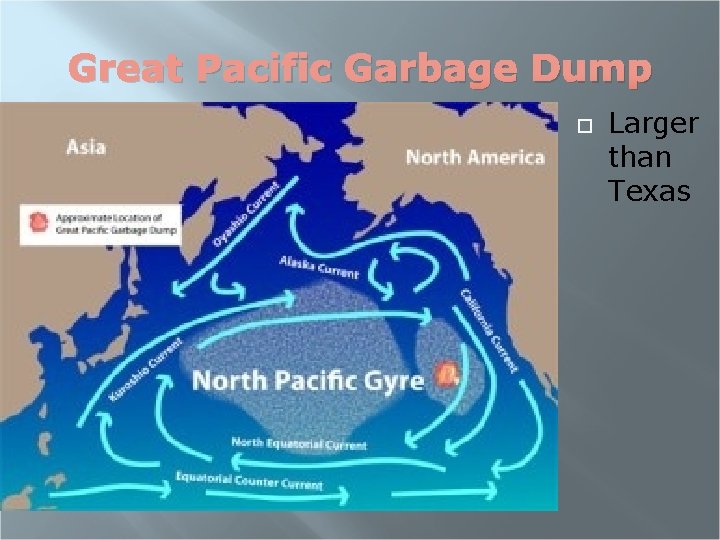
Great Pacific Garbage Dump Larger than Texas
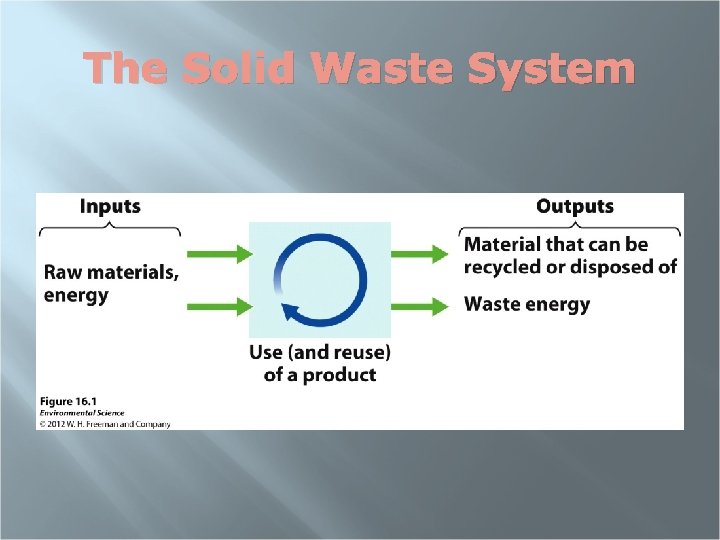
The Solid Waste System
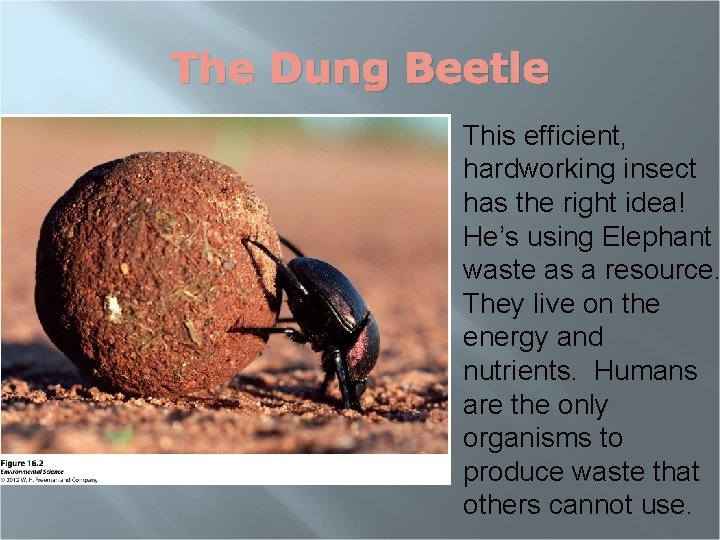
The Dung Beetle This efficient, hardworking insect has the right idea! He’s using Elephant waste as a resource. They live on the energy and nutrients. Humans are the only organisms to produce waste that others cannot use.
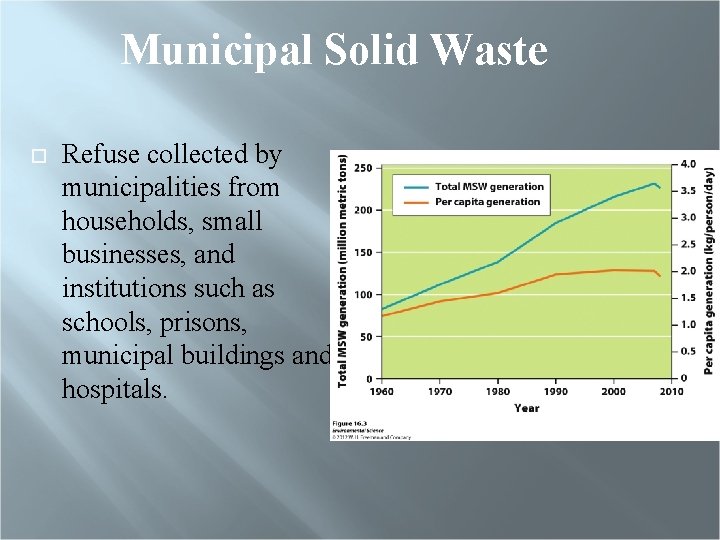
Municipal Solid Waste Refuse collected by municipalities from households, small businesses, and institutions such as schools, prisons, municipal buildings and hospitals.
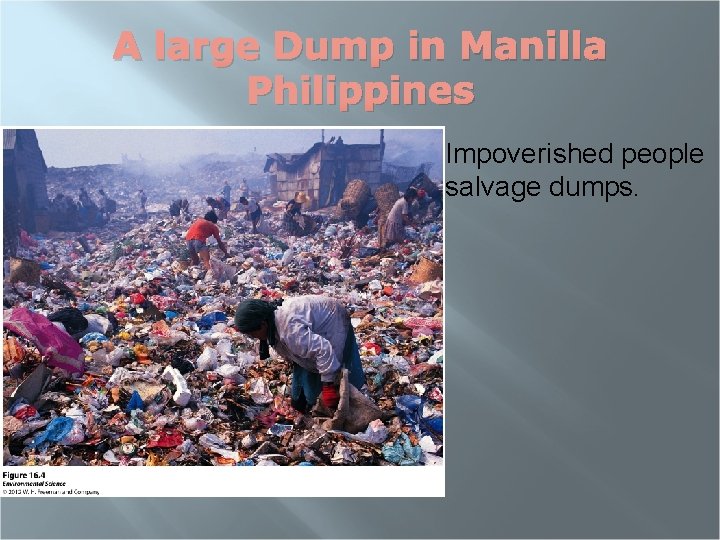
A large Dump in Manilla Philippines Impoverished people salvage dumps.
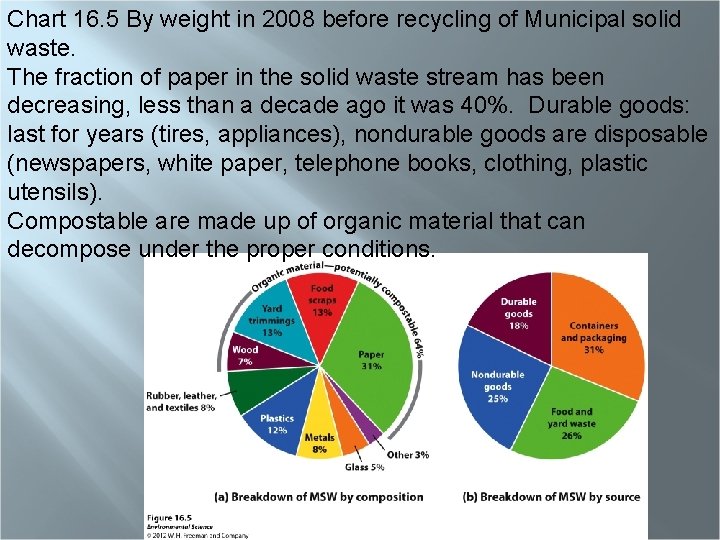
Chart 16. 5 By weight in 2008 before recycling of Municipal solid waste. The fraction of paper in the solid waste stream has been decreasing, less than a decade ago it was 40%. Durable goods: last for years (tires, appliances), nondurable goods are disposable (newspapers, white paper, telephone books, clothing, plastic utensils). Compostable are made up of organic material that can decompose under the proper conditions.
Composition of Municipal Solid Waste 31% - paper 33%- organic materials (yard waste, food scraps, wood) 12%- plastic 18%- durable goods (appliances, tires)
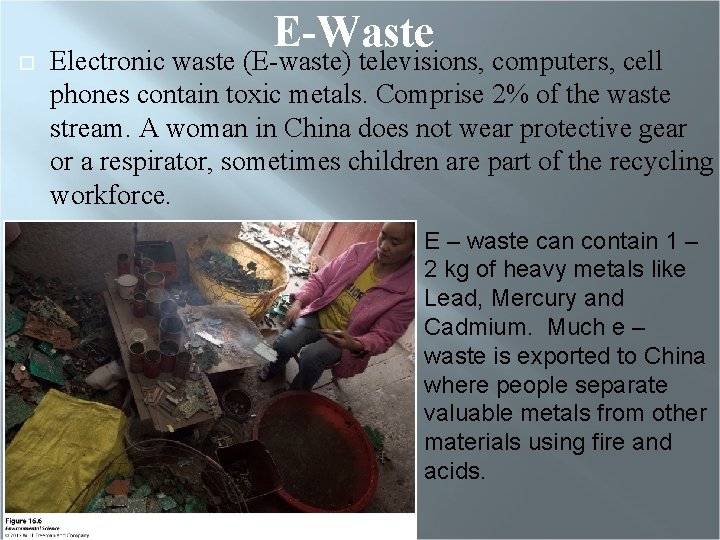
E-Waste Electronic waste (E-waste) televisions, computers, cell phones contain toxic metals. Comprise 2% of the waste stream. A woman in China does not wear protective gear or a respirator, sometimes children are part of the recycling workforce. E – waste can contain 1 – 2 kg of heavy metals like Lead, Mercury and Cadmium. Much e – waste is exported to China where people separate valuable metals from other materials using fire and acids.
Reduce, Reuse, Recycle #1 Reduce- waste minimization or prevention #2 Reuse- reusing something like a disposable cup more than once #3 Recycle- materials are collected and converted into raw materials and then used to produce new objects
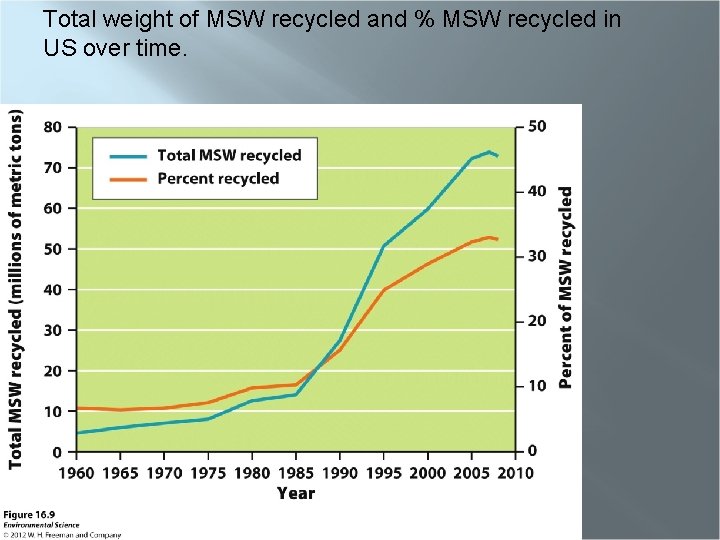
Total weight of MSW recycled and % MSW recycled in US over time.
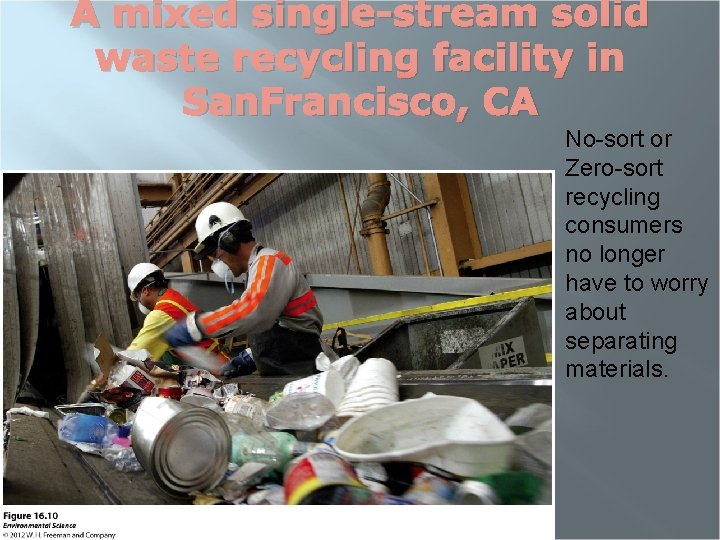
A mixed single-stream solid waste recycling facility in San. Francisco, CA No-sort or Zero-sort recycling consumers no longer have to worry about separating materials.
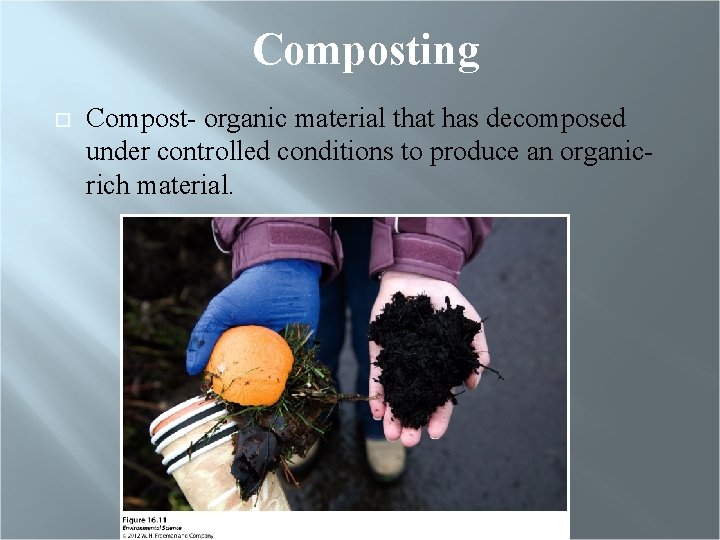
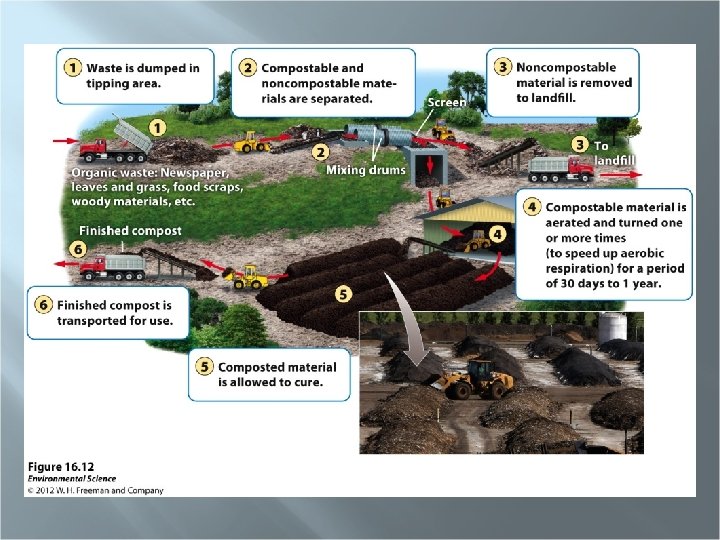
Composting Compost- organic material that has decomposed under controlled conditions to produce an organicrich material.
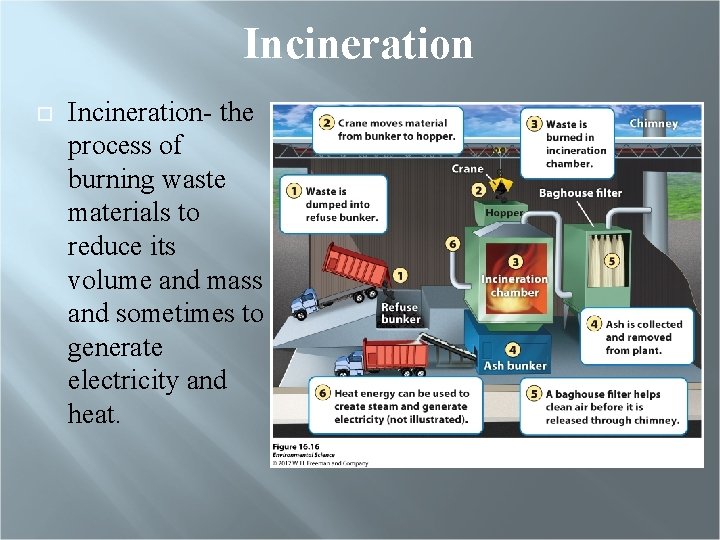
Incineration Incineration- the process of burning waste materials to reduce its volume and mass and sometimes to generate electricity and heat.
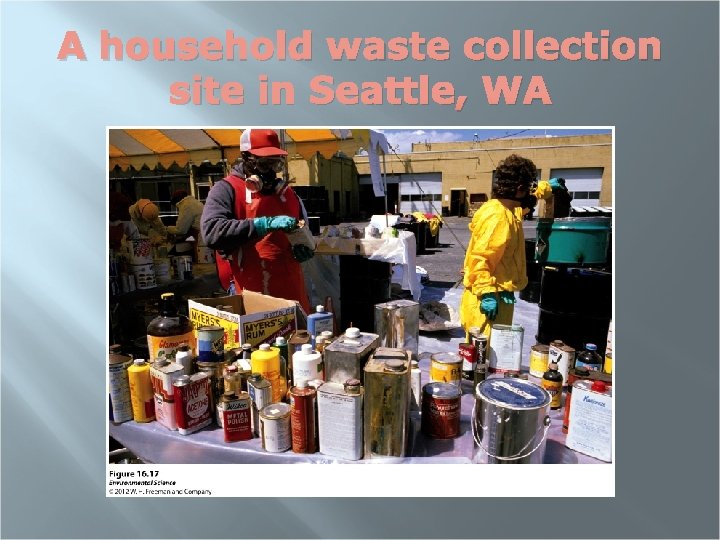
A household waste collection site in Seattle, WA
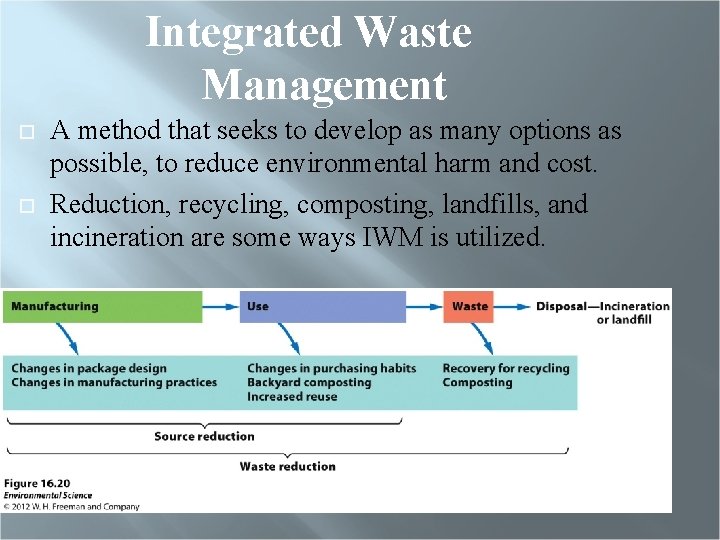
Integrated Waste Management A method that seeks to develop as many options as possible, to reduce environmental harm and cost. Reduction, recycling, composting, landfills, and incineration are some ways IWM is utilized.
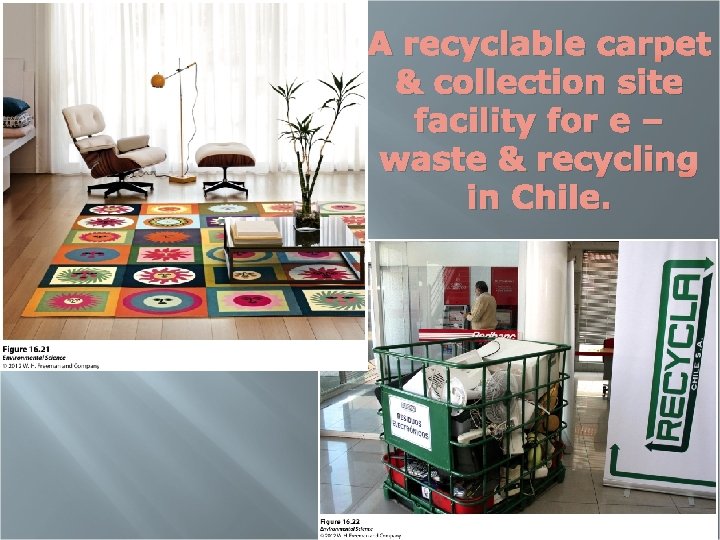
A recyclable carpet & collection site facility for e – waste & recycling in Chile.
WASTE & CO 2 LAB Due Thursday
Topics/ Concepts discussed Throw away society & waste Planned Obsolescence Decomposition – microrganism Landfill Structure – clay liner, methane collectors, leachate collection Global Warming BMP – Best Management Practices Carbon Sink/ Carbon Flux & Carbon Cycle
Topics/ Concepts discussed Ocean Acidification Point & nonpoint Source Pollution Ozone Layer? (Affect of CFC’s not CH 4 or CO 2) Remediation Agricultural Runoff Industrial Revolution Photosynthesis & Cellular Respiration Sustainability
Topics/ Concepts discussed Methane Production Fossil Fuels Biological Assimilation Waste Management Leaching Anthropogenic Activities Septic Tank Metabolism
Topics/ Concepts discussed Treatment Plant Aerobic & Anaerobic Organisms Oxidation Sewage Treatment Biodegradable Material Biofiltration Natural & Constructed Wetlands Greenbelts Treatment Ponds Riparian Areas
Working Toward Sustainability Recycling E – Waste in Chile P. 457 ESBK

- Slides: 62