
Landau Theory of Phase Transitions As a reminder
- Slides: 14
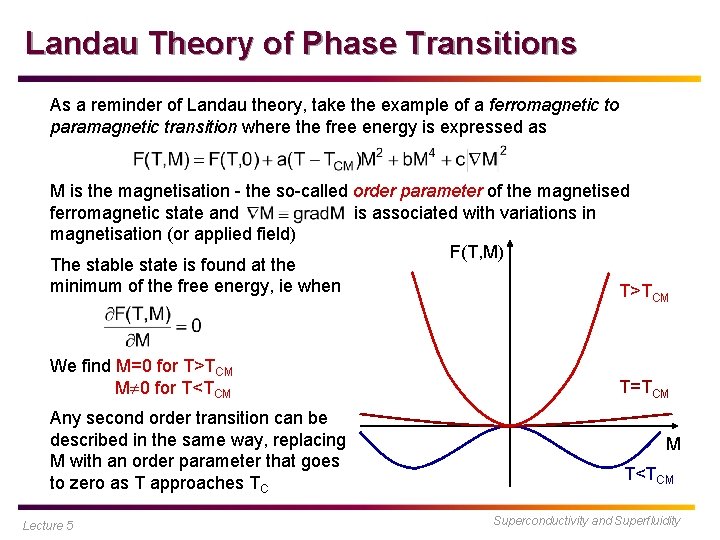
Landau Theory of Phase Transitions As a reminder of Landau theory, take the example of a ferromagnetic to paramagnetic transition where the free energy is expressed as M is the magnetisation - the so-called order parameter of the magnetised ferromagnetic state and is associated with variations in magnetisation (or applied field) F(T, M) The stable state is found at the minimum of the free energy, ie when T>TCM We find M=0 for T>TCM M 0 for T<TCM Any second order transition can be described in the same way, replacing M with an order parameter that goes to zero as T approaches TC Lecture 5 T=TCM M T<TCM Superconductivity and Superfluidity
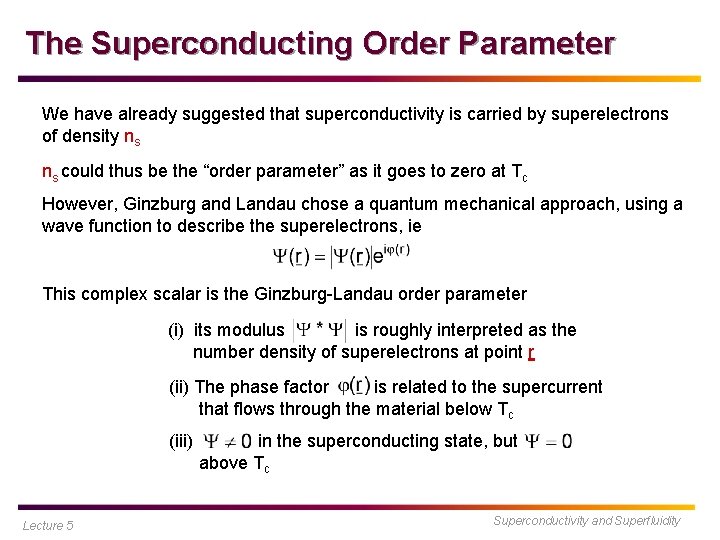
The Superconducting Order Parameter We have already suggested that superconductivity is carried by superelectrons of density ns ns could thus be the “order parameter” as it goes to zero at Tc However, Ginzburg and Landau chose a quantum mechanical approach, using a wave function to describe the superelectrons, ie This complex scalar is the Ginzburg-Landau order parameter (i) its modulus is roughly interpreted as the number density of superelectrons at point r (ii) The phase factor is related to the supercurrent that flows through the material below Tc (iii) Lecture 5 in the superconducting state, but above Tc Superconductivity and Superfluidity
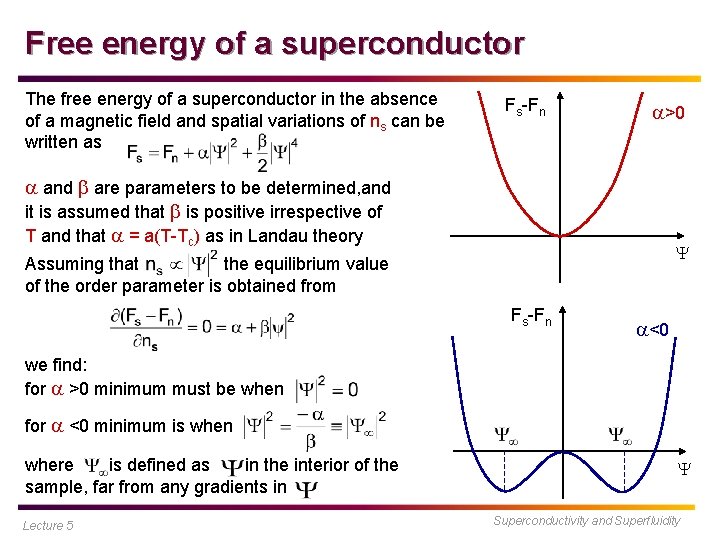
Free energy of a superconductor The free energy of a superconductor in the absence of a magnetic field and spatial variations of ns can be written as Fs-Fn >0 and are parameters to be determined, and it is assumed that is positive irrespective of T and that = a(T-Tc) as in Landau theory Assuming that the equilibrium value of the order parameter is obtained from Fs-Fn <0 we find: for >0 minimum must be when for <0 minimum is when where is defined as in the interior of the sample, far from any gradients in Lecture 5 Superconductivity and Superfluidity
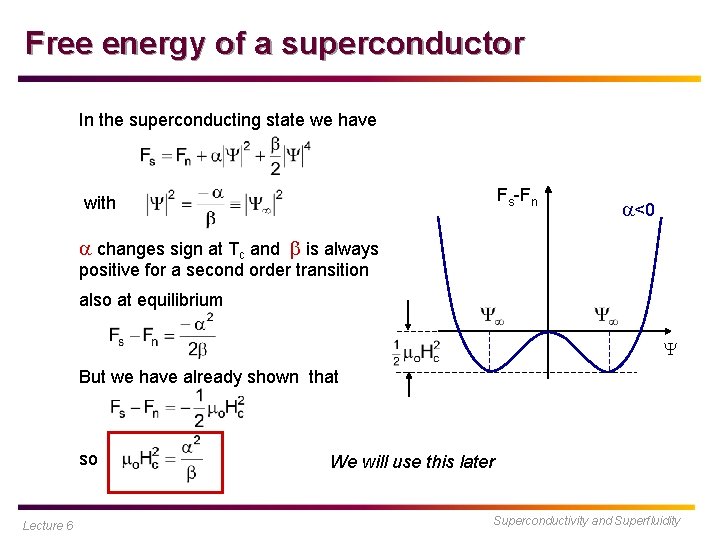
Free energy of a superconductor In the superconducting state we have Fs-Fn with <0 changes sign at Tc and is always positive for a second order transition also at equilibrium But we have already shown that so Lecture 6 We will use this later Superconductivity and Superfluidity
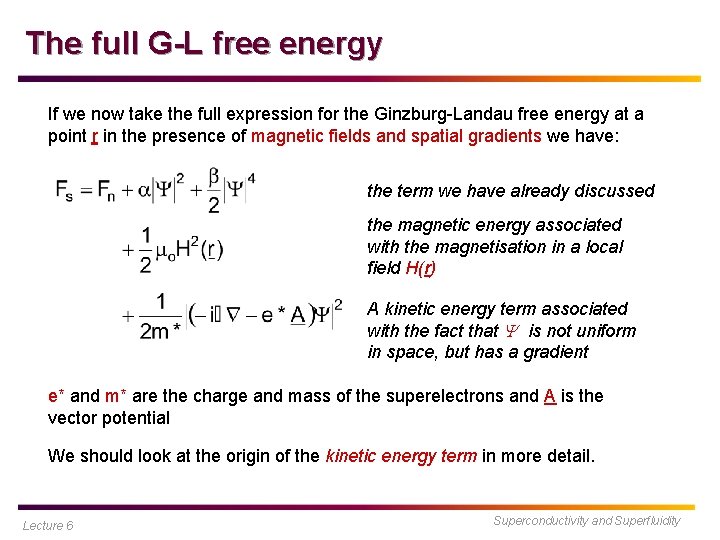
The full G-L free energy If we now take the full expression for the Ginzburg-Landau free energy at a point r in the presence of magnetic fields and spatial gradients we have: the term we have already discussed the magnetic energy associated with the magnetisation in a local field H(r) A kinetic energy term associated with the fact that is not uniform in space, but has a gradient e* and m* are the charge and mass of the superelectrons and A is the vector potential We should look at the origin of the kinetic energy term in more detail. Lecture 6 Superconductivity and Superfluidity
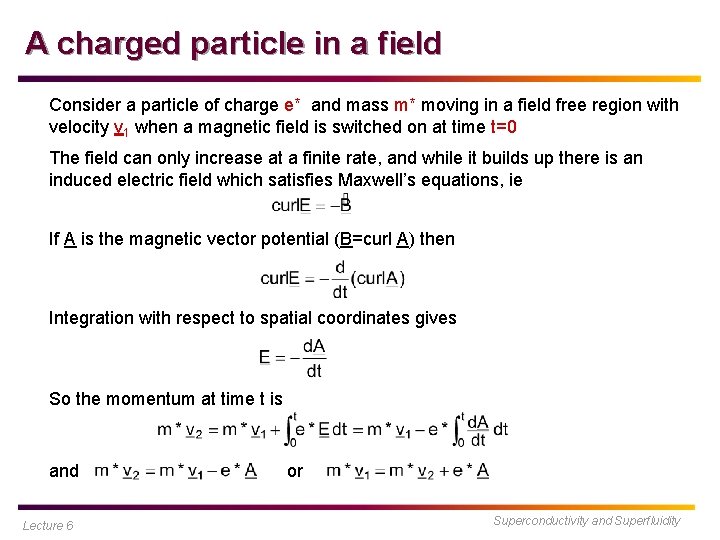
A charged particle in a field Consider a particle of charge e* and mass m* moving in a field free region with velocity v 1 when a magnetic field is switched on at time t=0 The field can only increase at a finite rate, and while it builds up there is an induced electric field which satisfies Maxwell’s equations, ie If A is the magnetic vector potential (B=curl A) then Integration with respect to spatial coordinates gives So the momentum at time t is and Lecture 6 or Superconductivity and Superfluidity
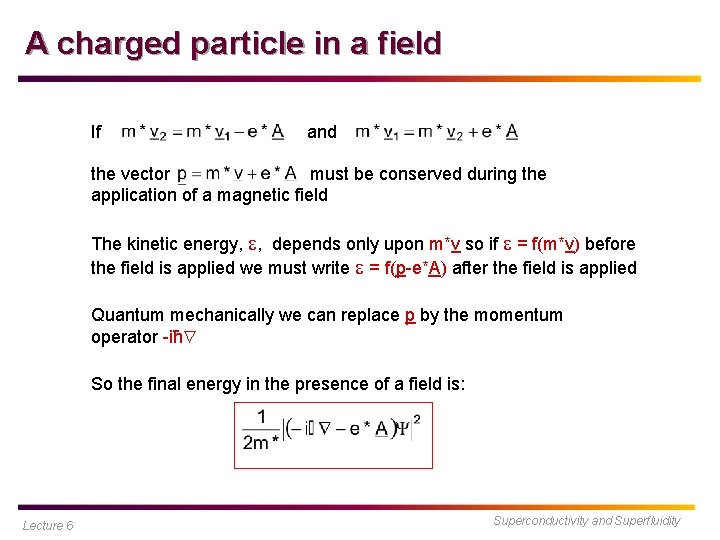
A charged particle in a field If and the vector must be conserved during the application of a magnetic field The kinetic energy, , depends only upon m*v so if = f(m*v) before the field is applied we must write = f(p-e*A) after the field is applied Quantum mechanically we can replace p by the momentum operator -iħ So the final energy in the presence of a field is: Lecture 6 Superconductivity and Superfluidity
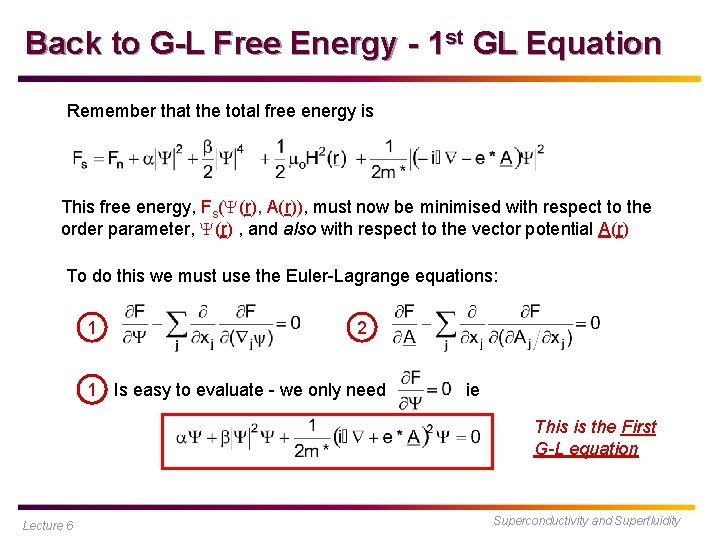
Back to G-L Free Energy - 1 st GL Equation Remember that the total free energy is This free energy, Fs( (r), A(r)), must now be minimised with respect to the order parameter, (r) , and also with respect to the vector potential A(r) To do this we must use the Euler-Lagrange equations: 1 2 1 Is easy to evaluate - we only need ie This is the First G-L equation Lecture 6 Superconductivity and Superfluidity
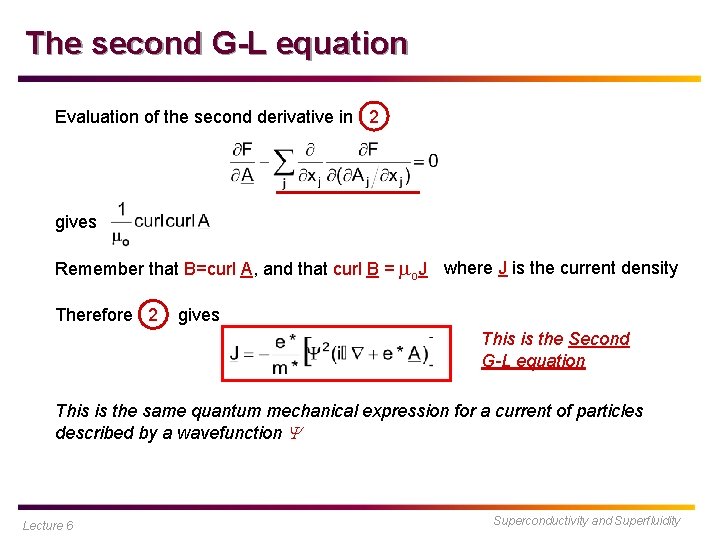
The second G-L equation Evaluation of the second derivative in 2 gives Remember that B=curl A, and that curl B = o. J where J is the current density Therefore 2 gives This is the Second G-L equation This is the same quantum mechanical expression for a current of particles described by a wavefunction Lecture 6 Superconductivity and Superfluidity
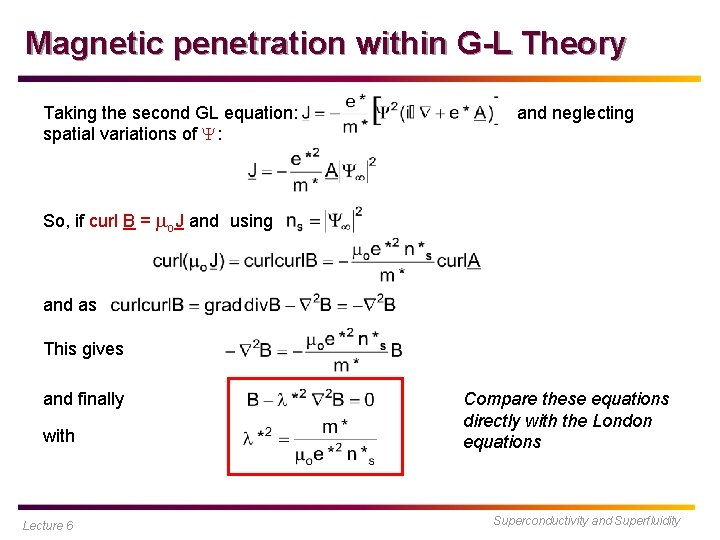
Magnetic penetration within G-L Theory Taking the second GL equation: spatial variations of : and neglecting So, if curl B = o. J and using and as This gives and finally with Lecture 6 Compare these equations directly with the London equations Superconductivity and Superfluidity
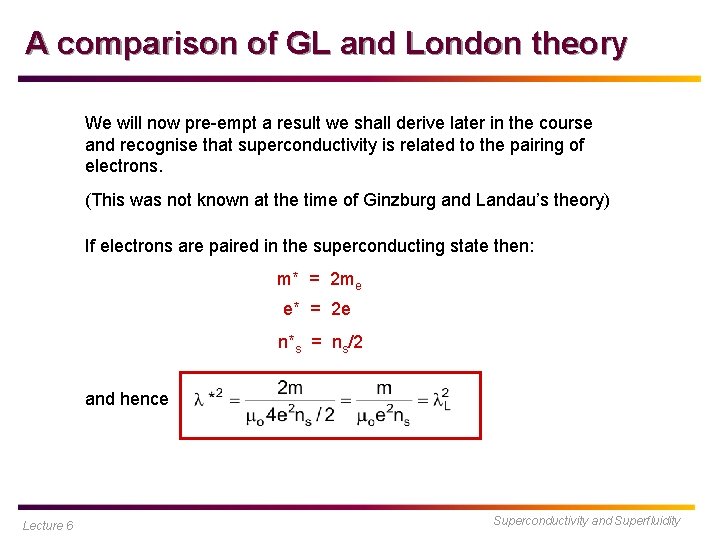
A comparison of GL and London theory We will now pre-empt a result we shall derive later in the course and recognise that superconductivity is related to the pairing of electrons. (This was not known at the time of Ginzburg and Landau’s theory) If electrons are paired in the superconducting state then: m* = 2 me e* = 2 e n*s = ns/2 and hence Lecture 6 Superconductivity and Superfluidity
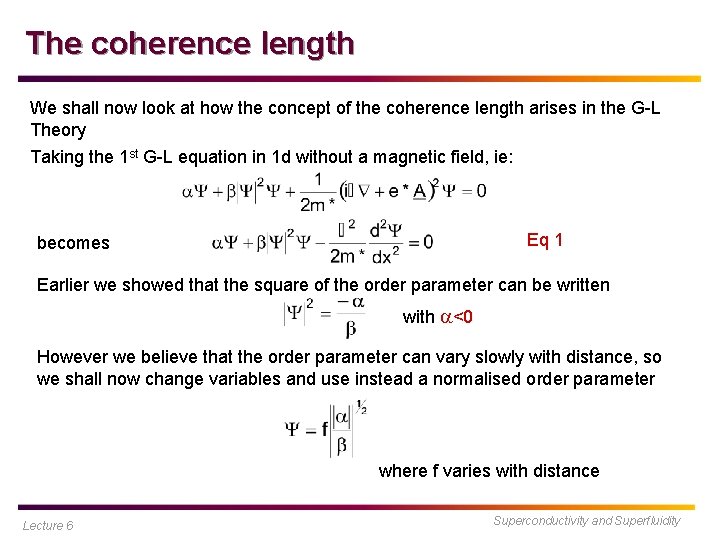
The coherence length We shall now look at how the concept of the coherence length arises in the G-L Theory Taking the 1 st G-L equation in 1 d without a magnetic field, ie: Eq 1 becomes Earlier we showed that the square of the order parameter can be written with <0 However we believe that the order parameter can vary slowly with distance, so we shall now change variables and use instead a normalised order parameter where f varies with distance Lecture 6 Superconductivity and Superfluidity
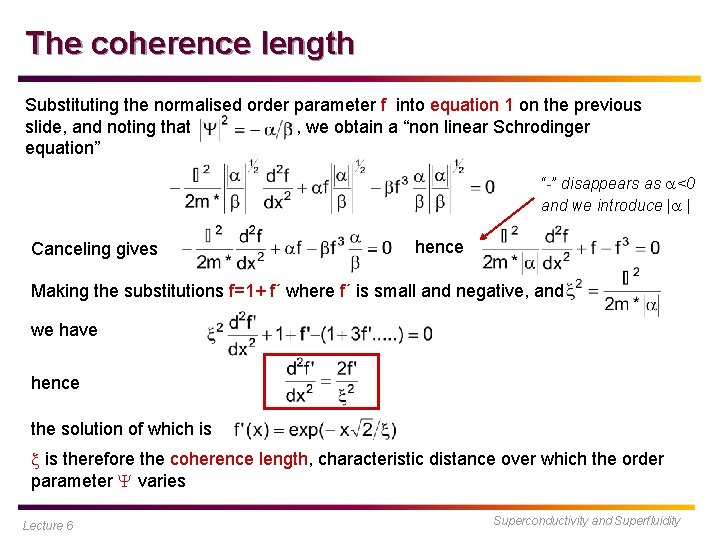
The coherence length Substituting the normalised order parameter f into equation 1 on the previous slide, and noting that , we obtain a “non linear Schrodinger equation” “-” disappears as <0 and we introduce | | Canceling gives hence Making the substitutions f=1+ f´ where f´ is small and negative, and we have hence the solution of which is therefore the coherence length, characteristic distance over which the order parameter varies Lecture 6 Superconductivity and Superfluidity
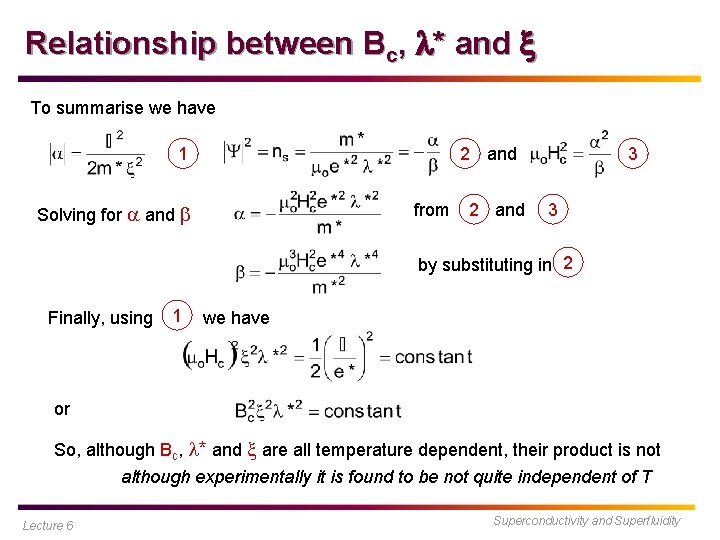
Relationship between Bc, * and To summarise we have 1 2 and from Solving for and 2 and 3 3 by substituting in 2 Finally, using 1 we have or So, although Bc, * and are all temperature dependent, their product is not although experimentally it is found to be not quite independent of T Lecture 6 Superconductivity and Superfluidity