
Land Use Planning for Transit Related Development Jerry
- Slides: 30
Land Use Planning for Transit Related Development Jerry Lutin Colette Santasieri Sunil Saigal New Jersey Institute of Technology Charles Goodman John Sprowls Federal Transit Administration Bruce Spear Cambridge Systematics Transportation Planning Applications Conference Houston, TX May 17 -21, 2009
Land Use Planning for Transit Related Development • The nation is being challenged to maintain mobility in the face of rising transportation costs, environmental challenges, and uncertainty about future energy supplies. • Public transit can play a significant role in creation of a sustainable transportation system, but only if transit investments are supported by compatible land use policies and integrated with other economic development tools. • Planning decisions for transit investments and land development patterns occur at different scales and by different stakeholders – better communication is needed to bridge the gap.
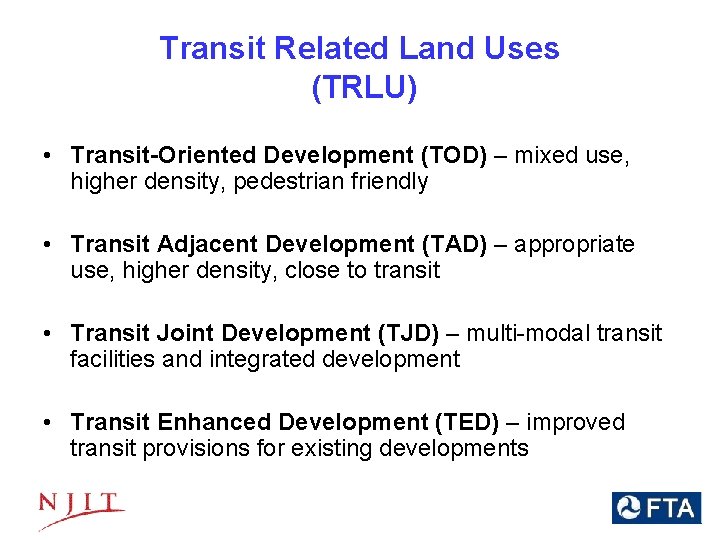
Transit Related Land Uses (TRLU) • Transit-Oriented Development (TOD) – mixed use, higher density, pedestrian friendly • Transit Adjacent Development (TAD) – appropriate use, higher density, close to transit • Transit Joint Development (TJD) – multi-modal transit facilities and integrated development • Transit Enhanced Development (TED) – improved transit provisions for existing developments
Project Goals Develop a “toolbox” of common sense and practical tools for MPOs and regional planners that: • • Maximize the user benefits of transit investments Realize environmental and economic development benefits from transit-related land uses.
Applications • Proposed rail transit corridors • Existing transit stations/terminals • Bus rapid transit and enhanced bus service
Project Phases 1. Research good examples 2. Outreach to stakeholders and potential users 3. Develop performance measures 4. Develop prototype tools and visualization techniques 5. Conduct pilot corridor studies 6. Document results 7. Promote deployment
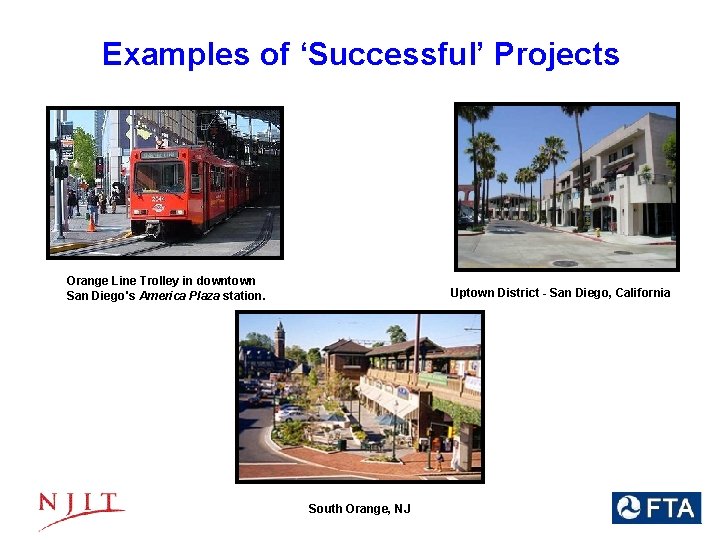
Examples of ‘Successful’ Projects Orange Line Trolley in downtown San Diego's America Plaza station. Uptown District - San Diego, California South Orange, NJ
Measures of ‘Successful’ Projects • What makes these projects successful? • What is the definition of success? • Who decides if the projects are successful? • What are the tangible measurements of success?
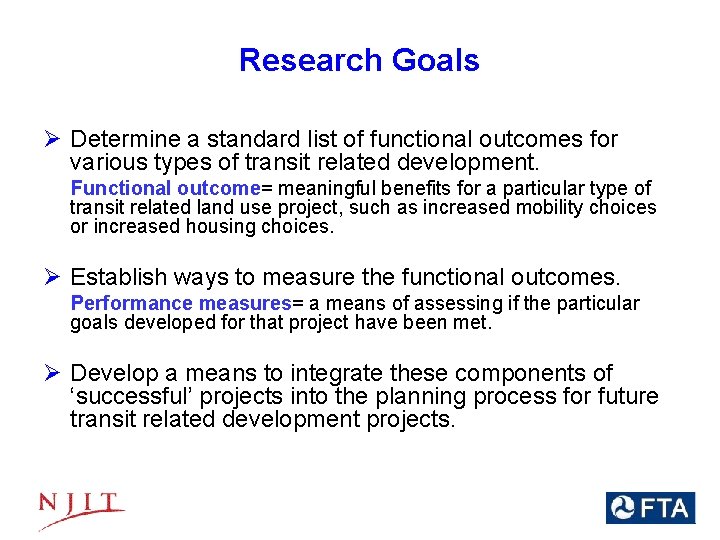
Research Goals Ø Determine a standard list of functional outcomes for various types of transit related development. Functional outcome= meaningful benefits for a particular type of transit related land use project, such as increased mobility choices or increased housing choices. Ø Establish ways to measure the functional outcomes. Performance measures= a means of assessing if the particular goals developed for that project have been met. Ø Develop a means to integrate these components of ‘successful’ projects into the planning process for future transit related development projects.
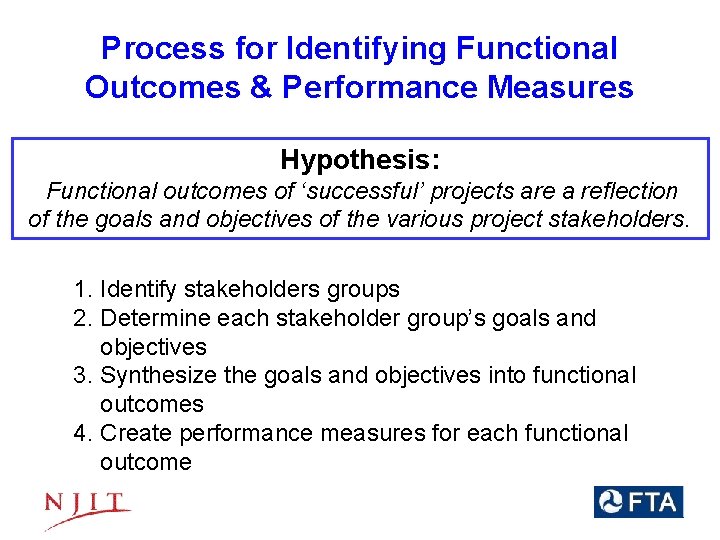
Process for Identifying Functional Outcomes & Performance Measures Hypothesis: Functional outcomes of ‘successful’ projects are a reflection of the goals and objectives of the various project stakeholders. 1. Identify stakeholders groups 2. Determine each stakeholder group’s goals and objectives 3. Synthesize the goals and objectives into functional outcomes 4. Create performance measures for each functional outcome
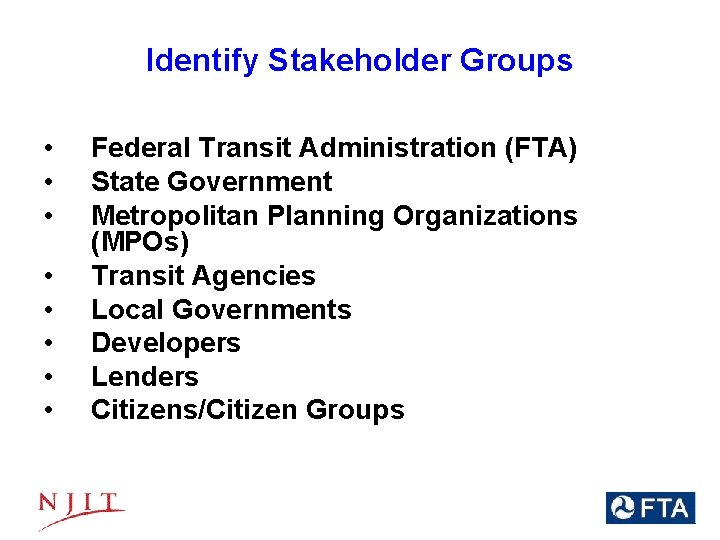
Identify Stakeholder Groups • • Federal Transit Administration (FTA) State Government Metropolitan Planning Organizations (MPOs) Transit Agencies Local Governments Developers Lenders Citizens/Citizen Groups
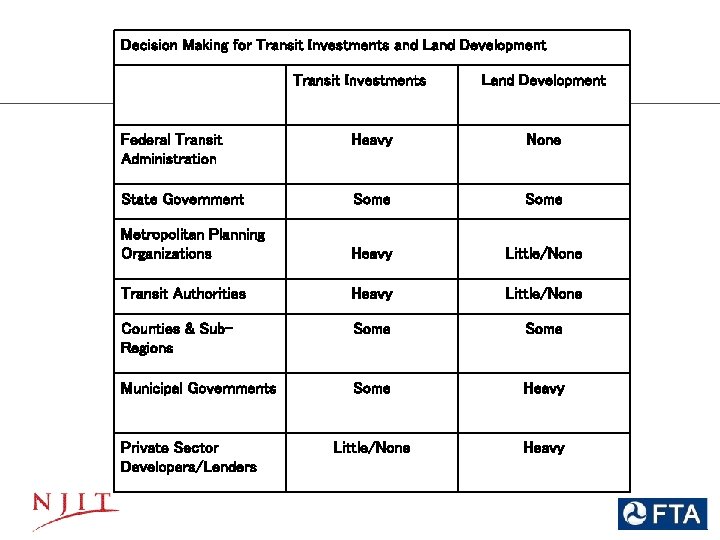
Decision Making for Transit Investments and Land Development Transit Investments Land Development Federal Transit Administration Heavy None State Government Some Metropolitan Planning Organizations Heavy Little/None Transit Authorities Heavy Little/None Counties & Sub. Regions Some Municipal Governments Some Heavy Little/None Heavy Private Sector Developers/Lenders
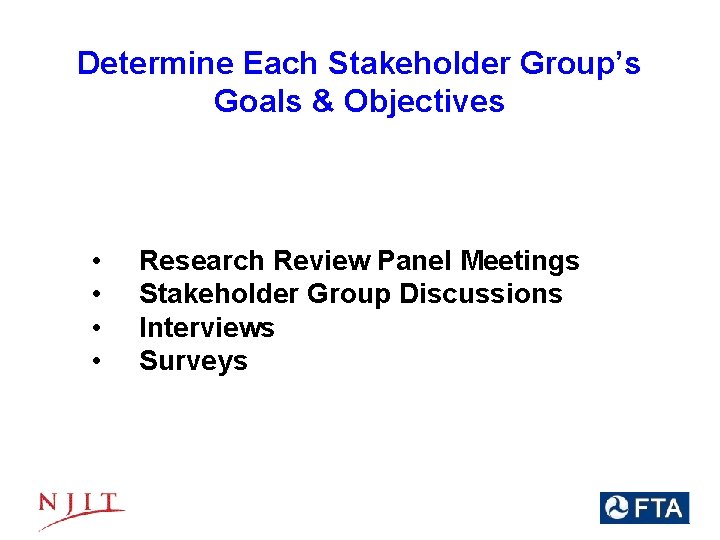
Determine Each Stakeholder Group’s Goals & Objectives • • Research Review Panel Meetings Stakeholder Group Discussions Interviews Surveys
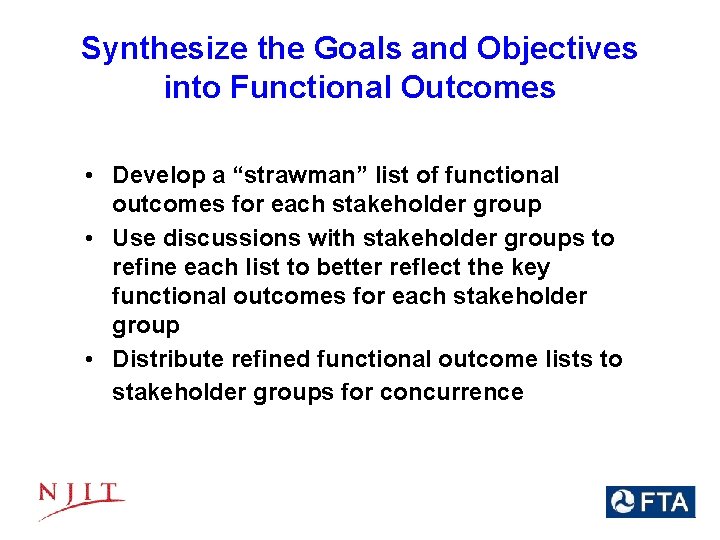
Synthesize the Goals and Objectives into Functional Outcomes • Develop a “strawman” list of functional outcomes for each stakeholder group • Use discussions with stakeholder groups to refine each list to better reflect the key functional outcomes for each stakeholder group • Distribute refined functional outcome lists to stakeholder groups for concurrence
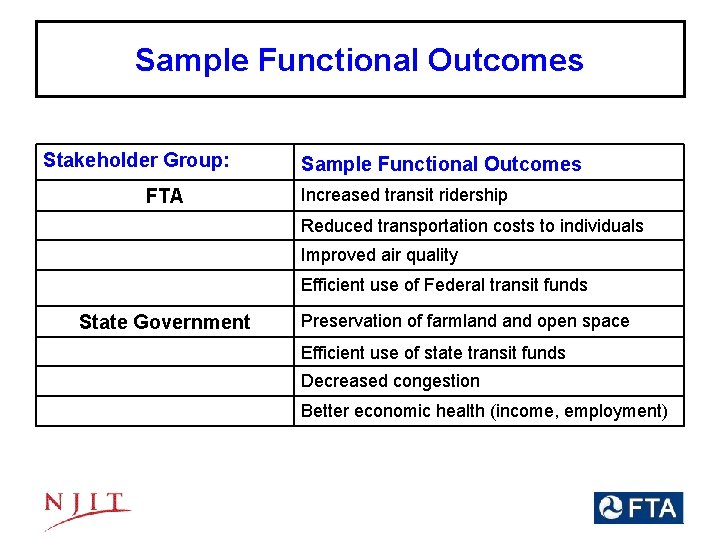
Sample Functional Outcomes Stakeholder Group: FTA Sample Functional Outcomes Increased transit ridership Reduced transportation costs to individuals Improved air quality Efficient use of Federal transit funds State Government Preservation of farmland open space Efficient use of state transit funds Decreased congestion Better economic health (income, employment)
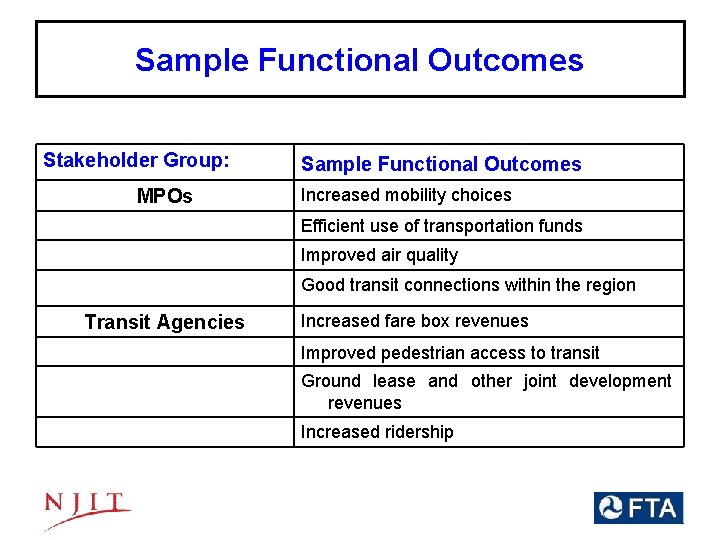
Sample Functional Outcomes Stakeholder Group: MPOs Sample Functional Outcomes Increased mobility choices Efficient use of transportation funds Improved air quality Good transit connections within the region Transit Agencies Increased fare box revenues Improved pedestrian access to transit Ground lease and other joint development revenues Increased ridership
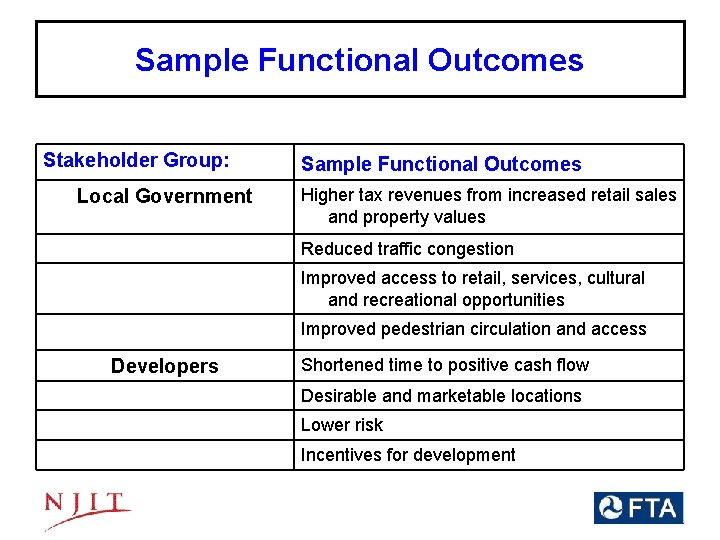
Sample Functional Outcomes Stakeholder Group: Local Government Sample Functional Outcomes Higher tax revenues from increased retail sales and property values Reduced traffic congestion Improved access to retail, services, cultural and recreational opportunities Improved pedestrian circulation and access Developers Shortened time to positive cash flow Desirable and marketable locations Lower risk Incentives for development
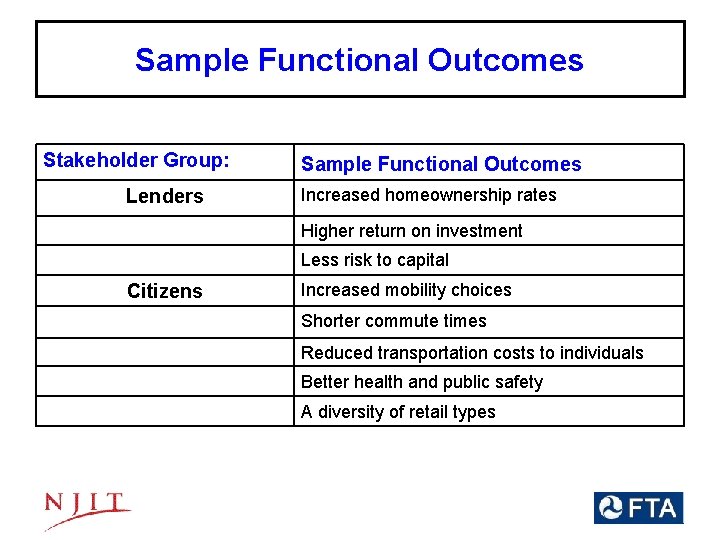
Sample Functional Outcomes Stakeholder Group: Lenders Sample Functional Outcomes Increased homeownership rates Higher return on investment Less risk to capital Citizens Increased mobility choices Shorter commute times Reduced transportation costs to individuals Better health and public safety A diversity of retail types
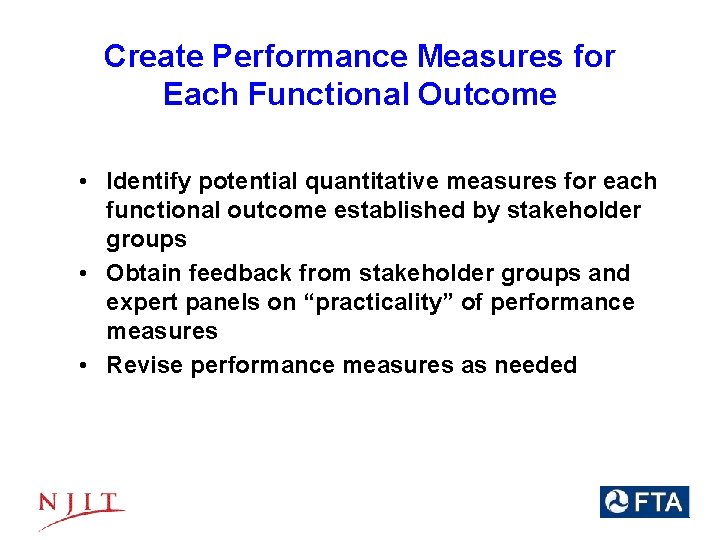
Create Performance Measures for Each Functional Outcome • Identify potential quantitative measures for each functional outcome established by stakeholder groups • Obtain feedback from stakeholder groups and expert panels on “practicality” of performance measures • Revise performance measures as needed
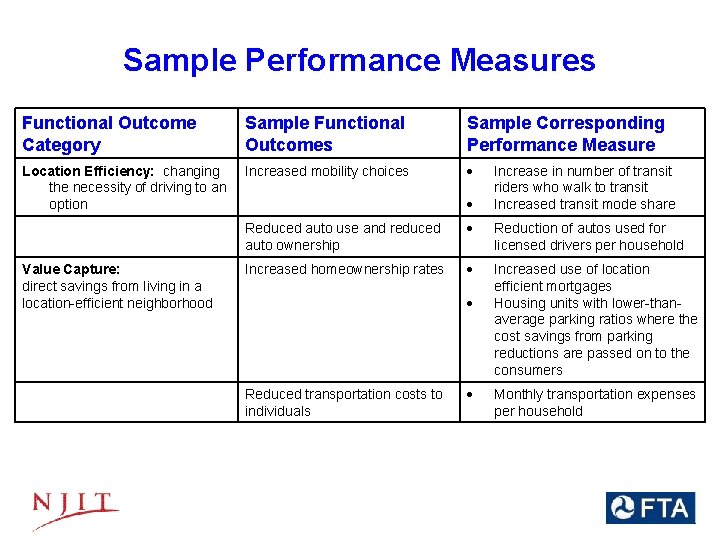
Sample Performance Measures Functional Outcome Category Sample Functional Outcomes Sample Corresponding Performance Measure Location Efficiency: changing the necessity of driving to an option Increased mobility choices Value Capture: direct savings from living in a location-efficient neighborhood Increase in number of transit riders who walk to transit Increased transit mode share Reduced auto use and reduced auto ownership Reduction of autos used for licensed drivers per household Increased homeownership rates Increased use of location efficient mortgages Housing units with lower-thanaverage parking ratios where the cost savings from parking reductions are passed on to the consumers Reduced transportation costs to individuals Monthly transportation expenses per household
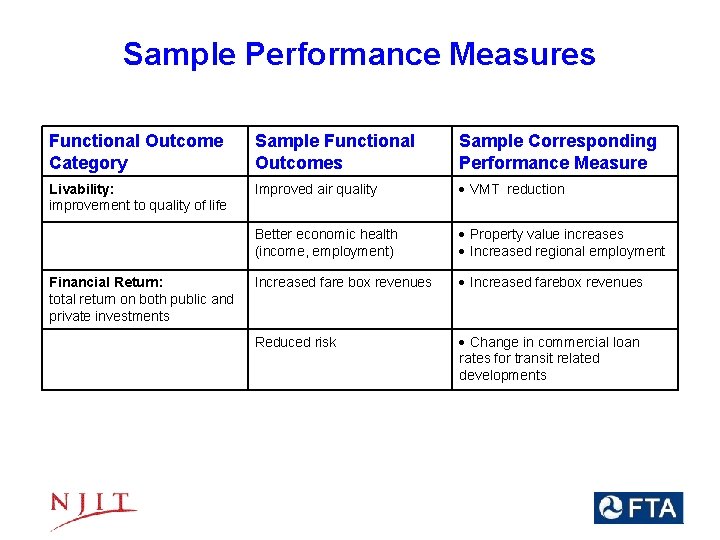
Sample Performance Measures Functional Outcome Category Sample Functional Outcomes Sample Corresponding Performance Measure Livability: improvement to quality of life Improved air quality VMT reduction Better economic health (income, employment) Property value increases Increased regional employment Increased fare box revenues Increased farebox revenues Reduced risk Change in commercial loan rates for transit related developments Financial Return: total return on both public and private investments
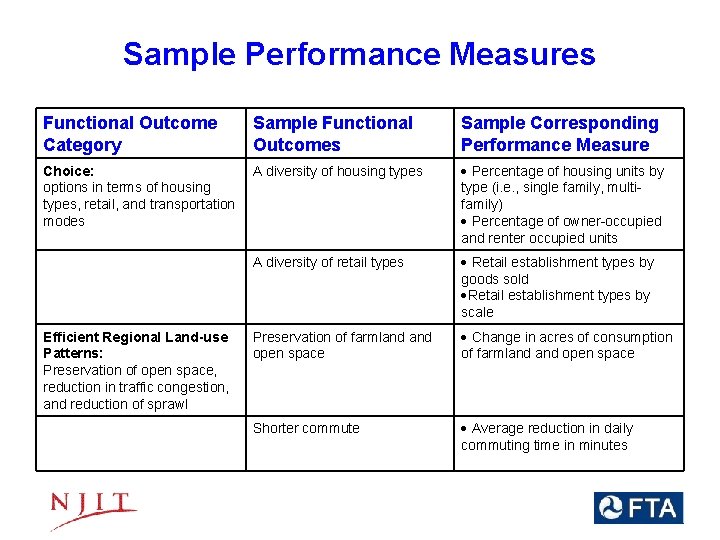
Sample Performance Measures Functional Outcome Category Sample Functional Outcomes Sample Corresponding Performance Measure Choice: options in terms of housing types, retail, and transportation modes A diversity of housing types Percentage of housing units by type (i. e. , single family, multifamily) Percentage of owner-occupied and renter occupied units A diversity of retail types Retail establishment types by goods sold Retail establishment types by scale Preservation of farmland open space Change in acres of consumption of farmland open space Shorter commute Average reduction in daily commuting time in minutes Efficient Regional Land-use Patterns: Preservation of open space, reduction in traffic congestion, and reduction of sprawl
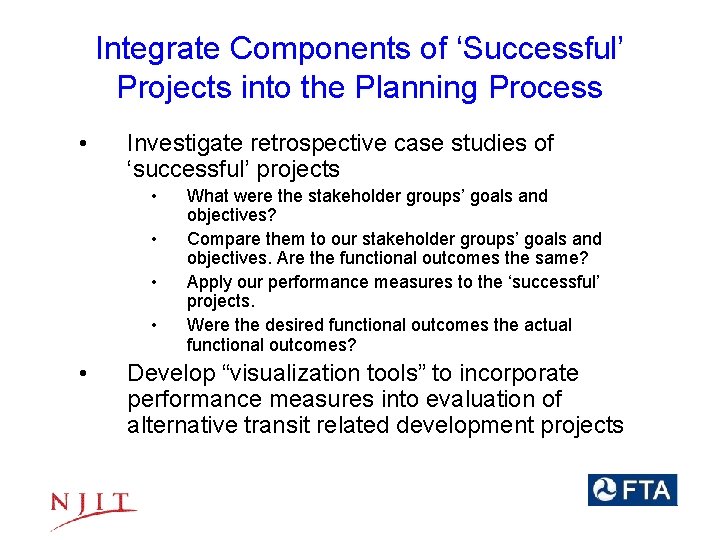
Integrate Components of ‘Successful’ Projects into the Planning Process • Investigate retrospective case studies of ‘successful’ projects • • • What were the stakeholder groups’ goals and objectives? Compare them to our stakeholder groups’ goals and objectives. Are the functional outcomes the same? Apply our performance measures to the ‘successful’ projects. Were the desired functional outcomes the actual functional outcomes? Develop “visualization tools” to incorporate performance measures into evaluation of alternative transit related development projects
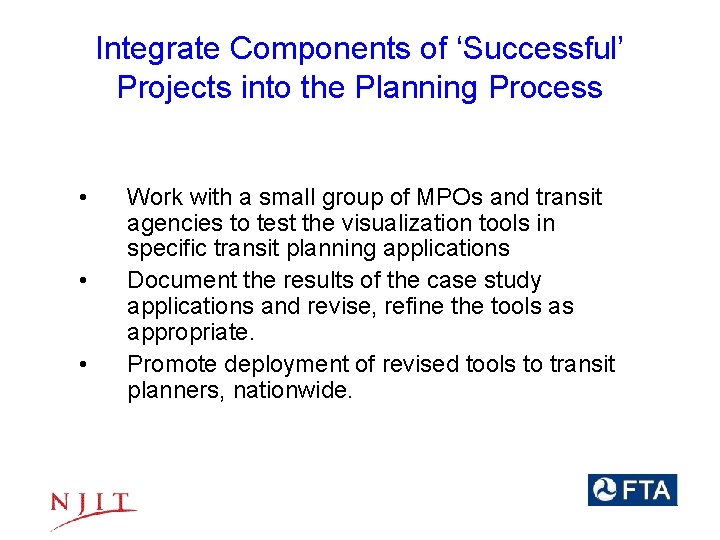
Integrate Components of ‘Successful’ Projects into the Planning Process • • • Work with a small group of MPOs and transit agencies to test the visualization tools in specific transit planning applications Document the results of the case study applications and revise, refine the tools as appropriate. Promote deployment of revised tools to transit planners, nationwide.
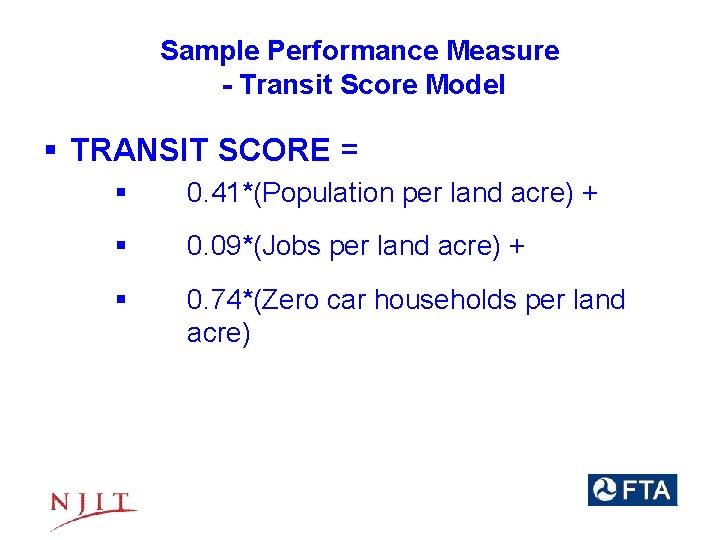
Sample Performance Measure - Transit Score Model § TRANSIT SCORE = § 0. 41*(Population per land acre) + § 0. 09*(Jobs per land acre) + § 0. 74*(Zero car households per land acre)
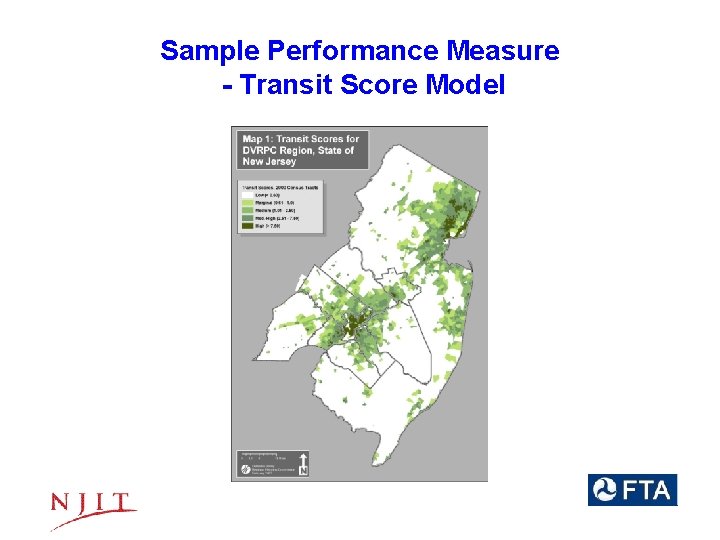
Sample Performance Measure - Transit Score Model
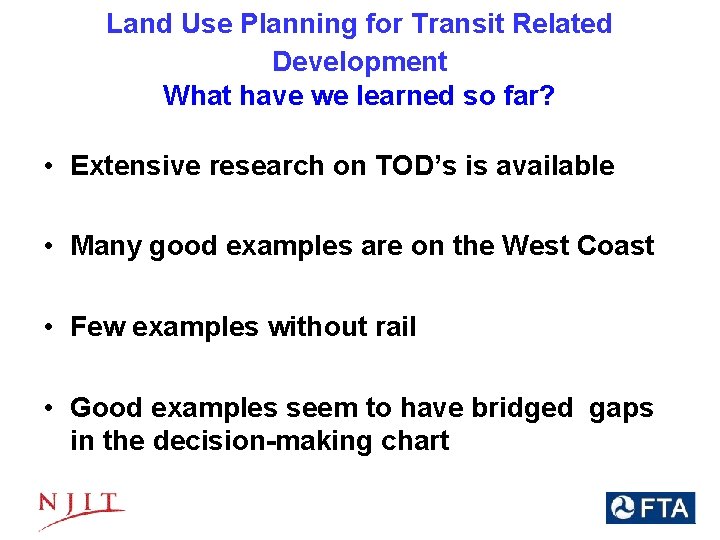
Land Use Planning for Transit Related Development What have we learned so far? • Extensive research on TOD’s is available • Many good examples are on the West Coast • Few examples without rail • Good examples seem to have bridged gaps in the decision-making chart
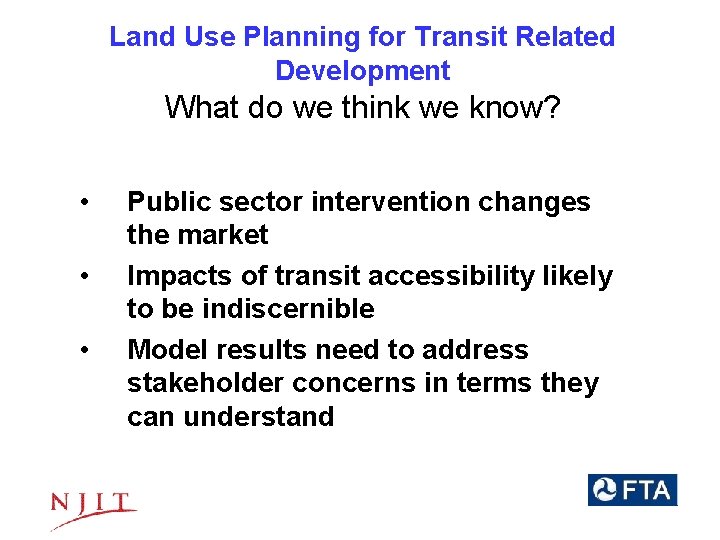
Land Use Planning for Transit Related Development What do we think we know? • • • Public sector intervention changes the market Impacts of transit accessibility likely to be indiscernible Model results need to address stakeholder concerns in terms they can understand
Land Use Planning for Transit Related Development What are the needs? • Data are needed to prove benefits • Bus Rapid Transit and other bus-oriented development examples are needed • Metropolitan Planning Organizations need to address land use in their regional plans • Education is needed at the municipal level
Land Use Planning for Transit Related Development THANK YOU Contact Jerry Lutin jlutin@njit. edu