
Land use in the UK UK Physical Characteristics
- Slides: 2
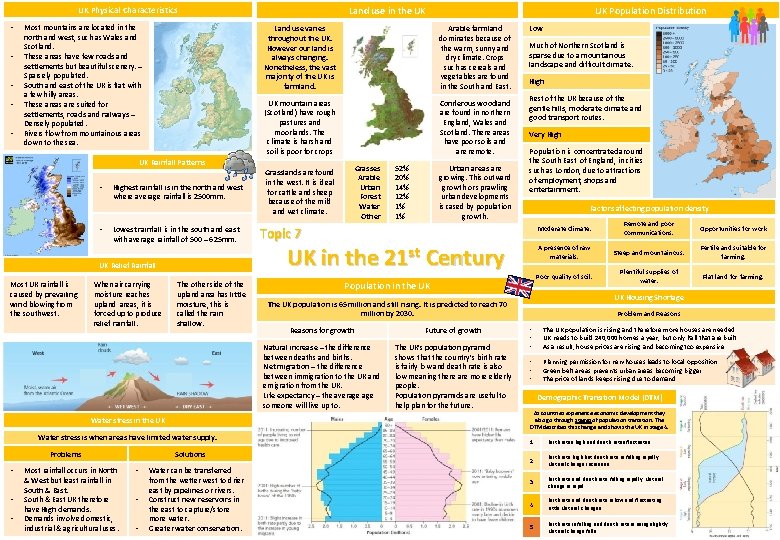
Land use in the UK UK Physical Characteristics • • • Most mountains are located in the north and west, such as Wales and Scotland. These areas have few roads and settlements but beautiful scenery. – Sparsely populated. South and east of the UK is flat with a few hilly areas. These areas are suited for settlements, roads and railways – Densely populated. Rivers flow from mountainous areas down to the sea. Land use varies throughout the UK. However our land is always changing. Nonetheless, the vast majority of the UK is farmland. Arable farmland dominates because of the warm, sunny and dry climate. Crops such as cereals and vegetables are found in the South and East. UK mountain areas (Scotland) have rough pastures and moorlands. The climate is harsh and soil is poor for crops Coniferous woodland are found in northern England, Wales and Scotland. There areas have poor soils and are remote. UK Rainfall Patterns • • Highest rainfall is in the north and west where average rainfall is 2500 mm. Lowest rainfall is in the south and east with average rainfall of 500 – 625 mm. UK Relief Rainfall Most UK rainfall is caused by prevailing wind blowing from the southwest. When air carrying moisture reaches upland areas, it is forced up to produce relief rainfall. The other side of the upland area has little moisture, this is called the rain shallow. Water stress in the UK Water stress is when areas have limited water supply. Problems • • • Most rainfall occurs in North & West but least rainfall in South & East UK therefore have High demands. Demands involve domestic, industrial & agricultural uses. Solutions • • • Water can be transferred from the wetter west to drier east by pipelines or rivers. Construct new reservoirs in the east to capture/store more water. Greater water conservation. UK Population Distribution Grasses Arable Urban Forest Water Other Grasslands are found in the west. It is ideal for cattle and sheep because of the mild and wet climate. Topic 7 52% 20% 14% 12% 1% 1% UK in the 21 st Urban areas are growing. This outward growth or sprawling urban developments is cased by population growth. Low Much of Northern Scotland is sparse due to a mountainous landscape and difficult climate. High Rest of the UK because of the gentle hills, moderate climate and good transport routes. Very High Population is concentrated around the South East of England, in cities such as London, due to attractions of employment, shops and entertainment. Factors affecting population density Century Population in the UK Future of growth Natural increase – the difference between deaths and births. Net migration – the difference between immigration to the UK and emigration from the UK. Life expectancy – the average someone will live up to. The UK’s population pyramid shows that the country’s birth rate is fairly low and death rate is also low meaning there are more elderly people. Population pyramids are useful to help plan for the future. Remote and poor communications. Opportunities for work A presence of raw materials. Steep and mountainous. Fertile and suitable for farming. Poor quality of soil. Plentiful supplies of water. Flat land for farming. UK Housing Shortage The UK population is 65 million and still rising. It is predicted to reach 70 million by 2030. Reasons for growth Moderate climate. Problem and Reasons • • • The UK population is rising and therefore more houses are needed. UK needs to build 240, 000 homes a year, but only half that are built. As a result, house prices are rising and becoming too expensive. • • • Planning permission for new houses leads to local opposition. Green belt areas prevents urban areas becoming bigger. The price of lands keeps rising due to demand. Demographic Transition Model (DTM) As countries experience economic development they also go through stages of population transition. The DTM describes this change and shows the UK in stage 4. 1 Birth rates high and death rates fluctuates. 2 Birth rate high but death rate is falling rapidly. Natural change increases. 3 Birth rate and death rate falling rapidly. Natural change is rapid. 4 Birth rate and death rate is low and fluctuating. Little Natural changes. 5 Birth rate is falling and death rate is rising slightly. Natural change falls.
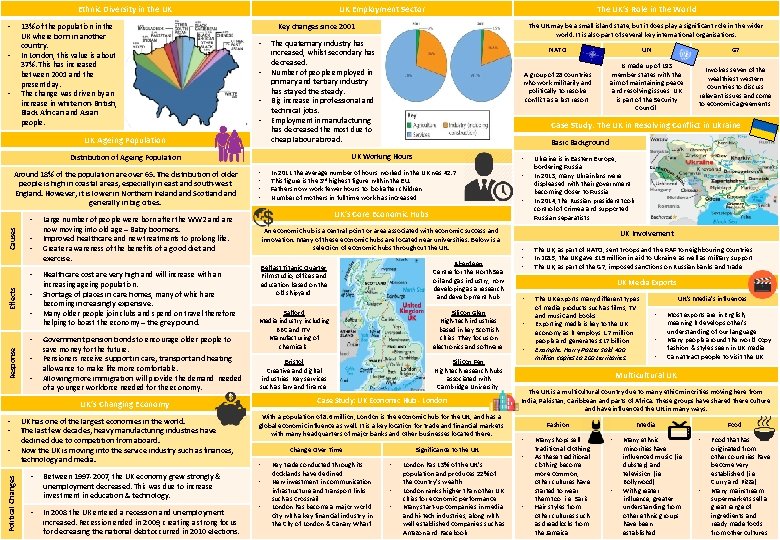
Ethnic Diversity in the UK • 13% of the population in the UK where born in another country. In London, this value is about 37%. This has increased between 2001 and the present day. The change was driven by an increase in white non-British, Black African and Asian people. • • Key changes since 2001 • • UK Ageing Population Causes • • • Effects • • • Response • • Government pension bonds to encourage older people to save money for the future. Pensioners receive support in care, transport and heating allowance to make life more comfortable. Allowing more immigration will provide the demand needed of a younger workforce needed for the economy. Political Changes • UK has one of the largest economies in the world. The last few decades, heavy manufacturing industries have declined due to competition from aboard. Now the UK is moving into the service industry such as finances, technology and media. • • Between 1997 -2007, the UK economy grew strongly & unemployment decreased. This was due to increase investment in education & technology. In 2008 the UK entered a recession and unemployment increased. Recession ended in 2009, creating a strong focus for decreasing the national debt occurred in 2010 elections. UN G 7 A group of 28 countries who work militarily and politically to resolve conflict as a last resort. Is made up of 193 member states with the aim of maintaining peace and resolving issues. UK is part of the Security Council. Involves seven of the wealthiest western countries to discuss relevant issues and come to economic agreements. Basic Background • In 2011 the average number of hours worked in the UK was 42. 7. This figure is the 3 rd highest figure within the EU. Fathers now work fewer hours to look after children. Number of mothers in fulltime work has increased. • • UK’s Core Economic Hubs An economic hub is a central point or area associated with economic success and innovation. Many of these economic hubs are located near universities. Below is a selection of economic hubs throughout the UK. Belfast Titanic Quarter Film studio, offices and education based on the old shipyard. Aberdeen Centre for the North Sea oil and gas industry, now developing as a research and development hub. Salford Media industry including BBC and ITV. Manufacturing of chemicals. Silicon Glen High-tech industries based in key Scottish cities. They focus on electronics and software. Bristol Creative and digital industries. Key services such as law and finance. Silicon Fen High tech research hubs associated with Cambridge University. Case Study: UK Economic Hub - London UK’s Changing Economy • • NATO Case Study: The UK in Resolving Conflict in Ukraine UK Working Hours Large number of people were born after the WW 2 and are now moving into old age – Baby boomers. Improved healthcare and new treatments to prolong life. Greater awareness of the benefits of a good diet and exercise. Healthcare cost are very high and will increase with an increasing ageing population. Shortage of places in care homes, many of which are becoming increasingly expensive. Many older people join clubs and spend on travel therefore helping to boast the economy – the grey pound. The UK may be a small island state, but it does play a significant role in the wider world. It is also part of several key international organisations. The quaternary industry has increased, whilst secondary has decreased. Number of people employed in primary and tertiary industry has stayed the steady. Big increase in professional and technical jobs. Employment in manufacturing has decreased the most due to cheap labour abroad. Distribution of Ageing Population Around 18% of the population are over 65. The distribution of older people is high in coastal areas, especially in east and south-west England. However, it is lower in Northern Ireland Scotland generally in big cities. The UK’s Role in the World UK Employment Sector With a population of 8. 6 million, London is the economic hub for the UK, and has a global economic influence as well. It is a key location for trade and financial markets with many headquarters of major banks and other businesses located there. Change Over Time • • • Key trade conducted through its docklands have declined. New investment in communication infrastructure and transport links such as Crossrail. London has become a major world city with a key financial industry in the City of London & Canary Wharf. Significance to the UK • • • London has 13% of the UK’s population and produces 22% of the country’s wealth. London ranks higher than other UK cities for economic performance. Many start-up companies in media and hi-tech industries, along with well established companies such as Amazon and Facebook. Ukraine is in Eastern Europe, bordering Russia. In 2013, many Ukrainians were displeased with their government becoming closer to Russia. In 2014, the Russian president took control of Crimea and supported Russian separatists. UK Involvement • • • The UK, as part of NATO, sent troops and the RAF to neighbouring countries. In 2015, the UK gave £ 15 million in aid to Ukraine as well as military support. The UK, as part of the G 7, imposed sanctions on Russian banks and trade. UK Media Exports • • • The UK exports many different types of media products such as films, TV and music and books. Exporting media is key to the UK economy as it employs 1. 7 million people and generates £ 17 billion. Example: Harry Potter sold 400 million copies to 200 territories. UK’s Media’s influences • • • Most exports are in English, meaning it develops other’s understanding of our language. Many people around the world copy fashion & styles seen in UK media. Can attract people to visit the UK. Multicultural UK The UK is a multicultural country due to many ethic minorities moving here from India, Pakistan, Caribbean and parts of Africa. These groups have shared there culture and have influenced the UK in many ways. Fashion • • • Many shops sell traditional clothing. As these traditional clothing become more common, other cultures have started to wear them too. i. e. Saris Hair styles from other cultures such as dreadlocks from the Jamaica. Media • • Many ethnic minorities have influenced music (i. e. dubstep) and television (i. e. Bollywood). With greater influence, greater understanding from other ethnic groups have been established. Food • • Food that has originated from other countries have become very established (i. e. Curry and Pizza). Many mainstream supermarkets sell a great range of ingredients and ready made foods from other cultures.