
Land slides Landslide refers to the downward sliding


- Slides: 17
Land slides
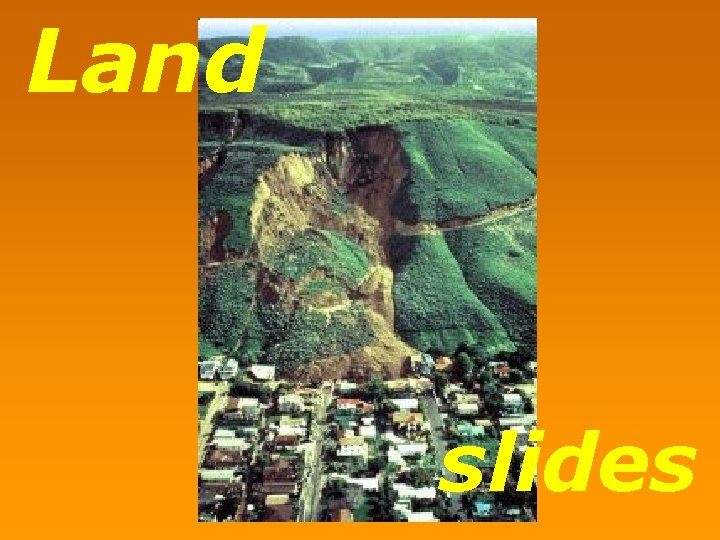
Landslide: refers to the downward sliding of huge quantities of land mass which occur along steep slopes of hills or mountains and may be sudden or slow
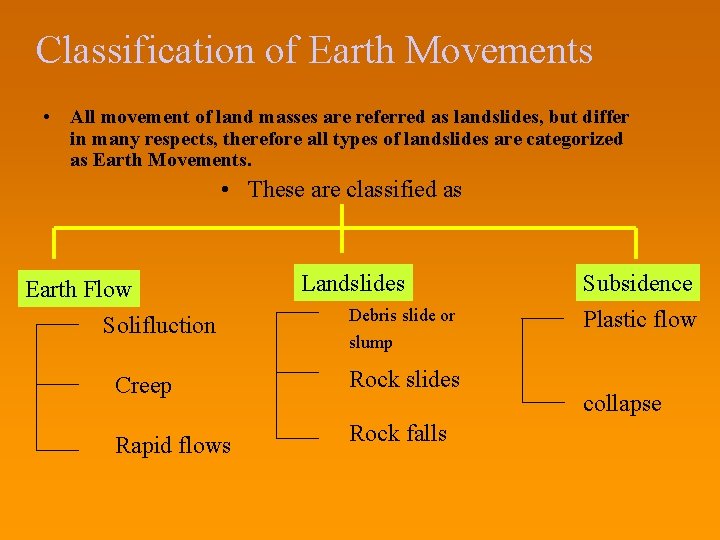
Classification of Earth Movements • All movement of land masses are referred as landslides, but differ in many respects, therefore all types of landslides are categorized as Earth Movements. • These are classified as Earth Flow Solifluction Landslides Debris slide or Subsidence Plastic flow slump Creep Rock slides Rapid flows Rock falls collapse
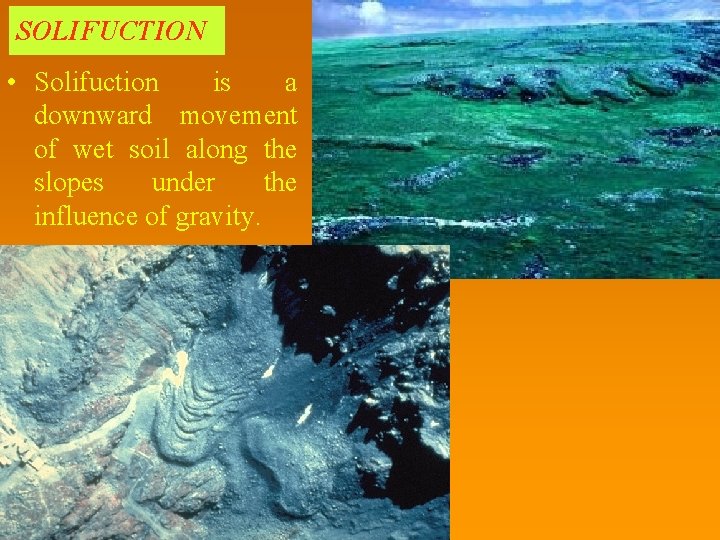
SOLIFUCTION • Solifuction is a downward movement of wet soil along the slopes under the influence of gravity.
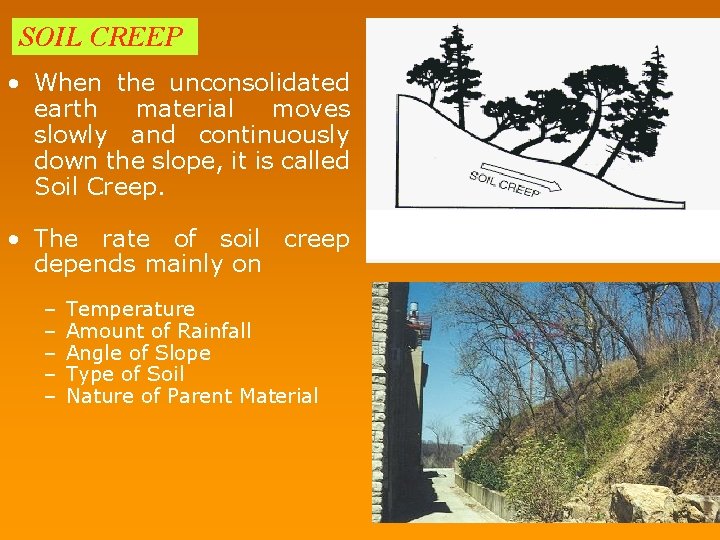
SOIL CREEP • When the unconsolidated earth material moves slowly and continuously down the slope, it is called Soil Creep. • The rate of soil creep depends mainly on – – – Temperature Amount of Rainfall Angle of Slope Type of Soil Nature of Parent Material
• RAPID FLOWS: Rapid flow is similar to the creep, but differ in terms of speed and depth. It is faster. • Creep is involved up to shallow depth (app. 1 -2 m), whereas the rapid flow is involved to greater depth (app. up to 5 m or more)
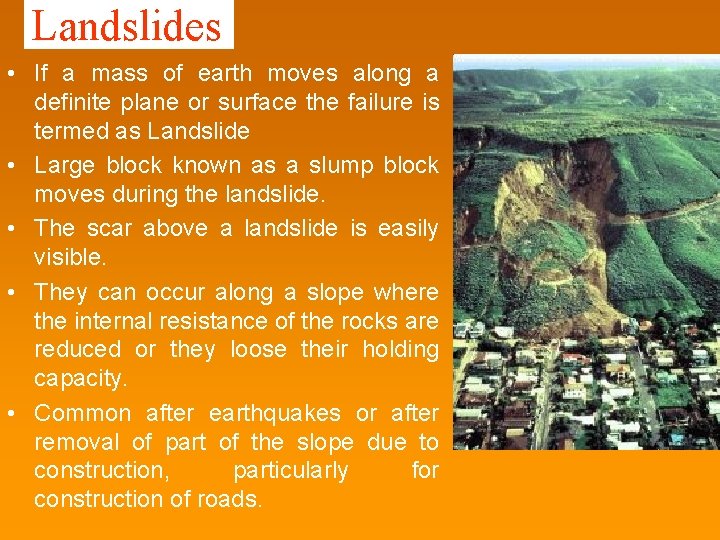
Landslides • If a mass of earth moves along a definite plane or surface the failure is termed as Landslide • Large block known as a slump block moves during the landslide. • The scar above a landslide is easily visible. • They can occur along a slope where the internal resistance of the rocks are reduced or they loose their holding capacity. • Common after earthquakes or after removal of part of the slope due to construction, particularly for construction of roads.
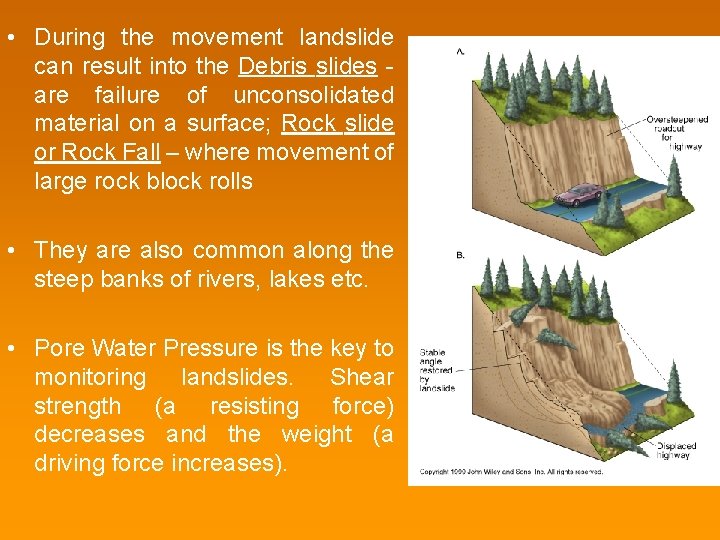
• During the movement landslide can result into the Debris slides are failure of unconsolidated material on a surface; Rock slide or Rock Fall – where movement of large rock block rolls • They are also common along the steep banks of rivers, lakes etc. • Pore Water Pressure is the key to monitoring landslides. Shear strength (a resisting force) decreases and the weight (a driving force increases).
• Talus – accumulation formed by the coarser rock fragments resulted from the mechanical weathering along a slope under influence of gravity
Subsidence • It represents the downward movement of the surface • It may occur due to plastic outflow of the underlying strata or due to the compaction of the underlying material • (1) Subsidence due to Plastic outflow: It may occur when a plastic layer like clay bed is squeezed outward due to overlying heavy load • (2) Subsidence due to collapse: It occur due to extensive pull out of large volume of underground water or due to subsurface solution activity in limestone terrain.
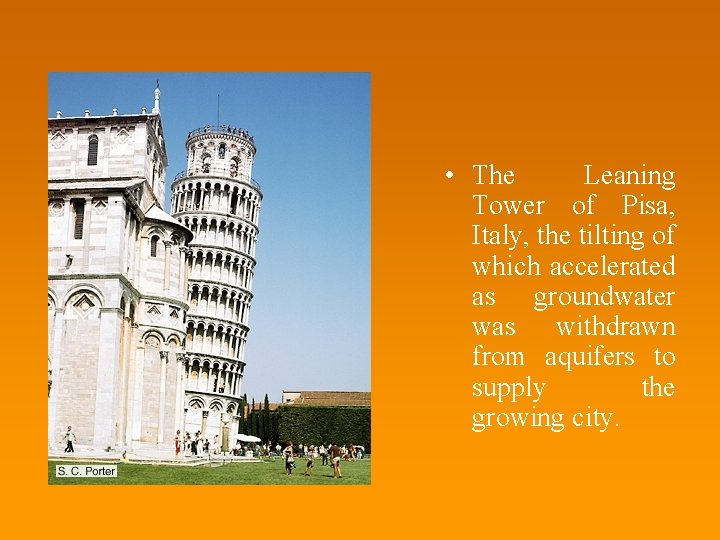
• The Leaning Tower of Pisa, Italy, the tilting of which accelerated as groundwater was withdrawn from aquifers to supply the growing city.
CAUSES OF LANDSLIDES • LANDSLIDES OCCUR DUE OF VARIOUS REASONS • Internal Causes: • Influence of slope- Provides favourable condition for landslides; steeper slope are prone to slippage of land. It is known that most of the materials are stable upto certain angle- “Critical angle” or “angle of repose” – it varies from 300 for unconsolidated sediments to 900 for massive rocks and 600 -900 for partially jointed rocks. • Ground water or associated water- Main factor responsible for slippage. Suppose the hard or massive rocks are underlained by softer rocks (shale or clay bed) • When rain water percolates through some fractures or joints the clayey beds becomes very plastic and acts as slippery base, which enhance the chances of loose overburden to slip downward. • Water is the most powerful solvent, which not only causes decomposition of minerals but also leaches out the soluble matter of the rock and reduces the strength.
• Lithology- rock which are rich in clay (montmorillonite, bentonite), mica, calcite, gypsum etc are prone to landslide because these minerals are prone to weathering. • Geological structures- Occurrence of inclined bedding planes, joints, fault or shear zone are the planes of weakness, which create conditions of instability. • Human Influence- undercutting along the hill slopes for laying roads or rail tracks can result into instability. • Deforestation in the uplands, result into more erosion during the rainy season.
• External factors • Most common is the vibration resulted due to earthquakes; blasting to explosives; volcanic eruption etc. • Earthquakes often initiate mass failures on large scale eg. 1897 Assam quake produced gigantic landslide ever recorded in the region.
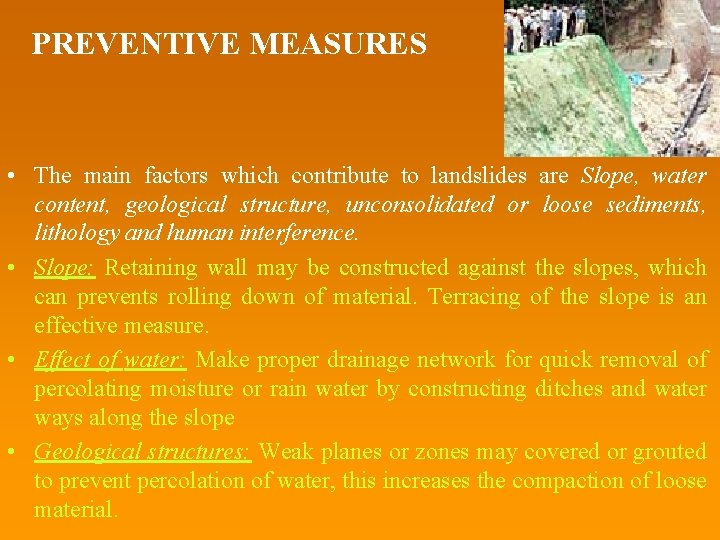
PREVENTIVE MEASURES • The main factors which contribute to landslides are Slope, water content, geological structure, unconsolidated or loose sediments, lithology and human interference. • Slope: Retaining wall may be constructed against the slopes, which can prevents rolling down of material. Terracing of the slope is an effective measure. • Effect of water: Make proper drainage network for quick removal of percolating moisture or rain water by constructing ditches and water ways along the slope • Geological structures: Weak planes or zones may covered or grouted to prevent percolation of water, this increases the compaction of loose material.
• LANDSLIDES AND MUDFLOWS • Plants cover on slopes and build retaining walls. • In mudflow areas, build channels or deflection walls to direct the flow around buildings. • Install flexible pipe fittings to avoid gas or water leaks.