
Land Slides Causes and Protective Measures Prof Dr
















- Slides: 68
Land Slides Causes and Protective Measures Prof. Dr. Attaullah Shah 1
of land mass, which occur along steep slopes of hills or mountains and may be sudden or slow Geological Phenomena involving downward movement of large quantities of material such as rocks, earth, sand combination The Movement may be slow from few millimeters per year to few centimeter per year. In flow type land slides, it may be 15 km/h in some cases The collapse of masses may also be suddent as in case of Avalanche on the steep slope. In recent days, the earthquake at Nepal led to huge avalanche at the bases camp of Mount Everest which caused huge human losses.
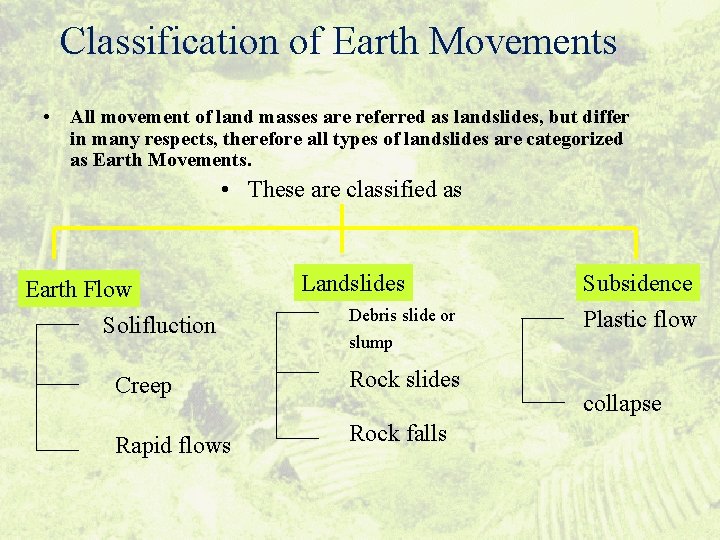
Classification of Earth Movements • All movement of land masses are referred as landslides, but differ in many respects, therefore all types of landslides are categorized as Earth Movements. • These are classified as Earth Flow Solifluction Landslides Debris slide or Subsidence Plastic flow slump Creep Rock slides Rapid flows Rock falls collapse
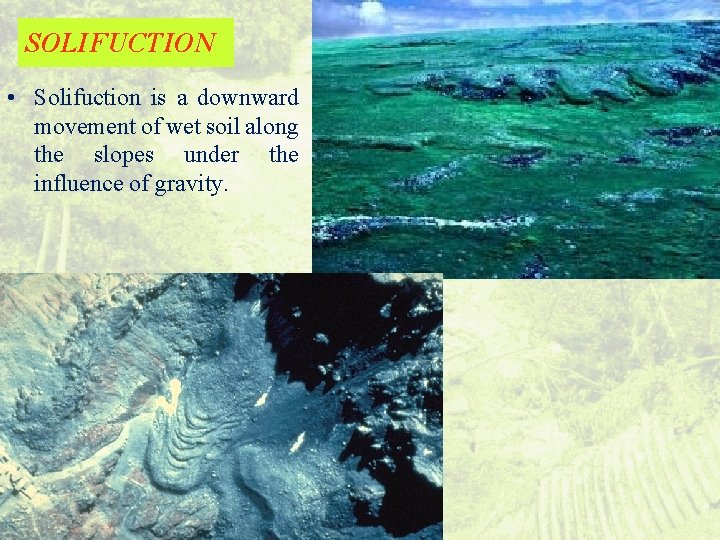
SOLIFUCTION • Solifuction is a downward movement of wet soil along the slopes under the influence of gravity.
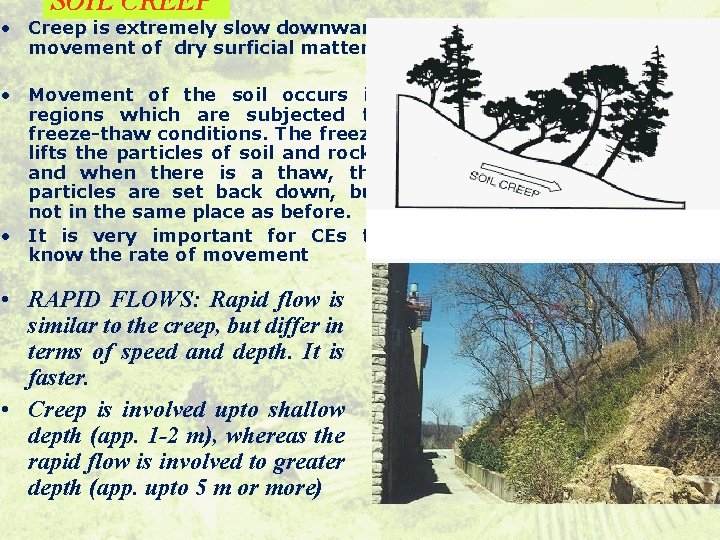
SOIL CREEP • Creep is extremely slow downward movement of dry surficial matter. • Movement of the soil occurs in regions which are subjected to freeze-thaw conditions. The freeze lifts the particles of soil and rocks and when there is a thaw, the particles are set back down, but not in the same place as before. • It is very important for CEs to know the rate of movement • RAPID FLOWS: Rapid flow is similar to the creep, but differ in terms of speed and depth. It is faster. • Creep is involved upto shallow depth (app. 1 -2 m), whereas the rapid flow is involved to greater depth (app. upto 5 m or more)
Landslides • If a mass of earth moves along a definite plane or surface the failure is termed as Landslide • Large block known as a slump block moves during the landslide. • The scar above a landslide is easily visible. • They can occur along a slope where the internal resistance of the rocks are reduced or they loose their holding capacity. • Common after earthquakes or after removal of part of the slope due to construction, particularly for construction of roads.
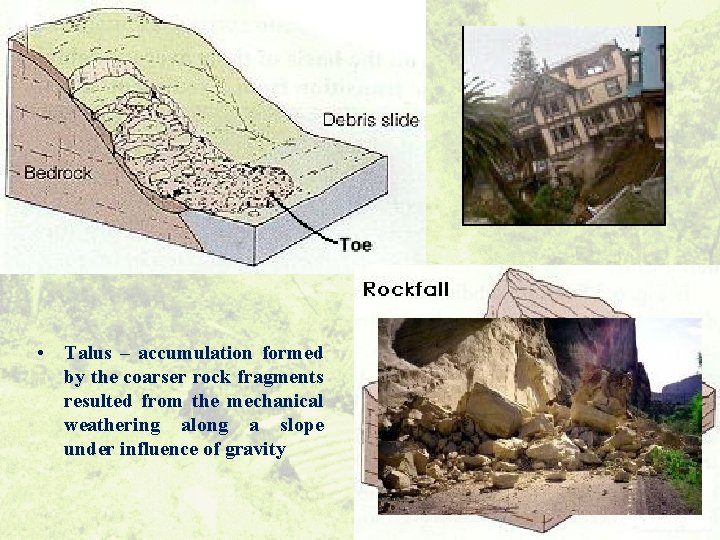
• During the movement landslide can result into the Debris slides - are failure of unconsolidated material on a surface; Rock slide or Rock Fall – where movement of large rock block rolls • They are also common along the steep banks of rivers, lakes etc. • Pore Water Pressure is the key to monitoring landslides. Shear strength (a resisting force) decreases and the weight (a driving force increases).
• Talus – accumulation formed by the coarser rock fragments resulted from the mechanical weathering along a slope under influence of gravity
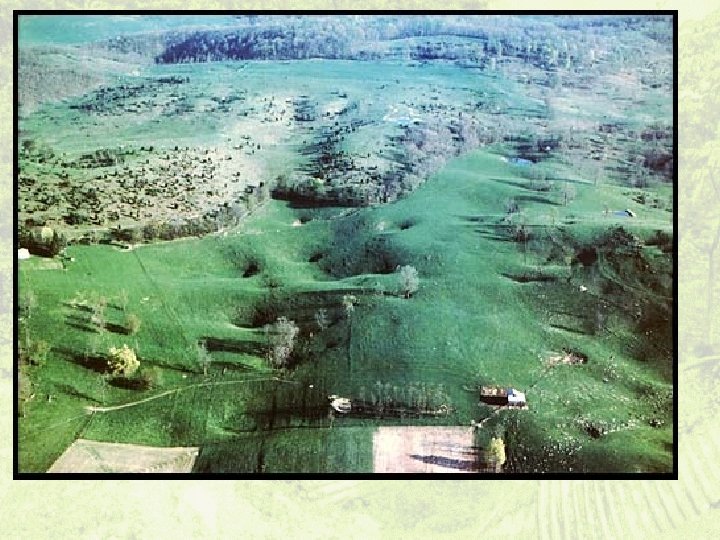
Subsidence • It represents the downward movement of the surface • It may occur due to plastic outflow of the underlying strata or due to the compaction of the underlying material • (1) Subsidence due to Plastic outflow: It may occur when a plastic layer like clay bed is squeezed outward due to overlying heavy load • (2) Subsidence due to collapse: It occur due to extensive pull out of large volume of underground water or due to subsurface solution activity in limestone terrain.
• The Leaning Tower of Pisa, Italy, the tilting of which accelerated as groundwater was withdrawn from aquifers to supply the growing city.
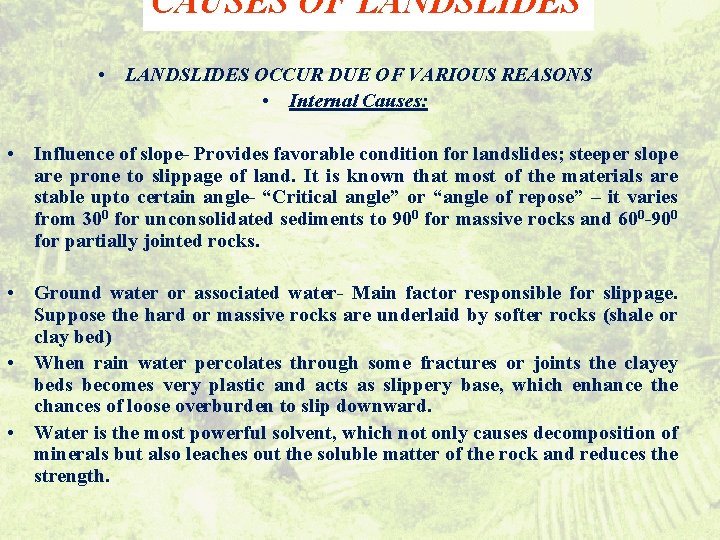
CAUSES OF LANDSLIDES • LANDSLIDES OCCUR DUE OF VARIOUS REASONS • Internal Causes: • Influence of slope- Provides favorable condition for landslides; steeper slope are prone to slippage of land. It is known that most of the materials are stable upto certain angle- “Critical angle” or “angle of repose” – it varies from 300 for unconsolidated sediments to 900 for massive rocks and 600 -900 for partially jointed rocks. • Ground water or associated water- Main factor responsible for slippage. Suppose the hard or massive rocks are underlaid by softer rocks (shale or clay bed) • When rain water percolates through some fractures or joints the clayey beds becomes very plastic and acts as slippery base, which enhance the chances of loose overburden to slip downward. • Water is the most powerful solvent, which not only causes decomposition of minerals but also leaches out the soluble matter of the rock and reduces the strength.
• Lithology- rock which are rich in clay (montmorillonite, bentonite), mica, calcite, gypsum etc are prone to landslide because these minerals are prone to weathering. • Geological structures- Occurrence of inclined bedding planes, joints, fault or shear zone are the planes of weakness, which create conditions of instability. • Human Influence- undercutting along the hill slopes for laying roads or rail tracks can result into instability. • Deforestation in the uplands, result into more erosion during the rainy season.
• External factors • Most common is the vibration resulted due to earthquakes; blasting to explosives; volcanic eruption etc. • Earthquakes often initiate mass failures on large scale e. g. 1897 Assam quake produced gigantic landslide ever recorded in the region.
Geological process causing Landslides • Erosion: – Cause steepening of slopes – Remove cementing material • • • Weathering of Rocks Freeze and Thaw actions ( Swelling and expansion) Shearing, jointing and cracks etc Leaching of limes and earth 15
Human actions causing landslides • Construction of human settlements at vulnerable areas near the critical slopes. • Blasting and mining • Vibrations of machines and earth moving equipment • Dumping of Rocks and debris causes lateral pressure • Vegetation and tree roots bind the slopes, but its cutting can cause slides. • Overgrazing in unconsolidated soils • Water leakages from utilities 16
Natural Causes • • Heavy rainfalls leads to saturation of soils Erosion and undercutting of slopes by rivers Earthquakes and ground movements Excessive water filtration in ground Volcanic eruption Ocean waves may also cause coastal slides Freeze and Thaw actions Action of thunder and storms 17
PREVENTIVE MEASURES • The main factors which contribute to landslides are Slope, water content, geological structure, unconsolidated or loose sediments, lithology and human interference. • Slope: Retaining wall may be constructed against the slopes, which can prevents rolling down of material. Terracing of the slope is an effective measure. • Effect of water: Make proper drainage network for quick removal of percolating moisture or rain water by constructing ditches and water ways along the slope • Geological structures: Weak planes or zones may covered or grouted to prevent percolation of water, this increases the compaction of loose material.
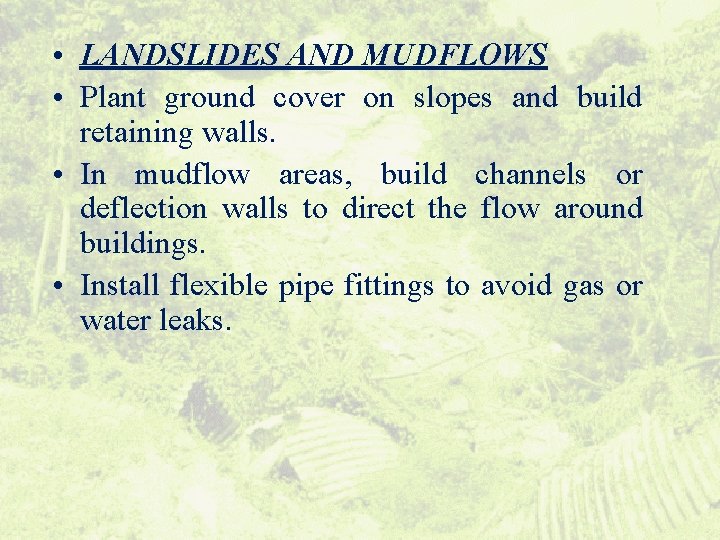
• LANDSLIDES AND MUDFLOWS • Plant ground cover on slopes and build retaining walls. • In mudflow areas, build channels or deflection walls to direct the flow around buildings. • Install flexible pipe fittings to avoid gas or water leaks.
Landslide Mitigation measures • Afforestation – Local suitable plants that can withstand the existing hydrological conditions • Modification of Slope geometry • Drainage arrangement for Ground water management • Slope Reinforcement • Retaining Structures • Other methods; – – Electro Thermo Osmosis Use of Geogrids and Geotextiles Use of steel wire meshes and Gabions Soil nailing 20
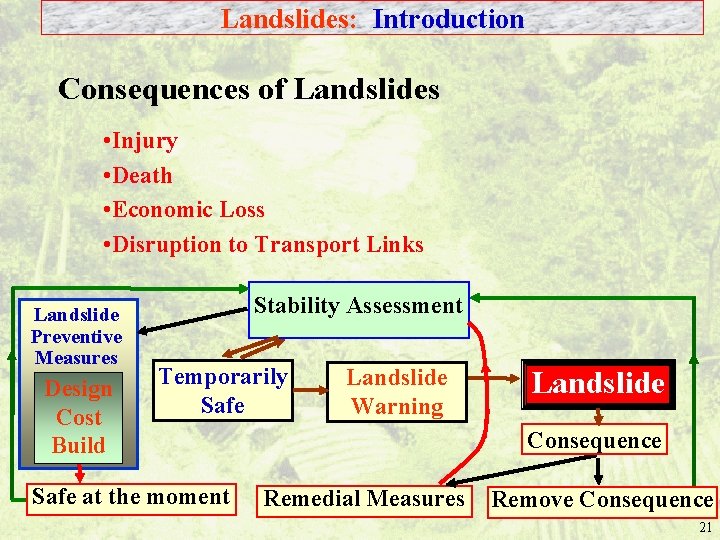
Landslides: Introduction Consequences of Landslides • Injury • Death • Economic Loss • Disruption to Transport Links Landslide Preventive Measures Design Cost Build Stability Assessment Temporarily Safe at the moment Landslide Warning Landslide Consequence Remedial Measures Remove Consequence 21
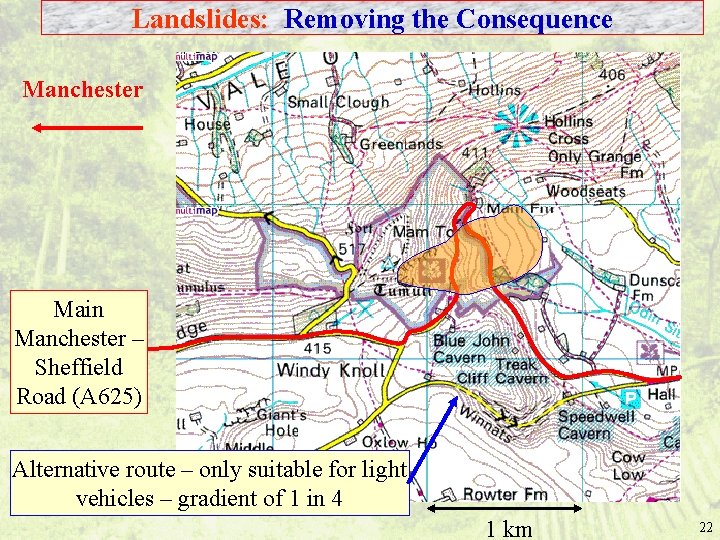
Landslides: Removing the Consequence Manchester Main Manchester – Sheffield Road (A 625) Alternative route – only suitable for light vehicles – gradient of 1 in 4 1 km 22
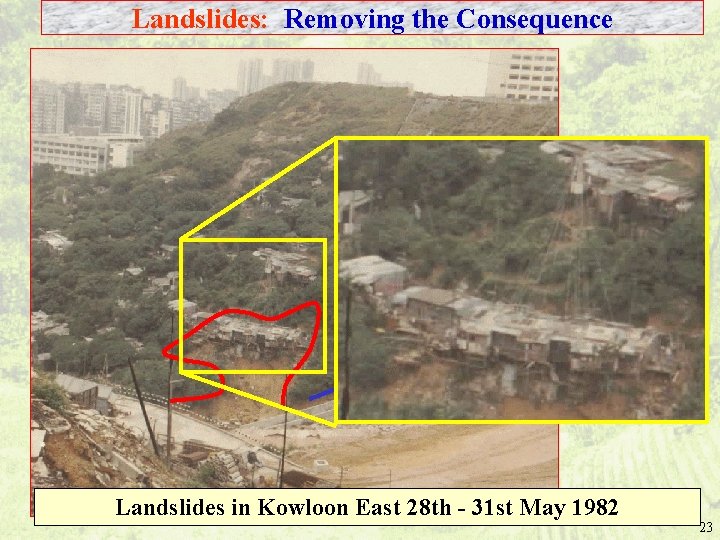
Landslides: Removing the Consequence Landslides in Kowloon East 28 th - 31 st May 1982 23
Landslides: Engineering Modelling Methods Man’s Influence (Agriculture /Development) Geology Hydrology Landslide Preventive Measures Design Cost Build Material Properties (Shear Strength) Slope Angle Loading Stability Assessment Temporarily Safe Landslide Warning But only for specific slopes Safe at the moment Remedial Measures Landslide Consequence Remove Consequence 24
Landslides: Engineering Modelling Methods • Applicable to very specific locations only • Can have moderate to good accuracy for spatial predictions where information exists • Moderate accuracy for temporal predictions (good if accurate ground water temporal variations are available) • Poor for overall spatial coverage • Is costly to implement. But one must not be complacent 25
berms 26 Landslide in made Cut Slope at km 365 west of Sao Paolo - August 2002
Landslides: GIS Modelling Methods Hydrology Geology Soil Type General Slope (and aspect) Land Use Cataloguing slopes and landslides Database of existing Landslides Classification into potential Areas of Risk Identification of areas for detailed Engineering Study General Planning Guidelines of Landslide Risk 27
Landslides: GIS Modelling Methods • Good spatial (geographic) coverage of likelihood of landslides • Poor to moderate prediction of precise locations of landslides • Effective use of resources • Poor accuracy for temporal predictions – i. e. precisely when landslides occur Accuracy is dependant on existence of a good unbiassed database of landslides and slopes 28
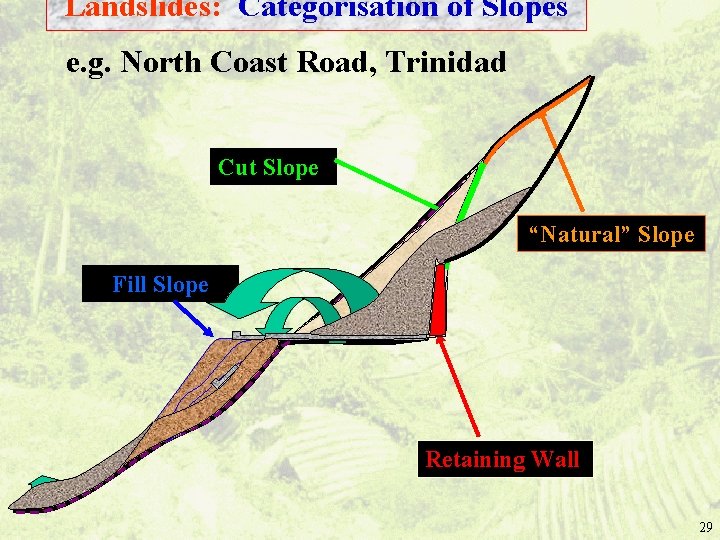
Landslides: Categorisation of Slopes e. g. North Coast Road, Trinidad Cut Slope “Natural” Slope Fill Slope Retaining Wall 29
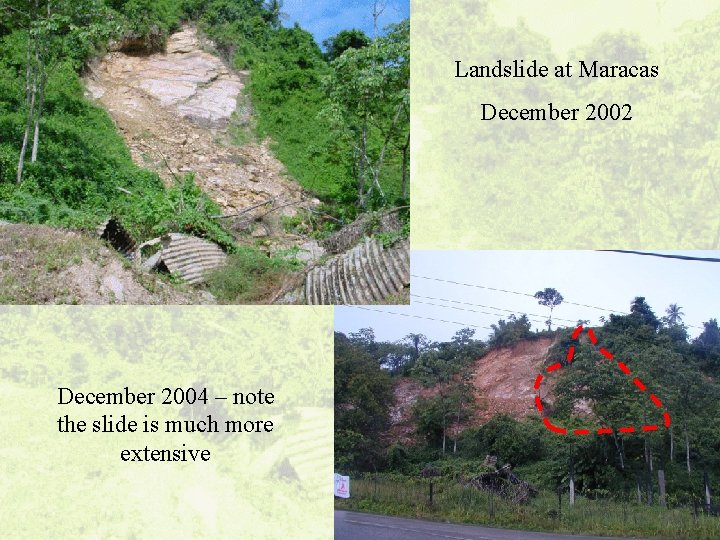
Landslide at Maracas December 2002 December 2004 – note the slide is much more extensive 30
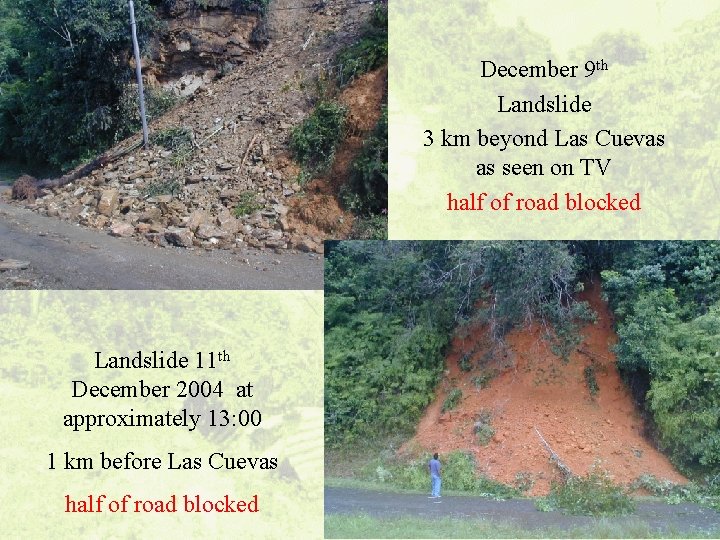
December 9 th Landslide 3 km beyond Las Cuevas as seen on TV half of road blocked Landslide 11 th December 2004 at approximately 13: 00 1 km before Las Cuevas half of road blocked 31
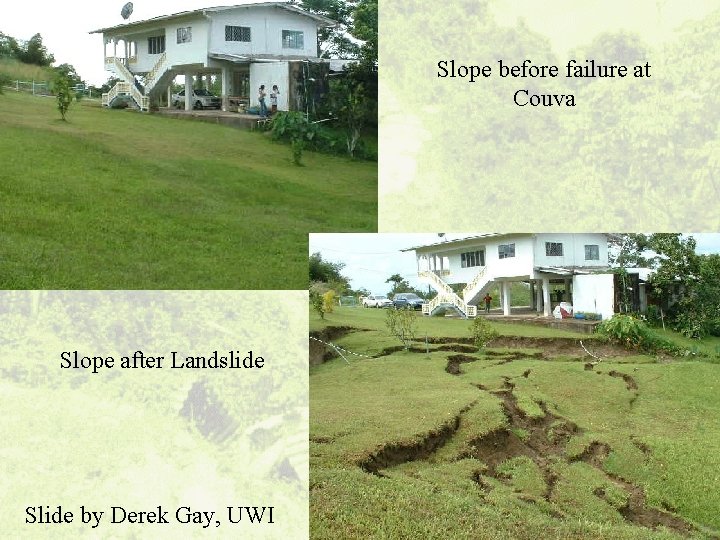
Slope before failure at Couva Slope after Landslide Slide by Derek Gay, UWI 32
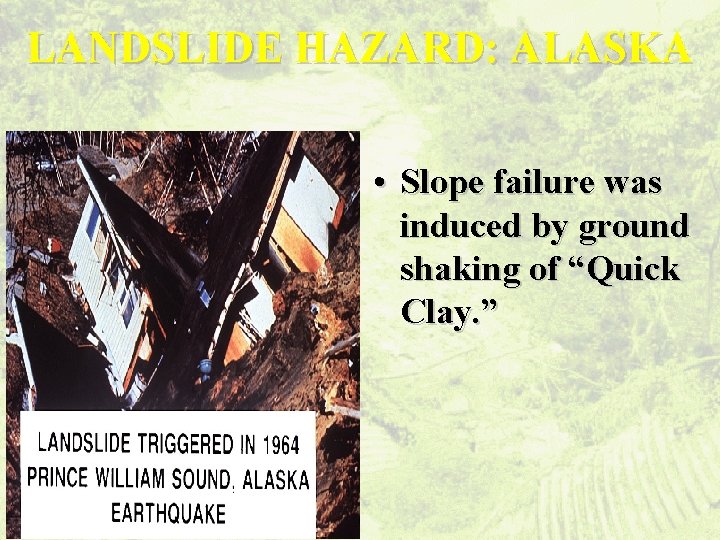
LANDSLIDE HAZARD: ALASKA • Slope failure was induced by ground shaking of “Quick Clay. ”
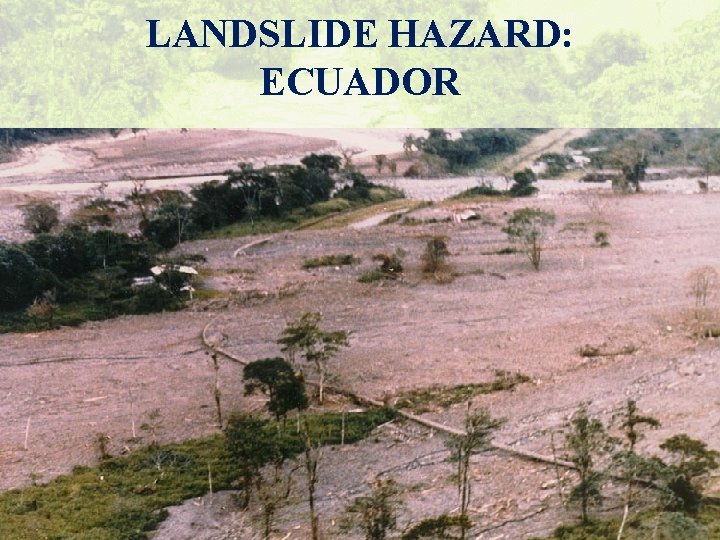
LANDSLIDE HAZARD: ECUADOR
LANDSLIDE HAZARD: JAPAN
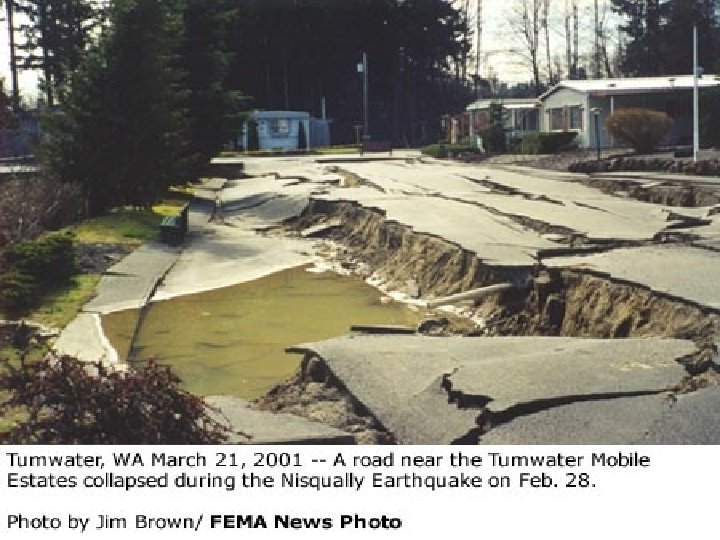
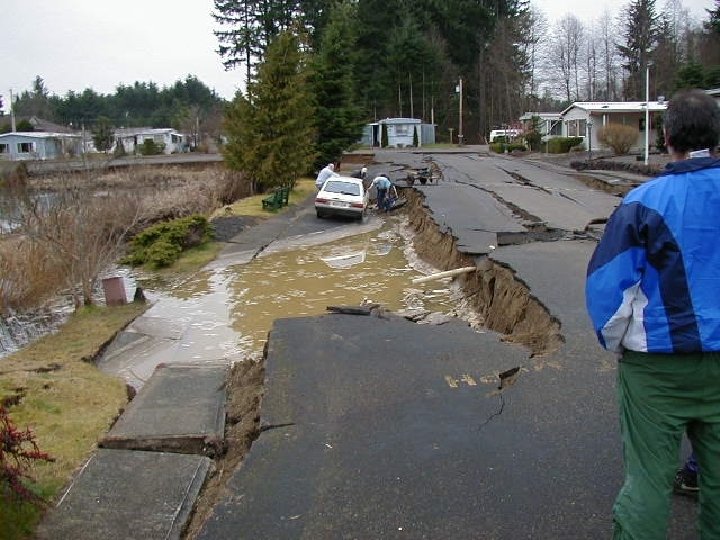
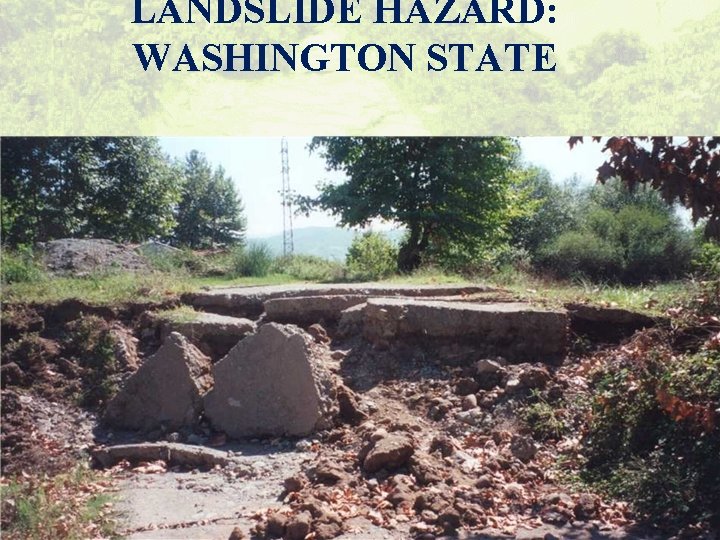
LANDSLIDE HAZARD: WASHINGTON STATE
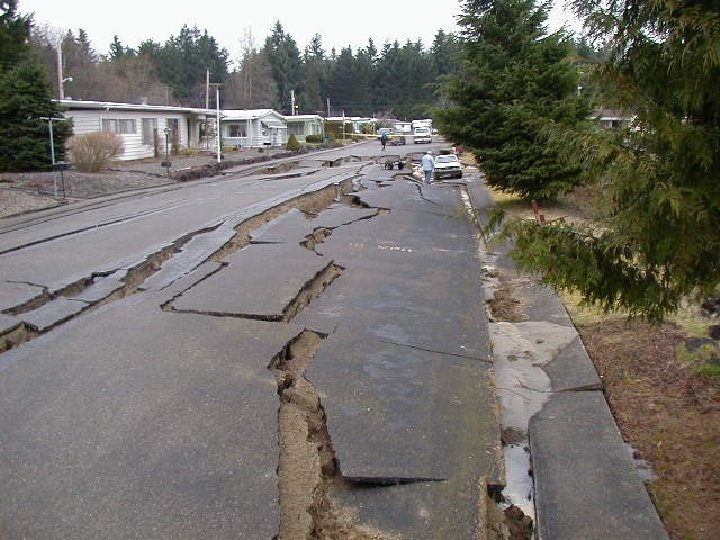
LATERAL SPREADING: JAPAN
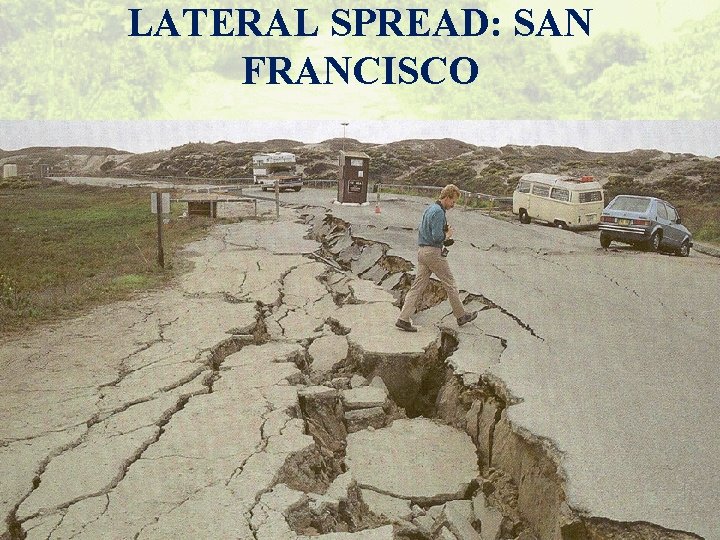
LATERAL SPREAD: SAN FRANCISCO
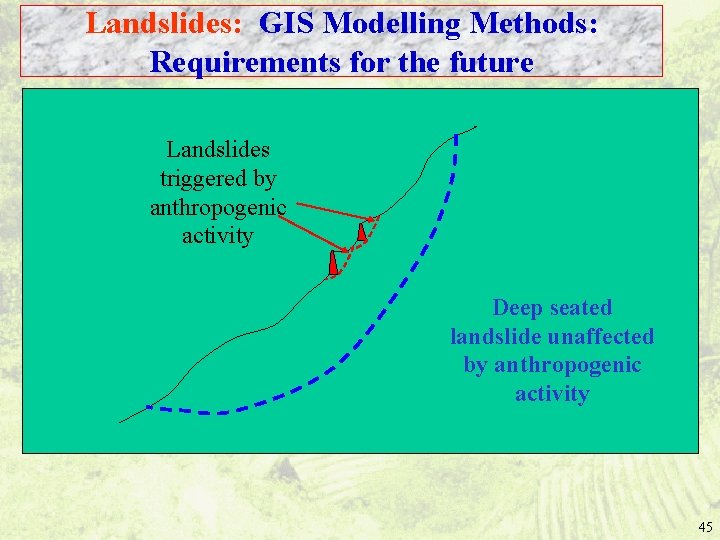
Landslides: GIS Modelling Methods: Requirements for the future • • • Landslides triggered by Cut Slopes anthropogenic Fill Slopes activity Retaining Walls Hybrids: Cut/Retaining Wall / Fill/Retaining Wall Deep seated “Natural” Slopes - is there a better word? landslide unaffected slopes where there has been no anthropogenic activity, by anthropogenic or where there is such activity it causes small changes to activity the geometry of the slope so that the Factor of Safety is largely unaffected. 45
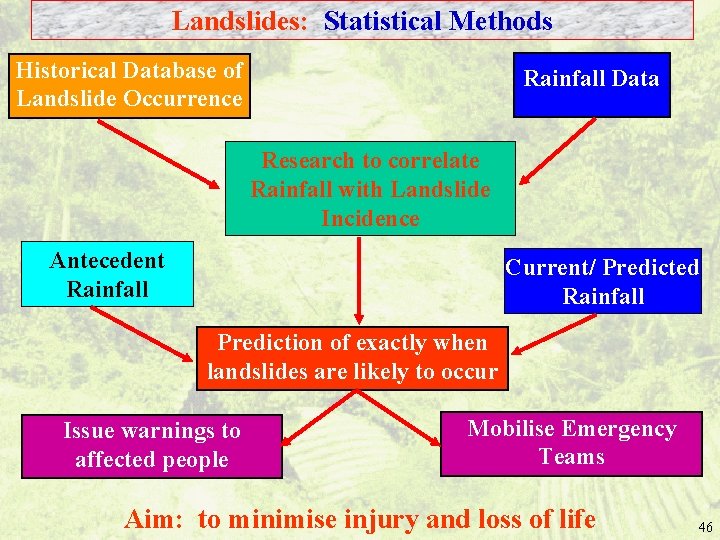
Landslides: Statistical Methods Historical Database of Landslide Occurrence Rainfall Data Research to correlate Rainfall with Landslide Incidence Antecedent Rainfall Current/ Predicted Rainfall Prediction of exactly when landslides are likely to occur Issue warnings to affected people Mobilise Emergency Teams Aim: to minimise injury and loss of life 46
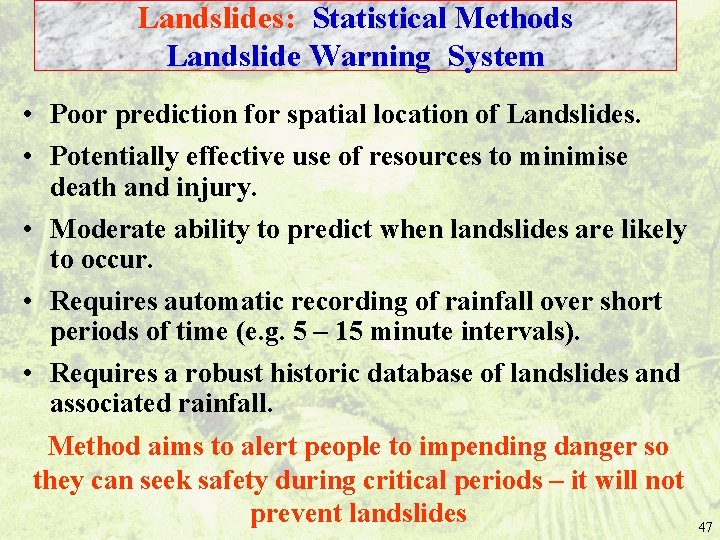
Landslides: Statistical Methods Landslide Warning System • Poor prediction for spatial location of Landslides. • Potentially effective use of resources to minimise death and injury. • Moderate ability to predict when landslides are likely to occur. • Requires automatic recording of rainfall over short periods of time (e. g. 5 – 15 minute intervals). • Requires a robust historic database of landslides and associated rainfall. Method aims to alert people to impending danger so they can seek safety during critical periods – it will not prevent landslides 47
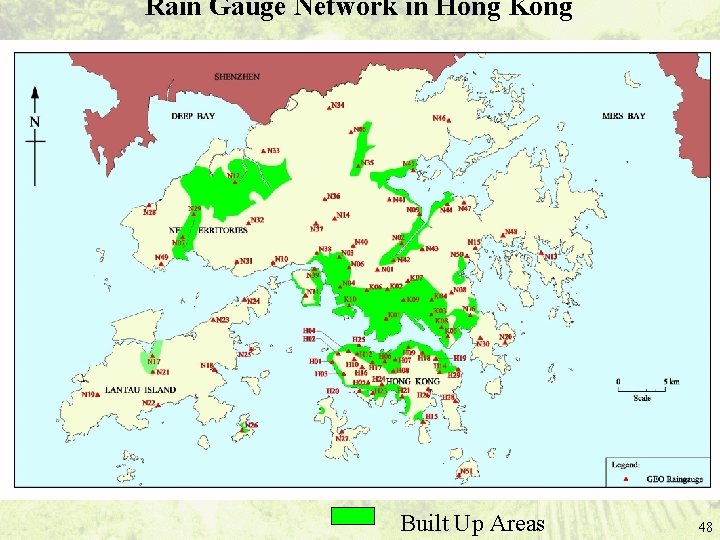
Rain Gauge Network in Hong Kong Built Up Areas 48
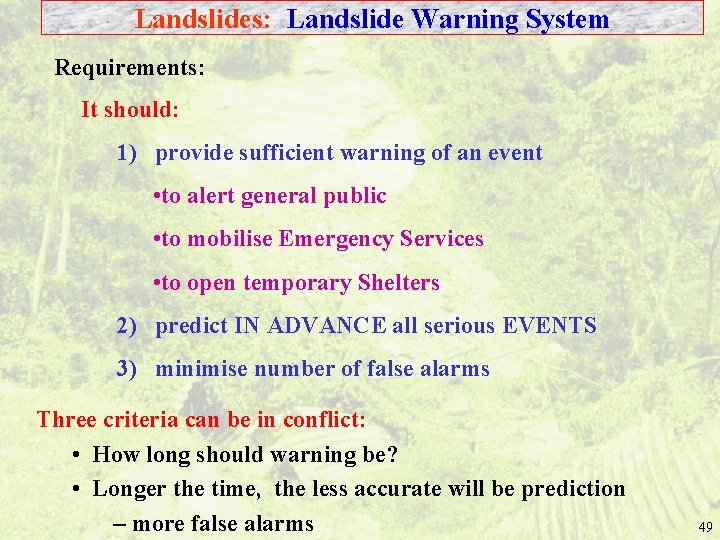
Landslides: Landslide Warning System Requirements: It should: 1) provide sufficient warning of an event • to alert general public • to mobilise Emergency Services • to open temporary Shelters 2) predict IN ADVANCE all serious EVENTS 3) minimise number of false alarms Three criteria can be in conflict: • How long should warning be? • Longer the time, the less accurate will be prediction – more false alarms 49
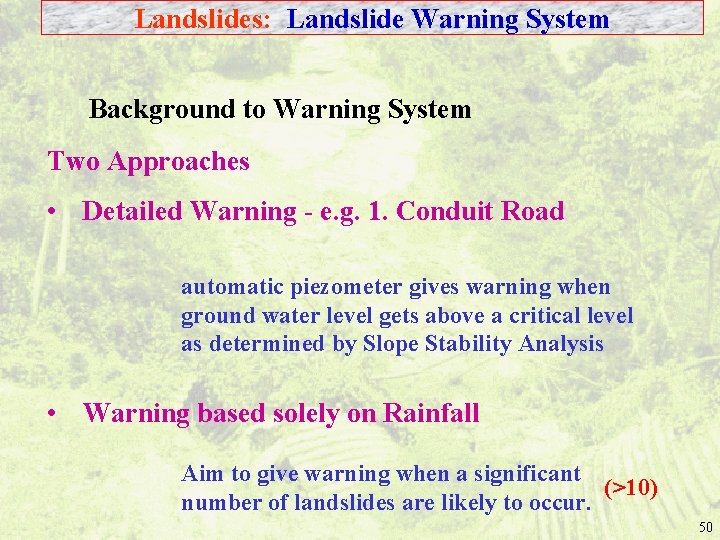
Landslides: Landslide Warning System Background to Warning System Two Approaches • Detailed Warning - e. g. 1. Conduit Road automatic piezometer gives warning when ground water level gets above a critical level as determined by Slope Stability Analysis • Warning based solely on Rainfall Aim to give warning when a significant (>10) number of landslides are likely to occur. 50
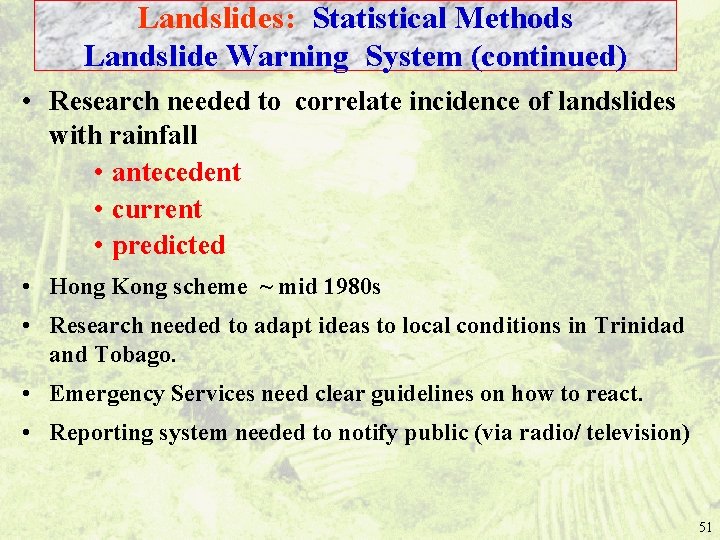
Landslides: Statistical Methods Landslide Warning System (continued) • Research needed to correlate incidence of landslides with rainfall • antecedent • current • predicted • Hong Kong scheme ~ mid 1980 s • Research needed to adapt ideas to local conditions in Trinidad and Tobago. • Emergency Services need clear guidelines on how to react. • Reporting system needed to notify public (via radio/ television) 51
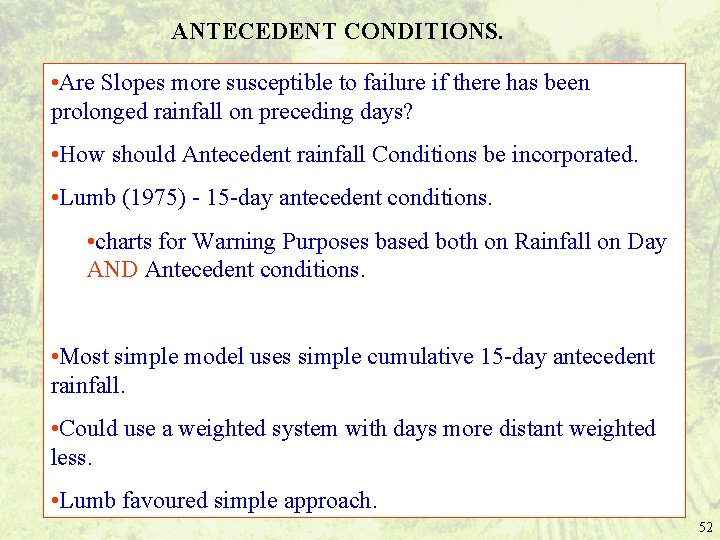
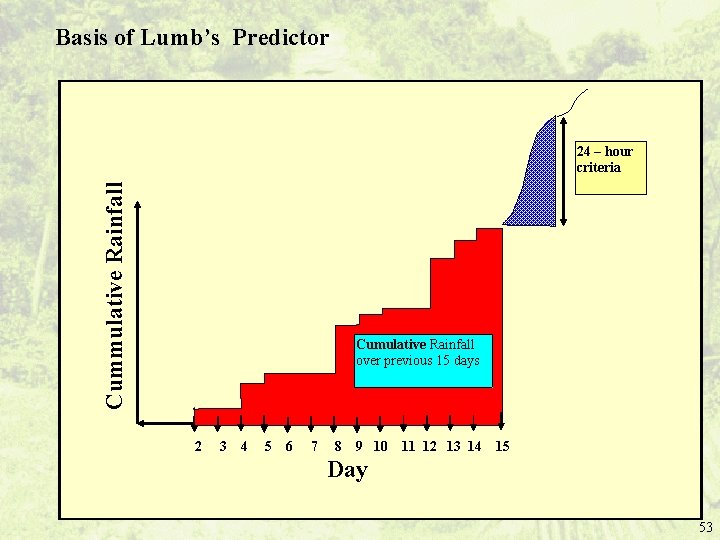
ANTECEDENT CONDITIONS. • Are Slopes more susceptible to failure if there has been prolonged rainfall on preceding days? • How should Antecedent rainfall Conditions be incorporated. • Lumb (1975) - 15 -day antecedent conditions. • charts for Warning Purposes based both on Rainfall on Day AND Antecedent conditions. • Most simple model uses simple cumulative 15 -day antecedent rainfall. • Could use a weighted system with days more distant weighted less. • Lumb favoured simple approach. 52
Basis of Lumb’s Predictor Cummulative Rainfall 24 – hour criteria Cumulative Rainfall over previous 15 days 2 3 4 5 6 7 8 9 10 11 12 13 14 15 Day 53
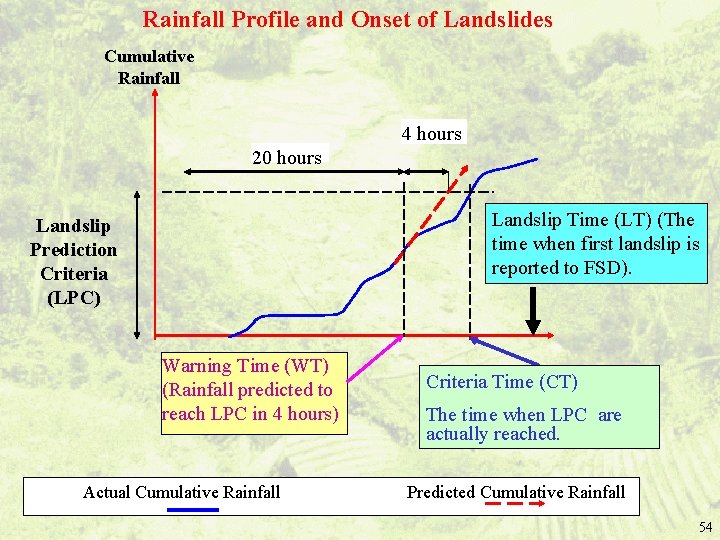
Rainfall Profile and Onset of Landslides Cumulative Rainfall 4 hours 20 hours Landslip Time (LT) (The time when first landslip is reported to FSD). Landslip Prediction Criteria (LPC) Warning Time (WT) (Rainfall predicted to reach LPC in 4 hours) Actual Cumulative Rainfall Criteria Time (CT) The time when LPC are actually reached. Predicted Cumulative Rainfall 54
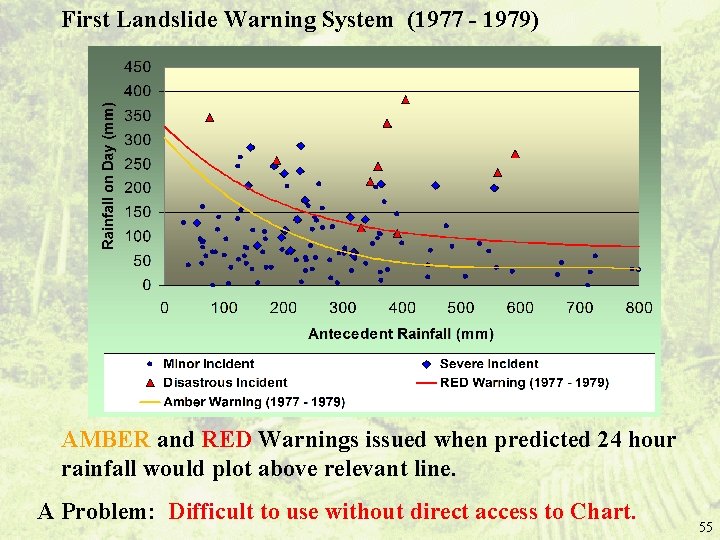
First Landslide Warning System (1977 - 1979) AMBER and RED Warnings issued when predicted 24 hour rainfall would plot above relevant line. A Problem: Difficult to use without direct access to Chart. 55
Landslide Warning System 2: (1980 - mid 1983) Advantage: Much easier to identify whether WARNING should be called - even when chart is not to hand. 56
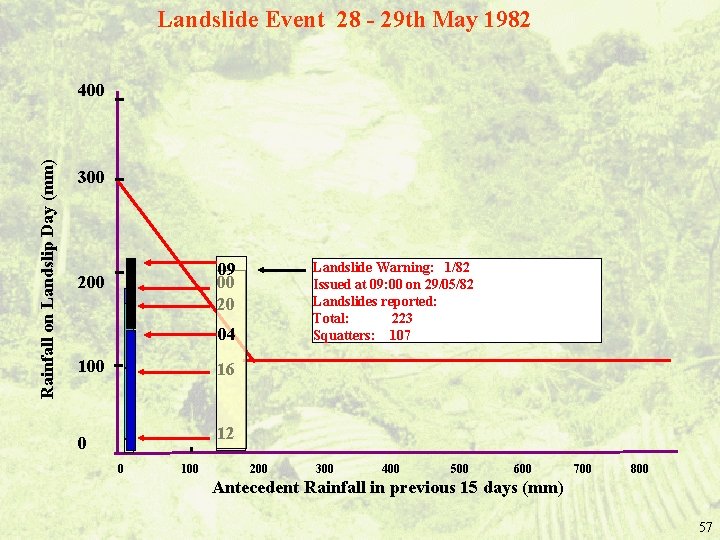
Landslide Event 28 - 29 th May 1982 Rainfall on Landslip Day (mm) 400 300 09 00 20 200 Landslide Warning: 1/82 Issued at 09: 00 on 29/05/82 Landslides reported: Total: 223 Squatters: 107 04 100 16 12 0 0 100 200 300 400 500 600 700 800 Antecedent Rainfall in previous 15 days (mm) 57
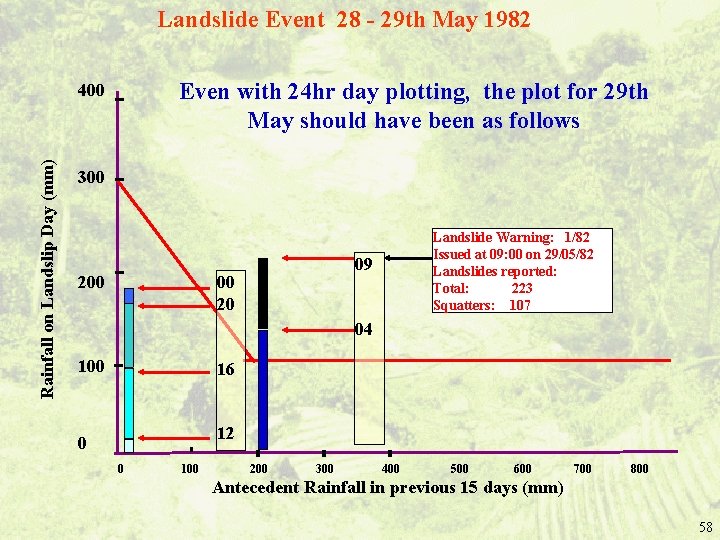
Landslide Event 28 - 29 th May 1982 Even with 24 hr day plotting, the plot for 29 th May should have been as follows Rainfall on Landslip Day (mm) 400 300 200 Landslide Warning: 1/82 Issued at 09: 00 on 29/05/82 Landslides reported: Total: 223 Squatters: 107 09 00 20 04 100 16 12 0 0 100 200 300 400 500 600 700 800 Antecedent Rainfall in previous 15 days (mm) 58
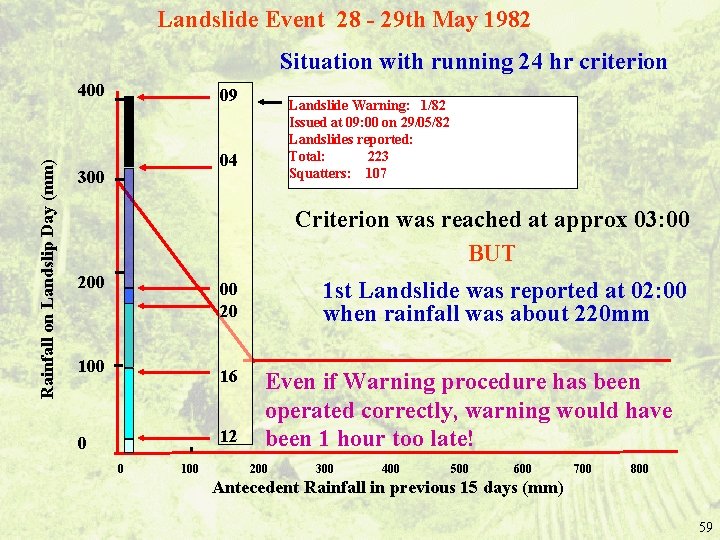
Landslide Event 28 - 29 th May 1982 Situation with running 24 hr criterion Rainfall on Landslip Day (mm) 400 09 Landslide Warning: 1/82 Issued at 09: 00 on 29/05/82 Landslides reported: Total: 223 Squatters: 107 04 300 Criterion was reached at approx 03: 00 BUT 200 1 st Landslide was reported at 02: 00 when rainfall was about 220 mm 00 20 100 16 12 0 0 100 Even if Warning procedure has been operated correctly, warning would have been 1 hour too late! 200 300 400 500 600 700 800 Antecedent Rainfall in previous 15 days (mm) 59
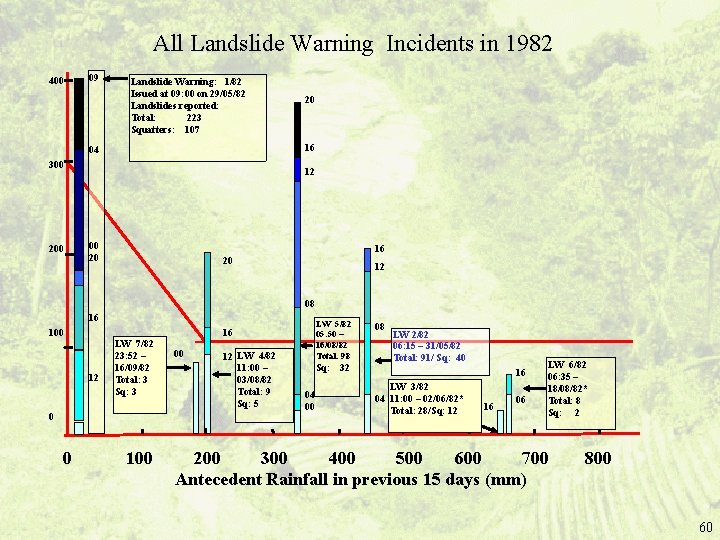
All Landslide Warning Incidents in 1982 400 09 Landslide Warning: 1/82 Issued at 09: 00 on 29/05/82 Landslides reported: Total: 223 Squatters: 107 16 04 300 20 12 00 20 16 20 12 08 16 100 12 LW 7/82 23: 52 – 16/09/82 Total: 3 Sq: 3 0 0 100 LW 5/82 05: 50 – 16/08/82 Total: 98 16 00 12 LW 4/82 11: 00 – 03/08/82 Total: 9 Sq: 5 Sq: 04 00 32 08 LW 2/82 06: 15 – 31/05/82 Total: 91/ Sq: 40 16 LW 3/82 04 11: 00 – 02/06/82* Total: 28/Sq: 12 16 06 LW 6/82 06: 35 – 18/08/82* Total: 8 Sq: 2 200 300 400 500 600 700 Antecedent Rainfall in previous 15 days (mm) 800 60
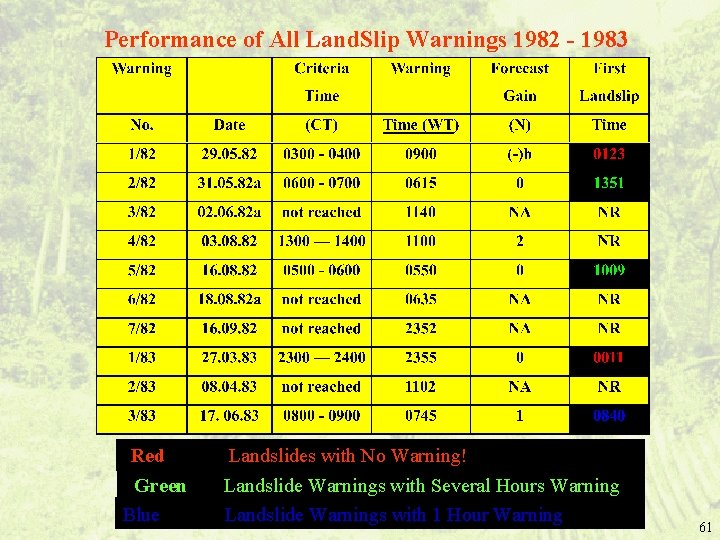
Performance of All Land. Slip Warnings 1982 - 1983 Red Green Blue Landslides with No Warning! Landslide Warnings with Several Hours Warning Landslide Warnings with 1 Hour Warning 61
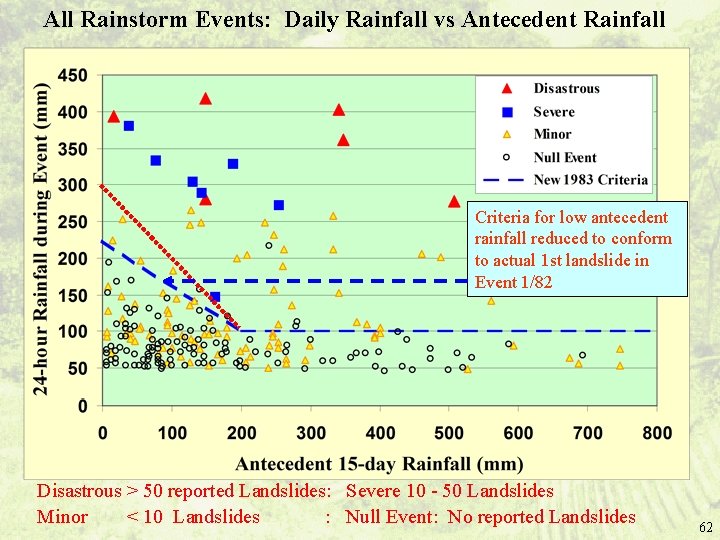
All Rainstorm Events: Daily Rainfall vs Antecedent Rainfall Criteria for low antecedent rainfall reduced to conform to actual 1 st landslide in Event 1/82 Disastrous > 50 reported Landslides: Severe 10 - 50 Landslides Minor < 10 Landslides : Null Event: No reported Landslides 62
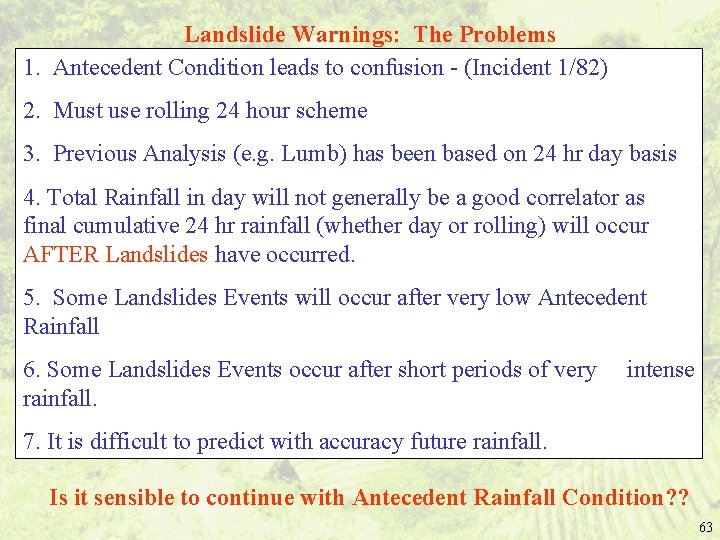
Landslide Warnings: The Problems 1. Antecedent Condition leads to confusion - (Incident 1/82) 2. Must use rolling 24 hour scheme 3. Previous Analysis (e. g. Lumb) has been based on 24 hr day basis 4. Total Rainfall in day will not generally be a good correlator as final cumulative 24 hr rainfall (whether day or rolling) will occur AFTER Landslides have occurred. 5. Some Landslides Events will occur after very low Antecedent Rainfall 6. Some Landslides Events occur after short periods of very rainfall. intense 7. It is difficult to predict with accuracy future rainfall. Is it sensible to continue with Antecedent Rainfall Condition? ? 63
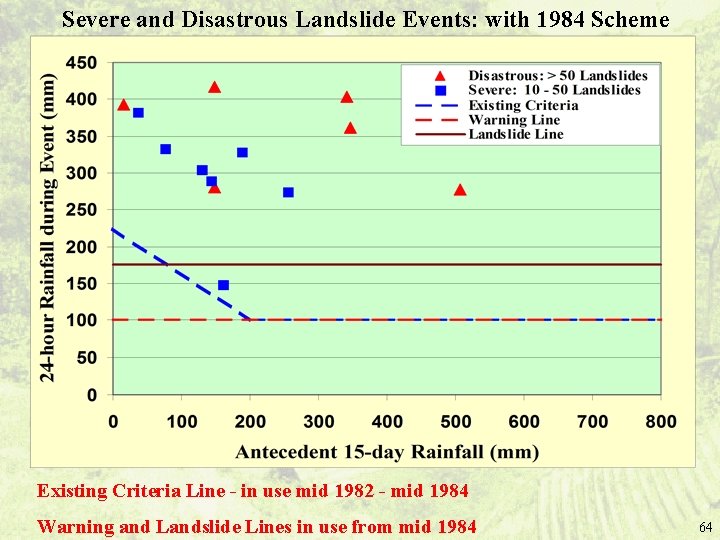
Severe and Disastrous Landslide Events: with 1984 Scheme Existing Criteria Line - in use mid 1982 - mid 1984 Warning and Landslide Lines in use from mid 1984 64
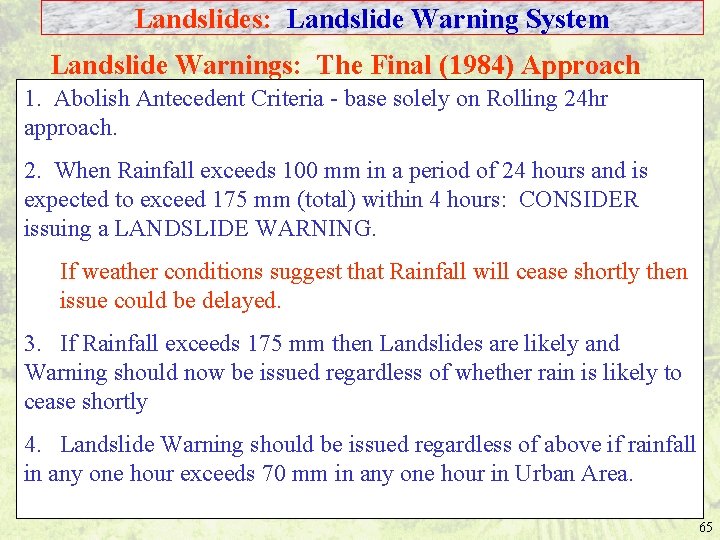
Landslides: Landslide Warning System Landslide Warnings: The Final (1984) Approach 1. Abolish Antecedent Criteria - base solely on Rolling 24 hr approach. 2. When Rainfall exceeds 100 mm in a period of 24 hours and is expected to exceed 175 mm (total) within 4 hours: CONSIDER issuing a LANDSLIDE WARNING. If weather conditions suggest that Rainfall will cease shortly then issue could be delayed. 3. If Rainfall exceeds 175 mm then Landslides are likely and Warning should now be issued regardless of whether rain is likely to cease shortly 4. Landslide Warning should be issued regardless of above if rainfall in any one hour exceeds 70 mm in any one hour in Urban Area. 65
Landslides: Landslide Warning System The 1984 Warning Scheme • Simple to understand • On average ~ 0 - 7 Warnings in a Year • up to one third are false alarms • identifies all serious/disastrous events • about one third of warnings classified as minor (i. e. less than 10 landslides). Further Improvements were introduced in 1999 66
Landslides: The Way Forward • the Engineering Approach is justified in a few cases New developments / highways etc • GIS methods are powerful and cost effective BUT • Requires development of a robust Database • Catalogue of Slope Types (whether failed on not) • Catalogue of Landslides Trinidad and Tobago (Carribean) can build on an improve on the scheme developed in Hong Kong. • Research needed to enhance GIS prediction of landslides • Incorporate Geotechnical information 67
Landslides: Conclusions • Interdisciplinary Research incorporating all three approaches is important for effective management of slopes and mitigation of adverse effects of landslides. • Proactive Management of slope hazards will be more cost effective in the long term. • Hong Kong woke up to the seriousness of the issues following disastrous landslides in 1972. Caribbean Countries should learn from their experience. • Important to begin and resource fully the research needed to achieve these aims. 68